(adsbygoogle = window.adsbygoogle || []).push({});Executive Summary:
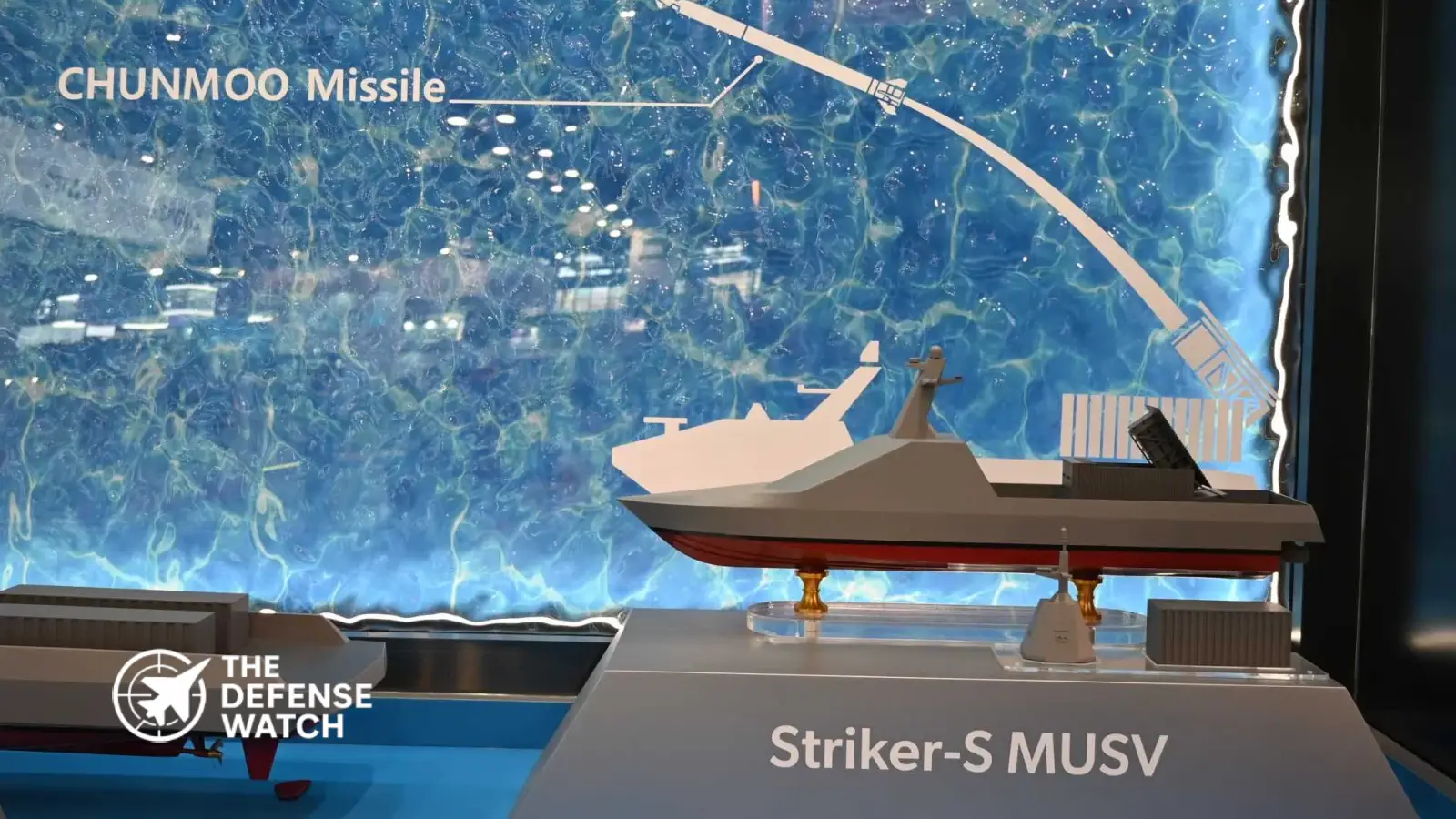
Hanwha used Eurosatory 2026 to showcase the Striker-S Medium Unmanned Surface Vessel (MUSV), an autonomous maritime platform designed to carry Chunmoo missile systems and other modular payloads. The development reflects a broader shift toward distributed naval operations, where uncrewed vessels can extend strike reach, increase survivability, and support manned fleets in contested environments.
Hanwha Reveals Striker-S MUSV With Chunmoo Missile Capability At Eurosatory 2026
Hanwha presented its Striker-S Medium Unmanned Surface Vessel (MUSV) at Eurosatory 2026, highlighting a new approach to combining autonomous maritime operations with long-range precision strike capabilities. The vessel integrates payload concepts derived from the K239 Chunmoo rocket and missile family, one of South Korea’s most successful defense export programs.
The unveiling comes as South Korean defense companies continue expanding their presence in both European and North American markets. Hanwha has increasingly positioned itself not only as a supplier of artillery and armored systems, but also as a developer of next-generation autonomous naval platforms.
Striker-S Designed Around Distributed Maritime Operations
The Striker-S belongs to the growing category of medium unmanned surface vessels being developed worldwide to support future naval concepts. Unlike traditional warships, these vessels operate without onboard crews and can be deployed for surveillance, strike, communications relay, or electronic warfare missions.
Hanwha’s concept emphasizes modularity. Mission payloads can be adapted based on operational requirements, allowing the platform to support reconnaissance, missile strike, or force protection roles. Similar design principles are increasingly being pursued by the U.S. Navy and allied maritime forces seeking lower-cost methods of expanding naval presence across large operational areas.
The company has already partnered with U.S.-based autonomy specialists to develop a 38-meter missile-capable MUSV intended for future American naval requirements. That effort demonstrates Hanwha’s ambition to compete in a rapidly growing market for autonomous maritime systems.
(adsbygoogle = window.adsbygoogle || []).push({});Chunmoo Integration Extends Precision Strike Reach
A key feature of the Striker-S concept is the integration of missiles derived from the Chunmoo family.
The K239 Chunmoo Multiple Launch Rocket System has gained significant international traction in recent years, particularly in Europe. Confirmed European orders now total more than 300 launchers across Poland, Estonia, and Norway, making the system one of the fastest-growing long-range fires programs within NATO.
Chunmoo’s modular architecture enables employment of several munition types:
| Munition | Approximate Range | Mission Type |
|---|---|---|
| CGR-080 Guided Rocket | 80 km | Tactical precision fires |
| CTM-MR Missile | 160 km | Operational strike |
| CTM-290 Missile | 290 km | Deep strike missions |
Ranges are based on publicly available manufacturer and procurement information.
By adapting missile payloads for maritime deployment, Hanwha could provide naval forces with a relatively low-cost strike platform capable of engaging targets at significant distances while minimizing risk to personnel.
Why Uncrewed Missile Vessels Matter
The emergence of missile-equipped unmanned surface vessels reflects a major shift in naval warfare.
Traditionally, long-range maritime strike missions were conducted by large surface combatants, submarines, or aircraft. Autonomous vessels introduce a new layer of capability by allowing navies to disperse firepower across numerous platforms rather than concentrating it aboard a small number of high-value ships.
This approach offers several operational advantages:
- Reduced risk to sailors during high-threat missions
- Greater force dispersion and survivability
- Increased missile capacity across a fleet
- Lower procurement and operating costs than major combatants
- Enhanced ability to conduct persistent operations in contested waters
For military planners, distributed lethality has become increasingly important as anti-ship missiles, drones, and long-range surveillance systems make large warships more vulnerable.
Strategic Implications For Indo-Pacific And NATO Navies
The Striker-S arrives as many allied navies seek ways to expand fleet capacity without the cost and manpower requirements associated with traditional warships.
For Indo-Pacific operators, autonomous missile vessels could help monitor vast maritime regions while providing rapid response options during crises. For European navies, the concept aligns with broader efforts to strengthen maritime deterrence and integrate long-range precision strike capabilities across NATO.
Hanwha’s growing Chunmoo ecosystem may also play a role. The company has supported localized missile production initiatives in Poland and continues expanding industrial partnerships throughout Europe. These efforts strengthen supply chains while increasing the attractiveness of Korean defense systems to allied customers.
The convergence of autonomous vessels and established missile families creates a potentially scalable model for future naval modernization programs.
Technical And Operational Challenges Remain
Despite the promise of autonomous missile vessels, several challenges remain before such systems become routine operational assets.
Key hurdles include:
- Secure and resilient communications links
- Cybersecurity protection against hostile intrusion
- Reliable autonomous navigation in contested environments
- Rules of engagement governing autonomous strike operations
- Integration with existing naval command-and-control networks
Military operators must also ensure that unmanned platforms can function effectively when satellite communications or data links are degraded by electronic warfare.
These issues are not unique to Hanwha’s program. They affect virtually every autonomous naval initiative currently under development worldwide.
Outlook
Hanwha’s Striker-S MUSV demonstrates how autonomous maritime systems are evolving beyond surveillance and reconnaissance roles into platforms capable of delivering meaningful combat effects.
By combining uncrewed vessel technology with the proven Chunmoo missile family, Hanwha is positioning itself at the intersection of two major defense trends: long-range precision fires and autonomous naval operations.
As navies increasingly embrace distributed maritime concepts, platforms such as the Striker-S could become an important component of future force structures, providing additional strike capacity while reducing operational risk to personnel.