
- Home
- Defense Systems
- Bombers & Strategic Aircraft
- KC-30A Tanker Aircraft
KC-30A Tanker Aircraft
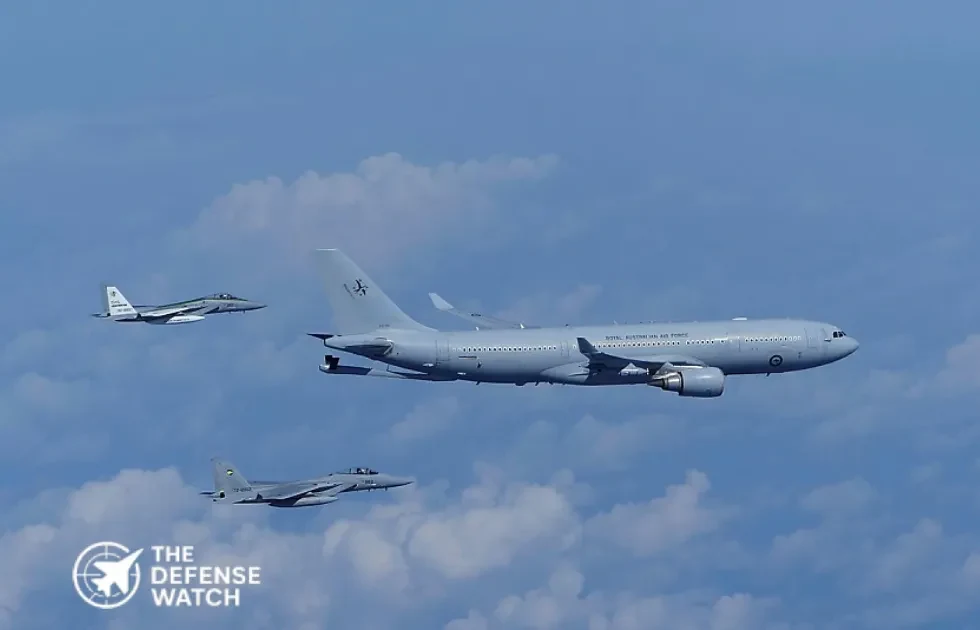
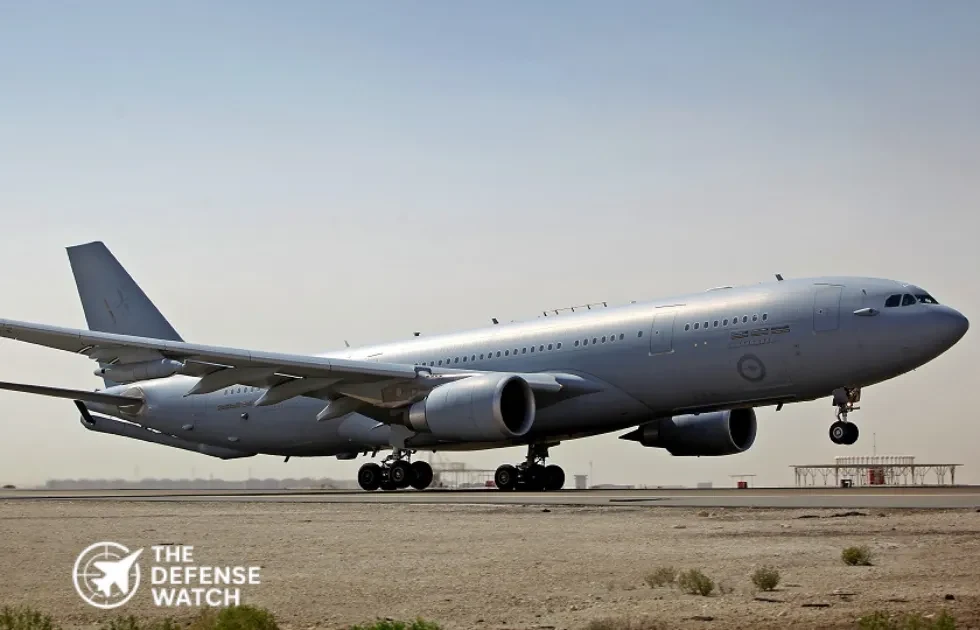
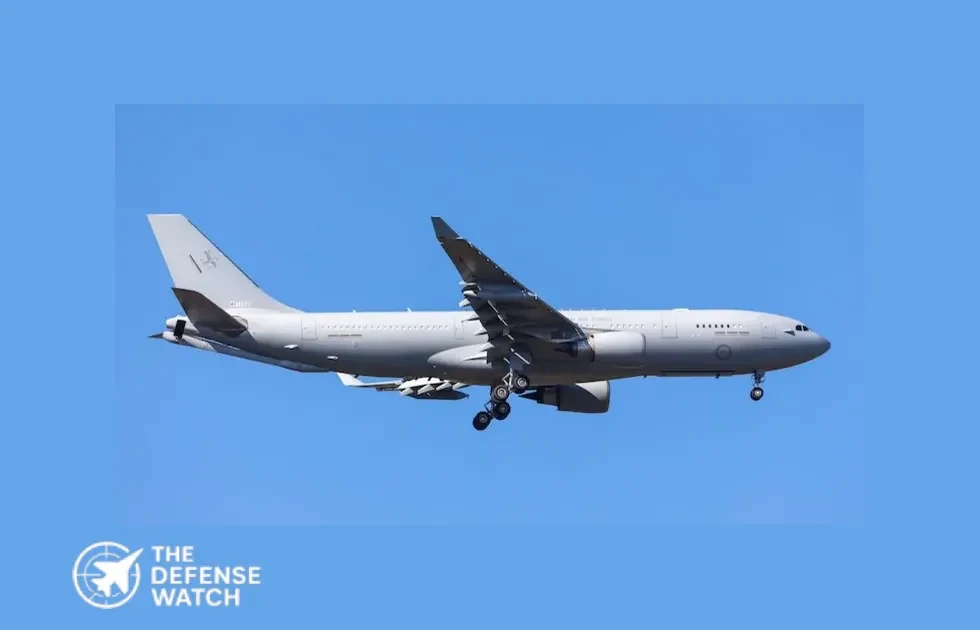
Defense Systems Full Specifications
1. General Information
| Name | KC-30A Multi Role Tanker Transport |
| Manufacturer | Airbus Defence and Space |
| Country of Origin | Europe |
| Introduction / In Service Since | 2011 |
| Status | Active |
| Category | Aerial Refueling and Strategic Airlift |
| Crew | 3 |
| Unit Cost | Approximately $220 million to $280 million |
2. Dimensions & Structure
| Length | 58.8 m |
| Wingspan | 60.3 m |
| Height | 17.4 m |
| Wing Area | 361.6 m² |
| Empty Weight | Approximately 125,000 kg |
| Maximum Takeoff Weight (MTOW) | 251,000 kg |
3. Performance
| Maximum Speed | Mach 0.86 |
| Range | 14,800 km |
| Combat Radius | Mission dependent |
| Service Ceiling | 41,450 ft (12,600 m) |
| Rate of Climb | Approximately 9.3 m/s |
4. Powerplant
| Engine Type | 2 × Rolls Royce Trent 700 or GE CF6 class turbofans |
| Thrust (per engine) | Up to 320 kN |
| Total Thrust | Up to 640 kN |
5. Payload & Armament
| Internal Payload Capacity | Up to 45 tonnes |
| Weapons Bay | None |
| Compatible Weapons | Not applicable |
| Hardpoints | None |
6. Avionics & Systems
| Radar System | Civil weather radar and mission systems |
| Navigation | GPS, INS, Flight Management System |
| Electronic Warfare (EW) | Optional defensive aids suite |
| Stealth Features | None |
7. Operational History
| Primary Operator | Royal Australian Air Force |
| Conflict Usage | Middle East coalition operations, global deployments |
| Notable Missions | Air refueling, humanitarian relief, strategic airlift, medical evacuation |
8. Additional Information
| Variants | A330 MRTT, KC-30A, Voyager KC2/KC3 |
| Successor / Future Replacement | No direct replacement currently planned |
| Notable Features | Boom and hose and drogue refueling systems |
| Estimated Operational Life | 35 to 40 years |
PROS
- Excellent long range and endurance
- Large fuel offload capability
- Multi role transport, tanker, and medical evacuation platform
- Compatible with boom and probe and drogue refueling
- Modern commercial airframe reduces operating complexity
CONS
- High acquisition cost
- Requires long runways for maximum performance
- Large aircraft footprint limits deployment options
- Higher operating costs than smaller tankers
- Not designed for contested airspace without escort
KC-30A Multi Role Tanker Transport Aircraft
The KC-30A Multi Role Tanker Transport (MRTT) is one of the world’s most capable aerial refueling and strategic airlift aircraft. Based on the Airbus A330-200 commercial airliner, the KC-30A combines long range, high fuel capacity, cargo transport, passenger movement, and medical evacuation into a single platform. It enables fighter aircraft, bombers, surveillance aircraft, and transport fleets to remain airborne longer without returning to base for refueling.
Designed for expeditionary operations, the KC-30A supports coalition missions across vast distances while providing significant cargo and troop carrying capacity. Its advanced fly by wire refueling systems and modern avionics have made it a preferred tanker for several allied air forces.
Manufacturer
The KC-30A is manufactured by Airbus Defence and Space, headquartered in Europe. The aircraft is derived from the Airbus A330-200 airliner and configured as the A330 MRTT (Multi Role Tanker Transport). Australia became the launch customer, designating the aircraft as the KC-30A within the Royal Australian Air Force (RAAF). Other operators include NATO’s Multinational MRTT Fleet, the United Kingdom, France, South Korea, Singapore, Saudi Arabia, and the United Arab Emirates.
Speed and Range
Powered by two high bypass turbofan engines, the KC-30A cruises at approximately Mach 0.86 (around 913 km/h or 567 mph). It has a ferry range of roughly 14,800 km (about 9,200 miles), allowing long distance deployments without refueling. The aircraft carries up to 111 tonnes of fuel, enabling simultaneous support for multiple combat aircraft during extended operations.
Its refueling systems include an advanced aerial refueling boom and underwing hose and drogue pods, making it compatible with a wide variety of NATO and allied aircraft.
Cost/Price
The estimated procurement cost of a KC-30A varies depending on customer configuration, support equipment, training, and mission systems. A fully equipped aircraft generally costs approximately $220 million to $280 million. Life cycle costs depend on operational tempo, maintenance contracts, and fleet size.
Disclaimer Note
The information provided on TheDefenseWatch.com is for general informational purposes only. While we strive to ensure the accuracy, completeness, and timeliness of our content regarding defense and aerospace products, technologies, and specifications, we cannot guarantee that all information is 100% accurate or up-to-date due to the evolving nature of military technology and classified data.TheDefenseWatch.com does not warrant the reliability, suitability, or availability of the information for any specific purpose. Users are advised to consult official sources, such as manufacturers, government publications, or defense agencies, for precise and verified data before making decisions based on our content.We are not affiliated with any defense manufacturers, governments, or military organizations mentioned. Opinions, reviews, and ratings reflect expert analysis but are subjective and should not be considered endorsements. TheDefenseWatch.com is not responsible for any errors, omissions, or consequences arising from the use of this website’s content.External links are provided for convenience and do not imply endorsement. TheDefenseWatch.com reserves the right to update or modify content without prior notice. By using this website, you agree to our Privacy & Cookies Policy.
More Defense Systems from Airbus Defence & Space

New Arrivals

Popular Comparisons
-
 J-10C vs JF-17 Thunder: Which Fighter Is More Capable?
View Comparison →
J-10C vs JF-17 Thunder: Which Fighter Is More Capable?
View Comparison → -
Tejas vs Gripen: Key Differences and Capabilities
View Comparison →
-
Tejas vs MiG-21 Bison: How India Replaced Its Iconic Supersonic Fighter
View Comparison →
-
F-35 vs F-16: Stealth, Sensors and Combat Roles
View Comparison →
-
Tejas Fighter Jet vs F-16 Fighting Falcon: Capability Compared
View Comparison →
-
Rafale Fighter Jet vs F-16 Fighting Falcon : Which Fighter Has the Edge?
View Comparison →
-
Su-57 Fighter Jet vs J-20 Fighter Jet: Stealth and Air Combat Compared
View Comparison →
-
Mirage 2000 vs Tejas Mk1A: Legacy Combat Power vs Indigenous Modernization
View Comparison →
-
Rafale Fighter Jet vs F-22 Raptor: Which Air Dominance Fighter Has the Edge?
View Comparison →
-
Tejas Fighter Jet vs. Rafale Fighter Jet: India’s Indigenous Fighter Meets France’s Proven Multirole Combat Aircraft
View Comparison →


- DIA 2026 Space Report Warns China May Field Orbital Directed-Energy Weapons by Late 2020s

- Boeing Advances Second MQ-25 Stingray Toward Testing for U.S. Navy
- Saab Unveils Sea Giraffe AMB D Radar With 250-Kilometer Air Surveillance Range
- Most Advanced Fighter Jet in the World in 2026: F-22 vs. F-35 vs. J-20
- Lockheed Martin Wins $88.6 Million Navy Contract for Radiant Mercury Systems
- Pentagon Uses Department of War Name to Reinforce Message to Adversaries
- Israel’s Military Chief Reportedly Opposed Pre-Election Strike on Iran
- Canada Receives First Two F-35 Fighters as Review of 72 Aircraft Continues
- Lockheed Martin Completes $3.45 Billion Ultra Maritime Acquisition
- Lockheed Martin Advances Ramjet-Powered PrSM Increment 4 Missile




Fighter Jets
-
 F-100 Super Sabre
-
North American F-86 Sabre
-
Northrop YF-23 Fighter
-
Rafale F5 Fighter
-
SU-57 Felon Stealth Fighter
-
Boeing F/A-XX Fighter
-
JF-17 Thunder Fighter Jet
-
F-47 Fighter Jet
-
MIG-31 Fighter Jet
-
J-10CE Fighter Jet
-
Chengdu J-10 Fighter Jet
-
Chengdu J-10C Fighter Jet
-
Gripen E Fighter Jet
-
Tejas Mk1A Fighter Jet
-
Tejas Mk‑2 Fighter Jet
-
F-16V Viper Block 70 Fighter Jet
-
F-15EX Eagle II Fighter
-
F-15E Strike Eagle Fighter
-
F/A-18E/F Super Hornet Fighter Jet
-
Saab Gripen F Fighter Jet
-
JAS 39E/F Gripen Fighter Jet
-
JAS 39 Gripen Fighter Jet
-
F-35A Lightning II Fighter Jet
-
F/A-18F Super Hornet







Recent Compares
-
J-10C vs JF-17 Thunder: Which Fighter Is More Capable?
View Comparison →
-
Tejas vs Gripen: Key Differences and Capabilities
View Comparison →
-
Tejas vs MiG-21 Bison: How India Replaced Its Iconic Supersonic Fighter
View Comparison →
-
F-35 vs F-16: Stealth, Sensors and Combat Roles
View Comparison →
-
Tejas Fighter Jet vs F-16 Fighting Falcon: Capability Compared
View Comparison →
Latest Defense Systems
10 Compares Defense Systems
-
J-10C vs JF-17 Thunder: Which Fighter Is More Capable?
View Comparison →
-
Tejas vs Gripen: Key Differences and Capabilities
View Comparison →
-
Tejas vs MiG-21 Bison: How India Replaced Its Iconic Supersonic Fighter
View Comparison →
-
F-35 vs F-16: Stealth, Sensors and Combat Roles
View Comparison →
-
Tejas Fighter Jet vs F-16 Fighting Falcon: Capability Compared
View Comparison →
-
Rafale Fighter Jet vs F-16 Fighting Falcon : Which Fighter Has the Edge?
View Comparison →
-
Su-57 Fighter Jet vs J-20 Fighter Jet: Stealth and Air Combat Compared
View Comparison →
-
Mirage 2000 vs Tejas Mk1A: Legacy Combat Power vs Indigenous Modernization
View Comparison →
-
Rafale Fighter Jet vs F-22 Raptor: Which Air Dominance Fighter Has the Edge?
View Comparison →
-
Tejas Fighter Jet vs. Rafale Fighter Jet: India’s Indigenous Fighter Meets France’s Proven Multirole Combat Aircraft
View Comparison →
- DIA 2026 Space Report Warns China May Field Orbital Directed-Energy Weapons by Late 2020s
- Boeing Advances Second MQ-25 Stingray Toward Testing for U.S. Navy
- Saab Unveils Sea Giraffe AMB D Radar With 250-Kilometer Air Surveillance Range
- Most Advanced Fighter Jet in the World in 2026: F-22 vs. F-35 vs. J-20
- Lockheed Martin Wins $88.6 Million Navy Contract for Radiant Mercury Systems