








@2026 – All Right Reserved. TheDefenseWatch.com
- Home
- Defense Systems
- Compare
- Rafale Fighter Jet vs F-22 Raptor: Which Air Dominance Fighter Has the Edge?
Rafale Fighter Jet vs F-22 Raptor: Which Air Dominance Fighter Has the Edge?
Rafale Fighter Jet vs F-22 Raptor: Fifth Generation Stealth Meets Proven Multirole Flexibility
Executive Summary:
The Dassault Rafale and Lockheed Martin F-22 Raptor rank among the world’s most respected fighter aircraft, yet they were built around entirely different operational concepts. While the F-22 was designed exclusively to dominate enemy fighters through stealth and air superiority, the Rafale emphasizes multirole flexibility, allowing it to conduct air defense, deep strike, reconnaissance, electronic warfare, and nuclear deterrence missions from a single platform.
For nations seeking complete battlefield versatility, the Rafale remains one of the most capable 4.5 generation fighters available. For uncontested control of hostile airspace, however, the F-22 continues to set the benchmark.
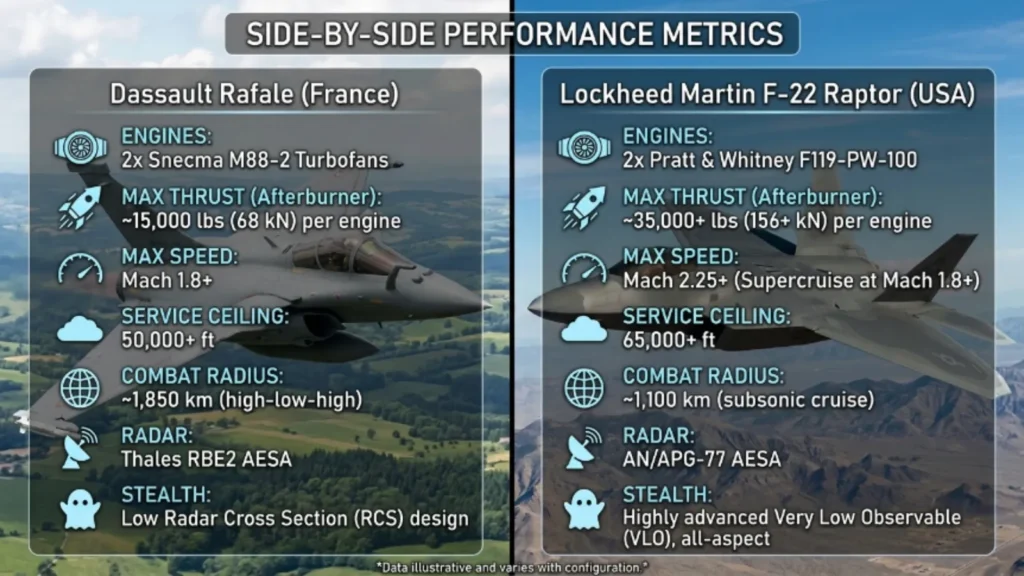
Tactical Overview
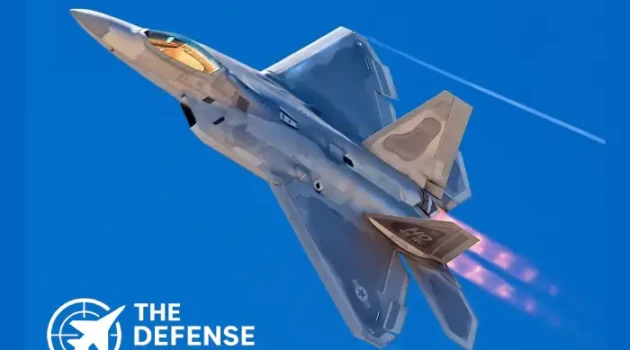
The F-22 Raptor entered service as America’s premier air superiority fighter, optimized to penetrate advanced air defenses while defeating enemy aircraft before being detected. Its low observable design, supercruise capability, thrust-vectoring engines, and advanced sensors remain unmatched.
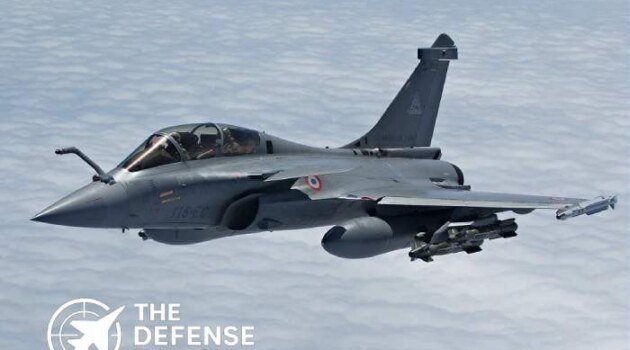
The Dassault Rafale, developed for the French Air and Space Force and French Navy, was designed as an omnirole fighter capable of switching missions during flight. Rather than specializing in one mission, Rafale balances air combat, precision strike, reconnaissance, electronic attack, and maritime operations.
Key Takeaways
F-22 Raptor Advantage
- True fifth generation stealth fighter.
- Supercruise above Mach 1.5 without afterburner.
- Industry leading air superiority performance.
- Exceptional agility through thrust vectoring.
Rafale Advantage
- Highly capable omnirole fighter.
- Excellent electronic warfare suite.
- Carries a larger external weapons load.
- Combat proven across multiple theaters.
Strategic Context
The F-22 dominates high end air combat where stealth and first shot capability are essential. The Rafale offers exceptional flexibility, lower operating costs, and outstanding multirole performance, making it one of the most attractive fighter aircraft for export customers.
Technical Specifications Matrix
| Specification | Rafale Fighter Jet | F-22 Raptor |
|---|---|---|
| Generation / Type | 4.5 Generation Multirole Fighter | Fifth Generation Air Superiority Fighter |
| Manufacturer | Dassault Aviation | Lockheed Martin |
| Crew | 1 or 2 | 1 |
| Length | 15.3 m | 18.9 m |
| Max Speed | Mach 1.8 | Mach 2.25 |
| Supercruise | Limited | Yes |
| Combat Radius | Approximately 1,000 km | Approximately 850 km |
| Ferry Range | 3,700 km | 2,960 km |
| Service Ceiling | 50,000 ft | Above 65,000 ft |
| Engine | 2 × Snecma M88 | 2 × Pratt & Whitney F119 |
| Payload Capacity | 9,500 kg | 8,200 kg |
| Hardpoints | 14 | Internal bays plus 4 external pylons |
| Primary Radar | Thales RBE2 AESA | AN/APG-77 AESA |
| Electronic Warfare | SPECTRA EW Suite | AN/ALR-94 Integrated EW System |
| Primary Air-to-Air Missiles | Meteor, MICA | AIM-120D, AIM-9X |
| Primary Strike Weapons | SCALP EG, AASM, Exocet | JDAM, Small Diameter Bomb |
| Stealth Level | Reduced Signature | Very Low Observable |
| Estimated Unit Cost | Approximately $120 Million | Approximately $143 Million (flyaway estimate, production ended) |
Deep Dive Analysis
1. Stealth & Survivability
The F-22 was engineered from the outset around stealth. Internal weapons bays, radar absorbing materials, carefully aligned surfaces, and infrared signature reduction enable it to operate inside heavily defended airspace with a significantly reduced radar cross section.
The Rafale incorporates limited signature reduction measures, including composite materials and careful airframe shaping, but it is not a stealth aircraft. Instead, it relies heavily on the highly regarded SPECTRA electronic warfare suite, which provides threat detection, jamming, decoy deployment, and electronic countermeasures.
In highly contested environments against advanced integrated air defense systems, the F-22 enjoys a substantial survivability advantage.
2. Sensors, Radar & Targeting Capabilities
The F-22’s AN/APG-77 AESA radar remains one of the most sophisticated airborne radars ever fielded. Combined with passive sensors, electronic support measures, and sensor fusion, it enables the Raptor to detect, track, and engage multiple targets while minimizing its own emissions.
The Rafale’s Thales RBE2 AESA radar offers excellent detection performance and is complemented by the Front Sector Optronics system and the SPECTRA electronic warfare suite. The aircraft is also compatible with the long range Meteor beyond visual range missile, giving it formidable engagement capability.
Although the Rafale possesses outstanding situational awareness for a 4.5 generation aircraft, the F-22 maintains a clear edge in low observable sensor integration.
3. Payload Options & Operational Deployments
One of Rafale’s greatest strengths is mission flexibility. It can simultaneously carry air to air missiles, precision guided bombs, anti ship missiles, reconnaissance pods, electronic warfare equipment, and external fuel tanks. French forces have successfully employed Rafale in Afghanistan, Libya, Iraq, Syria, Mali, and counterterrorism operations across Africa.
The F-22 primarily carries six AIM-120 AMRAAM missiles and two AIM-9 Sidewinders internally for air superiority missions. It can also carry precision guided bombs while maintaining stealth, although this comes with reduced air to air missile capacity. Its operational history includes deployments to Syria and numerous Indo-Pacific deterrence missions.
Strategic Verdict & Tactical Scenarios
When the Rafale Prevails
- Multirole expeditionary operations
- Maritime strike missions
- Nuclear deterrence missions
- Export affordability and sustainment
- Long duration precision strike campaigns
- Missions requiring maximum weapons flexibility
When the F-22 Raptor Prevails
- Air superiority operations
- Beyond visual range engagements
- Penetrating advanced integrated air defense systems
- Stealth first strike missions
- High threat peer conflict
- Offensive counter air operations
Final Assessment
Comparing the Rafale Fighter Jet vs F-22 Raptor ultimately comes down to mission requirements rather than identifying a universal winner.
The F-22 Raptor remains the world’s premier dedicated air superiority fighter. Its stealth, supercruise performance, advanced sensor fusion, and unmatched maneuverability allow it to dominate contested airspace against sophisticated adversaries.
The Dassault Rafale, meanwhile, stands out as one of the most capable and combat proven multirole fighters in service today. Its advanced electronic warfare system, diverse weapons integration, carrier compatibility, and operational flexibility make it an exceptionally effective platform for air forces seeking a single aircraft capable of performing nearly every combat mission.
In a pure air superiority contest, the F-22 holds a decisive advantage. In real world operations requiring versatility, sustained deployments, and multirole effectiveness, the Rafale remains among the strongest fighters available on the global market.
| |
| Price | |
| Our Rating | |
| Manufacturer | Dassault Aviation Lockheed Martin |
| Category | Fighter Jets Fighter Jets |
General Information
| Name | Dassault Rafale F-22 Raptor |
| Manufacturer | Dassault Aviation Lockheed Martin, Boeing Defense |
| Country of Origin | France United States |
| Type / Role | Multirole Fighter Air Superiority Stealth Fighter |
| Generation | 4.5th Fifth Generation |
| Status | Active Service In active service |
| First Flight | July 4, 1986 September 7, 1997 |
| Introduction / In Service Since | 2001 December 15, 2005 |
| Number Built | 240+ 187 operational units |
| Operators | France, India, Egypt, Qatar, Greece, Indonesia United States Air Force |
Dimensions & Structure
| Length | 15.27 m 62 ft (18.9 m) |
| Wingspan | 10.9 m 44.5 ft (13.6 m) |
| Height | 5.3 m 16.7 ft (5.1 m) |
| Wing Area | 45.7 m² 840 sq ft (78 m²) |
| Empty Weight | 10,600 kg 43,340 lb (19,700 kg) |
| Maximum Takeoff Weight (MTOW) | 24,500 kg 83,500 lb (38,000 kg) |
| Internal Weapons Bay | None 3 total (1 centerline, 2 side) |
| External Hardpoints | 14 4 (non-stealth configuration) |
Performance
| Maximum Speed | Mach 1.8 (2,223 km/h) Mach 2.25 (2,414 km/h) |
| Range | 3,700 km 1,840 miles (2,960 km) |
| Combat Radius | 1,000–1,850 km 530 miles (850 km) |
| Service Ceiling | 50,000 ft 65,000 ft (19,800 m) |
| Rate of Climb | 305 m/s 62,000 ft/min (315 m/s) |
| Thrust-to-Weight Ratio | 1.13 1.26 |
| G Limits | +9 / -3.6 +9 G |
Powerplant
| Engine Type | Snecma M88-2 Turbofan Pratt & Whitney F119-PW-100 turbofan |
| No. of Engines | 2 2 |
| Thrust (each) | 16,500 lbf 35,000 lbf (156 kN) |
| Thrust Vectoring | No Yes (2D pitch vectoring) |
| Fuel Capacity | 4,700 kg (internal) 18,000 lb (8,200 kg) internal |
Armament
| Gun | GIAT 30mm cannon 1× M61A2 Vulcan 20mm cannon |
| Missiles (Air-to-Air) | MICA, Meteor AIM-120 AMRAAM, AIM-9 Sidewinder |
| Missiles (Air-to-Ground) | SCALP-EG, AM39 Exocet JDAM, SDB |
| Bombs | Paveway, AASM GBU-32 JDAM, GBU-39 SDB |
| Hardpoints | 14 4 external (optional) |
| Payload Capacity | 9,500 kg 18,000 lb (8,200 kg) |
Avionics & Systems
| Radar | Thales RBE2 AESA AN/APG-77 AESA radar |
| Radar Range | 200+ km 125+ miles (200+ km) |
| Electronic Warfare (EW) System | SPECTRA Suite AN/ALR-94 suite |
| Targeting System | Thales Damocles / TALIOS Pod Integrated multi-sensor fusion |
| Helmet Display | Integrated HMD Standard HUD (no HMD in baseline) |
| Navigation | GPS/INS GPS/INS |
| Autopilot / AI Assistance | Semi-Automated Digital fly-by-wire |
| Communication | Secure Datalink, SATCOM Intra-flight data link, secure comms |
Stealth & Technology
| Radar Cross Section (RCS) | ~1 m² ~0.0001 m² |
| Stealth Features | Radar-absorbent materials Radar-absorbent materials, internal weapons |
| Infrared Signature Reduction | Yes Engine exhaust shielding |
| Sensor Fusion | Full Yes |
| Networking Capabilities | NATO-compatible datalink Limited Link-16, proprietary data link |
Variants
| Special Export Versions | Rafale EH/IH (India), Rafale EM/QM (Egypt/Qatar) None (export restricted) |
Operational History
| Major Conflicts / Deployments | Libya, Mali, Iraq, Syria Syria (2014–present) |
| Notable Operators | France, India, Egypt USAF (Air Combat Command, PACAF) |
| Combat Proven? | Yes Yes |
| Mission Types | Air superiority, strike, reconnaissance, deterrence Air superiority, interception, precision strike |
Cost & Program
| Unit Cost | $85–115 million ~$150 million (flyaway) |
| Development Cost | ~$45 billion ~$67 billion (program total) |
| Program Name | Rafale Program Advanced Tactical Fighter (ATF) |
| Funding Countries | France United States only |
Additional Information
| Upgrades Planned | F4 & F5 standard upgrades Avionics, radar, networking, sensors |
| Future Replacement | Next-Gen Fighter (FCAS) NGAD (Next Generation Air Dominance) |
| Export Restrictions | Minimal (case-by-case) U.S. Congress export ban |
| Notable Achievements | Combat-proven multirole success First operational 5th-gen fighter |
| Competitors | Eurofighter Typhoon, F/A-18E/F, Gripen E F-35 Lightning II, Su-57, J-20 |

|
Disclaimer Note
The information provided on TheDefenseWatch.com is for general informational purposes only. While we strive to ensure the accuracy, completeness, and timeliness of our content regarding defense and aerospace products, technologies, and specifications, we cannot guarantee that all information is 100% accurate or up-to-date due to the evolving nature of military technology and classified data.TheDefenseWatch.com does not warrant the reliability, suitability, or availability of the information for any specific purpose. Users are advised to consult official sources, such as manufacturers, government publications, or defense agencies, for precise and verified data before making decisions based on our content.We are not affiliated with any defense manufacturers, governments, or military organizations mentioned. Opinions, reviews, and ratings reflect expert analysis but are subjective and should not be considered endorsements. TheDefenseWatch.com is not responsible for any errors, omissions, or consequences arising from the use of this website’s content.External links are provided for convenience and do not imply endorsement. TheDefenseWatch.com reserves the right to update or modify content without prior notice. By using this website, you agree to our Privacy & Cookies Policy.
New Arrivals
Popular Comparisons
-
 Su-57 Fighter Jet vs J-20 Fighter Jet: Stealth and Air Combat Compared
View Comparison →
Su-57 Fighter Jet vs J-20 Fighter Jet: Stealth and Air Combat Compared
View Comparison → -
Mirage 2000 vs Tejas Mk1A: Legacy Combat Power vs Indigenous Modernization
View Comparison →
-
Tejas Fighter Jet vs. Rafale Fighter Jet: India’s Indigenous Fighter Meets France’s Proven Multirole Combat Aircraft
View Comparison →
-
F-22 Raptor vs. F-35 Joint Strike Fighter: Which Fifth Generation Fighter Has the Edge?
View Comparison →
-
F-35A vs. F-22 Raptor: Which U.S. Stealth Fighter Dominates Modern Air Combat?
View Comparison →
-
AGM-114 Hellfire vs. AGM-179 JAGM: Which U.S. Precision Missile Is Better?
View Comparison →
-
Patriot (PAC-3) vs. THAAD: Complete Missile Defense System Comparison, Capabilities, Range, and Strategic Roles
View Comparison →
-
AIM-120 AMRAAM vs. AIM-9X Sidewinder: Complete Air-to-Air Missile Comparison, Range, Speed, and Combat Roles
View Comparison →
-
BGM-109 Tomahawk vs. AGM-158 JASSM: Which Long Range Precision Strike Missile Offers Greater Strategic Advantage?
View Comparison →
-
Patriot PAC-3 vs. Russian S-400 Triumf: Which Air Defense System Is More Capable?
View Comparison →
- U.S. Air Force Plans Major F-15EX Technical Refresh as Production Expands

- Eutelsat Orders 229 OneWeb Satellites To Extend LEO Network Through 2034
- Australia Declares JASSM-ER and LRASM Operational on F/A-18F Super Hornets
- GCAP Electronics Contract Advances Integrated Sensing And Communications For Sixth Generation Fighter
- Northrop Grumman Expands B-21 Raider Production With New Utah Facility
- Kongsberg Integrates Echodyne Radar With PROTECTOR Stations for Counter-UAS Missio
- Anthropic Says Yemen Weapons Cell Used Claude Code to Develop Missile Guidance Software
- Northrop Grumman Expands Air Defense and Weapons Collaboration Across Central Europe
- Rolls-Royce B-52 Engine Contract Rises To $3.04 Billion
- General Dynamics Secures $184.25 Million NGEAU Contract For Navy Growler Upgrades