
- Home
- Defense Systems
- Fighter Jets
- M-346 Trainer Jet
M-346 Trainer Jet
Defense Systems Full Specifications
General Information
| Name | M-346 Master |
| Manufacturer | Leonardo |
| Country of Origin | Italy |
| Type / Role | Advanced Jet Trainer / Light Combat |
| Generation | 4th Gen trainer |
| Status | In Production |
| First Flight | 2004 |
| Introduction / In Service Since | 2014 |
| Number Built | 100+ |
| Operators | Italy, Israel, Poland, Singapore, Qatar, Greece |
Dimensions & Structure
| Length | 11.49 m |
| Wingspan | 9.72 m |
| Height | 4.76 m |
| Wing Area | 23.5 m² |
| Empty Weight | 4,600 kg |
| Maximum Takeoff Weight (MTOW) | 9,500 kg |
| Internal Weapons Bay | None |
| External Hardpoints | Up to 7 |
Performance
| Maximum Speed | 1,090 km/h |
| Range | 1,980 km |
| Combat Radius | Mission dependent |
| Service Ceiling | 45,000 ft |
| Rate of Climb | 22,000 ft/min |
| Thrust-to-Weight Ratio | Approx. 0.84 |
| G Limits | +8 / -3 |
Powerplant
| Engine Type | Honeywell F124-GA-200 turbofan |
| No. of Engines | 2 |
| Thrust (each) | 6,280 lbf |
| Thrust Vectoring | No |
| Fuel Capacity | Internal plus external tanks |
Armament
| Gun | Optional gun pod |
| Missiles (Air-to-Air) | Short range missiles |
| Missiles (Air-to-Ground) | Guided munitions on FA variant |
| Bombs | General purpose / guided bombs |
| Hardpoints | Up to 7 |
| Payload Capacity | Approx. 3,000 kg |
Avionics & Systems
| Radar | Optional Grifo radar (FA variant) |
| Radar Range | Mission dependent |
| Electronic Warfare (EW) System | Defensive aids suite optional |
| Targeting System | Optional pods |
| Helmet Display | Yes |
| Navigation | INS/GPS |
| Autopilot / AI Assistance | Digital flight controls |
| Communication | Secure military datalink capable |
Stealth & Technology
| Radar Cross Section (RCS) | Conventional |
| Stealth Features | Limited |
| Infrared Signature Reduction | Standard exhaust management |
| Sensor Fusion | Training simulation based |
| Networking Capabilities | Yes |
Variants
| Special Export Versions | M-346 AJT, M-346FA, T-346A |
Operational History
| Major Conflicts / Deployments | Primarily training roles |
| Notable Operators | Italy, Israel, Poland |
| Combat Proven? | Limited in armed variants |
| Mission Types | Training, aggressor, light strike |
Cost & Program
| Unit Cost | $25M to $35M estimated |
| Development Cost | Undisclosed |
| Program Name | M-346 Master |
| Funding Countries | Italy, export customers |
Additional Information
| Upgrades Planned | Sensors, networking, FA growth |
| Future Replacement | None announced |
| Export Restrictions | Case by case |
| Notable Achievements | Global trainer export success |
| Competitors | T-50, Hawk, Yak-130 |
PROS
- Fighter like handling for advanced pilot training
- Twin engine safety and reliability
- Lower operating cost than frontline fighters
- Modern glass cockpit and embedded simulation
- Light attack and aggressor mission options
CONS
- Not a stealth aircraft
- Limited payload compared with dedicated fighters
- Subsonic in level flight
- Export cost can rise with training packages
- Smaller user base than some rival trainers
M-346 Master Advanced Jet Trainer
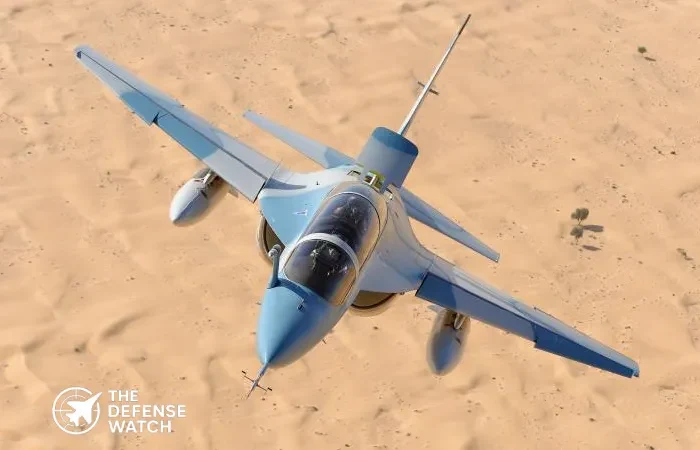
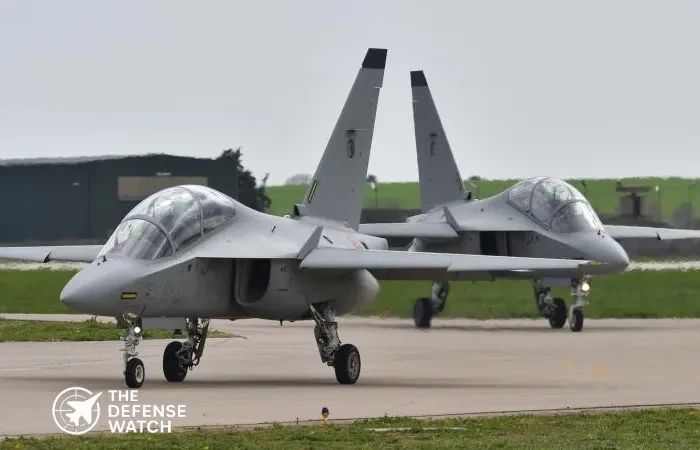
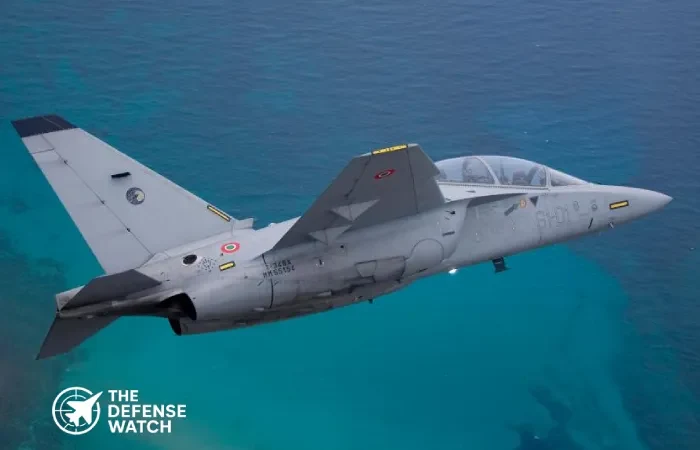
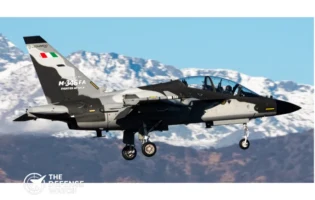
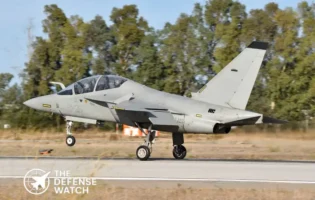
The M-346 Master is a modern advanced jet trainer built to prepare pilots for frontline fighters such as the F-35, Eurofighter, and other fourth and fifth generation aircraft. Designed for lead in fighter training, the aircraft combines agile handling, digital flight controls, and a glass cockpit to replicate the workload of combat jets at lower operating cost.
Its twin engine layout improves safety during training missions, while fly by wire controls help student pilots transition into high performance fighters. The platform is also available in armed versions for light attack, aggressor training, and tactical support roles.
Manufacturer
The aircraft is produced by Leonardo S.p.A. of Italy, formerly Alenia Aermacchi. Development began as a joint concept with Russia before the final Italian design evolved into the current M-346 program. It entered operational service in the 2010s and has been adopted by several air forces including Italy, Israel, Poland, Singapore, Qatar, and Greece.
The M-346 uses advanced simulation tools, embedded tactical training systems, and ground based simulators that reduce the need for expensive live combat aircraft hours.
Speed and Range
The M-346 reaches about Mach 1.2 in dive conditions, with level speed around 1,090 km/h. Ferry range is roughly 2,700 km with external tanks, while standard mission range is about 2,000 km depending on loadout. Service ceiling is 45,000 ft.
Powered by two Honeywell F124 turbofan engines, the aircraft offers strong acceleration and high angle of attack performance. It is rated to +8g / -3g, ideal for fighter style maneuver training.
Cost / Price
Estimated unit price varies by package, support equipment, and training systems. Open source estimates place the aircraft between $25 million and $35 million per jet, while full national training packages cost significantly more depending on simulators and logistics.
Disclaimer Note
The information provided on TheDefenseWatch.com is for general informational purposes only. While we strive to ensure the accuracy, completeness, and timeliness of our content regarding defense and aerospace products, technologies, and specifications, we cannot guarantee that all information is 100% accurate or up-to-date due to the evolving nature of military technology and classified data.TheDefenseWatch.com does not warrant the reliability, suitability, or availability of the information for any specific purpose. Users are advised to consult official sources, such as manufacturers, government publications, or defense agencies, for precise and verified data before making decisions based on our content.We are not affiliated with any defense manufacturers, governments, or military organizations mentioned. Opinions, reviews, and ratings reflect expert analysis but are subjective and should not be considered endorsements. TheDefenseWatch.com is not responsible for any errors, omissions, or consequences arising from the use of this website’s content.External links are provided for convenience and do not imply endorsement. TheDefenseWatch.com reserves the right to update or modify content without prior notice. By using this website, you agree to our Privacy & Cookies Policy.

New Arrivals


Popular Comparisons
-
 J-10C vs JF-17 Thunder: Which Fighter Is More Capable?
View Comparison →
J-10C vs JF-17 Thunder: Which Fighter Is More Capable?
View Comparison → -
Tejas vs Gripen: Key Differences and Capabilities
View Comparison →
-
Tejas vs MiG-21 Bison: How India Replaced Its Iconic Supersonic Fighter
View Comparison →
-
F-35 vs F-16: Stealth, Sensors and Combat Roles
View Comparison →
-
Tejas Fighter Jet vs F-16 Fighting Falcon: Capability Compared
View Comparison →
-
Rafale Fighter Jet vs F-16 Fighting Falcon : Which Fighter Has the Edge?
View Comparison →
-
Su-57 Fighter Jet vs J-20 Fighter Jet: Stealth and Air Combat Compared
View Comparison →
-
Mirage 2000 vs Tejas Mk1A: Legacy Combat Power vs Indigenous Modernization
View Comparison →
-
Rafale Fighter Jet vs F-22 Raptor: Which Air Dominance Fighter Has the Edge?
View Comparison →
-
Tejas Fighter Jet vs. Rafale Fighter Jet: India’s Indigenous Fighter Meets France’s Proven Multirole Combat Aircraft
View Comparison →


- Ukrainian Drone Unit Caused 70% of Simulated U.S. Brigade Casualties in Germany Exercise

- OCCAR Marks 25 Years of European Defense Cooperation With 28 Programs
- Saab Q3 2026 Results Show 30.6% Organic Sales Growth as Orders Surge
- How Much Does a Tomahawk Missile Cost? Price, Range and Blocks
- Faster Than Sound, Unstoppable at Sea: Inside China’s YJ-20 and YJ-17 Hypersonic Missiles
- U.S., Australia and UK Test Maritime Autonomy Under AUKUS
- TAI Anka-3: Turkey’s Stealth Flying-Wing Drone and Specifications
- Lockheed Martin’s Third-Quarter Innovations Span Missile Defense, Aviation and Space
- RTX Plans to Increase Missile Production Up to Fourfold Under Pentagon Contracts
- UK Restarts Large-Caliber Gun Manufacturing After 20-Year Gap



Fighter Jets
-
 SU-57 Felon Stealth Fighter
-
Boeing F/A-XX Fighter
-
JF-17 Thunder Fighter Jet
-
F-47 Fighter Jet
-
MIG-31 Fighter Jet
-
J-10CE Fighter Jet
-
Chengdu J-10 Fighter Jet
-
Chengdu J-10C Fighter Jet
-
Gripen E Fighter Jet
-
Tejas Mk1A Fighter Jet
-
Tejas Mk‑2 Fighter Jet
-
F-16V Viper Block 70 Fighter Jet
-
F-15EX Eagle II Fighter
-
F-15E Strike Eagle Fighter
-
F/A-18E/F Super Hornet Fighter Jet
-
Saab Gripen F Fighter Jet
-
JAS 39E/F Gripen Fighter Jet
-
JAS 39 Gripen Fighter Jet
-
F-35A Lightning II Fighter Jet
-
F/A-18F Super Hornet
-
J-50 Fighter Jet
-
Spanish EF-18 Hornet Fighter
-
F-35i Adir Fighter Jet
-
F-16 Fighting Falcon






Recent Compares
-
J-10C vs JF-17 Thunder: Which Fighter Is More Capable?
View Comparison →
-
Tejas vs Gripen: Key Differences and Capabilities
View Comparison →
-
Tejas vs MiG-21 Bison: How India Replaced Its Iconic Supersonic Fighter
View Comparison →
-
F-35 vs F-16: Stealth, Sensors and Combat Roles
View Comparison →
-
Tejas Fighter Jet vs F-16 Fighting Falcon: Capability Compared
View Comparison →
Latest Defense Systems
10 Compares Defense Systems
-
J-10C vs JF-17 Thunder: Which Fighter Is More Capable?
View Comparison →
-
Tejas vs Gripen: Key Differences and Capabilities
View Comparison →
-
Tejas vs MiG-21 Bison: How India Replaced Its Iconic Supersonic Fighter
View Comparison →
-
F-35 vs F-16: Stealth, Sensors and Combat Roles
View Comparison →
-
Tejas Fighter Jet vs F-16 Fighting Falcon: Capability Compared
View Comparison →
-
Rafale Fighter Jet vs F-16 Fighting Falcon : Which Fighter Has the Edge?
View Comparison →
-
Su-57 Fighter Jet vs J-20 Fighter Jet: Stealth and Air Combat Compared
View Comparison →
-
Mirage 2000 vs Tejas Mk1A: Legacy Combat Power vs Indigenous Modernization
View Comparison →
-
Rafale Fighter Jet vs F-22 Raptor: Which Air Dominance Fighter Has the Edge?
View Comparison →
-
Tejas Fighter Jet vs. Rafale Fighter Jet: India’s Indigenous Fighter Meets France’s Proven Multirole Combat Aircraft
View Comparison →
- Ukrainian Drone Unit Caused 70% of Simulated U.S. Brigade Casualties in Germany Exercise
- OCCAR Marks 25 Years of European Defense Cooperation With 28 Programs
- Saab Q3 2026 Results Show 30.6% Organic Sales Growth as Orders Surge
- How Much Does a Tomahawk Missile Cost? Price, Range and Blocks
- Faster Than Sound, Unstoppable at Sea: Inside China’s YJ-20 and YJ-17 Hypersonic Missiles