









@2026 – All Right Reserved. TheDefenseWatch.com
- Home
- Defense Systems
- Fighter Jets
- Jaguar Fighter Jet
Jaguar Fighter Jet
Defense Systems Full Specifications
General Information
| Name | SEPECAT Jaguar |
| Manufacturer | SEPECAT (BAC/Breguet) |
| Country of Origin | United Kingdom / France |
| Type / Role | Ground-attack / Tactical strike |
| Generation | 3rd |
| Status | In limited service (primarily India) |
| First Flight | 8 September 1968 |
| Introduction / In Service Since | 1973 |
| Number Built | 573 |
| Operators | Indian Air Force (main); historically UK, France, Oman, Ecuador, Nigeria |
Dimensions & Structure
| Length | 16.83 m (55 ft 3 in) |
| Wingspan | 8.69 m (28 ft 6 in) |
| Height | 4.89 m (16 ft 1 in) |
| Wing Area | ~24 m² |
| Empty Weight | ~7,000 kg (15,432 lb) |
| Maximum Takeoff Weight (MTOW) | 15,700 kg (34,612 lb) |
| Internal Weapons Bay | No |
| External Hardpoints | 5–7 |
Performance
| Maximum Speed | Mach 1.6 (1,699 km/h) |
| Range | Ferry: ~3,524 km |
| Combat Radius | 575–815 km |
| Service Ceiling | 14,000 m (46,000 ft) |
| Rate of Climb | High (twin Adour engines) |
| Thrust-to-Weight Ratio | ~0.8–1.0 (loaded) |
| G Limits | +8.5 / -4 (approx.) |
Powerplant
| Engine Type | Rolls-Royce/Turbomeca Adour turbofan |
| No. of Engines | 2 |
| Thrust (each) | ~22.75 kN dry / 32.5 kN with afterburner |
| Thrust Vectoring | No |
| Fuel Capacity | Internal + external tanks |
Armament
| Gun | 2 × 30 mm DEFA or Aden cannons |
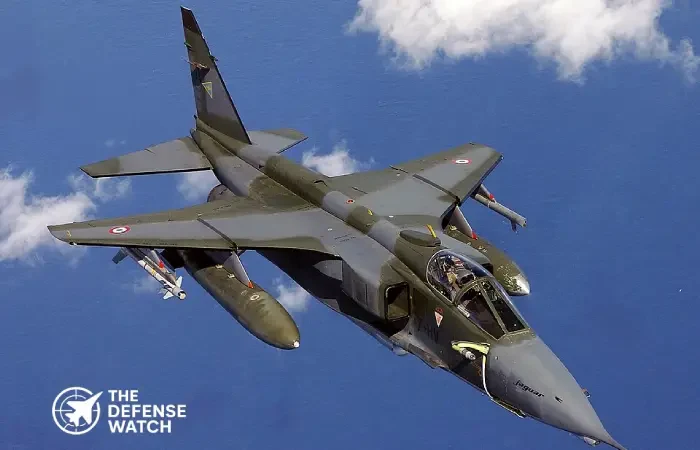
| Missiles (Air-to-Air) | AIM-9 Sidewinder, Magic, ASRAAM (upgraded) |
| Missiles (Air-to-Ground) | AS.37 Martel, AS-30, Rampage (Indian) |
| Bombs | Conventional, laser-guided, cluster |
| Hardpoints | 5–7 |
Avionics & Systems
| Radar | Multi-mode (DARIN III upgrades) |
| Radar Range | Enhanced in modern variants |
| Electronic Warfare (EW) System | RWR, jamming pods (upgraded) |
| Targeting System | Laser designator, HUD |
| Helmet Display | Planned/integrated in upgrades |
| Navigation | Inertial + GPS (DARIN) |
| Autopilot / AI Assistance | Yes (in DARIN III) |
| Communication | Secure voice/data |
Stealth & Technology
| Radar Cross Section (RCS) | Conventional (~5+ m² estimated) |
| Stealth Features | Limited (some RAM in Gulf ops) |
| Infrared Signature Reduction | Basic |
| Sensor Fusion | Partial in upgraded variants |
| Networking Capabilities | Improved datalinks in modern fits |
Variants
| Special Export Versions | Jaguar A, Jaguar GR.1, Jaguar IS, Jaguar IM (maritime), various trainers |
Operational History
| Major Conflicts / Deployments | Gulf War (1991), various IAF ops |
| Notable Operators | Indian Air Force |
| Combat Proven? | Yes |
| Mission Types | Close air support, deep strike, reconnaissance, anti-shipping |
Cost & Program
| Unit Cost | ~$8–16 million (historical) |
| Development Cost | Joint program |
| Program Name | SEPECAT Jaguar |
| Funding Countries | UK, France (primary) |
Additional Information
| Upgrades Planned | DARIN III, new engines, weapons |
| Future Replacement | Newer IAF platforms |
| Export Restrictions | Standard defense controls |
| Notable Achievements | Longevity in IAF service |
| Competitors | A-10 Thunderbolt II, Su-25 |
PROS
- Excellent low-level flight performance and terrain-following capability for penetrating defended airspace.
- Robust, reliable airframe suited for dispersed operations and harsh environments.
- Versatile armament options supporting a wide range of air-to-ground and limited air-to-air missions.
- Cost-effective to operate compared to newer multirole fighters, with successful upgrade programs extending service life.
- Proven track record with extensive combat experience and export success.
CONS
- Aging design with limited beyond-visual-range air-to-air capabilities compared to 4.5+ generation fighters.
- Higher radar signature than modern stealth platforms, increasing vulnerability in high-threat environments.
- Maintenance demands for older airframes, particularly engines, in smaller fleets.
- No internal weapons bay, relying on external stores that increase drag and RCS.
- Phasing out in most original operators, with limited future upgrade potential.
SEPECAT Jaguar Attack Jet: Proven Low-Level Strike Power
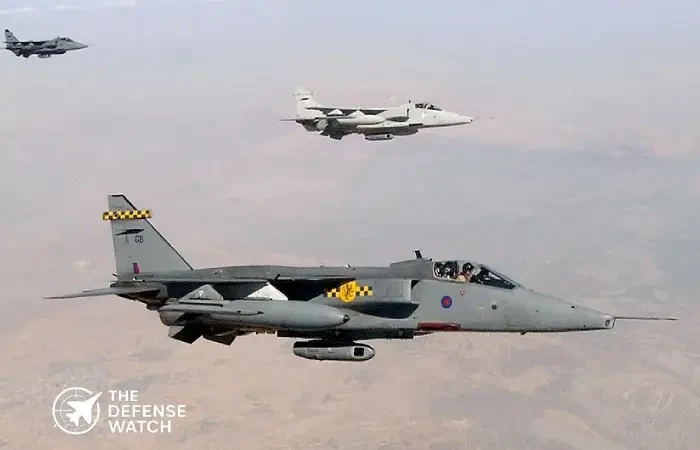
The SEPECAT Jaguar stands as a Cold War-era success story in international defense collaboration. Designed as a supersonic jet for tactical strike and close air support, this twin-engine aircraft excels in high-speed, low-level operations, hugging terrain to evade enemy defenses while delivering precise ordnance. Born from British and French requirements for a versatile attack platform, the Jaguar has proven its durability through decades of service, transitioning from European air forces to continued frontline duty with the Indian Air Force (IAF). Its robust airframe, powerful engines, and adaptability to modern upgrades make it a cost-effective asset for nations seeking reliable strike capabilities without the complexity of fifth-generation fighters.
Manufacturer
The Jaguar Fighter Jet was developed by SEPECAT (Société Européenne de Production de l’Avion d’École de Combat et d’Appui Tactique), a joint venture between Britain’s British Aircraft Corporation (BAC, later BAE Systems) and France’s Breguet Aviation (later Dassault-Breguet). Production ran from 1968 to 1981, with additional license manufacturing in India by Hindustan Aeronautics Limited (HAL).
Speed and Range
Powered by two Rolls-Royce/Turbomeca Adour turbofan engines, the Jaguar achieves a maximum speed of Mach 1.6 at altitude (approximately 1,699 km/h) and Mach 1.1 at sea level. It offers a combat radius of around 575–815 km depending on profile (lo-lo-lo or hi-lo-hi) and a ferry range exceeding 3,500 km with external tanks, enabling deep strikes into contested airspace.
Variants
| Variant | Description |
|---|---|
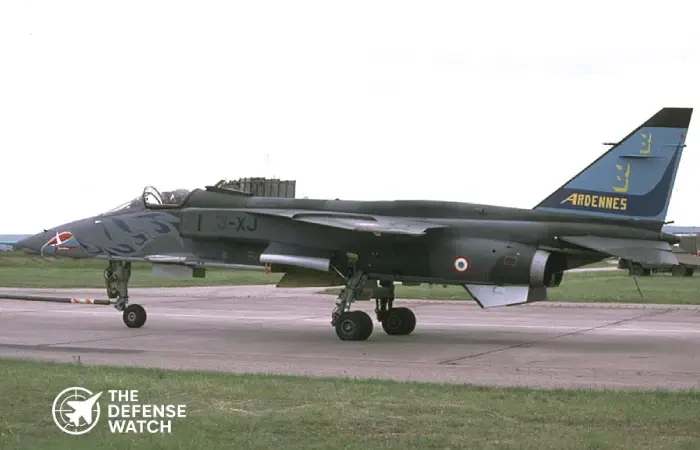
| Jaguar A | French single-seat tactical strike/ground attack |
| Jaguar E | French two-seat trainer |
| Jaguar GR.1 / S | British single-seat ground attack (later upgraded) |
| Jaguar T.2 / B | British two-seat trainer |
| Jaguar IS / IB | Indian single-seat strike and two-seat trainer (Shamsher), license-built with DARIN upgrades |
| Jaguar IM | Indian maritime strike variant |
| Jaguar MAX | HAL-proposed modern upgrade with advanced avionics |
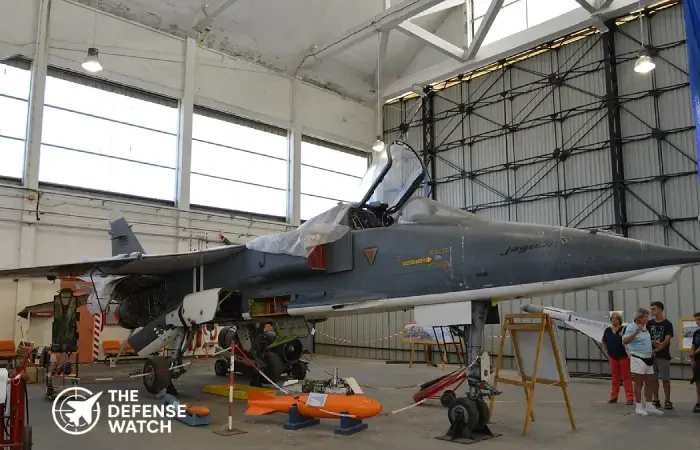
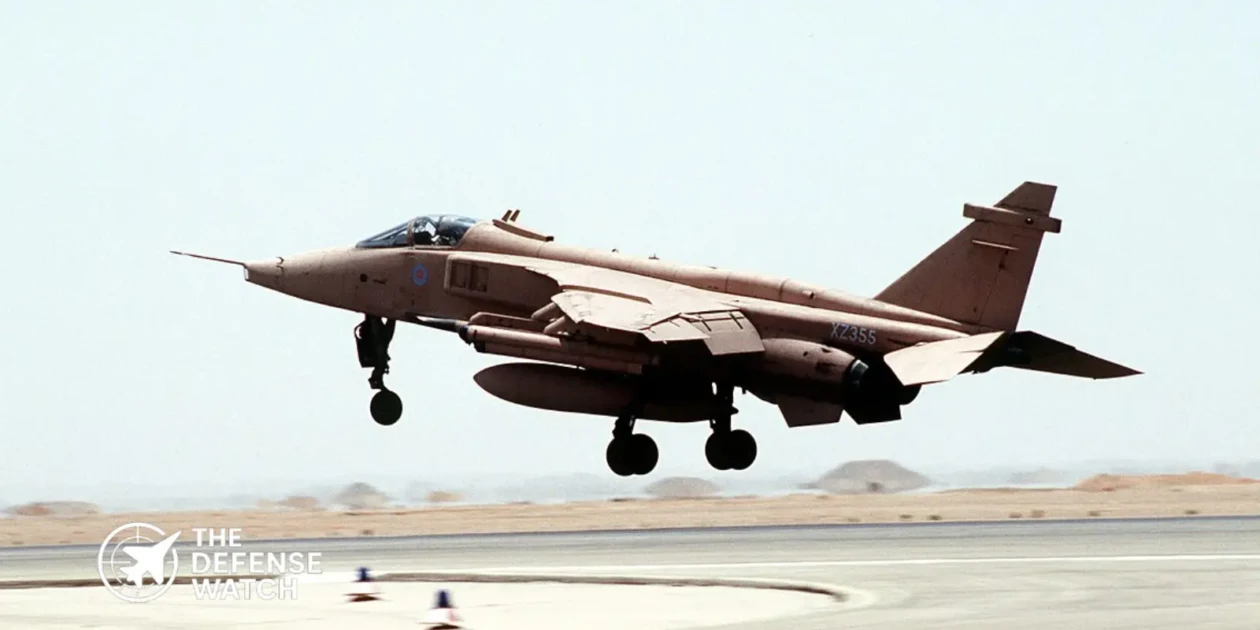
The Jaguar Fighter Jet design prioritizes ruggedness for operations from austere bases, featuring high-mounted swept wings and robust landing gear. Early models focused on inertial navigation and weapon-aiming systems like NAVWASS, while Indian variants incorporate the indigenous DARIN III suite with multi-mode radar, improved cockpit displays, autopilot, and integration of modern weapons such as precision-guided munitions and stand-off missiles. Though lacking inherent stealth, some RAF examples received radar-absorbent materials for Gulf War operations. It has seen combat in conflicts including the 1991 Gulf War (RAF) and various IAF missions, proving effective in ground attack, reconnaissance, and anti-shipping roles.
Disclaimer Note
The information provided on TheDefenseWatch.com is for general informational purposes only. While we strive to ensure the accuracy, completeness, and timeliness of our content regarding defense and aerospace products, technologies, and specifications, we cannot guarantee that all information is 100% accurate or up-to-date due to the evolving nature of military technology and classified data.TheDefenseWatch.com does not warrant the reliability, suitability, or availability of the information for any specific purpose. Users are advised to consult official sources, such as manufacturers, government publications, or defense agencies, for precise and verified data before making decisions based on our content.We are not affiliated with any defense manufacturers, governments, or military organizations mentioned. Opinions, reviews, and ratings reflect expert analysis but are subjective and should not be considered endorsements. TheDefenseWatch.com is not responsible for any errors, omissions, or consequences arising from the use of this website’s content.External links are provided for convenience and do not imply endorsement. TheDefenseWatch.com reserves the right to update or modify content without prior notice. By using this website, you agree to our Privacy & Cookies Policy.
New Arrivals
Popular Comparisons
-
 Tejas Fighter Jet vs F-16 Fighting Falcon: Capability Compared
View Comparison →
Tejas Fighter Jet vs F-16 Fighting Falcon: Capability Compared
View Comparison → -
Rafale Fighter Jet vs F-16 Fighting Falcon : Which Fighter Has the Edge?
View Comparison →
-
Su-57 Fighter Jet vs J-20 Fighter Jet: Stealth and Air Combat Compared
View Comparison →
-
Mirage 2000 vs Tejas Mk1A: Legacy Combat Power vs Indigenous Modernization
View Comparison →
-
Rafale Fighter Jet vs F-22 Raptor: Which Air Dominance Fighter Has the Edge?
View Comparison →
-
Tejas Fighter Jet vs. Rafale Fighter Jet: India’s Indigenous Fighter Meets France’s Proven Multirole Combat Aircraft
View Comparison →
-
F-22 Raptor vs. F-35 Joint Strike Fighter: Which Fifth Generation Fighter Has the Edge?
View Comparison →
-
F-35A vs. F-22 Raptor: Which U.S. Stealth Fighter Dominates Modern Air Combat?
View Comparison →
-
AGM-114 Hellfire vs. AGM-179 JAGM: Which U.S. Precision Missile Is Better?
View Comparison →
-
Patriot (PAC-3) vs. THAAD: Complete Missile Defense System Comparison, Capabilities, Range, and Strategic Roles
View Comparison →
- FQ-42 Vengeance Flies With F-35 and F-15E as Air Force Advances CCA Teaming

- Albania Secures $302 Million U.S. Defense Loan for Military Modernization
- Rockwell Collins Wins $10.7M Navy E-2D Training Contract
- Boeing Receives $11.8 Million Contract Modification for Kuwait F/A-18E/F Support
- General Dynamics Wins $22.4M MK 41 VLS Engineering Contract
- Bell Boeing Wins $29.7M Contract for V-22 Loads and Dynamics Data
- Raytheon Wins $34.4M V-22 Tactical Software Sustainment Contract
- Dayton T. Brown Wins $55.8M P-8A Mobile Mission Systems Contract
- Finland deepens European F-35 cooperation with first pilot flight in Europe
- Luxembourg Deploys Additional Detection Assets After Drone Sightings