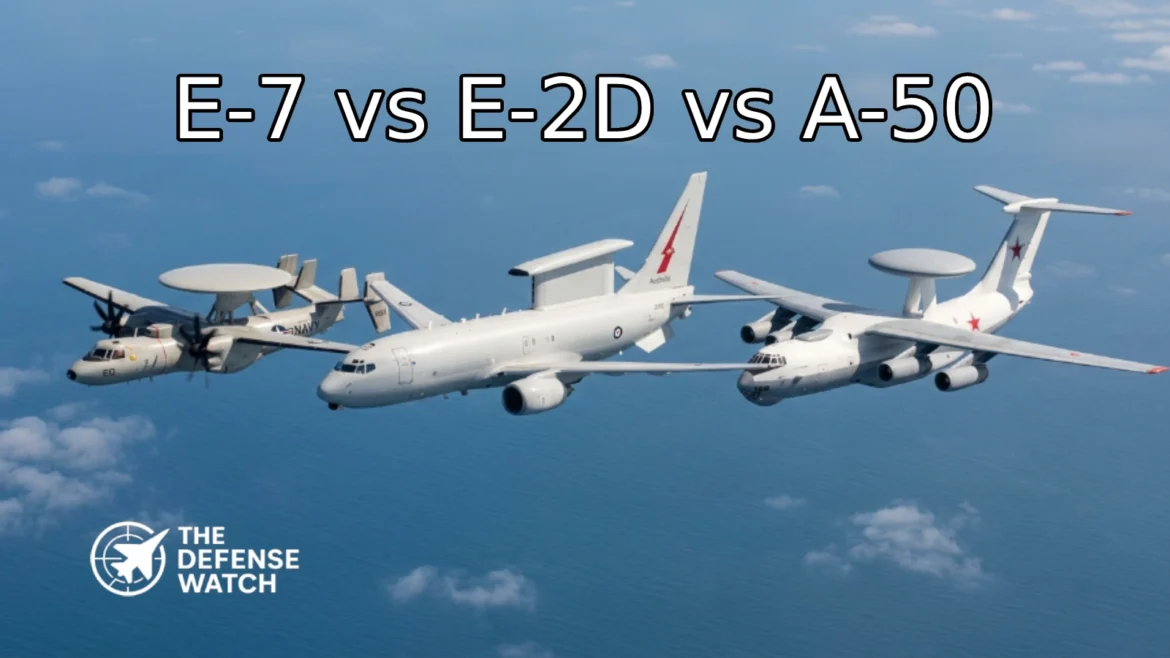
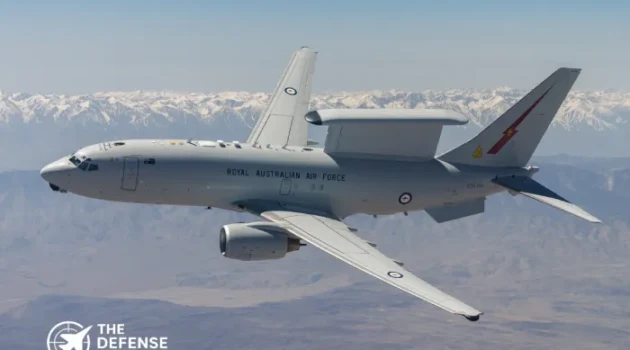
The E-7 is based on the Boeing 737-700 and uses a Northrop Grumman Multi-Role Electronically Scanned Array, or MESA, mounted above the fuselage. Australia’s E-7A fleet is officially listed at six aircraft, with a published range of 7,040 km and a maximum speed of 955 km/h. Boeing lists the E-7’s unrefueled range at 3,500 nautical miles, or about 6,482 km.
The E-2D Advanced Hawkeye is a very different design. It is a carrier-based aircraft built around the E-2 family and equipped with the AN/APY-9 radar. NAVAIR lists a speed above 300 knots, a ceiling of 37,000 feet and two T56-A-427A turboprops producing 5,100 shaft horsepower each.
KEY FACTS AT A GLANCE
| Specification | E-7 Wedgetail | E-2D Advanced Hawkeye | A-50/A-50U Mainstay |
|---|---|---|---|
| Manufacturer | Boeing | Northrop Grumman | Beriev, with Vega/Rostec mission systems |
| Basic platform | Boeing 737-700 | Carrier-based E-2 airframe | Ilyushin Il-76 transport derivative |
| Generation | Modern AEW&C | Modern carrier AEW&C | A-50U modernized legacy AEW&C |
| Maximum speed | 955 km/h | 300+ knots, about 556 km/h | About 800 km/h |
| Published range | 6,482 km unrefueled | Public sources emphasize endurance and aerial refueling rather than a single combat-radius figure | About 5,000 km for A-50 |
| Ceiling | 41,000 ft | 37,000 ft in NAVAIR specification | About 10,000 m |
| Primary sensor | Northrop Grumman MESA radar | AN/APY-9 radar | Shmel-M radar system |
| Radar architecture | Electronically scanned array | Electronically scanned array within rotodome | Large rotating radar system |
| Crew | 2 pilots plus mission crew | 5 | About 15 for A-50 |
| Armament | None | None | None |
| Air-to-air refueling | Yes | Yes on equipped aircraft | Not treated as a standard published capability |
| Main role | Long-range AEW&C and battle management | Carrier AEW&C and fleet command and control | Long-range airborne radar surveillance and control |
The Russian A-50 is derived from the Il-76 transport aircraft. The A-50U modernization replaces or upgrades significant elements of the mission system, including radar electronics and operator displays. Russian sources state that the A-50U can track more targets and direct more fighters than the earlier A-50.
Executive Summary
The E-7 Wedgetail, E-2D Advanced Hawkeye and A-50 Mainstay represent three different approaches to airborne early warning and control. The E-7 uses a large 737-based airframe to combine long endurance, a sizable mission crew, electronically scanned radar and extensive communications. The E-2D is smaller and carrier compatible, making it central to U.S. Navy carrier strike group air defense and battle management. The A-50, meanwhile, is a heavy Il-76-derived platform designed to provide long-range radar surveillance and fighter control.
Recent milestones show continued investment in the Western systems. In May 2026, the first RAF E-7 Wedgetail arrived at RAF Lossiemouth for continued test and evaluation. The E-2D program is also receiving new capabilities, including a $33 million Precision Approach Landing Capability integration contract announced in April 2026. Russia continues to modernize its A-50 fleet through the A-50U program, although detailed current performance data remain limited in public sources.
E-7 Wedgetail: Large-Area Surveillance and Battle Management
The E-7 Wedgetail is designed around the idea that an AEW&C aircraft is more than a flying radar. It functions as an airborne command node connecting aircraft, ships, ground forces and other sensors.
Its most distinctive feature is the MESA radar, mounted in a fixed structure above the fuselage. Unlike the large rotating radar dish used on older AWACS aircraft, the MESA architecture provides electronically scanned coverage while avoiding the need for a mechanically rotating antenna.
Australia states that the E-7 can simultaneously track airborne and maritime targets and cover more than four million square kilometers during a standard mission. The aircraft also carries 10 mission consoles and supports HF, VHF, UHF, Link 11, Link 16 and satellite communications.
The 737-based airframe gives the E-7 considerable internal volume for mission equipment, operators, fuel and communications equipment. Its published maximum ceiling is 41,000 feet, while the Australian aircraft can receive aerial refueling.
A major recent milestone came in May 2026, when the first British E-7 arrived at RAF Lossiemouth. The aircraft, designated WT001, entered continued test and evaluation rather than operational service.
The E-7 has also demonstrated its role in future networked warfare. In 2025, Boeing and the Royal Australian Air Force demonstrated control of multiple MQ-28 Ghost Bat aircraft from an E-7, followed later that year by an air-to-air missile engagement involving the MQ-28, E-7A and F/A-18F.
E-2D Advanced Hawkeye: Carrier-Based Airborne Command Node
The E-2D Advanced Hawkeye is optimized for a different operating environment. Its defining advantage is carrier compatibility.
The aircraft uses the AN/APY-9 radar, which NAVAIR describes as providing a major increase in radar capability over earlier E-2 variants. The system is designed for airborne surveillance, early warning, target tracking and battle management across maritime and land environments.
The E-2D uses a five-person crew and a glass cockpit with a tactical fourth operator display. Its mission system can integrate radar, IFF, electronic support measures and off-board sensors, allowing the aircraft to distribute tactical information to other forces.
Aerial refueling has significantly expanded the operational flexibility of the E-2D. The Navy states that refueling allows the aircraft to remain airborne longer and operate farther from its carrier.
In April 2026, NAVAIR announced a $33 million contract to integrate Precision Approach Landing Capability into the E-2D. The system is intended to improve carrier landing precision in adverse weather, low visibility and nighttime conditions.
The E-2D therefore combines airborne early warning with the specific requirements of carrier aviation. Its smaller airframe and lower speed compared with the E-7 are not necessarily disadvantages because its design priorities include carrier launch and recovery, fleet air defense and integration with naval combat systems.
A-50 Mainstay: Russia’s Heavy AEW&C Platform
The A-50 Mainstay is the oldest basic design in this comparison. It is derived from the Il-76 transport aircraft and uses a large radar system mounted above the fuselage.
The aircraft is designed to detect, identify and track airborne targets while also monitoring large surface and ground targets. It can transmit information to command centers and guide fighter aircraft.
The A-50U modernization program introduces newer electronics, larger LCD displays and an updated navigation system. Russian industry sources say the modernization reduces equipment weight while improving radar and mission-system performance.
Public technical sources list the original A-50 at approximately 800 km/h maximum speed, around 5,000 km range and a ceiling of about 10,000 meters. Published figures for the A-50U’s actual operational performance are less complete, so those numbers should not automatically be applied to every modernized aircraft.
The A-50’s large airframe offers substantial space for mission personnel and equipment. However, the platform’s public modernization record is less transparent than that of the U.S. and allied aircraft.
Sensor Fusion and Electronic Warfare
The three aircraft are not stealth platforms. Their survivability comes primarily from standoff distance, altitude, electronic protection, networking, fighter escorts and situational awareness, rather than low radar cross section.
Consequently, assigning a specific RCS figure to any of the three would be misleading because authoritative public figures are not available.
The E-7 emphasizes networked battle management. Boeing describes its system as integrating airborne surveillance with multidomain data and communications.
The E-2D similarly operates as a networked command-and-control aircraft. Its radar, IFF, electronic support measures and data links allow it to create and distribute a broader tactical picture.
The A-50U performs a comparable mission using the Russian Vega-developed radar and command system. Russian sources state that the modernized aircraft can detect newer aircraft types and track more targets than the original configuration.
None of these aircraft carries a conventional primary armament. Their combat value comes from detecting threats, managing the air battle and passing targeting information to fighters, ships and other weapons platforms.
Propulsion and Performance
The propulsion philosophies reflect their airframe designs.
The E-7 uses two CFM International CFM56-7 turbofans, each producing 27,300 pounds of thrust according to Australia’s published specifications.
The E-2D uses two Rolls-Royce T56-A-427A turboprops, each rated at 5,100 shaft horsepower. Its lower speed is offset by its ability to operate from aircraft carriers and remain integrated with the carrier air wing.
The A-50 uses four engines because it is based on the much larger Il-76 transport architecture. Public specifications identify four turbofan engines on the A-50 family.
Comparative Assessment
Area E-7 Wedgetail E-2D Advanced Hawkeye A-50/A-50U Long-range AEW&C Very strong Strong Strong Carrier operations No Yes No Mission crew capacity Large Smaller Large Networking Extensive Extensive Extensive, with less public detail Radar technology MESA electronically scanned array AN/APY-9 electronically scanned radar Shmel-M family Aerial refueling Yes Yes Public data limited Maritime operations Strong Strong Strong Modernization transparency High High Limited Primary design emphasis Joint battle management Carrier fleet defense Long-range air surveillance Strategic and Export Outlook
The E-7 has developed into an international AEW&C platform rather than an Australian-only system. Australia operates six aircraft, while the United Kingdom is introducing the E-7AEW Mk1. Boeing also lists Türkiye and South Korea among E-7 customers.
The RAF’s first aircraft reached Lossiemouth in May 2026, marking an important step toward British operational service.
The E-2D follows a different export model centered on naval aviation. France became an international E-2D customer, while Japan is also part of the wider E-2D user community. Its carrier compatibility makes it particularly relevant to navies operating large-deck aircraft carriers.
Russia’s A-50U remains an important component of its long-range airborne surveillance architecture, but its modernization pace and fleet availability are harder to evaluate from public information. Russian defense sources continue to report A-50U upgrades and deliveries.
Conclusion
The E-7 Wedgetail, E-2D Advanced Hawkeye and A-50 are built around the same basic military requirement: extend the commander’s view of the battlespace beyond the limits of ground-based radar and individual fighters.
The E-7 combines a large commercial-derived airframe, electronically scanned radar and extensive networking for long-duration joint operations. The E-2D places similar sensor and command functions aboard a carrier-capable platform optimized for fleet air defense. The A-50 provides Russia with a heavy airborne radar and command platform based on the Il-76 architecture, with the A-50U modernization adding newer electronics and mission equipment.
The most important distinction is therefore not maximum speed or airframe size. It is how each aircraft fits into its wider combat network. Modern AEW&C aircraft increasingly serve as airborne data and command nodes, connecting sensors, aircraft, ships and weapons into a common operational picture. Recent E-7 demonstrations with the MQ-28 and continuing E-2D software and landing-system upgrades show how this role is expanding beyond traditional early warning toward distributed, networked air combat.

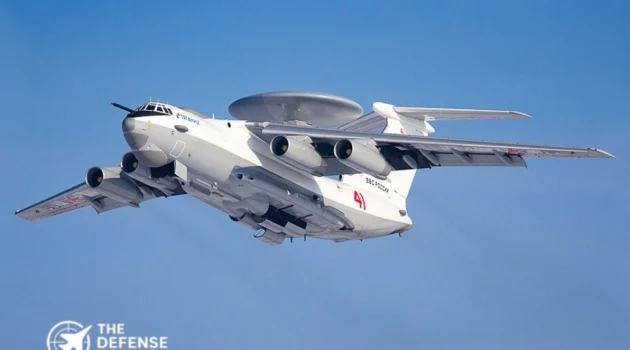
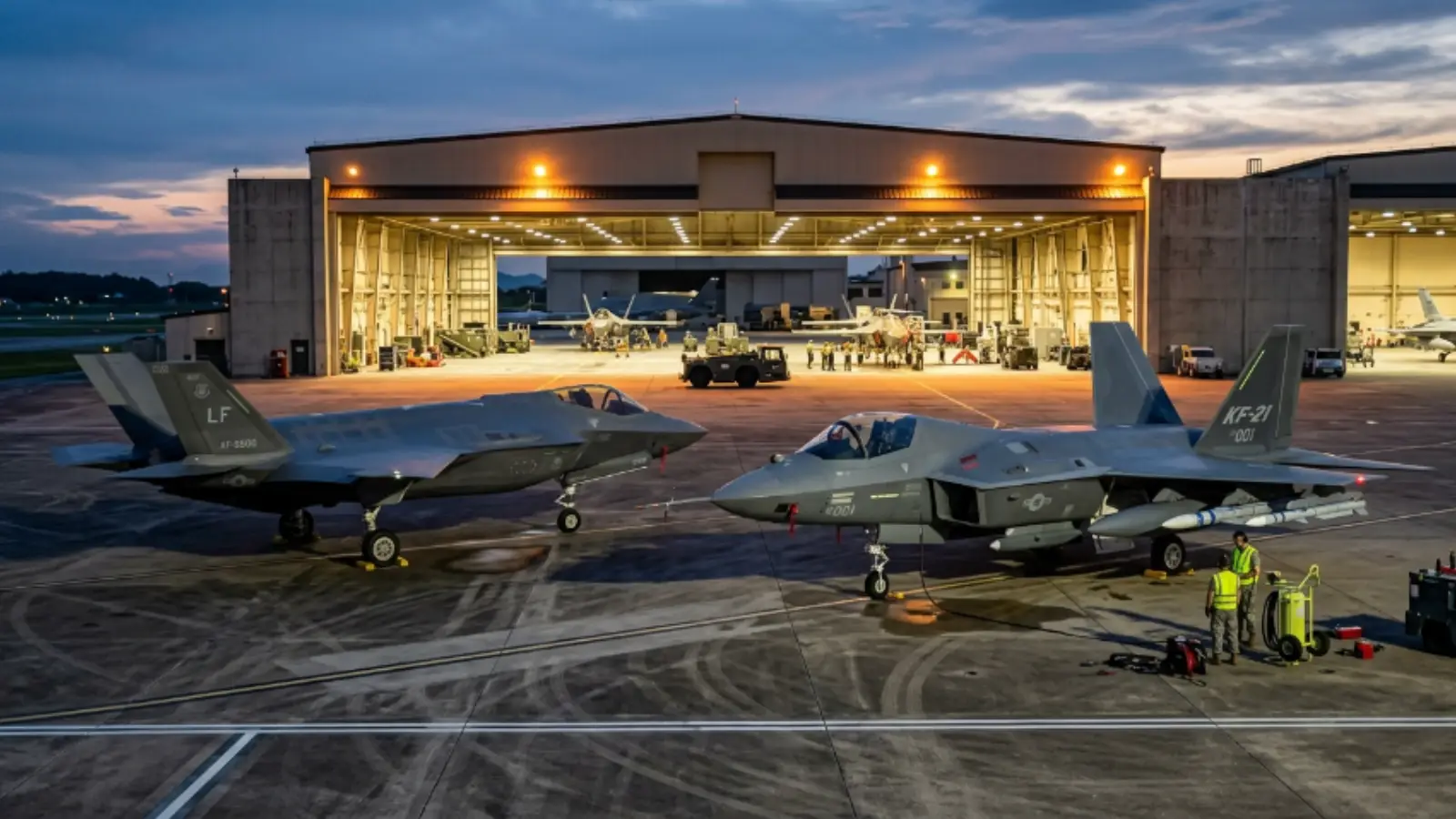
Executive Summary:
South Korea’s KF-21 Boramae rolled off the production line in March 2026, and its first Block I jets are already reaching the ROKAF — but the airframe still carries its missiles externally, with no internal weapons bay until Block III arrives in the next decade. The F-35A remains the only one of the two built around genuine low observability from the ground up. This is where the “semi-stealth” label stops being marketing language and becomes an operational limitation.
F-35A vs. KF-21 Boramae: Inside the Stealth Gap Splitting Asia’s Skies
A jet doesn’t need a radar cross-section rated in square meters to change the balance of power in a region. It just needs to be cheaper, available now, and good enough. That’s the bet South Korea is making with the KF-21 Boramae, and the first production airframe left the Sacheon assembly line in March 2026 to prove it.
The F-35A, by contrast, has spent over a decade answering a different question: what does it cost to make an airframe effectively invisible to enemy radar? The two jets are being marketed as complementary. The numbers say something more complicated.
The Deep Dive: Two Different Definitions of Stealth
The KF-21 Block I, now entering ROKAF service, carries its weapons the old-fashioned way — bolted to four semi-recessed stations under the fuselage and six wing hardpoints. Korea Aerospace Industries calls this “semi-stealth,” and that’s an honest description, not a euphemism.
Semi-recessed carriage shrinks radar return compared to a fully external pylon, but it’s nowhere near an internal bay. The airframe also skips radar-absorbent coatings on Block I and II, deferring that upgrade to the still-distant Block III, sometimes referred to as the KF-21EX.
The F-35A was designed in reverse order. Lockheed Martin built the internal weapons bay and RAM coating into the mold line from day one, which is why the jet can carry AIM-120 AMRAAMs and JDAMs without ever exposing a hardpoint to a hostile radar sweep.

That single design choice cascades through everything else. Internal carriage costs the F-35A payload capacity — it can only haul so much before pilots start bolting weapons externally and sacrificing the stealth they paid for. External carriage costs the KF-21 survivability against modern integrated air defense networks, full stop.
Where the Boramae claws back ground is avionics maturity delivered ahead of schedule. Its domestically built APY-016K AESA radar, fielded by Hanwha Systems, uses roughly 1,000 transmit-receive modules to detect targets out to 150–200 km and track around 20 simultaneously. Combined with an indigenous MUM-T (manned-unmanned teaming) architecture, the jet isn’t trying to out-stealth the F-35 — it’s trying to out-network it in cost-effective numbers.
The program’s pace has genuinely surprised skeptics. Flight testing wrapped in January 2026 after 1,600 accident-free sorties across 42 months, two months ahead of schedule. Air-to-ground weapons testing, originally targeted for 2028, has been pulled forward to the first half of 2027. Forty Block I jets are contracted, with eight delivering in 2026 alone, followed by 80 Block II aircraft with expanded strike capability arriving by 2032.
Data Block: Head-to-Head Metrics
Metric F-35A Lightning II KF-21 Boramae (Block I/II) Generation classification True 5th-generation 4.5-generation, semi-stealth Weapons carriage Internal bay + external hardpoints External / semi-recessed only (internal bay deferred to Block III) Radar-absorbent materials Full airframe RAM coating Not applied until Block III/KF-21EX Primary radar AN/APG-81 AESA APY-016K AESA (~1,000 TR modules, 150–200 km detection) Engine Single Pratt & Whitney F135 (43,000 lbf w/ afterburner) Twin GE F414-GE-400K (indigenous Hanwha engine planned for Block III) Flyaway unit cost (recent lots) ~$82.5 million ~$83 million (Block I) / ~$112 million (Block II) Combat-configured cost ~$95–120 million Comparable once mission systems are added Cost per flight hour ~$34,000–$42,000 Not yet publicly disaggregated; projected lower given simpler airframe Total planned units (initial phases) 2,470+ (multi-nation program) 40 Block I + 80 Block II (120 total through 2032) Weapons bay / MUM-T Bay only; limited teaming autonomy No bay; strong MUM-T/loyal wingman focus Service entry Operational since 2016 Block I entering service 2026 The Insight: Why This Is a Rush Strategy, Not a Stealth Strategy
Competitive gaming has a term for this exact tradeoff: the rush build. In real-time strategy titles, a rush composition sacrifices the late-game power spike for board presence right now — cheaper units, faster production, overwhelming numbers before the opponent’s expensive tech tree finishes.
The KF-21 is South Korea’s rush build. It skips the most expensive, most time-consuming part of fifth-generation design — the internal bay and full-spectrum RAM treatment — to get combat-credible airframes into squadron service years before a from-scratch stealth program could deliver. Block I entered service in 2026. A comparable clean-sheet stealth program elsewhere, like Turkey’s Kaan or the European GCAP effort, isn’t expected to field operational jets until well into the 2030s.
The F-35 is the maxed-out unit that takes longer to reach the field but wins the direct engagement when it arrives. It was never meant to be cheap or fast to produce in year one; the entire program logic bet on economies of scale eventually driving flyaway costs below $80 million; a bet that’s now paying off after years of criticism.
What makes this genuinely interesting from a strategy standpoint isn’t which jet is “better” in isolation. It’s that South Korea isn’t trying to replace its F-35A fleet with the Boramae at all. ROKAF pilots are explicit that the KF-21 shoulders routine air-defense and quick-reaction alert missions, freeing the F-35A for the missions where low observability actually matters — first-look, first-kill strikes against contested, radar-dense airspace.
Finally, South Korea has become a nation that possesses weapons to safeguard peace through its own technology and willpower — not only on land and sea but also in the skies.” — President Lee Jae-myung, at the KF-21 production rollout ceremony, March 25, 2026
What This Means Going Forward
The Boramae isn’t trying to beat the F-35A on stealth, and pretending otherwise misreads the program entirely. It’s trying to make sure South Korea never has to choose between an aircraft it can produce domestically in volume and one it has to wait a decade to import.
Block III, with its planned internal weapons bay, RAM coating, and 16,000-lb-thrust indigenous engine, is where the real fifth-generation claim gets tested — and that airframe is still years from cutting metal. Until then, the F-35A remains the only jet in Korean service built around low observability from the first line drawn on the mold.
For an air force squaring off against China’s J-20, J-35, and a rapidly modernizing North Korean posture, that gap between “semi-stealth today” and “full stealth eventually” isn’t academic. It’s the difference between deterrence on paper and deterrence in the air.
FAQ
Does the KF-21 Boramae have an internal weapons bay?No. Block I and Block II carry weapons externally on semi-recessed fuselage stations and wing hardpoints. An internal bay is planned only for the future Block III/KF-21EX variant.
Is the KF-21 considered a fifth-generation fighter?Officially, no. KAI and DAPA classify Block I/II as 4.5-generation “semi-stealth” aircraft. Full fifth-generation features are reserved for Block III.
How does the KF-21’s cost compare to the F-35A?Recent reporting places Block I units around $83 million and Block II around $112 million, close to the F-35A’s flyaway cost of roughly $82.5 million — though final combat-configured pricing depends on mission systems fitted to each.
When does the KF-21 enter full operational service?Block I aircraft began deliveries in 2026, with initial operational capability targeted before the full 40-jet batch completes by 2028. Block II, adding ground-attack capability, is scheduled through 2032.
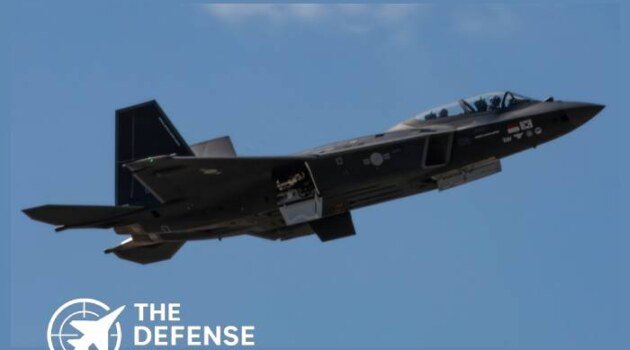
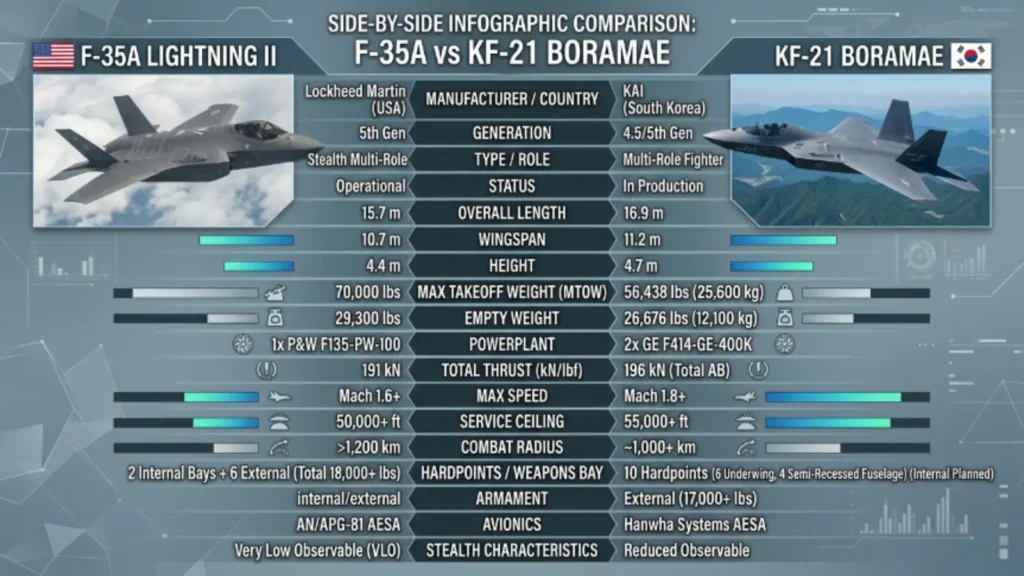
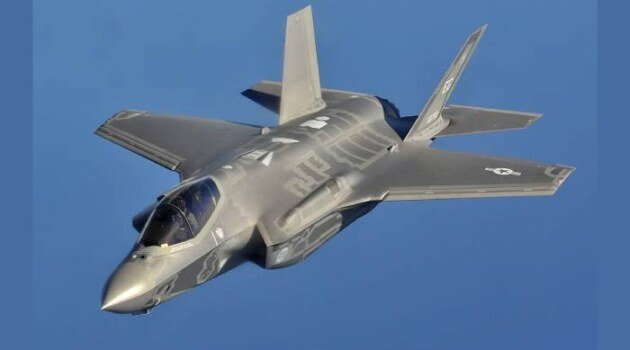
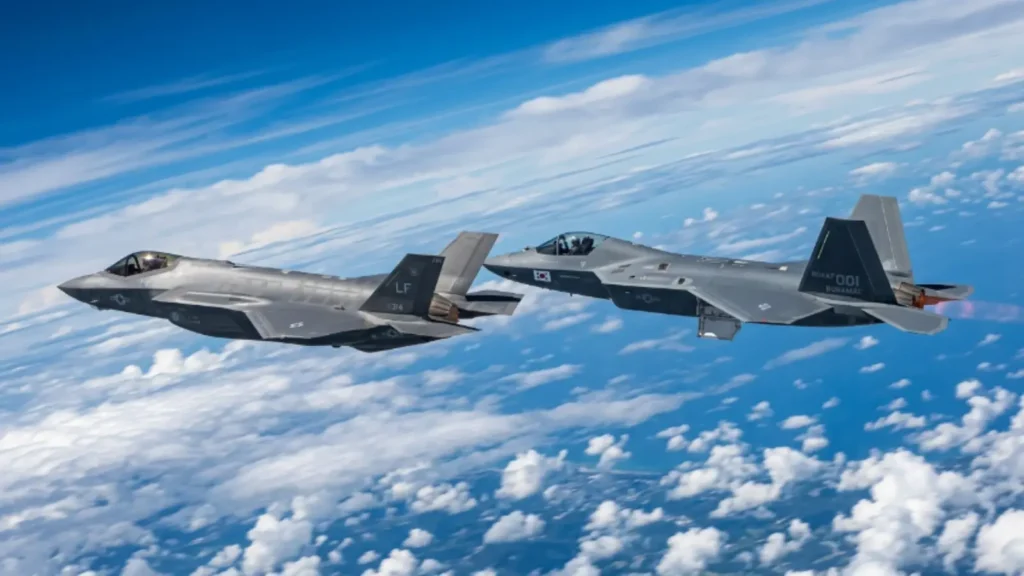
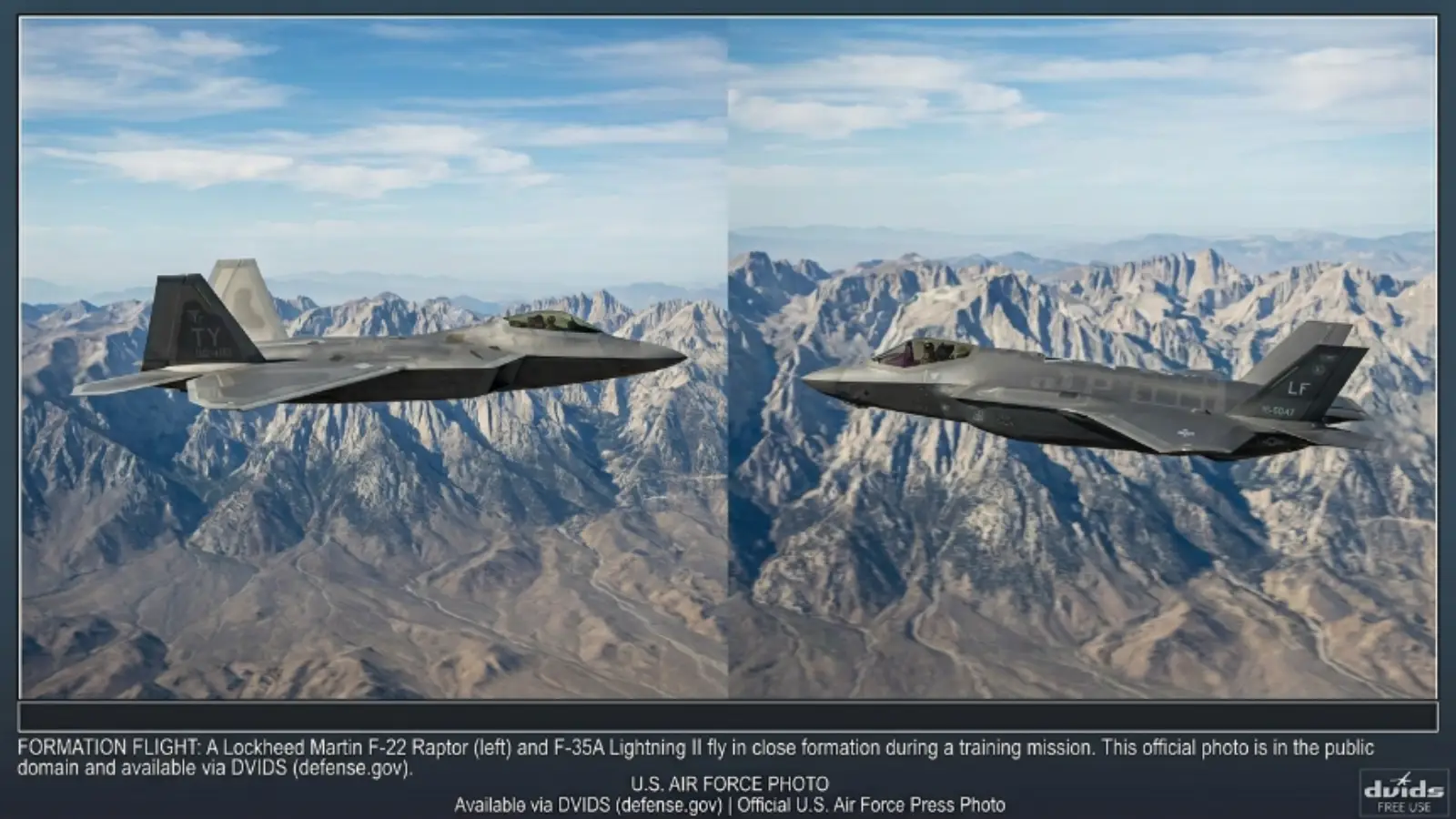
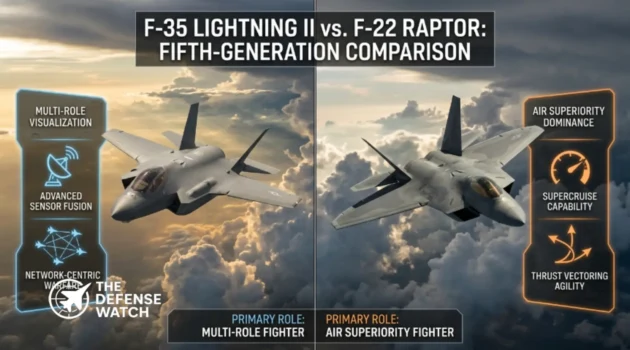
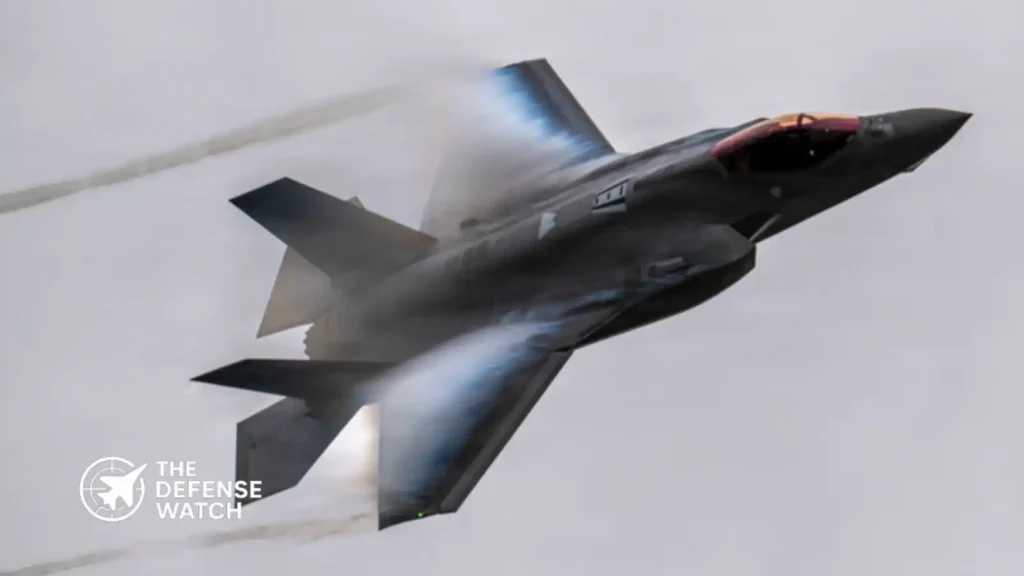
The debate over the F-35 Joint Strike Fighter vs F-22 Raptor has never been more relevant. In March 2025, the U.S. Air Force awarded Boeing the contract for the F-47 NGAD, the sixth-generation platform that will eventually replace the Raptor. That announcement drew a sharp line under a strategic question that has followed American defense planners for two decades: did the United States build the right stealth fighters, in the right numbers, for the right era?
(adsbygoogle = window.adsbygoogle || []).push({});With China’s J-20 and J-35 fleets expanding rapidly and Russia deploying Su-57s in limited numbers, the U.S. now operates two distinct fifth-generation platforms that are increasingly expected to work as a team rather than compete for the same missions. Understanding what each aircraft does — and what it cannot do — is essential context for anyone watching how American airpower will project itself across the Indo-Pacific and beyond.
This is the definitive F-35 vs F-22 breakdown for 2026.
F-35 Joint Strike Fighter vs F-22 Raptor: Specifications at a Glance
| Specification | F-22 Raptor | F-35A Lightning II |
|---|---|---|
| Manufacturer | Lockheed Martin / Boeing | Lockheed Martin |
| Role | Air Superiority Fighter | Multirole Strike Fighter |
| First Flight | 1997 | 2006 |
| Service Entry | 2005 | 2015 |
| Engine | 2× Pratt & Whitney F119-PW-100 | 1× Pratt & Whitney F135 |
| Thrust (with AB) | ~70,000 lbf combined | ~43,000 lbf |
| Top Speed | Mach 2.25 (~1,500 mph) | Mach 1.6 (~1,200 mph) |
| Supercruise | Yes (Mach 1.5+ without afterburner) | No |
| Climb Rate | 62,000+ ft/min | ~45,000 ft/min |
| Combat Radius | ~590 miles | ~670 miles (A variant) |
| Service Ceiling | 65,000 ft | 50,000 ft |
| Internal Weapons Bays | 3 bays | 2 main bays |
| Unit Cost (flyaway) | ~$334M (program avg.) | ~$82M (FY2025, A variant) |
| Operating Cost/hr | ~$85,000 | ~$42,000 |
| Aircraft Built | 186 (production ended 2012) | 1,150+ delivered, production ongoing |
| Export Eligible | No (Obey Amendment) | Yes (20+ partner nations) |
| Nuclear Capable | No | Yes (B61-12) |
Design and Technology: Built for Different Wars
The F-22 Raptor — Cold War Vision, 21st-Century Execution
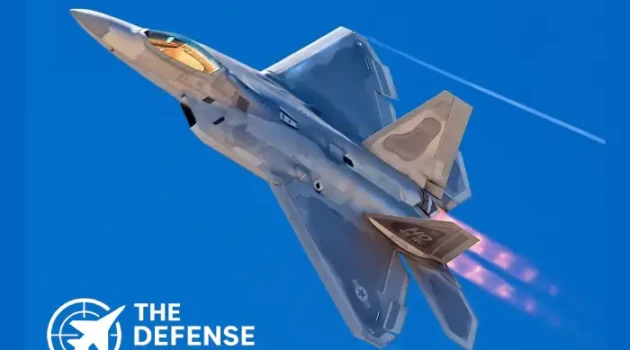
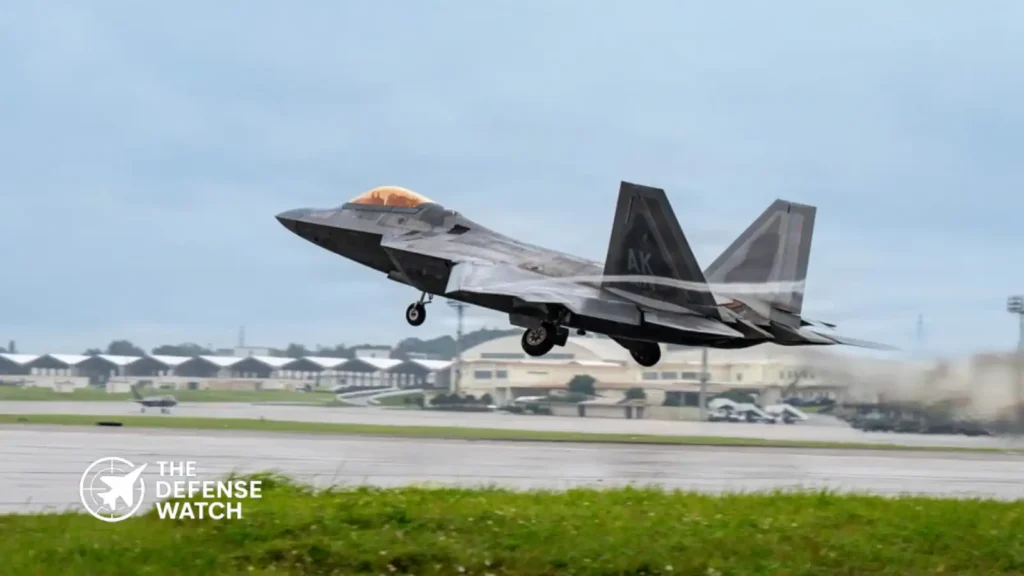
The Raptor was conceived in the 1980s to defeat the most advanced Soviet fighters expected in the 1990s. It emerged from the Advanced Tactical Fighter program as a machine optimized for one thing above all else: killing other aircraft before they know it is there.
Its stealth geometry prioritizes low radar cross-section against airborne threats — meaning the shaping focuses on defeating the nose-on radar look angles that opposing fighters use during engagements. The F-22’s radar absorbent materials and precise edge alignment give it the lowest radar cross-section of any operational fighter in the world. This edge goes to the Raptor even when compared directly to its younger sibling.
- (adsbygoogle = window.adsbygoogle || []).push({});
The twin Pratt & Whitney F119 engines deliver supercruise — the ability to sustain supersonic flight without engaging afterburners. This capability is tactically decisive: it extends the Raptor’s time in contested airspace at high speed without generating the large infrared signature that afterburner use produces. Combined with thrust-vectoring nozzles that bend the exhaust to control pitch and yaw, the F-22 can execute maneuvers in a dogfight that few aircraft can match or even anticipate.
The F-35 Lightning II — A Fighter Built for the Network Age
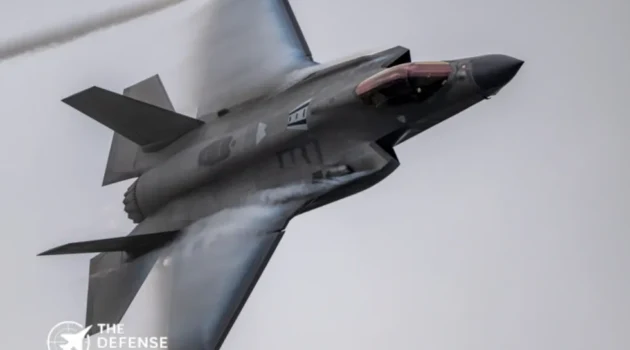
Where the Raptor was engineered to fight alone and win, the F-35 was designed to function as a node in a networked battlespace. Its AN/APG-81 AESA radar, the Distributed Aperture System (DAS) giving 360-degree infrared situational awareness, and the Electro-Optical Targeting System (EOTS) combine into a sensor fusion architecture that feeds a single, synthesized picture to the pilot through a helmet-mounted display.
The result is that an F-35 pilot sees more of the battlespace — from further away and across more domains — than any fighter pilot in history. The aircraft’s Multi-Function Advanced Data Link (MADL) allows it to share that picture with other F-35s and compatible platforms without broadcasting a detectable emissions signature. In practical terms, a flight of four F-35s can build a shared tactical picture that makes the entire formation dramatically more lethal than four independent aircraft would be.
atOptions = { ‘key’ : ‘e7d18db8b7513fb2a224cf4c3f18bbf0’, ‘format’ : ‘iframe’, ‘height’ : 90, ‘width’ : 728, ‘params’ : {} };The F-35’s stealth profile is optimized for ground-based radar threats — the low-frequency and high-frequency systems that surface-to-air missile networks rely upon. This makes it extremely effective at penetrating defended airspace to strike targets on the ground, a mission the Raptor was never primarily designed to execute.
Firepower and Weapons Loadout: Specialist vs Swiss Army Knife
F-22 Raptor Weapons
The Raptor carries all weapons internally to preserve its stealth profile. Its primary air-to-air armament consists of:
- 6× AIM-120D AMRAAM (beyond-visual-range, semi-active/active radar guided)
- 2× AIM-9X Sidewinder (short-range, infrared-guided)
- 1× M61A2 Vulcan 20mm rotary cannon (480 rounds)
For the ground attack role, the Raptor can carry two GBU-32 JDAMs (1,000-lb precision guided bombs) in its main bays, though this secondary mission significantly underutilizes its capabilities.
F-35 Lightning II Weapons
The F-35 carries a far broader weapons suite, adaptable across variants and mission sets:
- AIM-120D AMRAAM (BVR air-to-air)
- AIM-9X Sidewinder (short-range air-to-air)
- AIM-132 ASRAAM / Meteor (European F-35 operators)
- GBU-31/32 JDAM (precision ground attack)
- JASSM-ER (long-range cruise missile, stealth)
- SPEAR-3 (network-enabled precision strike, UK variant)
- B61-12 nuclear gravity bomb (nuclear deterrence)
- AGM-154 JSOW (standoff anti-armor)
- 1× GAU-22/A 25mm cannon (A/C variants internal; B variant external pod)
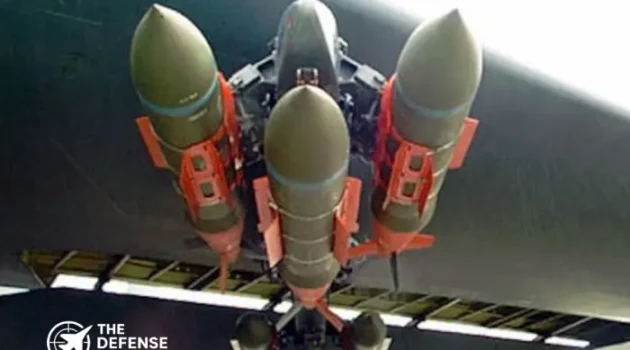
The F-35 can also carry weapons externally on six hardpoints, sacrificing stealth for a heavier payload when operating in lower-threat environments. This flexibility allows it to function as both a deep-penetration stealth striker and a conventional bomb truck — a dual capability the Raptor cannot replicate.
(adsbygoogle = window.adsbygoogle || []).push({});Operational Range and Mobility
Both aircraft are broadly comparable in combat radius, with the F-35A holding a modest edge at approximately 670 miles versus the Raptor’s 590 miles. However, the context matters enormously.
The F-22’s supercruise capability means it can cover that radius at sustained supersonic speeds — spending more time in the target area and less time vulnerable during transit. The F-35 relies on afterburner for supersonic flight, burning fuel at a significantly higher rate.
For the Indo-Pacific theater — where distances between island chains and carrier groups often exceed 1,000 miles — both aircraft benefit significantly from aerial refueling. The F-35C carrier variant operates from U.S. Navy supercarriers, extending its operational reach considerably. The F-22 operates exclusively from land bases, a strategic limitation as the Pacific theater demands dispersed, expeditionary basing options.
The F-35B STOVL variant addresses this limitation indirectly. Marines and allied navies (UK, Italy, Japan) operate F-35Bs from amphibious assault ships and smaller carriers, bringing stealth strike capability into theaters where conventional carrier operations would be impractical.
Combat Effectiveness: What the Real Record Shows
Neither aircraft has engaged an enemy fighter in air-to-air combat. This fact is often cited as evidence of their deterrence value — peer adversaries have not chosen to contest U.S. airspace in environments where these jets operate.
The F-22 entered combat in September 2014, striking ISIS targets in Syria. It was the first operational use of the Raptor in any combat role — and it was used as a striker, not an air superiority platform, an irony not lost on defense analysts who criticized the decision to end production at just 186 airframes rather than the originally planned 750.
The F-35 has seen broader combat employment, including Israeli Air Force strikes in contested Syrian airspace and U.S. operations in the Middle East. Israel’s F-35Is — locally designated “Adir” — have reportedly conducted strikes in environments defended by Russian-supplied S-300 systems, validating the aircraft’s low-observable penetration capability in real-world conditions.
Exercise data paints a consistent picture. In training engagements, the F-22 consistently defeats fourth-generation opponents at exchange ratios that make air superiority planners confident. The F-35’s sensor fusion advantage becomes decisive in multi-ship engagements where network-shared targeting data allows F-35 pilots to engage threats their own radar has not yet directly detected.
(adsbygoogle = window.adsbygoogle || []).push({});Cost and Export Value: The Strategic Divide
The cost difference between these two aircraft is not merely a budgetary footnote — it fundamentally shapes how American airpower is structured and distributed.
The F-22’s unit cost of approximately $334 million (when total program costs are divided across 186 aircraft) made it unaffordable at the scale originally envisioned. Congress canceled the program in 2009 at 186 airframes — a decision that Air Force leadership has repeatedly described as a strategic mistake given the pace of Chinese fifth-generation development.
The Obey Amendment prohibits F-22 export to any nation, protecting its classified stealth and avionics technology. This means the Raptor remains an exclusively American asset, with no foreign operators to share development and sustainment costs.
The F-35 operates under a fundamentally different model. As an international program from conception, it distributes costs and production across partner nations. More than 20 countries have ordered the F-35, and the program has delivered over 1,150 aircraft to date. This scale drives unit costs down — the F-35A now costs approximately $82 million per aircraft in FY2025, a figure that has declined steadily as production rates increased. Operating costs run roughly $42,000 per flight hour versus the Raptor’s $85,000.
The F-35’s export footprint also creates significant geopolitical leverage. When Japan, South Korea, Australia, and NATO allies all fly the same platform with compatible data links, coalition operations become dramatically more effective. A combined allied F-35 network in the Pacific theater would present a coordinated sensor and strike capability that no adversary air defense system has yet been designed to defeat.
Strengths and Weaknesses: The Balanced Assessment
F-22 Raptor
Strengths: Unmatched speed, altitude, and maneuverability. Lowest radar cross-section of any operational fighter. Supercruise capability with sustained supersonic performance. Thrust-vectoring for extreme agility in within-visual-range engagements.
Weaknesses: Production ended at 186 airframes — far below planned quantities. No export market to share costs. High per-flight-hour operating costs. Cannot carry nuclear weapons. Limited ground attack capability. Aging avionics relative to the F-35’s sensor fusion architecture. No STOVL or carrier variant.
F-35 Lightning II
Strengths: Unmatched sensor fusion and networked warfare capability. Broadest weapons suite of any western fighter. Three variants covering land, carrier, and STOVL operations. Active production with declining unit costs. Nuclear-capable. Coalition interoperability with 20+ partner nations.
(adsbygoogle = window.adsbygoogle || []).push({});Weaknesses: Slower than the Raptor at Mach 1.6, with no supercruise. Less maneuverable in a close-in dogfight. Single engine reduces survivability margin compared to the twin-engine Raptor. Software and sustainment complexity has driven maintenance challenges. Cannon in the B variant is an external pod rather than internal.
Conclusion: Different Tools, Same Mission — Winning
The F-35 Joint Strike Fighter vs F-22 Raptor debate often gets framed as a contest. In reality, it is a division of labor.
If a future conflict with China or Russia reaches the point where U.S. fighters must contest enemy airspace against peer stealth aircraft, the F-22 is the platform that goes first — clearing lanes, suppressing enemy air defenses, and establishing air superiority that allows everything else to operate. In that scenario, the Raptor’s speed, agility, and stealth profile give it a decisive edge.
But the vast majority of combat scenarios the U.S. military will face are not symmetrical stealth-vs-stealth engagements. They involve precision strikes against defended targets, networked battlespace management, coalition coordination, and electronic warfare — all areas where the F-35’s capabilities are unmatched by any aircraft currently in service anywhere in the world.
atOptions = { ‘key’ : ‘3d48d603f906e3fe9f205be3c4433835’, ‘format’ : ‘iframe’, ‘height’ : 250, ‘width’ : 300, ‘params’ : {} };The Air Force understands this complementary relationship. The F-47 NGAD will eventually take the Raptor’s place as America’s dedicated air superiority platform, while the F-35 continues production and upgrades through the 2070s as the backbone of allied airpower.
In short: send the F-22 to win the fight. Send the F-35 to win the war.
FAQ: F-35 Joint Strike Fighter vs F-22 Raptor
In a direct dogfight, would the F-22 Raptor beat the F-35 Lightning II?In a within-visual-range dogfight, the F-22 holds a clear advantage. Its thrust-vectoring engines, higher top speed of Mach 2.25 versus the F-35’s Mach 1.6, and superior climb rate give it the maneuvering edge. However, modern air combat rarely comes down to close-range turning engagements — and the F-35’s sensor fusion gives it the advantage of detecting and targeting threats before they close to visual range.
Why did the U.S. stop building the F-22 Raptor?Congress ended F-22 production in 2009 at 186 airframes, citing the aircraft’s high unit cost (over $334 million per plane) and the belief that the post-Cold War threat environment did not justify the expense. Many Air Force leaders have since described this as a strategic error, given China’s rapid development of fifth-generation fighters including the J-20 and J-35.
Can the F-35 carry nuclear weapons, and can the F-22?Yes — the F-35 is certified to carry and deliver the B61-12 nuclear gravity bomb, making it a key component of U.S. extended nuclear deterrence in Europe and the Pacific. The F-22 Raptor is not nuclear-capable.
Which countries operate the F-35, and why can’t they buy the F-22?Over 20 nations operate or have ordered the F-35, including the UK, Japan, Australia, Israel, Italy, South Korea, Norway, and the Netherlands. The F-22 is prohibited from export by the Obey Amendment (1998), which protects its classified stealth technology and avionics from foreign access. The F-35 was designed as an international program from the outset.
With the F-47 NGAD replacing the F-22, what happens to the Raptor fleet?The F-47 is not expected to reach operational service until the early 2030s at the earliest. The F-22 fleet will continue in service through the transition period, likely into the mid-2030s. The Air Force is currently investing in avionics and radar upgrades to keep the Raptor combat-relevant while the F-47 program matures.

Executive Summary:
The battle rifle vs carbine debate reflects the changing demands of modern warfare, balancing long-range firepower against mobility and adaptability. Battle rifles offer superior range and stopping power through full-size cartridges, while carbines provide lighter weight, reduced recoil, and greater effectiveness in close to medium-range combat. Modern militaries increasingly employ both weapon types to address diverse operational requirements across conventional, urban, and expeditionary battlefields.
The debate over battle rifle vs carbine remains one of the most important discussions in military small arms history. From the battlefields of the Cold War to modern conflicts in Ukraine, Iraq, and Afghanistan, armies have continuously balanced firepower, range, and mobility when selecting infantry weapons.
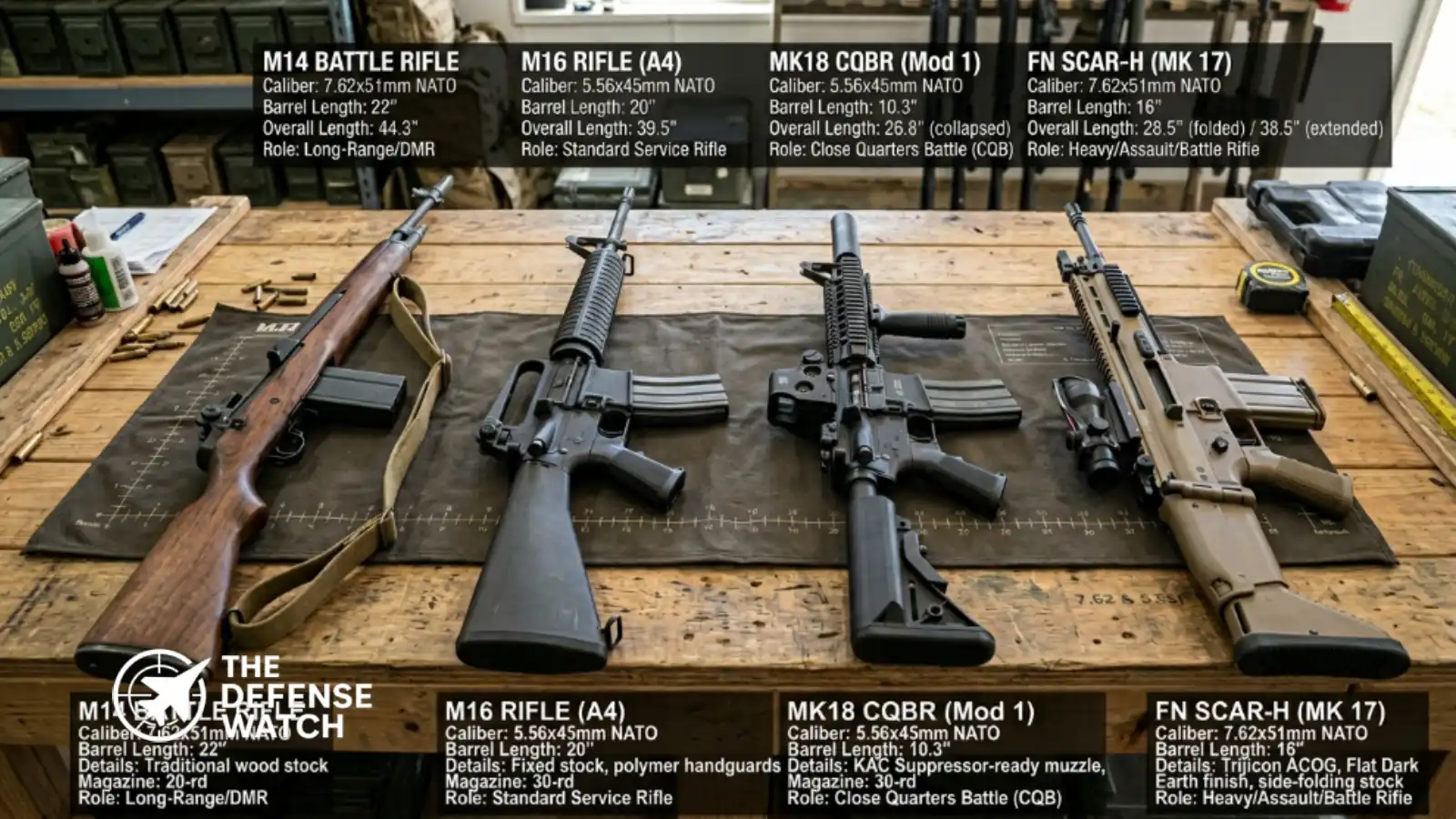
Historically, soldiers carried full-powered battle rifles chambered in cartridges designed for long-range engagements. However, changing combat realities pushed militaries toward lighter, more compact carbines firing intermediate cartridges. This shift transformed infantry doctrine and influenced weapons such as the M16 rifle, MK18 rifle, and SCAR rifle.
Today, the distinction between battle rifles and carbines remains relevant as NATO forces modernize while preparing for potential high-intensity conflicts against near-peer competitors such as Russia and China.
Battle Rifle vs Carbine Specifications Comparison
Specification Battle Rifle Carbine Typical Cartridge 7.62×51mm NATO 5.56×45mm NATO Effective Range 600-800 m 300-500 m Average Weight 8.5-11 lbs 5.5-7.5 lbs Barrel Length 18-22 inches 10-16 inches Recoil High Moderate Ammunition Carry Capacity Lower Higher Typical Role Long-range infantry combat Close to medium-range engagements Examples M14, FN FAL, HK G3, SCAR-H M4, M16 rifle, MK18 rifle, SCAR-L Service Introduction 1950s-1960s 1960s-present Combat Environment Open terrain, long-range warfare Urban combat, mechanized warfare What Is a Battle Rifle?
A battle rifle is generally defined as a shoulder-fired infantry weapon chambered for a full-power rifle cartridge such as the 7.62×51mm NATO round.
Classic examples include:
- M14
- FN FAL
- HK G3
- FN SCAR-H
These weapons emerged during the early Cold War when military planners expected large-scale conventional warfare across Europe. Engagement distances were believed to exceed 500 meters, requiring powerful cartridges capable of penetrating cover and maintaining energy at long range.
Battle rifles deliver superior terminal performance and longer effective range but typically generate greater recoil and weight.
What Is a Carbine?
A carbine is a shorter and lighter rifle designed for improved mobility. Modern military carbines usually fire intermediate cartridges such as 5.56×45mm NATO.
Common examples include:
- M4 Carbine
- M16 rifle variants
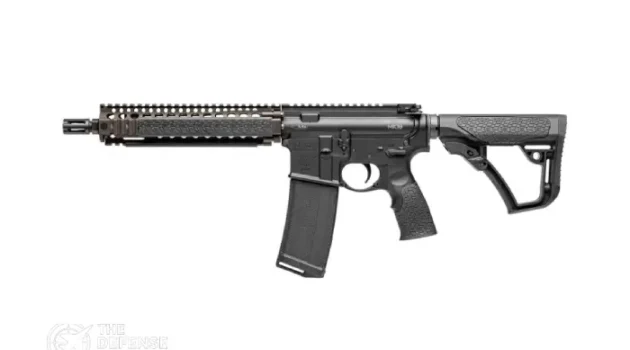
- MK18 rifle
- FN SCAR-L
The rise of mechanized warfare, airborne operations, and urban combat increased demand for compact weapons that could be easily carried inside vehicles, helicopters, and confined spaces.
Carbines sacrifice some long-range performance but provide greater maneuverability and reduced soldier fatigue.
Design and Technology: Battle Rifle vs Carbine
Battle Rifle Design Philosophy
Battle rifles were built around maximum battlefield effectiveness at extended distances.
Key characteristics include:
- Long barrels for increased muzzle velocity
- Robust receivers
- Full-power ammunition
- Enhanced penetration against barriers
Weapons such as the M14 and FN FAL reflected lessons learned during World War II, where infantry often engaged targets across open terrain.
The modern SCAR rifle family continues this philosophy through the SCAR-H variant, which uses the 7.62×51mm NATO cartridge while incorporating modern materials and modular accessories.
Carbine Design Philosophy
Carbines emphasize mobility and adaptability.
Modern carbines feature:
- Shorter barrels
- Lightweight materials
- Accessory rails
- Optical sights
- Suppressor compatibility
The MK18 rifle, developed for U.S. Special Operations Forces, exemplifies this approach. Its compact 10.3-inch barrel makes it highly effective in close-quarters combat and urban operations.
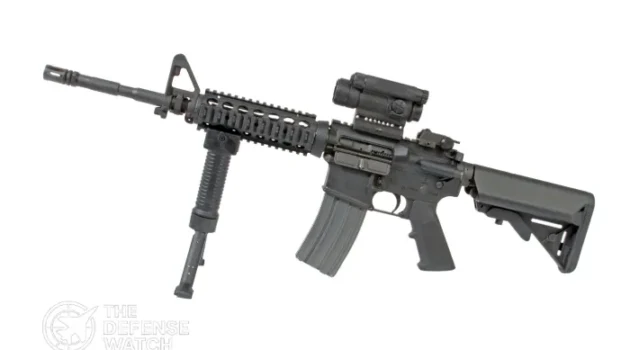
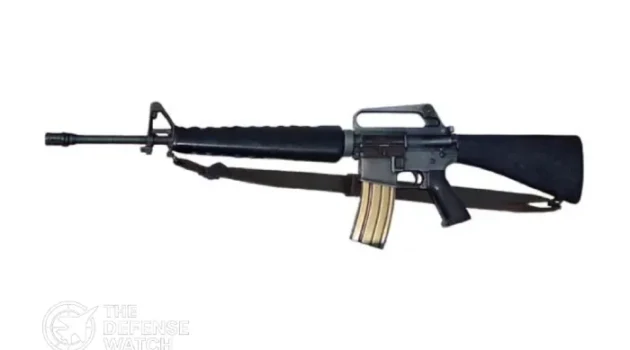
Similarly, the M16 rifle family evolved into shorter configurations that ultimately led to the M4 carbine becoming the standard U.S. infantry weapon.
Firepower and Performance
Battle Rifle Firepower
Battle rifles excel in:
- Long-range engagements
- Barrier penetration
- Suppression at extended distances
- Higher retained energy
The 7.62×51mm NATO cartridge delivers significantly greater energy than 5.56mm ammunition. This makes battle rifles particularly valuable in mountainous terrain and open battlefields.
Modern designated marksmen frequently employ battle-rifle platforms because of their superior range and accuracy.
Carbine Firepower
Carbines prioritize controllability and volume of fire.
Advantages include:
- Faster follow-up shots
- Lower recoil
- Increased ammunition capacity
- Improved handling
The M16 rifle became famous during the Vietnam War partly because soldiers could carry substantially more ammunition than those armed with battle rifles.
The MK18 rifle further optimized performance for special operations missions involving close engagements and rapid target acquisition.
Operational Range and Mobility
Battle Rifle Range Advantages
Battle rifles maintain effectiveness beyond 600 meters and can engage targets at distances that challenge most carbines.
This capability remains important in:
- Mountain warfare
- Open desert operations
- Long-range patrol missions
- Designated marksman roles
Weapons like the SCAR-H continue to serve special operations units because they provide greater reach against distant threats.
Carbine Mobility Advantages
Modern combat often occurs in urban environments where engagement distances are significantly shorter.
Carbines offer:
- Faster movement through buildings
- Easier vehicle operations
- Reduced fatigue
- Better close-quarters handling
The MK18 rifle became especially popular among U.S. special operations units because its compact size is ideal for ship boarding, hostage rescue, and urban warfare.
Combat Effectiveness in Modern Warfare
Battle Rifles in Contemporary Conflicts
Although many armies transitioned away from battle rifles as standard infantry weapons, they never disappeared entirely.
Recent conflicts have highlighted their continued relevance.
In Afghanistan, coalition forces often encountered enemies engaging from distances beyond the effective range of standard carbines. This renewed interest in 7.62mm weapons and designated marksman rifles.
The war in Ukraine has also demonstrated the importance of long-range infantry engagements, reinforcing demand for more powerful cartridges.
Carbines in Modern Combat
Carbines remain the dominant infantry weapon worldwide.
Reasons include:
- Most engagements occur within 300 meters
- Increased mobility for soldiers
- Compatibility with modern optics
- Reduced logistical burden
The U.S. military’s widespread adoption of the M4 carbine reflects these realities.
Modern optics, lasers, and suppressors have further enhanced carbine effectiveness, allowing compact weapons to perform beyond their traditional limitations.
M16 Rifle vs MK18 Rifle vs SCAR Rifle
M16 Rifle
The M16 rifle revolutionized military small arms by introducing lightweight construction and the 5.56mm cartridge.
Strengths:
- Excellent accuracy
- Lightweight
- High ammunition capacity
Weaknesses:
- Longer overall length compared to carbines
- Less maneuverable in confined spaces
MK18 Rifle
The MK18 rifle is optimized for close-quarters combat.
Strengths:
- Extremely compact
- Ideal for special operations
- Excellent urban warfare performance
Weaknesses:
- Reduced effective range
- Lower muzzle velocity
SCAR Rifle
The SCAR rifle family offers both light and heavy variants.
Strengths:
- Modular design
- Multi-role capability
- Available in both 5.56mm and 7.62mm configurations
Weaknesses:
- Higher procurement cost
- More complex logistics compared to standard service rifles
Cost and Export Value
Battle Rifles
Battle rifles generally cost more to operate due to heavier ammunition and increased wear from more powerful cartridges.
However, many countries continue to purchase modern 7.62mm systems for specialized roles.
The SCAR-H has attracted interest among special operations forces seeking greater long-range effectiveness.
Carbines
Carbines remain more economical for large-scale military procurement.
Benefits include:
- Lower ammunition costs
- Reduced transportation burden
- Simpler training requirements
- Greater suitability for mass infantry forces
This explains why most NATO members continue to field 5.56mm carbines as their primary service weapons.
Battle Rifle vs Carbine: Which Has the Edge?
The answer depends entirely on mission requirements.
Battle rifles offer:
- Superior range
- Better penetration
- Greater stopping power
Carbines offer:
- Better maneuverability
- Lower recoil
- Higher ammunition capacity
- Greater versatility in urban combat
The U.S. military increasingly employs a mixed approach. Standard infantry units rely primarily on carbines, while designated marksmen and specialized personnel use battle-rifle platforms when extended range is required.
This layered strategy provides flexibility across diverse operational environments.
Conclusion
The battle rifle vs carbine debate reflects the changing nature of warfare rather than a clear winner. Battle rifles continue to provide unmatched long-range performance and terminal effectiveness, while carbines dominate modern infantry operations through superior mobility and ease of use.
Weapons such as the M16 rifle, MK18 rifle, and SCAR rifle demonstrate how military small arms have evolved to meet different battlefield requirements. As future conflicts increasingly combine urban combat with long-range engagements, both categories are likely to remain essential components of modern military arsenals.
For most conventional infantry missions, carbines retain the advantage. For extended-range combat and specialized roles, battle rifles still offer capabilities that lighter weapons cannot fully replace.
FAQ: Battle Rifle vs Carbine
What is the main difference between a battle rifle and a carbine?A battle rifle typically fires a full-power cartridge such as 7.62×51mm NATO, while a carbine usually fires an intermediate cartridge like 5.56×45mm NATO and features a shorter barrel.
Is the M16 rifle a battle rifle or a carbine?The M16 rifle is generally classified as a service rifle firing an intermediate cartridge. It shares many characteristics with modern carbines but has a longer barrel than most carbine designs.
Why do special forces use the MK18 rifle?The MK18 rifle is highly compact and optimized for close-quarters combat, making it ideal for urban warfare, direct action missions, and maritime operations.
Is the SCAR rifle a battle rifle?The SCAR family includes both variants. The SCAR-L is a carbine-style rifle chambered in 5.56mm, while the SCAR-H is considered a modern battle rifle chambered in 7.62mm NATO.
In a battle rifle vs carbine comparison, which weapon wins?Neither wins in every scenario. Battle rifles dominate at long range and against hard targets, while carbines excel in mobility, urban combat, and general infantry operations.
(adsbygoogle = window.adsbygoogle || []).push({});Executive Summary:
THAAD and Patriot PAC-3 represent the two most combat-tested layers of U.S. ballistic missile defense — but the emergence of maneuvering hypersonic glide vehicles is stress-testing both systems in ways their original architects never designed for. Real-world expenditure data from the June 2025 Israel-Iran conflict, where over 150 THAAD interceptors were fired in twelve days, has exposed a production crisis that no amount of technical capability can paper over. Understanding what these systems can and cannot do against hypersonic threats is no longer an academic exercise — it is the defining strategic question of the 2020s.
Thirty-nine THAAD interceptors, at $12.7 million each, were fired in a single twelve-day window during June 2025. That figure — a minimum estimate from CSIS and Arms Control Wonk analysis — consumed more than a full year’s production run of the entire system. The question of whether these interceptors actually work against the newest category of hypersonic threats is not rhetorical. It now has budget line items, operational after-action reports, and documented failures attached to it.
The layered air defense problem comes down to geometry, physics, and time windows measured in seconds. THAAD and Patriot PAC-3 MSE are complementary systems that occupy different altitude bands in U.S. missile defense architecture. Neither was designed primarily to defeat maneuvering hypersonic glide vehicles. Both are being asked to do exactly that.
The Architecture of Layered Defense: What THAAD and PAC-3 Are Actually Built to Do
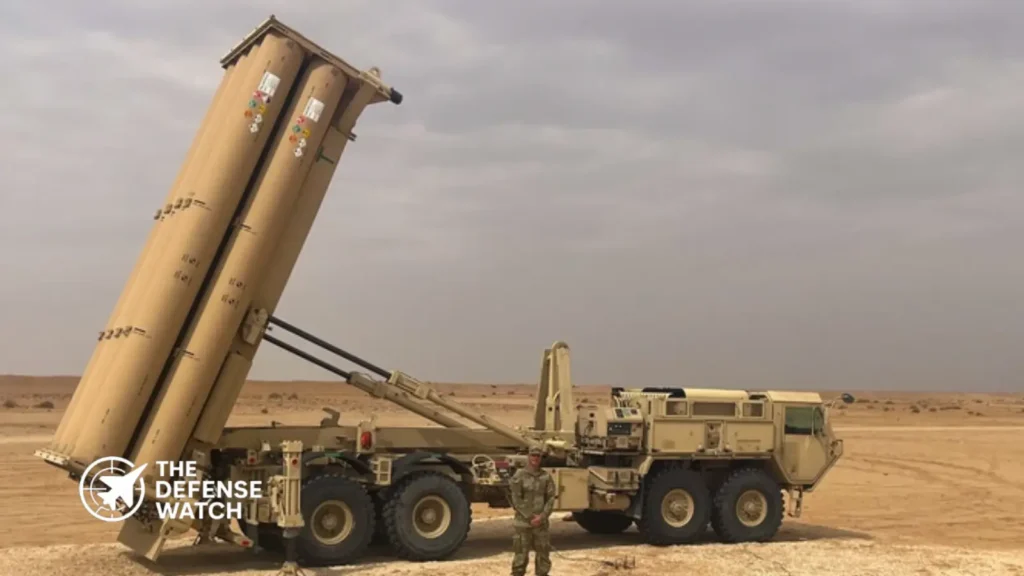
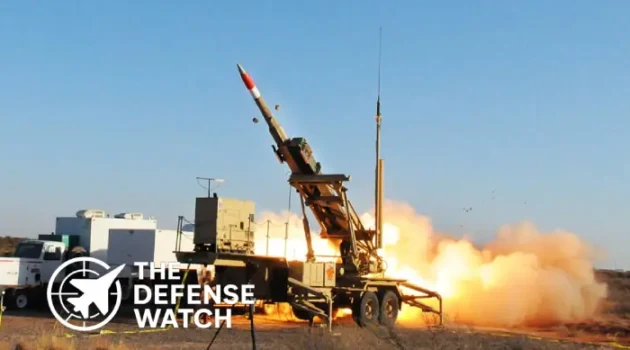
THAAD — Terminal High Altitude Area Defense — is a hit-to-kill system produced by Lockheed Martin. It is designed to defeat short- and medium-range ballistic missiles in the terminal phase of flight, engaging targets both inside and outside the atmosphere using kinetic impact technology. The system’s operational altitude band runs from approximately 40 km to 150 km, sitting above Patriot but below the exoatmospheric intercept envelope of the Navy’s SM-3.
A complete THAAD battery deploys with six M1120 HEMTT-based launchers, each carrying eight interceptors, for a total capacity of 48 missiles, requiring a 95-soldier crew for full operations. The AN/TPY-2 radar — which received a Gallium Nitride (GaN) upgrade delivered in May 2025 that doubles detection range and provides enhanced sensitivity for hypersonic threat tracking — is the system’s most strategically valuable component. The radar alone runs $400–500 million per unit.
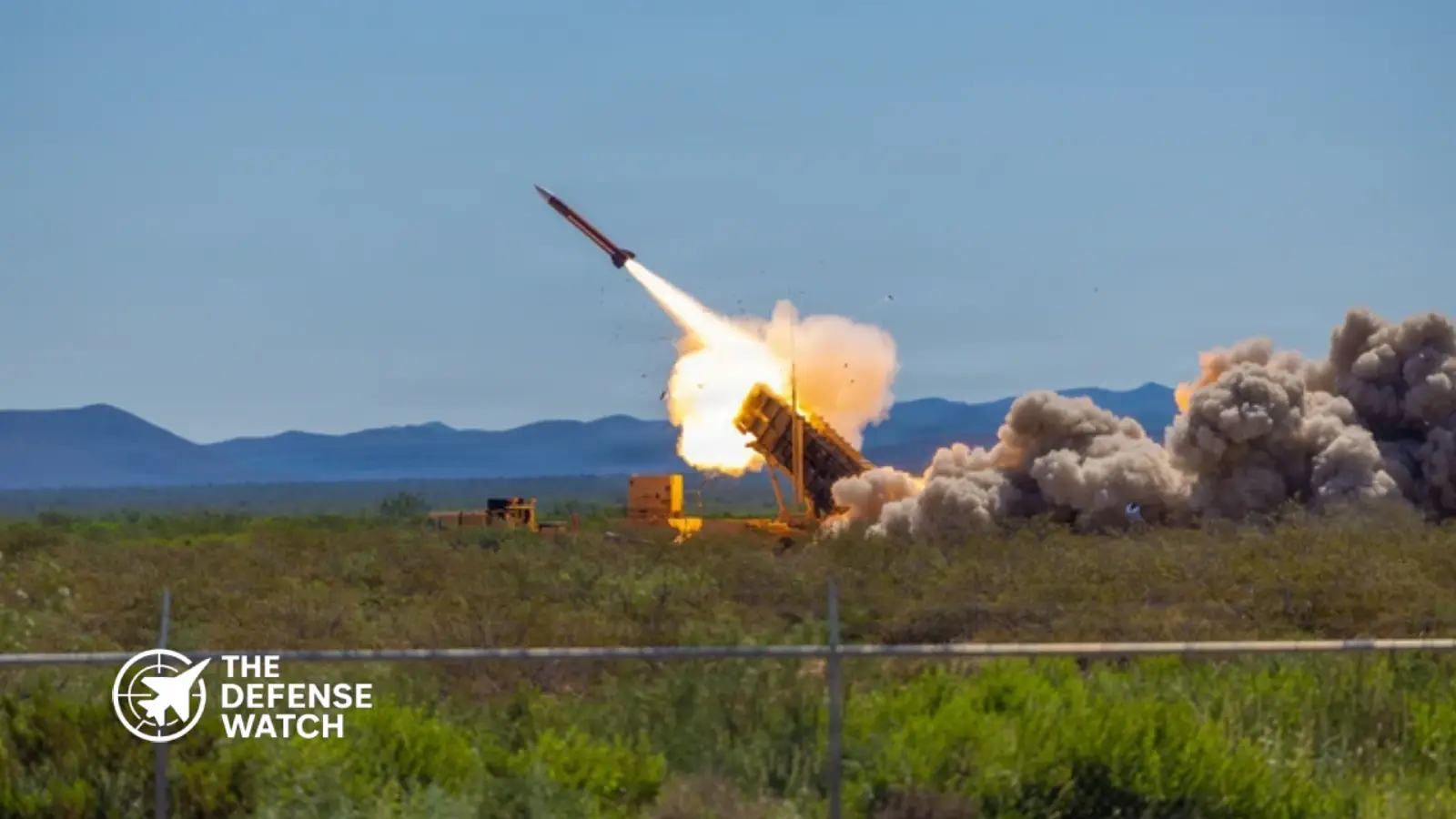
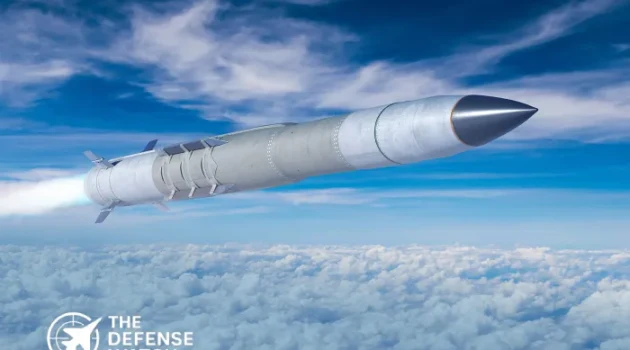
Patriot PAC-3 MSE (Missile Segment Enhanced) operates at the lower tier, handling threats in the 10–40 km altitude band that THAAD either overshoots or cannot engage cost-effectively. PAC-3 MSE features a dual-pulse motor, improved guidance, and the ability to counter ballistic missiles, cruise missiles, and aircraft, with an extended range of 60-plus kilometers. In 2022, Lockheed Martin integrated PAC-3 MSE with the THAAD system, allowing the Army to engage targets across both altitude bands without co-locating the two weapon systems — a significant reduction in logistics and ground equipment requirements.
The cost differential between the two systems is stark. THAAD interceptors cost $12.7 million per unit, while Patriot PAC-3 MSE interceptors run $3.7–4.2 million each — roughly 71 percent less expensive. That gap matters enormously when both systems are firing at volume.
The Hypersonic Problem: Physics That Neither System Was Designed For
A conventional ballistic missile follows a predictable arc. Radar tracks the trajectory; fire control calculates the intercept point; the interceptor flies to that geometry. The physics are difficult, but deterministic. THAAD has achieved a 100% success rate in controlled operational testing against ballistic threats with this profile.
Hypersonic glide vehicles break that determinism. They operate in the 20–80 km altitude band — precisely the seam between THAAD’s lower engagement floor and Patriot’s upper ceiling — and they maneuver laterally throughout terminal approach. If a hypersonic weapon is maneuvering aggressively while traveling at speeds exceeding Mach 6, interceptors may struggle to match its lateral acceleration and speed. A study modeled a scenario involving PAC-3 MSE attempting to destroy a hypersonic glide vehicle similar to the experimental HTV-2, with results suggesting successful interception becomes unlikely if the target maintains speeds above Mach 6 during its terminal dive.
The engagement timeline is the critical constraint. At Mach 10 — roughly 3.4 km per second — a target descending through THAAD’s engagement envelope gives a fire control system roughly 20–30 seconds to detect, track, compute, and launch. Some interceptors, such as Aegis SM-2 and SM-6 missiles, travel at around Mach 4, making them potentially less effective against hypersonic threats. THAAD’s own interceptor reaches approximately Mach 8 in boost phase, but that speed advantage narrows dangerously against a maneuvering target.
(adsbygoogle = window.adsbygoogle || []).push({});Real-world data confirmed the gap. In May 2025, THAAD failed to intercept a hypersonic missile targeting Ben Gurion Airport, followed by a second failure against a Houthi missile within one week — highlighting challenges against maneuvering threats that operate below THAAD’s optimal engagement envelope.
Comparative Data: THAAD vs. Patriot PAC-3 MSE
Parameter THAAD Patriot PAC-3 MSE Interceptor Unit Cost ~$12.7 million ~$3.7–4.2 million Engagement Altitude 40–150 km ~10–40 km Engagement Range ~200 km ~60 km Intercept Mode Hit-to-kill, endo- & exo-atmospheric Hit-to-kill, endoatmospheric Interceptors Per Battery 48 (6 launchers × 8) 16 (4 launchers × 4) Radar System AN/TPY-2 (GaN-upgraded 2025) AN/MPQ-65 / LTAMDS (new) FY2025 Annual Production ~12–32 interceptors ~600–620 interceptors Target Threat Profile MRBMs, IRBMs, limited HGVs SRBMs, cruise missiles, aircraft Battery Acquisition Cost ~$3 billion ~$1 billion Combat Deployment Israel (2025), UAE (2022) Saudi Arabia, Israel, Qatar (2025) Sources: FY2025 MDA Budget, CSIS Missile Defense Report, JINSA cost analysis
The Magazine Problem: Why Production Numbers Are the Real Strategic Vulnerability
Technical performance is only half the equation. During the June 2025 Israel-Iran conflict, a minimum of 39 THAAD interceptors were fired in twelve days, at $12.7 million each — more than an entire year’s FY2026 production quota of 32 missiles, with FY2025 production running at only 12 interceptors total.
The broader inventory picture is more alarming. The United States reportedly engaged Iranian ballistic missile attacks with over 150 THAAD interceptors and approximately 80 SM-3s during the 12-day conflict, following a year of defending against Houthi attacks in the Red Sea that consumed roughly 200 SM-2 and SM-6 interceptors.
The Pentagon, in partnership with Lockheed Martin and Boeing, is now executing a seven-year plan to triple PAC-3 MSE production from roughly 600 annually to 2,000 by 2030. THAAD production will also be increased. But seven-year production ramps offer zero relief for a conflict that could exhaust stockpiles in weeks.
(adsbygoogle = window.adsbygoogle || []).push({});“The strategic math is already alarming. More than an entire year’s worth of THAAD interceptors were fired in twelve days. The production rate in FY2025 was only 12 missiles.” — Arms Control Wonk, June 2025
This is the defining asymmetry in modern layered defense: adversaries can manufacture hypersonic glide vehicles — and the ballistic missiles used to saturate defense systems — at a fraction of the cost of the interceptors fired to stop them. The U.S. used up roughly 14 percent of all its THAAD interceptors during the twelve-day conflict, with replenishment estimated to take three to eight years at prior production rates.
The Layered Defense Doctrine: What Game Theory Teaches Us About Saturation
This is where the operational parallels to competitive strategy become analytically useful — not as decoration, but as structural insight. Any competitive system with high-value, limited-magazine assets faces the same core problem: when your opponent can force you to expend premium resources against low-cost probes, they shift the exchange ratio in their favor.
Iran’s June 2025 campaign sent approximately 550 ballistic missiles at Israel. The saturation logic is explicit — force the defender to shoot expensive interceptors at cheap threats, then route the actual priority payloads through degraded coverage. During periods when THAAD represented over 60 percent of interceptors used, Iran increased its successful hit rate by one to four percent. That marginal increase, compounded across a sustained campaign, compounds into strategic effect.
Layered defense doctrine is the counter: force the adversary to penetrate multiple overlapping systems, each with different engagement geometries, rather than concentrating all intercept burden on one tier. THAAD handles the high-altitude midcourse threats; PAC-3 MSE takes the low-end leakers and cruise missiles; the Aegis SM-3 provides midcourse engagement at sea. The seam, however, is the hypersonic glide vehicle — which threads the 20–80 km band between these tiers and maneuvers to avoid the intercept geometry each system is optimized for.
Traditional systems like Patriot and THAAD can engage ballistic missiles traveling at hypersonic speeds along predictable trajectories, but maneuvering hypersonic glide vehicles present significantly greater challenges due to their ability to change course during flight. No fielded U.S. system has a confirmed intercept of a maneuvering HGV under real combat conditions. That gap remains open.
The Next Step: LTAMDS, THAAD-ER, and the Future of the Kill Chain
The path forward has three vectors. First, sensor modernization: the Lower Tier Air and Missile Defense Sensor (LTAMDS) is a next-generation AESA radar replacing the AN/MPQ-65, providing 360-degree coverage and simultaneous multi-mission capability, while IBCS (Integrated Battle Command System) enables a network-centric architecture allowing distributed sensors and shooters — breaking the “one radar, one battery” limitation.
Second, interceptor upgrades: THAAD-ER (Extended Range) is a future variant with a larger booster for increased velocity, enabling extended engagement range and higher intercept altitude. Higher terminal velocity on the interceptor is the most direct kinematic response to the HGV speed problem.
(adsbygoogle = window.adsbygoogle || []).push({});Third, directed energy. Israel’s Iron Beam delivered confirmed operational use against drone and rocket threats in limited engagement on the Lebanon front in March 2026, with per-shot costs estimated at approximately two dollars. Directed-energy systems cannot yet engage maneuvering ballistic threats at altitude — but against the low-end saturation threats that drain Patriot and THAAD magazines, they represent an asymmetric cost equalizer.
Conclusion: The Exchange Ratio Is the War
THAAD and Patriot PAC-3 MSE are, by any objective metric, the most combat-capable mobile air defense systems currently deployed. The PAC-3 MSE’s documented intercept of Russian Kinzhal missiles over Ukraine validated hit-to-kill technology against a real hypersonic weapon. THAAD’s performance defending Israel — even while burning through annual production in less than two weeks — confirmed the system’s lethality under sustained attack.
But the hypersonic glide vehicle remains a fundamentally different problem. It exploits the altitude seam between tiers, combines ballistic speed with aerodynamic maneuverability, and degrades the fire control geometry that both systems depend on. The GaN radar upgrades and LTAMDS modernization improve tracking. THAAD-ER improves terminal kinematics. Neither fully closes the intercept gap against a Mach 8+ maneuvering target at 40 km.
The deeper issue is economic. At $12.7 million per THAAD shot versus the estimated $3–10 million cost of an advanced hypersonic missile, the attacker holds the exchange ratio advantage. No amount of technical performance closes that gap if the magazine runs empty first.
The strategic lesson from the June 2025 data is unambiguous: production capacity is now as operationally decisive as intercept probability. Until annual THAAD production scales from dozens to hundreds, the most technically advanced air defense system in U.S. inventory remains a finite resource in an era of potentially unlimited threats.
(adsbygoogle = window.adsbygoogle || []).push({});Executive Summary: The Tomahawk cruise missile costs roughly $2 million to $2.5 million per missile and offers long-range strike capability exceeding 1,000 miles, making it a strategic weapon for attacking high-value targets deep inside enemy territory. The Naval Strike Missile (NSM) typically costs $1 million to $1.5 million, prioritizing stealth, anti-ship warfare, and flexible deployment from ships and coastal launchers. Rather than competing directly, the two missiles fulfill complementary roles in modern naval strategy.
The Tomahawk cruise missile cost is typically estimated at $2 million to $2.5 million per round, while the Naval Strike Missile (NSM) generally falls between $1 million and $1.5 million. That price gap raises an obvious question: why would navies pay nearly twice as much for a Tomahawk?
The answer lies in mission design. The Tomahawk is a strategic strike weapon capable of reaching targets more than 1,000 miles away, while the NSM is a stealth-focused anti-ship missile built to dominate naval engagements closer to the battlespace. Comparing them is less about price and more about understanding two very different approaches to maritime warfare.
Modern fleet planners increasingly view the missiles as complementary systems rather than direct competitors. One delivers deep-strike capability across an entire theater of operations. The other helps secure sea control against hostile surface fleets.
Technical Analysis: Cost, Range, and Mission Profiles
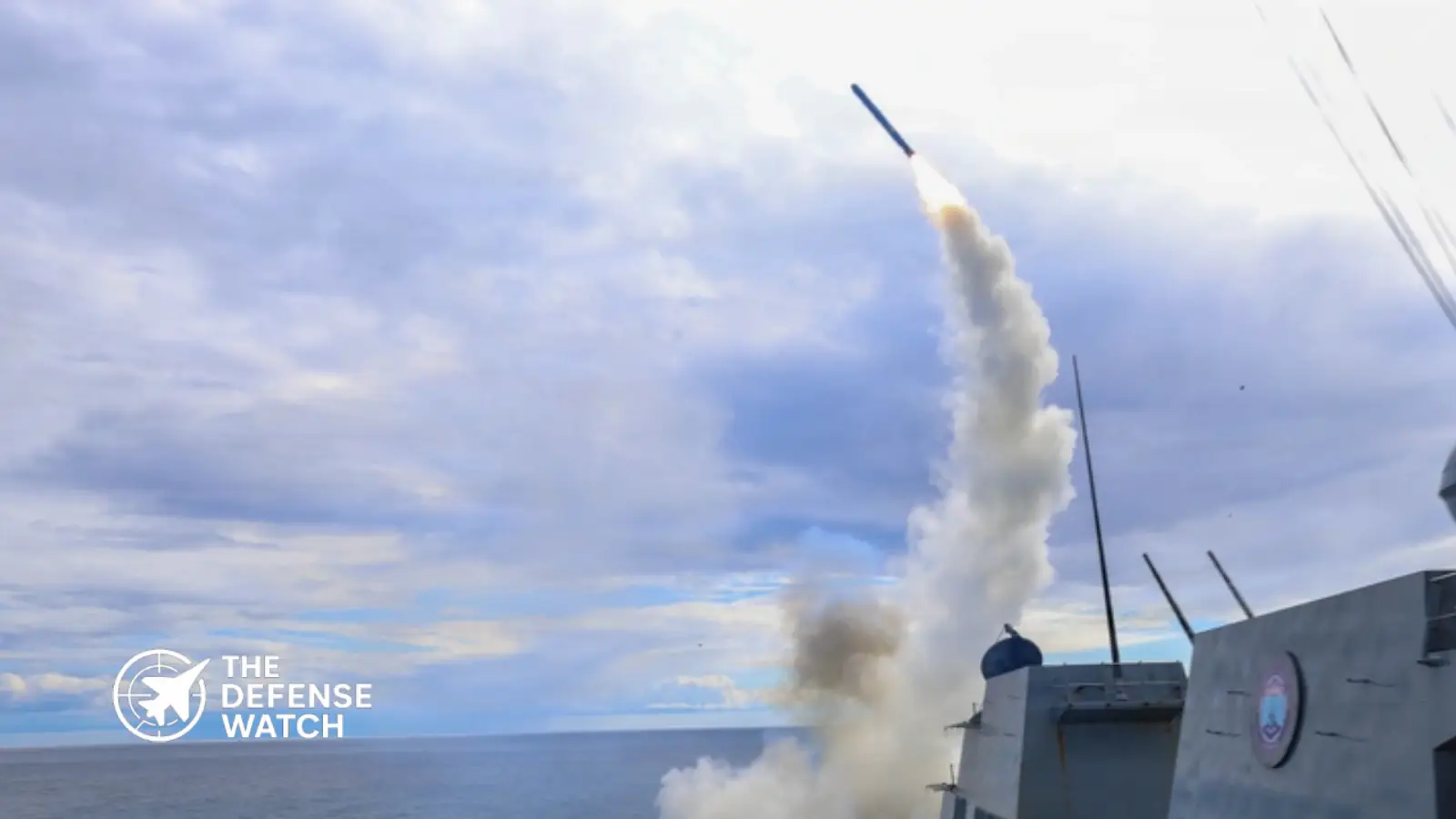
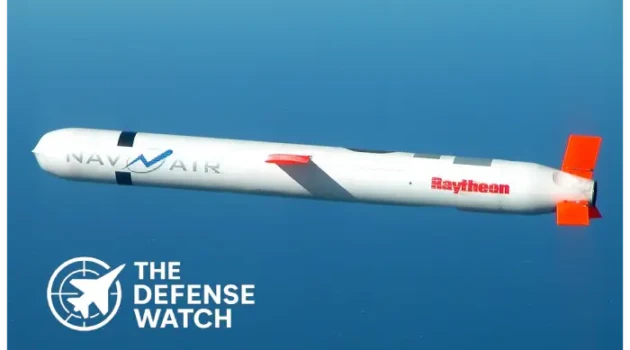
The Tomahawk remains one of the most combat-proven cruise missiles ever developed. First introduced during the Cold War, the weapon has evolved through multiple upgrades and remains a cornerstone of U.S. naval strike capability. The latest Block V variants can engage both land targets and certain maritime threats while maintaining exceptional stand-off range.
- (adsbygoogle = window.adsbygoogle || []).push({});
The Naval Strike Missile represents a different generation of thinking. Developed by Norway’s Kongsberg and now fielded by the U.S. Navy and Marine Corps, the NSM prioritizes survivability, stealth, and advanced terminal attack profiles designed to penetrate modern air defenses.
Tomahawk vs NSM Comparison
Metric Tomahawk Block V Naval Strike Missile (NSM) Approximate Unit Cost $2.0M to $2.5M+ $1.0M to $1.5M Primary Role Land attack and maritime strike Anti-ship warfare Range 1,000+ miles (1,600+ km) 100 to 150+ miles (185 to 250+ km) Launch Platforms Destroyers, cruisers, submarines Surface ships, coastal batteries, mobile launchers Guidance GPS, INS, terrain matching, seeker GPS, INS, imaging infrared seeker Warhead Approximately 1,000 lbs Approximately 275 lbs Flight Profile Subsonic cruise Sea-skimming, low observable The most significant difference is range. A Tomahawk can strike strategic infrastructure, command centers, logistics hubs, and air defense sites deep inside enemy territory. Few conventional naval weapons offer comparable reach.
The NSM is optimized for a different mission set. Rather than attacking inland targets hundreds of miles away, it focuses on destroying enemy surface combatants. Its sea-skimming flight profile and sophisticated target recognition capabilities make interception significantly more difficult.
For naval commanders, the question is not which missile is better. The real question is which missile best supports the mission at hand.
(adsbygoogle = window.adsbygoogle || []).push({});Surface Ship vs Submarine Launch: The Logistics Battle
Launch platform considerations often shape procurement decisions as much as missile performance.
Tomahawk missiles are typically carried aboard major surface combatants equipped with the Mk 41 Vertical Launch System. These ships function as mobile strike platforms capable of influencing operations far beyond the horizon.
Submarine-launched Tomahawks add another layer of strategic value. Attack submarines can approach contested areas undetected, launch precision strikes, and withdraw before adversaries can respond. This combination of stealth and range has repeatedly proven effective during combat operations in the Middle East and elsewhere.
The NSM follows a more distributed model. It can be mounted on smaller warships, truck-based coastal defense systems, and expeditionary launchers. This flexibility aligns closely with emerging U.S. and allied concepts of distributed maritime operations.
Rather than concentrating firepower aboard a handful of expensive platforms, commanders can disperse missile batteries across multiple locations. This creates a targeting challenge for adversaries and improves force survivability.
From a logistics perspective, the NSM offers affordability and flexibility. The Tomahawk offers reach and strategic impact. Modern navies increasingly seek both capabilities.
(adsbygoogle = window.adsbygoogle || []).push({});Why Cost Alone Doesn’t Determine Value
Defense procurement rarely revolves around unit price alone.
A missile costing $2.5 million may appear expensive until planners consider what it replaces. A Tomahawk can strike a target more than a thousand miles away without risking a pilot, tanker aircraft, escort fighters, or support assets.
The cost equation changes further when considering strategic effects. Destroying a high-value command center or disabling a critical air defense network can influence an entire campaign.
Meanwhile, NSM delivers value through quantity and operational flexibility. A force equipped with larger numbers of anti-ship missiles can create significant challenges for hostile fleets operating in contested waters.
This is why many Western navies continue investing in both long-range strike missiles and dedicated anti-ship weapons rather than choosing one category over the other.
The Gaming Parallel: What Tomahawk And NSM Teach Us About Competitive Strategy
The distinction between Tomahawk and NSM mirrors the difference between strategic and tactical play in competitive gaming.
In Call of Duty esports, legendary players such as Clayster built their reputation not simply through mechanical skill, but through map control, timing, and understanding when to commit valuable resources. The Tomahawk fills a similar role. It is the high-value strategic asset that can reshape the battlefield from extreme distance, much like a perfectly timed game-changing play during a championship match.
The NSM operates differently. It resembles a dominant meta weapon that excels in repeated engagements. Rather than delivering one dramatic strategic strike, it focuses on controlling the immediate fight through survivability, precision targeting, and flexible deployment options.
Military planners face the same challenge that elite esports teams face. Should resources be concentrated into a few powerful capabilities, or distributed across larger numbers of specialized tools?
(adsbygoogle = window.adsbygoogle || []).push({});The Tomahawk wins through reach and strategic impact. The Naval Strike Missile wins through flexibility, survivability, and sea control. Modern naval doctrine increasingly relies on both.
Conclusion & Takeaway
Comparing the Tomahawk cruise missile cost to the Naval Strike Missile reveals two fundamentally different philosophies of naval warfare.
Tomahawk delivers strategic depth, long-range precision, and multi-domain strike capability. NSM provides a cost-effective, highly survivable anti-ship weapon designed for distributed maritime operations and contested naval environments.
The future of naval warfare is unlikely to be defined by a single missile. Instead, success will depend on combining long-range strike systems with agile anti-ship capabilities that can survive in increasingly dangerous battlespaces.
In the end, the million-dollar question is not whether Tomahawk or NSM is superior. It is whether a navy can effectively integrate both into a coherent strategy. The fleets that master that balance will hold a decisive advantage in the maritime conflicts of the coming decades.
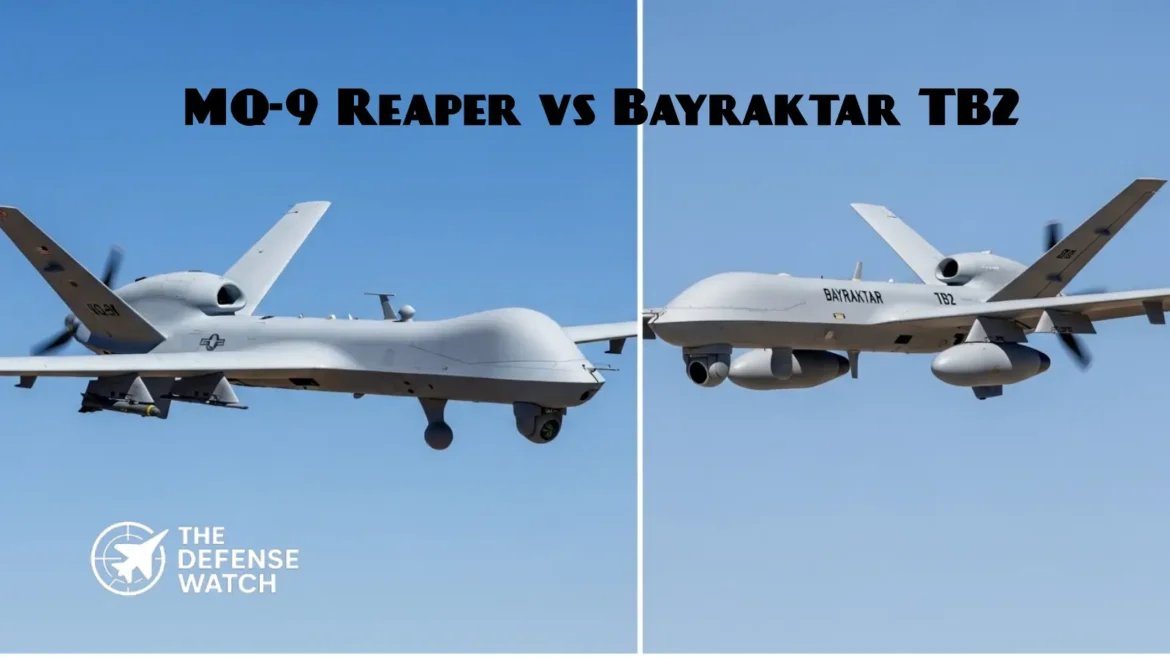
MQ-9 Reaper vs Bayraktar TB2 Payload Capacity
The MQ-9 Reaper vs Bayraktar TB2 payload capacity debate matters because armed drones now shape modern warfare. From counterterror missions in the Middle East to high-intensity conflicts in Eastern Europe, unmanned aircraft have become a core military tool. The United States built the MQ-9 Reaper as a high-end hunter-killer platform with long endurance and heavy strike capability. Turkey developed the Bayraktar TB2 as a lower-cost tactical drone designed for persistent surveillance and precision attack.
Both systems gained global attention through real combat operations. The MQ-9 became a symbol of American remote strike power. The TB2 became famous after conflicts in Libya, Nagorno-Karabakh, and Ukraine. But when comparing combat value, one key metric stands out: payload capacity.
Payload determines how many sensors, bombs, missiles, and fuel tanks a drone can carry. In simple terms, it shapes how much damage a UAV can deliver in a single sortie.
MQ-9 Reaper vs Bayraktar TB2 Specifications Table
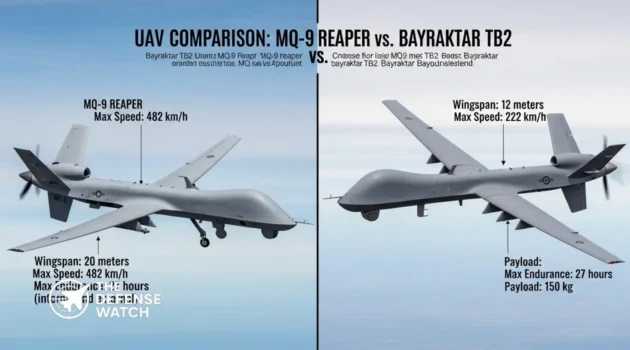
Specification MQ-9 Reaper Bayraktar TB2 Country United States Turkey Manufacturer General Atomics Baykar Role MALE strike UAV Tactical UCAV First Service Entry 2007 2014 Max Payload 3,800 lb (1,700+ kg) 330 lb (150 kg) Max Speed 300+ mph 135 mph Endurance 27+ hours 24+ hours Wingspan 66 ft 39 ft Range Global SATCOM capable 150+ km LOS, newer SATCOM variants longer Crew Remote crew Remote crew Estimated Unit Cost $30M+ $5M to $10M (varies) MQ-9 Reaper vs Bayraktar TB2 Design and Technology
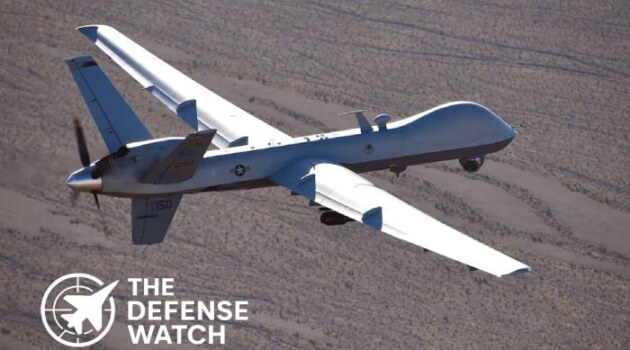
The MQ-9 Reaper is a larger and heavier aircraft built for strategic missions. It uses satellite communications, advanced electro-optical sensors, synthetic aperture radar, and multi-target tracking systems. This allows operations across continents with real-time data links.
The Bayraktar TB2 is smaller, lighter, and optimized for affordability. It focuses on battlefield surveillance and precision strikes at lower operating cost. Its smaller radar signature can help survivability, but it lacks the size and power generation of the Reaper.
In short, the Reaper is a long-range military truck in the sky. The TB2 is a lighter battlefield scout with strike capability.
MQ-9 Reaper vs Bayraktar TB2 Payload Capacity and Firepower
This is where the gap becomes clear.
MQ-9 Reaper Payload Capacity
The MQ-9 Reaper can carry roughly 3,800 pounds of payload across multiple hardpoints. That includes:
- AGM-114 Hellfire missiles
- GBU-12 Paveway II laser-guided bombs
- GBU-38 JDAM
- ISR sensor packages
- Fuel tanks and mixed loads
A Reaper can conduct surveillance and strike multiple targets in one mission.
Bayraktar TB2 Payload Capacity
The TB2 carries around 150 kilograms (330 pounds) total. Typical weapons include:
- MAM-L smart micro munition
- MAM-C lightweight guided bomb
- EO/IR sensors
This means the TB2 usually carries four small precision munitions rather than heavy bombs.
Verdict on Payload
In pure carrying capacity, the MQ-9 Reaper dominates. It can haul more than ten times the payload of the TB2.
Operational Range and Mobility
The Reaper benefits from U.S. satellite network integration. It can operate at long distances and remain on station for many hours. This gives commanders strategic reach.
The TB2 was originally line-of-sight controlled, which limited distance. Newer export variants added SATCOM options, improving range. Still, it is generally better suited for regional operations rather than global expeditionary warfare.
Combat Effectiveness in Real Conflicts
MQ-9 Reaper Combat Record
The MQ-9 has seen extensive use in:
- Afghanistan
- Iraq
- Syria
- Horn of Africa
- Maritime surveillance missions
It proved effective in ISR and precision strike roles against insurgent and terrorist targets.
Bayraktar TB2 Combat Record
The TB2 gained fame in:
- Libya
- Syria
- Nagorno-Karabakh War
- Ukraine (early conflict phase)
It helped destroy tanks, artillery, and air defense systems when enemy defenses were weak or poorly coordinated.
Battlefield Reality
Against advanced integrated air defense systems, both drones face risk. Neither is stealthy. But the larger Reaper is a higher-value target, while the cheaper TB2 is easier to replace.
Cost and Export Value
The MQ-9 Reaper is expensive and tightly controlled under U.S. export rules. Buyers include close partners such as the UK, Italy, India, and others.
The Bayraktar TB2 became a major export success because it offers lower cost and proven combat performance. Countries in Europe, Africa, the Middle East, and Asia bought it.
Turkey used TB2 exports to grow influence abroad. The United States uses Reaper sales more selectively with trusted allies.
MQ-9 Reaper vs Bayraktar TB2 Who Wins?
It depends on mission type.
MQ-9 Reaper Wins If You Need:
- Heavy payload capacity
- Long-range strategic operations
- Multi-target strike missions
- Advanced sensors and networking
- Integration with U.S./NATO systems
Bayraktar TB2 Wins If You Need:
- Lower purchase price
- Affordable operating costs
- Tactical battlefield strikes
- Rapid export delivery
- Easier fleet scaling
U.S. Defense View
The U.S. military sees the Reaper as a premium ISR-strike platform. It is not just a drone, it is part of a larger networked warfare system. The TB2 is respected as a disruptive low-cost combat UAV, but it serves a different market segment.
Conclusion
The MQ-9 Reaper vs Bayraktar TB2 payload capacity comparison is not close on raw numbers. The MQ-9 Reaper carries far more weapons, sensors, and mission equipment. It is built for strategic reach and sustained combat power.
The Bayraktar TB2, however, wins on affordability, accessibility, and export success. It offers many countries armed drone capability without U.S.-level costs.
So which system has the edge?
- For major military powers, the MQ-9 Reaper is stronger.
- For budget-conscious buyers, the TB2 is highly effective.
- For payload capacity alone, the MQ-9 Reaper is the clear leader.
FAQ: MQ-9 Reaper vs Bayraktar TB2
Which drone has higher payload capacity, MQ-9 Reaper or Bayraktar TB2?The MQ-9 Reaper by a wide margin. It carries over 3,800 pounds versus about 330 pounds for the TB2.
Is the Bayraktar TB2 cheaper than the MQ-9 Reaper?Yes. The TB2 is significantly cheaper to buy and operate.
Can the Bayraktar TB2 defeat the MQ-9 Reaper?They are not designed for direct dogfights. They serve different mission roles.
Why is the MQ-9 Reaper important to the U.S. military?It provides long-range surveillance and precision strike capability with global reach.
Why did the TB2 become famous?Its combat use in Ukraine, Libya, and Nagorno-Karabakh made it globally recognized.
The race between hypersonic missile speed and ballistic missile defense has become the defining arms competition of the 2020s — and U.S. strategists are watching closely, because the outcome could reshape deterrence across every major theater of war.
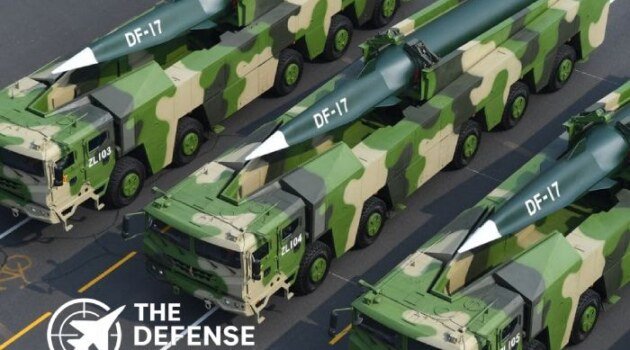
For decades, American ballistic missile defense (BMD) systems were architected around a predictable threat: missiles that arc through space on fixed, calculable trajectories. Intercept the arc, and you win. But adversaries studied that logic — and engineered around it. Today, China’s DF-17 hypersonic glide vehicle and Russia’s Avangard system maneuver unpredictably at speeds exceeding Mach 20, operating in an altitude band that existing sensors and interceptors were never designed to cover. The question facing the Pentagon, NATO partners, and U.S. allies in the Indo-Pacific is blunt: can the shield hold?
Specifications: Hypersonic Threats vs. BMD Systems
Specification Hypersonic Glide Vehicles
(e.g., DF-17 / Avangard)U.S. Ballistic Missile Defense
(GMD / THAAD / SM-3)Speed Mach 5–27 (varies by system) Interceptors: Mach 8–10+ Flight Altitude 25–100 km (near-space glide) GMD: 1,000+ km; THAAD: 40–150 km Maneuverability High — lateral, pull-up maneuvers Limited — fire-solution depends on predicted path Range 1,800–15,000+ km THAAD: ~200 km; GMD: intercontinental Radar Signature Small; plasma sheath disrupts radar Relies on early-warning satellites + ground radar Warhead Options Conventional / nuclear capable Hit-to-kill (kinetic); no explosive warhead Unit Cost (est.) $50–100M+ per missile SM-3: ~$24M; GBI: ~$75M per interceptor Reaction Window Minutes to impact from launch GMD: 30+ min lead time needed; THAAD: 5–8 min Service Entry DF-17: 2019; Avangard: 2019 GMD: 2004; THAAD: 2008; SM-3 IIA: 2018 Test Success Rate China/Russia: Classified GMD: ~55%; THAAD: ~100% (17/17 tests) Design & Technology: A Fundamental Mismatch
How Hypersonic Glide Vehicles Work
Hypersonic glide vehicles (HGVs) are launched atop ballistic missiles but separate before the terminal phase. Instead of following a predictable parabolic arc, they re-enter the atmosphere and glide at sustained hypersonic speeds — generating intense plasma that partially blinds radar. The DF-17’s warhead, designated the DF-ZF, reportedly pulls lateral maneuvers up to several Gs, making fire-control solutions exponentially harder to compute in real time.
How U.S. Ballistic Missile Defense Is Architected
The U.S. BMD architecture is layered. The Ground-Based Midcourse Defense (GMD) system — based at Fort Greely, Alaska — targets ICBMs in their midcourse phase, relying on long-range X-band radars and kill vehicles (EKVs) that collide with warheads at closing speeds above Mach 15. THAAD (Terminal High Altitude Area Defense) handles shorter-range threats in the terminal phase. Aegis SM-3 provides ship-based midcourse intercept capability and is the most mobile layer. The gap: none of these systems was designed to track and intercept a vehicle flying at 40–80 km altitude, maneuvering unpredictably at Mach 10+.
“You can’t intercept what you can’t track. Hypersonic glide vehicles exploit the seam between what our radars see and what our interceptors can reach.”
Firepower & Performance: Speed Is the Weapon
At Mach 20, the Russian Avangard travels roughly 6.8 kilometers per second. From a launch site in western Russia, it can reach the U.S. East Coast in under 15 minutes — far less than the 25–30 minutes a traditional ICBM requires. That compression of decision time is itself the weapon. It does not need to be nuclear to be destabilizing; a conventional HGV strike on a carrier strike group or command node collapses the window in which defensive responses — diplomatic, kinetic, or otherwise — can be organized.
U.S. BMD interceptors are fast, but the geometry is unforgiving. THAAD’s kill vehicle closes at approximately Mach 8. Against a target that maneuvers after radar track, the fire-control algorithm must predict where the threat will be at intercept — and HGVs are specifically designed to defeat that prediction.
Operational Range & Mobility
Range asymmetry compounds the problem. China’s DF-17, with a reported range of 1,800–2,500 km, can target U.S. bases in Guam, Japan, and South Korea from launch sites deep inside Chinese territory — well outside the effective defensive perimeter of sea-based SM-3 batteries. Avangard, boosted by Russia’s heavy RS-28 Sarmat ICBM, is essentially global in range.
On the U.S. side, THAAD batteries are mobile and deployable — as demonstrated by rotational deployments to South Korea and Guam — but they cover relatively small areas. Aegis-equipped destroyers offer flexibility, but repositioning ships takes hours to days. The Missile Defense Agency’s Next Generation Interceptor (NGI), currently in development, is intended to replace aging GMD kill vehicles, but it addresses ballistic threats primarily, not HGVs in their glide phase.
Combat Effectiveness: Real World & Doctrine
Hypersonic Offense BMD Defense Strengths in Combat Strengths in Defense Near-unpredictable terminal trajectory THAAD: 17/17 intercept test success Exploits “midcourse gap” in BMD layers Aegis SM-3: proven at sea, widely exported Compresses adversary decision time Layered architecture — multiple intercept opportunities Dual-use (conventional + nuclear ambiguity) Hypersonic Defense Architecture (HDA) in development China showcased the DF-17 at its 2019 National Day parade; Russia confirmed Avangard operational in December 2019. Neither system has been used in live combat — but Russia’s reported use of the Kinzhal quasi-ballistic missile in Ukraine has offered real-world data on radar evasion under combat conditions. The U.S. Missile Defense Agency acknowledged the HGV gap explicitly in its 2022 and 2024 budget requests, funding the Glide Phase Interceptor (GPI) program to address the near-space threat. The GPI aims for a first intercept demonstration in the late 2020s — a timeline that leaves a window of vulnerability. Cost & Export Value: Economics of the Arms Race
One overlooked dimension is cost asymmetry. A single GBI interceptor costs roughly $75 million. If an adversary saturates defenses with cheaper HGVs — or even conventional ballistic decoys — the economics of defense become unsustainable at scale. Each THAAD battery costs approximately $800 million; the missiles themselves run $11 million apiece. Against a $50–100 million HGV, the exchange ratio is problematic but not catastrophic — yet.
On the export front, Aegis and THAAD are critical U.S. alliance tools. Japan operates advanced Aegis destroyers and is integrating SM-3 Block IIA. South Korea hosts THAAD. Romania and Poland host Aegis Ashore sites. These deployments extend deterrence — but also extend the attack surface that adversary HGVs must be able to defeat, driving their development further. It is a feedback loop baked into the system. For more on U.S. BMD export posture.
Analysis: Where the Balance Sits in 2026
The honest assessment, drawn from open-source MDA documentation and think-tank analyses from CSIS and RAND, is that the United States currently lacks a fielded system capable of reliably intercepting a maneuvering HGV in its glide phase. The GPI program addresses this, but it will not reach operational capability before 2030 at the earliest. Space-based sensors — the Hypersonic and Ballistic Tracking Space Sensor (HBTSS) constellation, now in early orbit testing — are the most promising near-term enabler; they can track HGVs from above the plasma sheath that blinds ground radar.
That said, framing this purely as a “defense loses” story misses strategic context. Deterrence does not require perfect defense. It requires that any adversary calculate that a hypersonic first strike cannot disarm U.S. retaliatory capability entirely. The U.S. nuclear triad — submarines, ICBMs, and bombers — is survivable against a hypersonic strike, which limits the strategic utility of HGVs to coercive or conventional-strike scenarios. The more acute danger is conventional: hypersonic precision strikes on carriers, airfields, or command nodes in a Taiwan or Baltic crisis could create facts on the ground before a U.S. conventional response could organize.
Conclusion: Which System Has the Edge?
In a direct comparison of hypersonic missile speed vs. ballistic missile defense today, the offense holds a meaningful but not absolute advantage. Existing U.S. BMD layers were not designed for the HGV threat. The GPI and HBTSS programs are credible responses, but they are years away from operational readiness. In the near term, the U.S. relies on deterrence-by-punishment rather than deterrence-by-denial against hypersonic threats.
The edge shifts under different conditions. In a theater defense scenario — protecting a fixed asset like Guam — THAAD’s proven kill chain and potential GPI augmentation provide a meaningful layered defense by the early 2030s. In an ICBM-exchange scenario, Avangard’s glide phase still outpaces current GMD. The race is not over. But the United States is, for now, playing catch-up in the glide phase — and speed, in this contest, is everything.
While current U.S. Ballistic Missile Defense systems like THAAD and Aegis are highly effective against traditional arcs, they face a ‘capability gap’ against hypersonic glide vehicles. The Pentagon is currently closing this gap by developing the Glide Phase Interceptor (GPI) and satellite-based tracking layers.
FAQs
Can U.S. missile defense systems currently intercept hypersonic missiles?No current U.S. system is specifically fielded to intercept a maneuvering hypersonic glide vehicle in its glide phase. THAAD and GMD were designed for ballistic trajectories. The Glide Phase Interceptor (GPI), under MDA development, aims to close this gap but is not expected to reach operational status before 2030.
How fast are hypersonic missiles compared to traditional ballistic missiles?Traditional ICBMs re-enter at roughly Mach 20–23 at terminal phase, but follow predictable arcs. Hypersonic glide vehicles sustain speeds of Mach 5–27 across most of their flight and maneuver laterally — making speed and unpredictability a dual threat rather than speed alone.
What is the Glide Phase Interceptor and when will it be ready?The GPI is a Missile Defense Agency program to develop an interceptor capable of engaging HGVs during their extended glide phase, before terminal descent. It is being developed in partnership with Raytheon and Northrop Grumman. A first intercept flight test is targeted for the late 2020s, with initial operational capability potentially in the early 2030s.
Which countries pose the greatest hypersonic missile threat to the United States?China and Russia are the primary concerns. China has operationally deployed the DF-17 HGV and is developing additional hypersonic systems. Russia’s Avangard, boosted by the Sarmat ICBM, is declared operational.
.tdw-wrap { font-family: Georgia, ‘Times New Roman’, serif; color: #0f0e0d; line-height: 1.75; font-size: 17px; } .tdw-wrap *, .tdw-wrap *::before, .tdw-wrap *::after { box-sizing: border-box; } .tdw-wrap p { margin-bottom: 1.3rem; } .tdw-wrap a.tdw-link { color: #1a5a9e; text-decoration: none; border-bottom: 1px solid rgba(26,90,158,0.35); } .tdw-wrap a.tdw-link:hover { border-bottom-color: #1a5a9e; }/* INTRO CALLOUT */ .tdw-intro-callout { background: #f5e8e5; border-left: 4px solid #b5280f; padding: 1rem 1.4rem; margin-bottom: 2rem; border-radius: 0 4px 4px 0; font-size: 0.97rem; color: #8c1e0a; line-height: 1.65; }/* AIRCRAFT SNAPSHOT CARDS */ .tdw-aircraft-cards { display: grid; grid-template-columns: 1fr 1fr; gap: 1.2rem; margin: 1.8rem 0; } @media (max-width: 600px) { .tdw-aircraft-cards { grid-template-columns: 1fr; } } .tdw-ac-card { border: 1px solid #d8d0c4; border-radius: 6px; overflow: hidden; } .tdw-ac-header { padding: 0.9rem 1.1rem 0.75rem; color: #fff; } .tdw-ac-header.t50 { background: #0c3060; } .tdw-ac-header.m346 { background: #0f4a2a; } .tdw-ac-name { font-size: 1.2rem; font-weight: 700; display: block; margin-bottom: 3px; } .tdw-ac-sub { font-family: monospace; font-size: 11px; opacity: 0.7; } .tdw-ac-body { background: #fff; padding: 0.85rem 1.1rem; font-size: 0.87rem; color: #4a4540; line-height: 1.6; } .tdw-ac-body strong { color: #0f0e0d; }/* SPECS TABLE */ .tdw-specs-wrap { overflow-x: auto; margin: 1.5rem 0 2rem; border: 1px solid #d8d0c4; border-radius: 6px; } table.tdw-specs { width: 100%; border-collapse: collapse; font-size: 0.86rem; min-width: 560px; } table.tdw-specs thead tr { background: #111c30; color: #fff; } table.tdw-specs thead th { padding: 0.7rem 0.9rem; text-align: left; font-family: monospace; font-weight: 500; font-size: 11px; letter-spacing: 0.06em; } table.tdw-specs thead th.t50h { color: #7fc7ff; } table.tdw-specs thead th.m346h { color: #7fe8a8; } table.tdw-specs tbody tr:nth-child(even) { background: #f2ede4; } table.tdw-specs tbody tr:nth-child(odd) { background: #fff; } table.tdw-specs tbody td { padding: 0.6rem 0.9rem; border-bottom: 1px solid #d8d0c4; vertical-align: top; color: #0f0e0d; } table.tdw-specs tbody td:first-child { font-family: monospace; font-size: 11px; color: #7a7268; white-space: nowrap; } table.tdw-specs tbody td.tdw-win { font-weight: 600; } .tdw-badge { font-family: monospace; font-size: 9px; font-weight: 600; background: #c8921a; color: #fff; padding: 1px 6px; border-radius: 2px; margin-left: 5px; vertical-align: middle; letter-spacing: 0.04em; }/* SECTION DIVIDER */ .tdw-rule { border: none; border-top: 1px solid #d8d0c4; margin: 2.25rem 0; }/* COMPARE BARS */ .tdw-bars { margin: 1.5rem 0; } .tdw-bar-row { margin-bottom: 1rem; } .tdw-bar-label { font-family: monospace; font-size: 11.5px; color: #4a4540; margin-bottom: 4px; display: flex; justify-content: space-between; } .tdw-bar-track { background: #f2ede4; border: 1px solid #d8d0c4; border-radius: 3px; height: 10px; overflow: hidden; display: flex; } .tdw-bar-t50 { height: 10px; background: #1a5a9e; } .tdw-bar-m346 { height: 10px; background: #0f4a2a; margin-left: 2px; } .tdw-bar-legend { display: flex; gap: 1.5rem; margin-top: 0.9rem; font-family: monospace; font-size: 11px; color: #4a4540; } .tdw-dot { display: inline-block; width: 10px; height: 10px; border-radius: 2px; margin-right: 5px; vertical-align: middle; }/* PULL QUOTE */ .tdw-pull-quote { border-left: 4px solid #c8921a; padding: 0.8rem 1.4rem; margin: 2rem 0; background: #fdf4e3; border-radius: 0 4px 4px 0; font-size: 1.02rem; font-style: italic; color: #4a4540; line-height: 1.65; } .tdw-pull-quote cite { display: block; font-family: monospace; font-size: 11px; font-style: normal; color: #7a7268; margin-top: 0.5rem; }/* VERDICT GRID */ .tdw-verdict-grid { display: grid; grid-template-columns: 1fr 1fr; gap: 1.2rem; margin: 1.5rem 0; } @media (max-width: 600px) { .tdw-verdict-grid { grid-template-columns: 1fr; } } .tdw-verdict-card { border: 1px solid #d8d0c4; border-radius: 6px; padding: 1.1rem; background: #fff; } .tdw-verdict-card h4 { font-family: monospace; font-size: 11px; font-weight: 600; letter-spacing: 0.1em; text-transform: uppercase; margin-bottom: 0.75rem; margin-top: 0; } .tdw-verdict-card.t50 h4 { color: #1a5a9e; } .tdw-verdict-card.m346 h4 { color: #0f4a2a; } .tdw-verdict-card ul { list-style: none; padding: 0; margin: 0; display: flex; flex-direction: column; gap: 5px; } .tdw-verdict-card ul li { font-size: 0.86rem; color: #4a4540; padding-left: 1.1rem; position: relative; line-height: 1.5; } .tdw-verdict-card ul li.pro::before { content: ‘+’; position: absolute; left: 0; font-weight: 700; font-size: 0.9rem; } .tdw-verdict-card.t50 ul li.pro::before { color: #1a5a9e; } .tdw-verdict-card.m346 ul li.pro::before { color: #0f4a2a; } .tdw-verdict-card ul li.con::before { content: ‘−’; position: absolute; left: 0; font-weight: 700; font-size: 0.9rem; color: #b5280f; }/* CONCLUSION BANNERS */ .tdw-conclusion { background: #111c30; color: #fff; padding: 1.5rem 1.75rem; border-radius: 6px; margin: 1.5rem 0; display: grid; grid-template-columns: auto 1fr; gap: 1.2rem; align-items: center; } .tdw-conclusion-icon { font-size: 2.2rem; line-height: 1; } .tdw-conclusion-text h3 { color: #ffd87a; font-size: 1.1rem; font-weight: 700; margin: 0 0 0.4rem; } .tdw-conclusion-text p { font-size: 0.91rem; color: rgba(255,255,255,0.75); line-height: 1.6; margin: 0; }/* IMAGE NOTE */ .tdw-image-note { background: #f2ede4; border: 1px dashed #b8ae9e; border-radius: 4px; padding: 0.9rem 1.1rem; margin: 1.5rem 0; font-family: monospace; font-size: 11.5px; color: #7a7268; line-height: 1.6; } .tdw-image-note strong { color: #4a4540; }/* FAQ */ .tdw-faq { margin: 2rem 0 2.5rem; border: 1px solid #d8d0c4; border-radius: 6px; overflow: hidden; } .tdw-faq-header { background: #111c30; color: #fff; padding: 0.85rem 1.3rem; font-family: monospace; font-size: 11.5px; font-weight: 600; letter-spacing: 0.1em; text-transform: uppercase; } .tdw-faq-item { border-bottom: 1px solid #d8d0c4; padding: 1.1rem 1.3rem; background: #fff; } .tdw-faq-item:last-child { border-bottom: none; } .tdw-faq-q { font-weight: 700; font-size: 0.97rem; color: #111c30; margin-bottom: 0.5rem; } .tdw-faq-a { font-size: 0.87rem; color: #4a4540; line-height: 1.65; }/* SOURCES */ .tdw-sources { font-family: monospace; font-size: 11.5px; color: #7a7268; line-height: 1.9; margin-top: 0.5rem; } .tdw-sources strong { color: #4a4540; }/* SEO KEYWORD BOX */ .tdw-seo-box { background: #e4eef8; border: 1px solid #b8d4ee; border-left: 4px solid #1a5a9e; border-radius: 4px; padding: 0.9rem 1.1rem; margin: 1.5rem 0; font-family: monospace; font-size: 11.5px; color: #0c3060; } .tdw-seo-box .tdw-seo-title { font-weight: 600; font-size: 10.5px; letter-spacing: 0.1em; text-transform: uppercase; margin-bottom: 0.5rem; color: #1a5a9e; } .tdw-kws { display: flex; flex-wrap: wrap; gap: 6px; margin-top: 0.6rem; } .tdw-kw { background: #1a5a9e; color: #fff; padding: 2px 9px; border-radius: 2px; font-size: 10.5px; }The race for the next-generation pilot pipeline is on. The U.S. Air Force’s T-7A Red Hawk may have grabbed the headlines, but for dozens of allied air forces — from NATO Europe to Southeast Asia — two other jets are locked in a fierce contest for the advanced trainer role: South Korea’s KAI T-50 Golden Eagle and Italy’s Leonardo M-346 Master. Their rivalry has played out in procurement battles across four continents. Understanding it matters deeply to U.S. defense planners, export partners, and anyone tracking the shape of allied air power for the next two decades.The KAI T-50 vs M-346 comparison is more than a technical curiosity. Both aircraft emerged in the same era, share a supersonic or transonic design philosophy, and target the same shrinking market: air forces that need a modern lead-in fighter trainer (LIFT) capable of preparing pilots for F-16s, F-35s, Typhoons, and Rafales. Yet they represent fundamentally different industrial lineages, doctrine philosophies, and geopolitical alignments — and those differences have real-world consequences for how allied nations train, fight, and partner with the United States.
The T-50 is a joint American-Korean product. It carries Lockheed Martin DNA, uses a General Electric engine, and is deeply integrated into the U.S. arms export ecosystem. The M-346, by contrast, emerged from a dissolved joint venture with Russia’s Yakovlev bureau, was reborn as a fully Western platform under Italian leadership, and is now part of the Leonardo defense group’s portfolio. It serves NATO members including Italy, Poland, and Greece, as well as U.S. allies Israel and Singapore.
Both jets compete globally. Both have won major contracts. And both have lost to each other. Let’s break down exactly what separates them — and which one has the edge.
KAI T-50 Golden Eagle Korea Aerospace Industries + Lockheed Martin · South KoreaRole: Advanced supersonic trainer / lead-in fighter / light attack
First flight: August 2002
Service entry: 2005 (ROKAF)
Engine: 1× GE F404-GE-102 turbofan (w/ afterburner)
Operators: South Korea, Indonesia, Iraq, Thailand, Philippines, PolandLeonardo M-346 Master Leonardo S.p.A. (Alenia Aermacchi) · ItalyRole: Advanced transonic trainer / lead-in fighter / light attack (FA variant)
First flight: July 2004
Service entry: 2011 (Italian Air Force)
Engine: 2× Honeywell F124-GA-200 turbofan (no afterburner)
Operators: Italy, Israel, Singapore, Poland, Greece, Qatar, TurkmenistanSpecifications: KAI T-50 vs M-346 Side-by-Side
Raw numbers are never the whole story, but they establish a baseline. Here is how the two aircraft compare on the specifications that matter most to air force planners and defense analysts.
Specification KAI T-50 Golden Eagle Leonardo M-346 Master Manufacturer KAI / Lockheed Martin (South Korea / USA) Leonardo S.p.A. (Italy) Engines 1× GE F404-GE-102 (17,700 lbf w/ AB)SUPERSONIC 2× Honeywell F124-GA-200 (6,250 lbf each, no AB) Max Speed Mach 1.5 (supersonic)EDGE Mach 1.15–1.2 (transonic) Service Ceiling 48,000 ft (14,630 m) 45,000 ft (13,700 m) Max Takeoff Weight 26,455 lb (12,000 kg) 21,605 lb (9,800 kg) Combat Radius ~239 nmi / 443 km (FA-50) ~370 nmi / 690 km (FA variant)EDGE Hardpoints 7 (armed variants) 7 (+ wingtips) Internal Gun 20mm M197 gatling (3-barrel) Gun pod option only (23mm or 30mm) g-Limit +8g / −3g +8g / −3g (identical) High-AoA Capability Good Excellent (delta wing vortex lift)EDGE Fly-by-Wire Triple-redundant digital FBW Full-authority digital FBW Radar (armed variant) APG-67 (TA/FA-50) Leonardo Grifo-M346 multimodeEDGE Unit Cost (approx.) ~$25–$30M (trainer), ~$35M+ (FA-50) ~$25–$30M (trainer), higher for FA variant Total Built (approx.) 170+ (all variants)EDGE ~80+ U.S. Export Support Yes — Lockheed Martin partnership Partial (Boeing MOU; NATO-compatible) Design & Technology: Two Philosophies, One Goal
The T-50: An F-16 in Training Clothes
The KAI T-50 Golden Eagle was explicitly designed as an F-16 derivative. It resembles the F-16 Fighting Falcon at roughly 80 percent of the size, sharing similar wing geometry, a single-engine layout, and a Lockheed Martin-developed avionics and flight control system. The cockpit features two Honeywell MFDs, HOTAS controls, and a BAE Systems HUD — all designed to minimize transition time to fourth- and fifth-generation fighters. Critically, the T-50 uses a single afterburning GE F404 engine, giving it genuine supersonic capability up to Mach 1.5. This matters enormously for training realism: pilots learn supersonic handling, afterburner management, and transonic aerodynamics in a dedicated trainer rather than expensively burning hours in an F-16 or F/A-18.
The fly-by-wire system uses triple-redundant digital flight control — a standard inherited directly from Lockheed Martin’s fighter programs. The T-50 was the first trainer to employ electronic fly-by-wire and digital flight control for precision maneuvering, and its actuator system includes a direct-drive design with a reconfiguration mode for added redundancy.
The M-346: European Doctrine, Italian Craftsmanship
The M-346 Master took a different path. Originally co-developed with Russia’s Yakovlev bureau as the Yak/AEM-130, the partnership dissolved in 2000 and Alenia Aermacchi rebuilt the aircraft along Western lines. The result was a distinctive twin-engine, delta-wing design optimized for high angle-of-attack (AoA) flight — a training regime that better mimics the handling of Typhoons, Rafales, and even the F-35 at the edges of the flight envelope. The aerodynamic design uses vortex lift to provide manoeuvrability and controllability at very high angles of attack, giving it flight characteristics genuinely similar to modern delta-wing fighters.
Powered by two Honeywell F124 turbofan engines — notably without afterburners — the M-346 achieves transonic performance that its manufacturer describes as “second only to afterburner-equipped aircraft.” The twin-engine configuration also provides redundancy that single-engine platforms like the T-50 cannot match, a factor that weighs heavily in procurement decisions for nations operating over water or remote terrain.
Firepower & Performance: T-50 vs M-346 in the Combat Role
Both aircraft were designed primarily as trainers, but both have evolved into credible light combat platforms — an important factor in export sales to nations that want a single airframe to serve double duty.
The T-50 family’s armed variants — the TA-50 and FA-50 — carry a built-in 20mm M197 three-barrel gatling cannon, AIM-9 Sidewinder launch rails on the wingtips, and a suite of underwing ordnance that includes AGM-65 Maverick missiles, JDAM precision-guided bombs, Mk 82/83/84 general-purpose bombs, and sensor-fused weapons. The FA-50 adds an all-weather, day-night multimode APG-67 fire control radar. Poland’s FA-50PL variant, intended for a frontline role, is receiving a more capable radar system. In December 2025, Thailand’s Royal Thai Air Force deployed its T-50TH in live combat for the first time, conducting a deep-strike mission alongside F-16s and Gripens — a landmark validation of the platform’s real-world combat utility.
The M-346 FA (Fighter Attack) variant integrates a Leonardo Grifo-M346 multimode radar, seven hardpoints, AIM-9L air-to-air missiles (tested in 2017), air-to-ground precision munitions, and options for 23mm or 30mm gun pods. While it lacks an internal cannon — a legitimate drawback — its radar system is widely regarded as more capable than the APG-67 carried by baseline FA-50s, and its embedded simulation suite allows pilots to train against realistic threat environments without expending live munitions. The M-346’s per-flying-hour costs are reportedly one-tenth of those of the Eurofighter Typhoon, making it an economically attractive trainer for NATO air forces flying Typhoons.
Operational Range & Mobility
This is one area where the M-346 holds a clear tactical edge. With a combat radius approaching 690 km in its fighter-attack configuration — compared to roughly 443 km for the FA-50 — the Italian jet can range farther from base, persist longer on station, and better simulate the deep-strike profiles that modern pilots will execute in frontline fighters. The twin-engine configuration also reduces return-to-base anxiety over open water, a significant factor for island-nation operators like Singapore.
The T-50, however, benefits from shorter runway requirements and a lighter footprint that suits expeditionary or austere operating environments. Its single-engine simplicity reduces maintenance complexity and total life-cycle cost. For air forces operating from inland bases with robust logistics, the T-50’s range limitations are less operationally relevant.
“The T-50 integrated training system provides pilots with the best training solution available — incorporating a high-performance supersonic fast jet trainer, a modern ground-based training system, and a fully integrated logistics support package.” — Dr. Alex Jun, VP of Marketing, Korea Aerospace Industries (via Lockheed Martin press release)Combat Effectiveness & Training Doctrine
The T-50: Supersonic Fidelity for F-16 and F-35 Pipelines
The T-50’s greatest training asset is its genuine supersonic capability. Pilots preparing for the F-16, F/A-18, or F-35 need exposure to afterburner management, supersonic aerodynamics, and the physical demands of high-speed flight. The T-50 provides that in a dedicated trainer, rather than burning expensive hours in a frontline aircraft. KAI and Lockheed Martin position the T-50 as the only high-performance supersonic trainer in production capable of allowing new fighter pilots to smoothly transition into advanced aircraft such as the F-16 and 5th Generation F-35.
Iraq, Indonesia, the Philippines, and Poland have all acquired T-50 family aircraft and embedded them into structured advanced training pipelines. Poland’s emergency procurement of 48 FA-50GF aircraft following Russia’s 2022 invasion of Ukraine also demonstrated the platform’s rapid-acquisition credibility — KAI delivered early batches within months of contract signing.
The M-346: NATO Standard, Embedded Simulation
The M-346’s defining operational advantage is its embedded simulation architecture. The aircraft’s avionics can replicate threat environments, inject simulated contacts, and record sortie data for debrief — effectively functioning as both a live aircraft and a part-task trainer simultaneously. By mid-2024, M-346 operators globally had surpassed 120,000 flight hours, demonstrating the platform’s sustained operational tempo across multiple demanding programs.
Israel’s use of the M-346 — designated the “Lavi” by the Israeli Air Force — as its primary advanced trainer is particularly telling. The IAF operates one of the world’s most combat-experienced pilot training pipelines, and its choice of the M-346 over competing platforms reflects the aircraft’s high-fidelity simulation and NATO-compatible data links. The U.S. Air Force has also certified the Polish Air Force’s M-346 training system, a significant endorsement of its interoperability with American standards.
Cost & Export Value: Who Is Winning the Market?
On raw export numbers, the T-50 is ahead. With over 170 aircraft delivered across six nations, the Golden Eagle has broader market penetration. Its U.S. co-development heritage makes it politically easier for American allies to acquire through Foreign Military Sales (FMS) channels, and its F-16 DNA provides natural appeal to air forces already flying Lockheed products.
The M-346 wins on unit sophistication and NATO integration. Its approximately 80 aircraft serve in operationally demanding environments — Israel, Singapore, Poland — where training quality outweighs unit economics. In Poland, the M-346 and FA-50 now coexist: Warsaw chose the M-346 in 2014 for its primary advanced trainer requirement, then bought FA-50s in 2022 for emergency light combat capacity. That dual-track procurement reflects each aircraft’s distinct strengths rather than one platform displacing the other.
Unit costs for both aircraft are broadly comparable in the trainer configuration — roughly $25–$30 million. Armed variants command a premium, with the FA-50 exceeding $35 million depending on radar and weapons packages. The M-346 FA similarly commands a higher price for its enhanced combat configuration. Life-cycle costs favor the T-50 due to simpler single-engine maintenance, though the M-346’s twin-engine safety margin is valued in certain operational contexts.
Analysis: Strengths, Weaknesses, and the U.S. Perspective
KAI T-50 Golden Eagle
- Genuine supersonic performance (Mach 1.5)
- F-16/F-35 transition fidelity built-in
- Lockheed Martin partnership eases U.S. FMS sales
- Internal cannon in armed variants
- Proven combat debut (Thailand, 2025)
- Lower lifecycle cost (single engine)
- Shorter combat radius (~443 km FA-50)
- Less advanced radar vs M-346 FA
- Less NATO interoperability depth
Leonardo M-346 Master
- Superior high-AoA training realism (delta wing)
- Twin-engine safety and reliability
- Embedded simulation — simulate threats in-flight
- Greater combat radius (~690 km)
- Deep NATO integration (data links, sensors)
- Chosen by IAF — world-class endorsement
- No afterburner — transonic, not supersonic
- No internal gun (gun pod only)
- Lower total production — fewer operators
From a U.S. defense perspective, both platforms serve American strategic interests. The T-50 is effectively an American-Korean co-product and strengthens the U.S.-South Korea alliance. Its FMS-compatible status means American funding mechanisms can facilitate its sale to partners. The M-346’s adoption by NATO nations — particularly Poland and Italy — supports alliance interoperability and reduces the burden on the U.S. to supply trainer aircraft to allies building up their air forces in response to Russian aggression.
Conclusion: KAI T-50 vs M-346 — Who Wins?
The honest answer is that neither aircraft is the universal winner. They solve the advanced trainer challenge from different directions, and the “better” jet depends entirely on what an air force needs most.
Choose the T-50 if…
Your air force operates F-16s or F-35s, values supersonic training realism, needs an internal gun in the light-attack role, wants U.S. FMS support, or requires a platform with a larger global spare-parts network. The T-50’s combat debut in 2025 also removes any lingering doubt about its operational credibility.
Choose the M-346 if…
Your air force operates Typhoons, Rafales, or other delta-wing fighters, prioritizes high-AoA training fidelity, needs twin-engine safety over water, values embedded simulation depth, or requires deep NATO sensor and data-link integration. For nations in Europe under the shadow of Russian airpower, the M-346’s interoperability credentials are decisive.
Both aircraft will remain relevant well into the 2030s. The global trainer market is not a zero-sum game, and the fact that Poland operates both jets simultaneously is perhaps the most eloquent statement on their complementary value. For U.S. defense planners, both platforms represent allied industrial capacity worth supporting — and both will produce the next generation of fighter pilots who will fly alongside American aviators in the world’s most contested skies.
Frequently Asked Questions: KAI T-50 vs M-346Q1. Is the KAI T-50 faster than the M-346 Master?Yes. The T-50 reaches Mach 1.5 using its General Electric F404 afterburning turbofan, making it genuinely supersonic. The M-346, powered by two Honeywell F124 turbofans without afterburners, achieves approximately Mach 1.15–1.2 — transonic performance that its manufacturer describes as “second only to afterburner-equipped aircraft.” For training programs that require supersonic exposure, the T-50 holds a clear advantage.Q2. Which aircraft does the U.S. military prefer — the T-50 or M-346?Neither aircraft was selected for U.S. Air Force use — that role went to the Boeing T-7A Red Hawk. However, the T-50 (designated T-50A for U.S. competition purposes) was submitted by KAI and Lockheed Martin for the T-X trainer competition. The U.S. military views both platforms favorably for allied air forces and has certified the Polish Air Force’s M-346 training system, indicating a degree of endorsement for NATO interoperability standards.Q3. Which aircraft has a better combat capability — the FA-50 or M-346 FA?Both are capable light attack platforms, but with different strengths. The FA-50 carries an internal 20mm cannon, AIM-9 Sidewinders, and can deliver JDAM precision munitions — and has now proven itself in live combat operations with Thailand’s air force. The M-346 FA features a more advanced multimode radar (Leonardo Grifo-M346) and greater combat radius (~690 km vs ~443 km), but lacks an internal gun. For close air support and air defense, the FA-50 is more immediately ready; for longer-range precision strike and NATO-integrated missions, the M-346 FA has an edge.Q4. Why did Poland buy both the FA-50 and the M-346?Poland’s procurement reflects the two platforms’ complementary roles. Warsaw selected the M-346 in 2014 as its primary advanced jet trainer for lead-in fighter training, citing its NATO data links and high-fidelity simulation. Following Russia’s 2022 invasion of Ukraine, Poland urgently needed additional light combat aircraft and signed an emergency contract for 48 FA-50GFs with KAI — prioritizing rapid delivery and cost over the M-346’s deeper training capabilities. The two jets now serve parallel roles in Polish aviation.Q5. Which jet is more cost-effective for a developing air force’s pilot training program?The T-50 generally offers lower life-cycle costs due to its single-engine simplicity, larger global operator base (more competition in spare parts), and strong KAI/Lockheed Martin logistics support. Initial unit pricing is broadly comparable ($25–$30M for trainer variants). The M-346’s twin-engine configuration adds maintenance cost but provides the safety margin that some operators require. For air forces on tight budgets needing a dual-role trainer and light combat aircraft, the T-50 family’s range of variants — from basic trainer to FA-50 light fighter — offers a flexible and scalable solution.Sources & Further Reading:
KAI T-50 Golden Eagle — Wikipedia · Alenia Aermacchi M-346 Master — Wikipedia · T-50 Golden Eagle — Airforce Technology · M-346 Master — Airforce Technology · Lockheed Martin T-50 Press Release · Singapore MoD M-346 Fact Sheet HMS Dragon Type 45 Destroyer vs Arleigh Burke-class Specs
Modern destroyers are the backbone of Western naval power. They defend carrier groups, track submarines, launch missiles, and project force across the globe. That is why the debate around HMS Dragon Type 45 Destroyer vs Arleigh Burke-class specs matters far beyond naval enthusiasts.
(adsbygoogle = window.adsbygoogle || []).push({});The United Kingdom’s HMS Dragon represents one of NATO’s most advanced dedicated air-defense warships. Meanwhile, the U.S. Navy’s Arleigh Burke-class destroyer is the world’s most successful modern destroyer program, with dozens in service and more under construction.
For U.S. readers, this comparison highlights two different design philosophies. Britain focused on fleet air defense and radar excellence. America built a highly flexible, heavily armed multi-mission combatant.
HMS Dragon Type 45 Destroyer vs Arleigh Burke-class Specs Table
Specification HMS Dragon (Type 45) Arleigh Burke-class Country United Kingdom United States Service Entry 2012 (Dragon commissioned) 1991 Full Load Displacement Approx. 8,500 tons Approx. 9,200 to 9,800+ tons Length 152.4 m 154 to 156 m Crew Approx. 190 to 235 Approx. 300+ Top Speed 29+ knots 30+ knots Main Role Area air defense Multi-mission warfare Main Radar SAMPSON AESA radar AEGIS SPY-1 / SPY-6 (newer Flight III) VLS Cells 48 Sylver A50 90 to 96 Mk 41 Main Gun 114 mm Mk 8 127 mm / 5 inch gun Missiles Aster 15/30 SM-2, SM-3, SM-6, ESSM, Tomahawk Helicopter Merlin/Wildcat MH-60 Seahawk Approx. Unit Cost High, limited class production Lower economies of scale by volume HMS Dragon Type 45 Destroyer vs Arleigh Burke-class Design and Technology
Type 45 Strength, Built for Air Defense
The Type 45 class was designed primarily to shield fleets from aircraft and missile attack. Its standout feature is the SAMPSON multifunction radar paired with the Sea Viper missile system. This gives ships like HMS Dragon exceptional target tracking and engagement capability.
(adsbygoogle = window.adsbygoogle || []).push({});Its sleek superstructure also reduces radar signature, helping survivability.
Arleigh Burke Strength, Multi-Mission Combat System
The Arleigh Burke-class destroyer uses the famous AEGIS combat system, long considered the benchmark in naval battle management. Newer Flight III ships add SPY-6 radar, improving ballistic missile defense and air tracking.
Unlike Type 45, Burke ships were built from the start for anti-air, anti-submarine, anti-surface, and land attack missions in one hull.
Verdict
Type 45 may hold an edge in specialized air-defense radar performance, while Burke wins in overall mission flexibility.
Firepower and Performance
HMS Dragon Type 45 Weapons
Type 45 carries 48 Sylver launch cells typically loaded with Aster missiles. Aster 30 provides long-range area defense, while Aster 15 supports medium-range engagements. The ship also carries a 114 mm gun, close-in weapons, and helicopter support.
Its weakness has historically been limited strike options compared with U.S. destroyers.
Arleigh Burke Weapons
Burke-class ships usually field 90 to 96 Mk 41 VLS cells. These can carry:
- SM-2 for fleet air defense
- SM-3 for ballistic missile defense
- SM-6 for long-range multi-role intercepts
- ESSM for point defense
- Tomahawk cruise missiles for land strike
- ASROC for anti-submarine warfare
That gives Burke ships enormous flexibility.
Verdict
If measuring raw firepower, the Arleigh Burke-class wins clearly due to larger missile capacity and broader weapon mix.
Operational Range and Mobility
Type 45 destroyers were built for Royal Navy expeditionary operations, escorting carriers and operating globally. They offer strong endurance but operate in smaller numbers.
Burke destroyers are optimized for constant deployments across the Pacific, Atlantic, Mediterranean, and Middle East. Supported by U.S. logistics networks, they sustain higher global presence.
Verdict
The U.S. Navy gains a strategic edge through fleet size, support infrastructure, and deployment tempo.
Combat Effectiveness
HMS Dragon Combat Record
HMS Dragon has deployed in the Mediterranean, Gulf region, and carrier escort missions. Type 45 destroyers have also contributed to missile defense and NATO security patrols.
Arleigh Burke Combat Record
Arleigh Burke-class destroyer ships have seen extensive real-world operations, including:
- Tomahawk strike missions
- Ballistic missile defense patrols
- Carrier strike group escorts
- Maritime security operations
- Indo-Pacific deterrence missions
The Burke class benefits from decades of combat deployment experience.
Verdict
Burke leads in proven wartime operational use simply because of numbers and mission tempo.
Cost and Export Value
The Type 45 program produced only six ships, limiting economies of scale. It became a highly capable but expensive niche platform.
The Arleigh Burke program became a production success, with more than 70 ships delivered or planned. While each vessel is costly, serial production lowered relative unit costs over time.
Burke systems and AEGIS technology also strengthened U.S. alliances through broader naval integration with partners.
HMS Dragon Type 45 Destroyer vs Arleigh Burke-class Analysis
This comparison is really about specialization versus versatility.
Where HMS Dragon Has the Edge
- Excellent air-defense radar performance
- Strong anti-missile capability
- Lower crew size than Burke
- High-end NATO carrier escort role
Where Arleigh Burke Has the Edge
- Larger missile load
- Land attack strike capability
- Ballistic missile defense options
- Proven combat record
- Massive fleet size and sustainment network
How the U.S. Military Views Each System
U.S. planners generally see Type 45 ships as valuable allied escorts that complement coalition naval groups. However, the U.S. Navy still prioritizes the Burke model because of its ability to perform nearly every mission from one platform.
Conclusion, Which Ship Has the Edge
In a pure fleet air-defense scenario, HMS Dragon Type 45 Destroyer vs Arleigh Burke-class specs becomes a close contest. The British ship was built for exactly that mission and remains highly respected.
In almost every broader wartime scenario, the Arleigh Burke-class has the advantage. It carries more missiles, more mission types, greater strike reach, and operates in much larger numbers.
So who wins?
- Air defense specialist mission: Type 45 is highly competitive
- All-around naval warfare: Arleigh Burke wins
- Global power projection: Arleigh Burke wins decisively
Both ships remain important pillars of NATO maritime strength.
FAQ, HMS Dragon Type 45 Destroyer vs Arleigh Burke-class
Which ship is more powerful, HMS Dragon or Arleigh Burke?The Arleigh Burke-class is generally more powerful overall because it carries more missiles and supports more mission types.
Is HMS Dragon better at air defense?Many analysts rate the Type 45 as one of the best dedicated air-defense destroyers ever built.
How many missiles can each ship carry?Type 45 usually has 48 VLS cells, while Burke ships typically have 90 to 96 cells.
Can Type 45 launch cruise missiles like Tomahawk?Not in the same operational way as Arleigh Burke-class ships, which routinely field Tomahawk capability.
Why does the U.S. Navy rely on Arleigh Burke destroyers?Because they combine air defense, missile defense, strike warfare, anti-submarine warfare, and fleet escort in one proven platform.
Newer Posts
- (adsbygoogle = window.adsbygoogle || []).push({});