
- Home
- Defense Systems
- Attack & Multirole Drones (UAVs)
- Airbus U030 Flexrotor
Airbus U030 Flexrotor
Defense Systems Full Specifications
1. General Information
| Name | Airbus U030 Flexrotor |
| Manufacturer | Airbus Helicopters (formerly Aerovel) |
| Country of Origin | United States (production in Bingen, WA) |
| Type / Role | Group 2 small tactical VTOL UAS / ISTAR |
| First Flight / Introduced | Early 2010s (Aerovel); Airbus portfolio 2024 |
| Status | In service / production |
| Unit Cost | Not publicly disclosed |
2. Performance
| Maximum Speed | 140 km/h (77 kt dash) |
| Cruise Speed | ~78–87 km/h (min/typical) |
| Operational Range | Endurance-limited (line-of-sight/BLOS) |
| Endurance | 12–15 hours typical |
| Service Ceiling | >5,000 m (16,400 ft) |
| Rate of Climb | Not publicly detailed |
3. Dimensions
| Length | 2 m (6.6 ft) |
| Wingspan | 3 m (9.8 ft) |
| Height | 2.2 m |
| Maximum Takeoff Weight (MTOW) | 25 kg (55 lb) |
4. Payload & Armament
| Payload Capacity | 8 kg (18 lb) |
| Hardpoints | Modular payload bay (no fixed hardpoints listed) |
| Weapons | None (ISR-focused) |
| Sensors | EO/IR, radar, and other advanced modular sensors |
| Avionics | Autonomous flight control, GPS/INS, real-time data link |
5. Propulsion
| Engine Type | 28 cc two-stroke |
| Engine Power | Not publicly detailed |
| Propeller Type | Rotor for VTOL + wing-borne cruise |
6. Communication & Control
| Control Type | Fully autonomous / remote |
| Data Link Range | Line-of-sight (extended BLOS options, e.g., Starlink in some configs) |
| Navigation | GPS / INS (GPS-denied capable) |
| Ground Control Station | Portable / expeditionary |
7. Operational Use
| Primary Users | U.S. Navy exercises, EMSA, Canada (Voyageur), Australia (Drone Forge), Uzbekistan, commercial operators |
| Combat Proven | Mission-proven in exercises and real-world surveillance |
| Notable Operations | USS Paul Hamilton launches, Baltic Sea EMSA surveillance (2026), wildfire monitoring, maritime interdiction support |
PROS
- True VTOL with very small landing/take-off footprint (3.7 × 3.7 m) enabling ship and confined-area use
- Long endurance (12–15 hours typical) for persistent ISTAR
- Fully autonomous launch, recovery, and flight with rapid deployability (~30 min box-to-flight)
- Modular payload options (EO/IR, radar) and dual-fuel (gasoline/heavy fuel) engine
- Proven in maritime, high-threat, and GPS-denied environments plus commercial roles
CONS
- Limited maximum speed (140 km/h dash) compared with many fixed-wing Group 2 systems
- Modest 8 kg payload restricts heavy or multiple simultaneous sensors/weapons
- Small size and Group 2 classification limit range and all-weather performance relative to larger UAS
- Unit cost and full system pricing not publicly available, complicating budget comparisons
- Primarily ISR-focused with no organic armament capability
Airbus U030 Flexrotor VTOL Tactical UAS
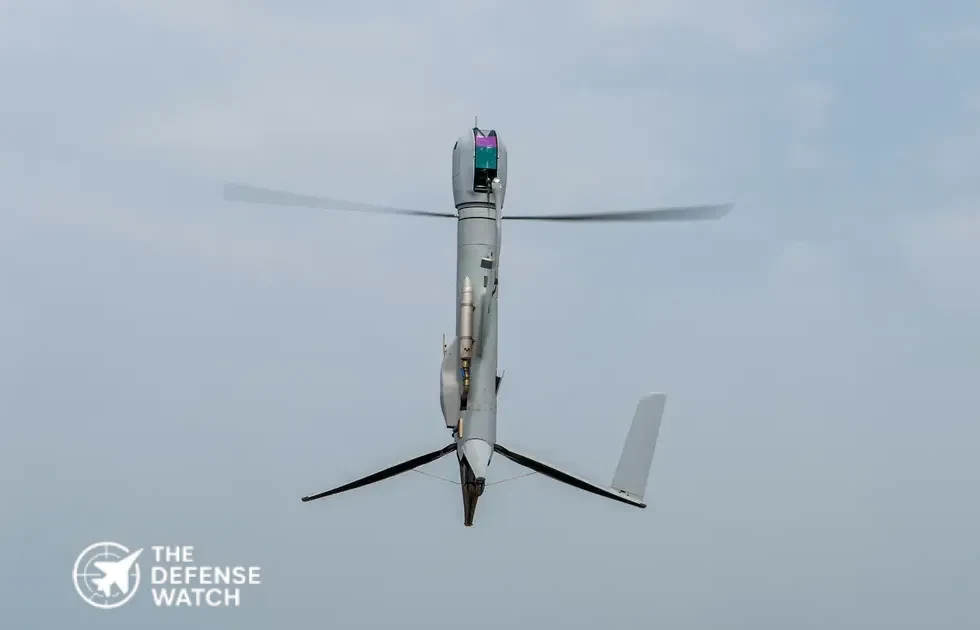
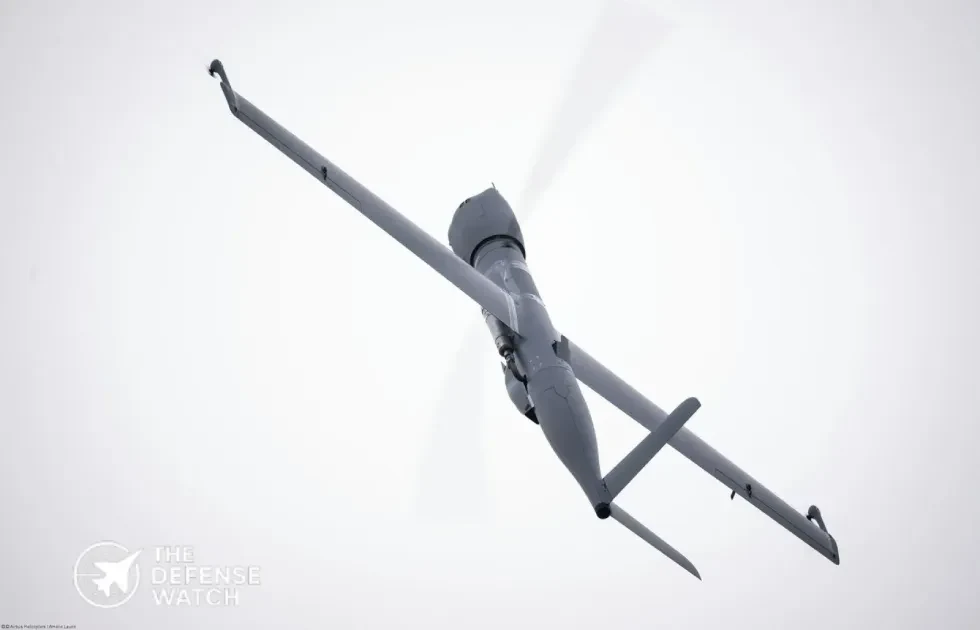
The Airbus U030 Flexrotor is a compact Group 2 tactical vertical take-off and landing (VTOL) uncrewed aircraft system optimized for persistent intelligence, surveillance, target acquisition, and reconnaissance (ISTAR) in demanding environments.
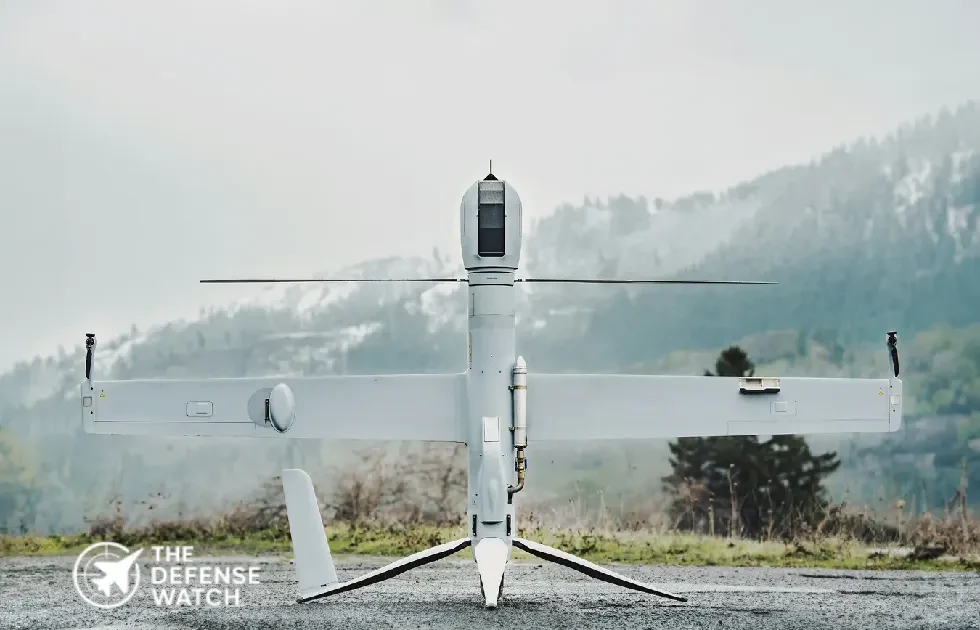
Originally developed by U.S. firm Aerovel Corporation in Bingen, Washington, and acquired by Airbus Helicopters in 2024, the Flexrotor combines rotorcraft vertical launch and recovery with efficient wing-borne cruise. It requires only a 3.7 m × 3.7 m (12 ft × 12 ft) area for autonomous operations from land or ship decks without dedicated flight decks, transitioning from stowed configuration to airborne in approximately 30 minutes.
With a maximum take-off weight of 25 kg (55 lb) and payload capacity of up to 8 kg (18 lb), the system supports modular electro-optical/infrared (EO/IR) sensors, radar, and other mission-specific payloads. Typical endurance reaches 12–15 hours, enabling persistent coverage for maritime surveillance, border security, search and rescue, firefighting support, and electronic warfare or communications relay tasks. Dash speed is listed at 140 km/h (77 kt), with minimum cruise around 78 km/h (42 kt) and service ceiling exceeding 5,000 m (16,400 ft). Propulsion comes from a 28 cc two-stroke engine capable of gasoline or heavy fuel.
The platform has demonstrated operations in harsh, high-threat, and GPS-denied conditions, including U.S. Navy exercises (such as launches from USS Paul Hamilton), European Maritime Safety Agency Baltic Sea surveillance missions starting in 2026, and commercial applications like wildfire monitoring. It supports crewed-uncrewed teaming and real-time data streaming. Unit cost is not publicly disclosed.
Designed for minimal logistical footprint, the U030 Flexrotor fills a niche for expeditionary forces needing reliable, long-endurance ISR without large support infrastructure.
Disclaimer Note
The information provided on TheDefenseWatch.com is for general informational purposes only. While we strive to ensure the accuracy, completeness, and timeliness of our content regarding defense and aerospace products, technologies, and specifications, we cannot guarantee that all information is 100% accurate or up-to-date due to the evolving nature of military technology and classified data.TheDefenseWatch.com does not warrant the reliability, suitability, or availability of the information for any specific purpose. Users are advised to consult official sources, such as manufacturers, government publications, or defense agencies, for precise and verified data before making decisions based on our content.We are not affiliated with any defense manufacturers, governments, or military organizations mentioned. Opinions, reviews, and ratings reflect expert analysis but are subjective and should not be considered endorsements. TheDefenseWatch.com is not responsible for any errors, omissions, or consequences arising from the use of this website’s content.External links are provided for convenience and do not imply endorsement. TheDefenseWatch.com reserves the right to update or modify content without prior notice. By using this website, you agree to our Privacy & Cookies Policy.




New Arrivals






Popular Comparisons
-
 J-10C vs JF-17 Thunder: Which Fighter Is More Capable?
View Comparison →
J-10C vs JF-17 Thunder: Which Fighter Is More Capable?
View Comparison → -
Tejas vs Gripen: Key Differences and Capabilities
View Comparison →
-
Tejas vs MiG-21 Bison: How India Replaced Its Iconic Supersonic Fighter
View Comparison →
-
F-35 vs F-16: Stealth, Sensors and Combat Roles
View Comparison →
-
Tejas Fighter Jet vs F-16 Fighting Falcon: Capability Compared
View Comparison →
-
Rafale Fighter Jet vs F-16 Fighting Falcon : Which Fighter Has the Edge?
View Comparison →
-
Su-57 Fighter Jet vs J-20 Fighter Jet: Stealth and Air Combat Compared
View Comparison →
-
Mirage 2000 vs Tejas Mk1A: Legacy Combat Power vs Indigenous Modernization
View Comparison →
-
Rafale Fighter Jet vs F-22 Raptor: Which Air Dominance Fighter Has the Edge?
View Comparison →
-
Tejas Fighter Jet vs. Rafale Fighter Jet: India’s Indigenous Fighter Meets France’s Proven Multirole Combat Aircraft
View Comparison →


- DIA 2026 Space Report Warns China May Field Orbital Directed-Energy Weapons by Late 2020s

- Boeing Advances Second MQ-25 Stingray Toward Testing for U.S. Navy
- Saab Unveils Sea Giraffe AMB D Radar With 250-Kilometer Air Surveillance Range
- Most Advanced Fighter Jet in the World in 2026: F-22 vs. F-35 vs. J-20
- Lockheed Martin Wins $88.6 Million Navy Contract for Radiant Mercury Systems
- Pentagon Uses Department of War Name to Reinforce Message to Adversaries
- Israel’s Military Chief Reportedly Opposed Pre-Election Strike on Iran
- Canada Receives First Two F-35 Fighters as Review of 72 Aircraft Continues
- Lockheed Martin Completes $3.45 Billion Ultra Maritime Acquisition
- Lockheed Martin Advances Ramjet-Powered PrSM Increment 4 Missile






Fighter Jets
-
 F-100 Super Sabre
-
North American F-86 Sabre
-
Northrop YF-23 Fighter
-
Rafale F5 Fighter
-
SU-57 Felon Stealth Fighter
-
Boeing F/A-XX Fighter
-
JF-17 Thunder Fighter Jet
-
F-47 Fighter Jet
-
MIG-31 Fighter Jet
-
J-10CE Fighter Jet
-
Chengdu J-10 Fighter Jet
-
Chengdu J-10C Fighter Jet
-
Gripen E Fighter Jet
-
Tejas Mk1A Fighter Jet
-
Tejas Mk‑2 Fighter Jet
-
F-16V Viper Block 70 Fighter Jet
-
F-15EX Eagle II Fighter
-
F-15E Strike Eagle Fighter
-
F/A-18E/F Super Hornet Fighter Jet
-
Saab Gripen F Fighter Jet
-
JAS 39E/F Gripen Fighter Jet
-
JAS 39 Gripen Fighter Jet
-
F-35A Lightning II Fighter Jet
-
F/A-18F Super Hornet








Recent Compares
-
J-10C vs JF-17 Thunder: Which Fighter Is More Capable?
View Comparison →
-
Tejas vs Gripen: Key Differences and Capabilities
View Comparison →
-
Tejas vs MiG-21 Bison: How India Replaced Its Iconic Supersonic Fighter
View Comparison →
-
F-35 vs F-16: Stealth, Sensors and Combat Roles
View Comparison →
-
Tejas Fighter Jet vs F-16 Fighting Falcon: Capability Compared
View Comparison →
Latest Defense Systems
10 Compares Defense Systems
-
J-10C vs JF-17 Thunder: Which Fighter Is More Capable?
View Comparison →
-
Tejas vs Gripen: Key Differences and Capabilities
View Comparison →
-
Tejas vs MiG-21 Bison: How India Replaced Its Iconic Supersonic Fighter
View Comparison →
-
F-35 vs F-16: Stealth, Sensors and Combat Roles
View Comparison →
-
Tejas Fighter Jet vs F-16 Fighting Falcon: Capability Compared
View Comparison →
-
Rafale Fighter Jet vs F-16 Fighting Falcon : Which Fighter Has the Edge?
View Comparison →
-
Su-57 Fighter Jet vs J-20 Fighter Jet: Stealth and Air Combat Compared
View Comparison →
-
Mirage 2000 vs Tejas Mk1A: Legacy Combat Power vs Indigenous Modernization
View Comparison →
-
Rafale Fighter Jet vs F-22 Raptor: Which Air Dominance Fighter Has the Edge?
View Comparison →
-
Tejas Fighter Jet vs. Rafale Fighter Jet: India’s Indigenous Fighter Meets France’s Proven Multirole Combat Aircraft
View Comparison →
- DIA 2026 Space Report Warns China May Field Orbital Directed-Energy Weapons by Late 2020s
- Boeing Advances Second MQ-25 Stingray Toward Testing for U.S. Navy
- Saab Unveils Sea Giraffe AMB D Radar With 250-Kilometer Air Surveillance Range
- Most Advanced Fighter Jet in the World in 2026: F-22 vs. F-35 vs. J-20
- Lockheed Martin Wins $88.6 Million Navy Contract for Radiant Mercury Systems