

Executive Summary:
Hanwha Aerospace has confirmed participation in South Korea’s indigenous long-range air-to-air missile program aimed at replacing the MBDA Meteor missile in Republic of Korea Air Force service.
The missile will support the KF-21 fighter program and reflects Seoul’s broader push for defense self-reliance and advanced aerospace weapons development.
Hanwha Long-Range Air-To-Air Missile Program Advances
South Korea’s new long-range air-to-air missile program is moving into full development as Hanwha Aerospace works alongside the country’s defense authorities to build an indigenous beyond-visual-range weapon comparable to the European Meteor missile.
The missile is intended to eventually replace imported Meteor BVRAAMs currently planned for South Korea’s next-generation fighter fleet.
The long-range air-to-air missile program is being led by South Korea’s Agency for Defense Development (ADD), while Hanwha Aerospace is contributing propulsion and missile technologies developed over nearly two decades of ramjet research.
Development is scheduled to run from 2026 through 2033 under a government-led framework. The effort follows approval from South Korea’s Defense Acquisition Program Committee in late 2025.
Designed To Support KF-21 Air Combat Capability
The new missile is expected to become a key component of the KF-21 Boramae fighter program, which remains central to Seoul’s long-term military aviation modernization strategy.
South Korea currently relies on foreign suppliers for advanced air-to-air missiles, including the MBDA Meteor. While the Meteor remains one of the most capable ramjet-powered BVRAAMs in operational service, Seoul increasingly views domestic missile production as strategically necessary.
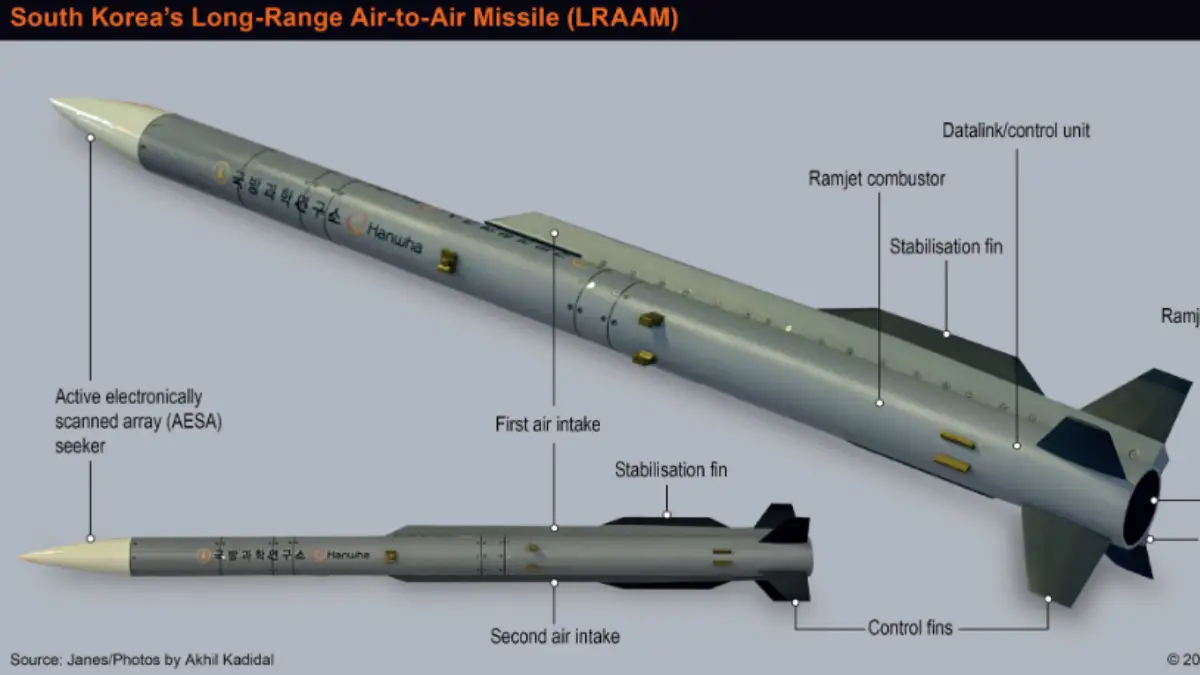
The Hanwha long-range air-to-air missile is expected to use a solid-fuel ducted ramjet propulsion system. That propulsion architecture is designed to sustain energy over long distances, allowing missiles to retain maneuverability and speed deeper into engagement envelopes compared with conventional rocket-powered systems.
A concept model displayed during Seoul ADEX 2025 showed a missile design visually similar to Meteor, including dual ramjet air intakes. However, the South Korean concept also included stabilizing fins around the intake section, indicating possible aerodynamic modifications tailored to domestic requirements.
Why The Program Matters Strategically
The missile project highlights a broader trend across Asia in which regional powers are attempting to reduce dependence on imported precision weapons and aerospace systems.
South Korea has already invested heavily in indigenous missile defense systems, including the L-SAM and L-SAM II programs. Hanwha Aerospace has become one of the country’s most prominent defense manufacturers through programs involving artillery rockets, missile defense, armored systems, and aerospace technologies.
The air-to-air missile effort also aligns with Seoul’s ambitions to improve export competitiveness for the KF-21 fighter. Export customers increasingly seek aircraft packages that include sovereign weapons integration rather than dependence on third-party missile approvals.
That issue has become more important globally as geopolitical tensions reshape defense supply chains and governments seek greater control over sustainment and munitions availability.
Analysts also note that ramjet-powered air-to-air missiles remain among the most technically demanding classes of guided weapons because they combine high-speed propulsion, advanced seekers, datalink integration, and long-range engagement requirements.
South Korea Expands Indigenous Missile Portfolio
The long-range missile program is not operating in isolation. South Korea is simultaneously pursuing a domestically developed short-range air-to-air missile program intended for the KF-21 platform.
Together, the short-range and long-range missile initiatives suggest Seoul is attempting to establish a fully domestic air combat weapons ecosystem for future fighter operations.
Hanwha Systems has also reportedly begun work tied to advanced missile seekers for future air-launched weapons.
At the same time, South Korean defense firms continue expanding internationally. Hanwha Aerospace recently secured major export agreements in Europe involving rocket artillery and missile production partnerships, strengthening the company’s position in the global defense market.
Outlook
The Hanwha long-range air-to-air missile remains years away from operational deployment, but the program represents an important step in South Korea’s broader aerospace and defense modernization effort.
If development proceeds on schedule, the missile could provide the Republic of Korea Air Force with an indigenous long-range air combat capability while reducing reliance on foreign missile suppliers for future KF-21 operations.
The project also signals South Korea’s growing ambition to compete in advanced guided weapon technologies traditionally dominated by the United States and major European defense manufacturers.
