Executive Summary:
Newly released footage of China’s Type 076 amphibious assault ship, Sichuan, provides the clearest public view yet of the People’s Liberation Army Navy’s emerging drone carrier concept. The images reinforce assessments that the vessel is designed to operate fixed wing unmanned combat aircraft, potentially giving the PLAN a new capability for long range surveillance, strike, and amphibious support operations across the Indo Pacific.
China Type 076 UAV Carrier Moves Closer To Operational Service
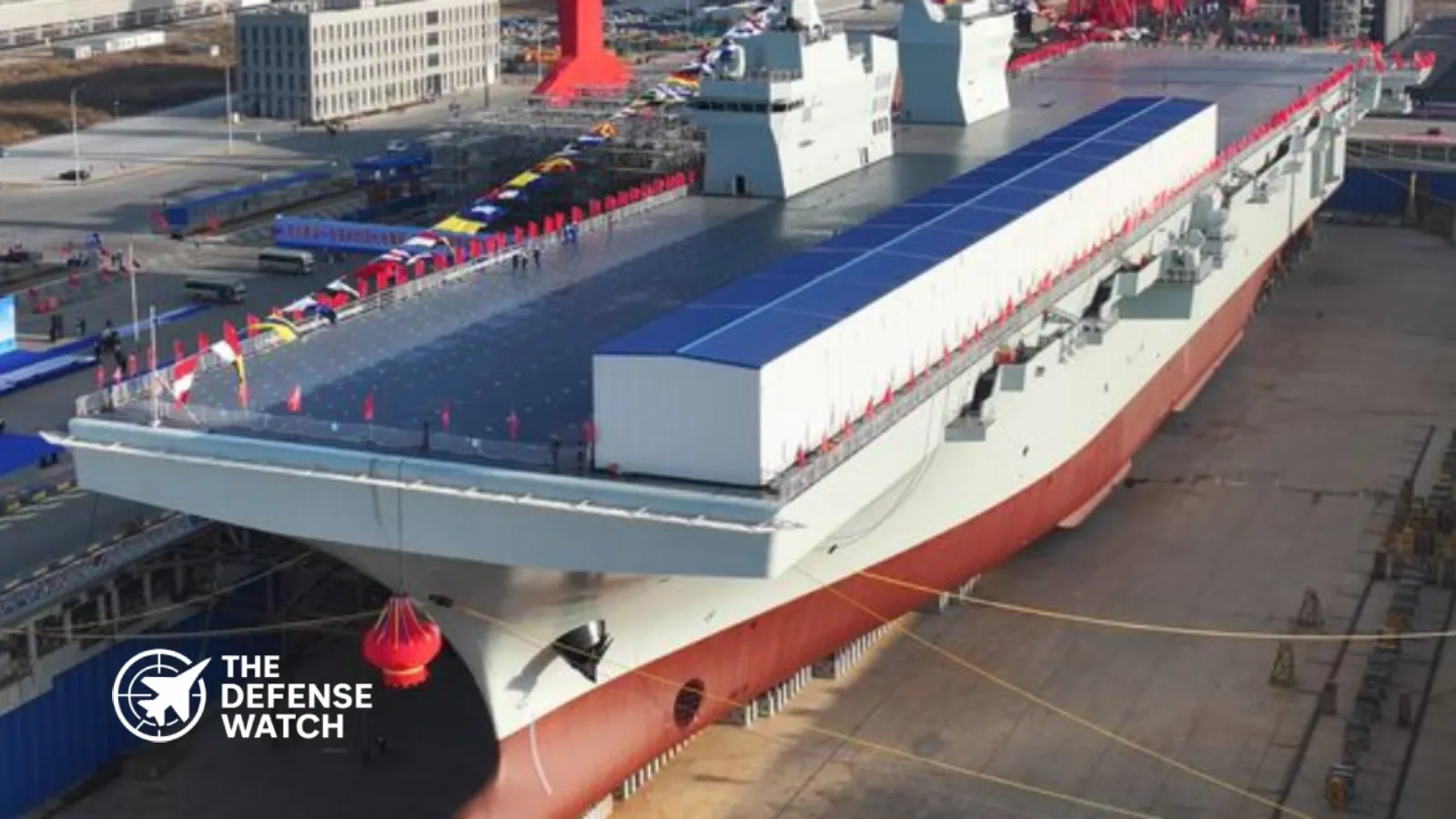
New video footage of China’s Type 076 UAV carrier, Sichuan, has provided the clearest public evidence to date of the People’s Liberation Army Navy’s (PLAN) evolving concept for operating fixed wing unmanned aircraft from an amphibious assault ship. The footage, first highlighted by Janes following the circulation of Chinese media imagery, shows that the vessel’s flight deck, electromagnetic launch system, arresting gear, and deck markings appear substantially complete as the ship progresses toward operational service.
The Type 076 represents a significant departure from traditional landing helicopter docks. Rather than relying solely on helicopters, the ship is expected to operate a mix of rotary wing aircraft and carrier capable unmanned aerial vehicles (UAVs), expanding the PLAN’s options for intelligence, surveillance, strike, and amphibious support missions.
A Hybrid Between An Amphibious Assault Ship And A Drone Carrier
Displacing approximately 40,000 tons, the Type 076 is China’s largest amphibious assault ship to date. Unlike earlier Type 075 vessels, it incorporates technologies typically associated with aircraft carriers, including:
| Capability | Type 076 Sichuan |
|---|---|
| Estimated displacement | About 40,000 tons |
| Flight deck | Full length |
| Launch system | Electromagnetic Aircraft Launch System (EMALS) |
| Recovery system | Arresting gear |
| Aircraft elevators | Two |
| Primary aviation focus | Helicopters and fixed wing UAVs |
These features make the Type 076 unique among amphibious assault ships currently known to be under construction worldwide.
Evidence Points Toward GJ 21 Naval UCAV Operations
Recent imagery previously analyzed by Janes showed what appeared to be a mock up of China’s naval unmanned combat aerial vehicle, commonly referred to as the GJ 21, positioned aboard Sichuan. The aircraft features folding wings and a tail hook, indicating compatibility with catapult assisted takeoff and arrested recovery (CATOBAR) operations.
Although the aircraft observed was likely a developmental mock up rather than an operational platform, its presence suggests that China is actively integrating stealth UAV operations into future naval deployments.
If fielded as expected, these aircraft could conduct:
- Long range intelligence, surveillance, and reconnaissance (ISR)
- Maritime targeting
- Precision strike missions
- Electronic warfare support
- Support for amphibious landings
Why The Type 076 Matters
The Type 076 introduces a capability that differs from conventional aircraft carriers.
Rather than replacing large fleet carriers such as China’s Type 003 Fujian, the new ship appears intended to complement them by extending unmanned aviation into expeditionary and amphibious operations. This could provide commanders with additional flexibility while reducing the operational risk associated with deploying manned aircraft for every mission.
The combination of helicopters and unmanned combat aircraft also reflects a broader global trend toward integrating autonomous systems into naval operations. Several navies are exploring similar concepts, but the Type 076 is among the first large amphibious ships specifically designed around catapult launched UAV operations.
Operational Implications For Indo Pacific Security
From a strategic perspective, the Type 076 could improve the PLAN’s ability to maintain persistent aerial surveillance over contested maritime regions.
Fixed wing UAVs generally offer longer endurance than shipborne helicopters while requiring fewer personnel than conventional fighter aircraft. Combined with electromagnetic launch capability, they could provide continuous reconnaissance during amphibious operations or maritime patrols.
For regional militaries, this development highlights China’s continued investment in distributed naval aviation and unmanned systems. While the vessel alone does not fundamentally alter the regional military balance, it expands the range of operational options available to the PLAN during expeditionary missions.
For the United States and allied navies operating in the Indo Pacific, the emergence of dedicated drone capable assault ships reinforces the importance of counter UAS capabilities, electronic warfare, integrated air defense, and persistent maritime surveillance.
Technical Challenges Remain
Despite the visible progress, several hurdles remain before the Type 076 reaches full operational capability.
Among the most significant are:
- Maturing carrier capable stealth UAVs suitable for sustained naval operations.
- Developing reliable autonomous launch and recovery procedures at sea.
- Integrating unmanned aircraft into fleet command and control networks.
- Training crews for simultaneous helicopter and UAV flight operations.
- Establishing maintenance and logistics support for advanced unmanned air wings.
Successful integration of these capabilities will determine whether the Type 076 becomes a transformational operational asset or primarily a technology demonstrator during its initial years of service.
Looking Ahead
The latest footage indicates that Sichuan is approaching the final stages of fitting out, with observers expecting delivery to the PLAN following completion of sea trials and acceptance testing.
As China’s naval modernization continues, the Type 076 will likely serve as an important testbed for integrating fixed wing unmanned aviation with amphibious warfare. Its eventual operational performance will provide valuable insight into how major navies may employ drone carriers alongside traditional aircraft carriers in future maritime operations.