Executive Summary
- The U.S. Army has begun fielding a new command and control network transport and infrastructure baseline to III Armored Corps at Fort Hood, Texas, making the corps the first formation to receive the capability through the Army’s centralized regional fielding process.
- The baseline replaces or reduces reliance on legacy Warfighter Information Network-Tactical equipment and incorporates multi-orbit satellite antennas, automated network traffic management, tactical gateway equipment and edge computing. The Army says its new LEO terminals provide approximately 40 times the throughput and speed of the legacy capability, although the service has not publicly disclosed the underlying throughput figures in the announcement.
- The fielding is an important infrastructure step toward the Army’s broader Next Generation Command and Control architecture, but scaling remains a major issue. A Government Accountability Office report published in August 2026 found that the Army lacked a detailed service-wide fielding schedule and complete life-cycle cost estimate for NGC2.
Army Replaces Legacy WIN-T With Modern C2 Network
The U.S. Army is replacing large legacy tactical network equipment with a more mobile command and control architecture, beginning with III Armored Corps at Fort Hood, Texas. The new baseline combines multi-orbit satellite communications, automated network management, tactical gateways and edge computing to reduce the physical footprint of battlefield communications while improving the ability to move data across contested and degraded environments.
The move is more significant than a simple equipment swap. It represents the infrastructure layer of the Army’s wider transition toward Next Generation Command and Control, or NGC2, in which transport, infrastructure, data and applications are designed as an integrated ecosystem rather than as isolated tactical systems.
III Armored Corps Becomes First Formation to Receive New Baseline
The Army said III Armored Corps is the first formation to receive the new command and control network baseline through a centralized fielding and training process.
The 57th and 62nd Expeditionary Signal Battalions-Enhanced, assigned to the 11th Corps Signal Brigade, also received the equipment at Fort Hood. The 57th ESB-E had already divested its legacy WIN-T equipment through earlier modernization efforts, but the new baseline provides additional transport and infrastructure capabilities.
The timing is important for an armored formation. Large combat formations need communications systems that can move with maneuver units rather than forcing command elements to remain tied to large, fixed infrastructure.
Lt. Col. Christopher Vanderberg, commander of the 57th ESB-E, highlighted mobility as a survivability issue. Smaller equipment can be deployed, dismantled and relocated more rapidly, reducing the time a command node remains in one location and potentially exposed to enemy detection.
That reflects a broader change in Army network design. The service’s 2025 Army Unified Network Plan 2.0 identified a persistently contested information environment and called for a more data-centric network capable of operating across connected and disconnected conditions.
What the New Army C2 Network Includes
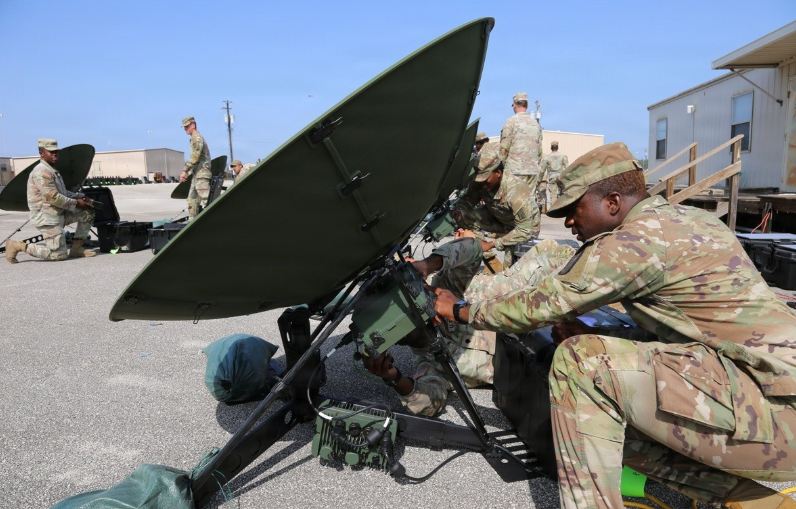
The new baseline is not a single communications device. It is an equipment architecture designed to provide transport, computing and network-management functions at the tactical edge.
| Capability | New baseline role | Operational significance |
|---|---|---|
| Multi-orbit SATCOM antennas | Provide high-throughput satellite transport | Adds alternative communications paths |
| Network orchestration appliances | Automatically manage and prioritize traffic | Helps move critical data when pathways are constrained |
| Tactical network gateway enclave | Connects edge nodes | Supports integration between tactical network segments |
| Tactical edge server | Provides local compute and storage | Reduces dependence on distant infrastructure |
| Transit-case equipment | Provides a smaller deployable footprint | Supports rapid movement and setup |
The Army says the architecture is designed to support data exchange in denied, degraded, intermittent and low-bandwidth environments. It also provides multiple pathways under a communications PACE plan, allowing units to shift between primary, alternate, contingency and emergency communications options when a particular pathway is disrupted.
This matters because network survivability is increasingly dependent on the ability to change paths rather than simply protect a single communications route.
LEO SATCOM Provides a Major Throughput Increase
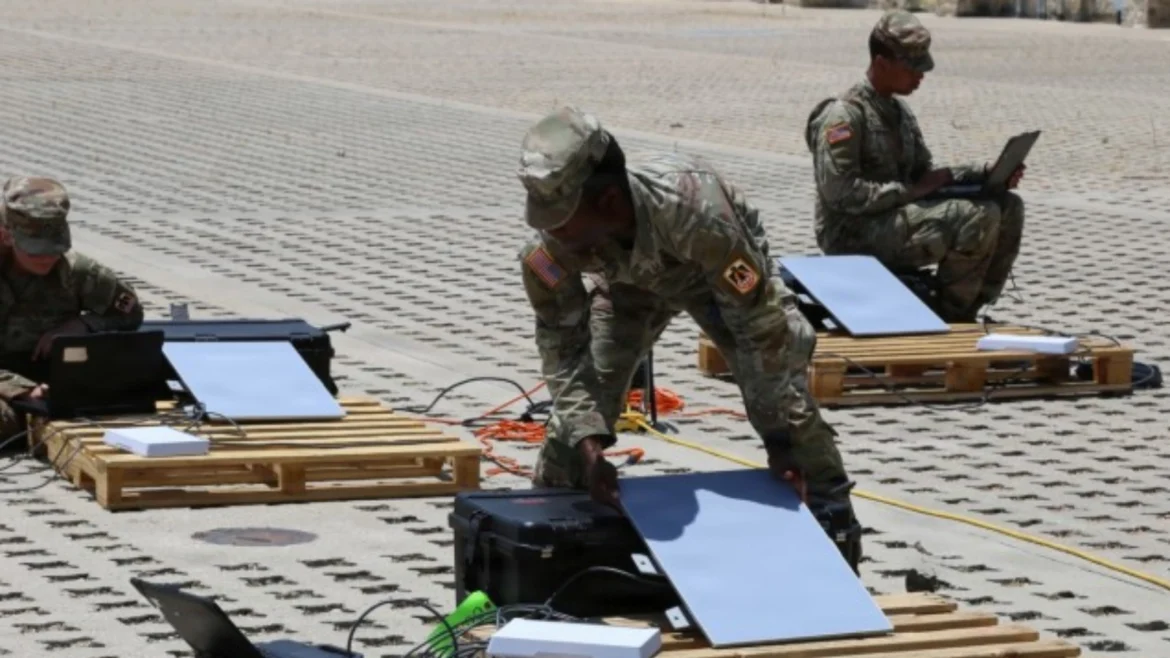
One of the most visible changes is the introduction of dismounted high-throughput multi-orbit satellite communications equipment.
Sgt. Maj. Joseph Scalies of the 1st Cavalry Division G-6 said the new LEO terminals provide approximately 40 times the throughput and speed of the legacy capability. He also said the equipment can be transported as commercial-airline baggage and established within minutes.
The Army’s announcement does not provide the actual throughput of either the legacy or new terminals. The 40-times figure should therefore be treated as the service’s stated comparison rather than an independently verified throughput measurement.
The more important change is architectural. A high-throughput satellite terminal becomes considerably more useful when paired with automated traffic management and edge computing. The network can prioritize information, select available paths and process or store data closer to the formation instead of relying on a single remote communications route.
That is particularly relevant to armored formations, where the network has to keep pace with mobile headquarters, fires, intelligence systems and maneuver units.
From WIN-T to a More Mobile Network
The Army’s transition away from WIN-T is part of a longer modernization effort.
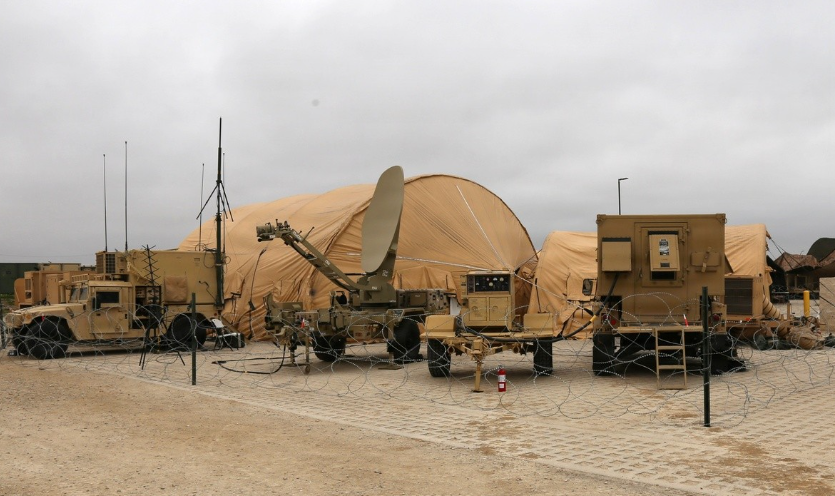
WIN-T provided the Army with a major improvement over earlier tactical communications architectures, but its larger equipment footprint was not designed around the same degree of mobility now being demanded from command posts operating under persistent surveillance and electronic warfare pressure.
The Army’s current approach is instead moving toward distributed and more rapidly relocatable infrastructure. GAO reported in August that the Army planned to divest some legacy systems within NGC2’s transport and infrastructure layers through a 30-month replacement strategy.
This distinction is important. The objective is not simply to make communications faster. It is to make the network harder to disrupt by reducing physical signatures, increasing transport options and distributing computing and data functions.
The Army’s Unified Network Plan 2.0 explicitly identifies security, survivability, interoperability and reduced technological complexity at the tactical edge as priorities.
The Network Is Becoming the Foundation for NGC2
The new baseline also provides infrastructure for the Army’s broader NGC2 effort.
NGC2 is structured around four layers: transport, infrastructure, data and applications. The Army describes it as an evolving ecosystem rather than a single program of record, with the ability to introduce and replace technologies as operational requirements and commercial capabilities change.
The new III Armored Corps fielding primarily addresses the lower layers of that architecture. Transport moves information, while infrastructure provides computing and storage. Those functions establish the technical foundation on which future data and application layers can operate.
This is where the current modernization effort differs from a conventional network replacement program. The Army is trying to establish a common infrastructure baseline that can support future software and data capabilities without requiring a completely new hardware architecture every time a new application is introduced.
That approach also matches the Army’s Unified Network Plan 2.0, which calls for faster incorporation of new technologies while reducing complexity at the tactical edge.
Electronic Warfare Makes Network Resilience Critical
The operational problem is straightforward. A tactical network that works only when its preferred communications pathway remains available is vulnerable in a contested electromagnetic environment.
The Army’s own NGC2 experimentation has included scenarios involving electromagnetic-spectrum contestation, network jamming and degraded communications. The objective is to give commanders options for moving information when individual pathways are disrupted.
The III Armored Corps baseline therefore addresses three related problems:
- Mobility: Smaller equipment can move with maneuver formations.
- Resilience: Multiple transport pathways can reduce dependence on one communications method.
- Data access: Edge computing and higher-bandwidth transport can move information closer to commanders and users.
None of these features guarantees communications during combat. Satellite links, radios, terrestrial networks and tactical nodes remain subject to physical damage, electronic attack, congestion, cyber threats and terrain constraints.
The value of the architecture is instead in giving units more options when one part of the network becomes unavailable.
The Army Still Faces a Scaling Problem
The fielding at Fort Hood demonstrates progress at the formation level, but the harder question is how quickly the architecture can be delivered across the force.
GAO’s August 2026 assessment found that the Army had a tentative goal of fielding the complete NGC2 technology stack across 11 divisions and four corps by the end of fiscal year 2032. However, GAO said the Army had not developed a detailed schedule identifying which units would receive the capability in each fiscal year.
GAO also found that the Army had identified approximately $3.3 billion in NGC2 costs through fiscal year 2026 but had not completed an initial life-cycle cost estimate for the overall effort. The watchdog recommended a detailed fielding schedule and a preliminary life-cycle cost estimate, with regular reassessment as the program evolves.
That creates an important gap between technical progress and force-wide implementation.
A modern tactical network is only as useful as its availability across the formations that have to operate together. If some corps and divisions use significantly different network architectures during a major operation, interoperability, training and sustainment can become more complicated.
The Army is attempting to address that problem through a common baseline. Its regional fielding approach combines equipment delivery, training and legacy equipment turn-in at centralized locations, with additional regional efforts planned in the United States and overseas.
Three Areas Will Determine the Operational Impact
1. Network survivability
The immediate advantage is the combination of mobility and multiple transport pathways. Rapid setup and teardown can reduce the time command elements spend operating from a fixed location, while alternate communications routes can help maintain connectivity when individual paths are disrupted.
2. Edge computing
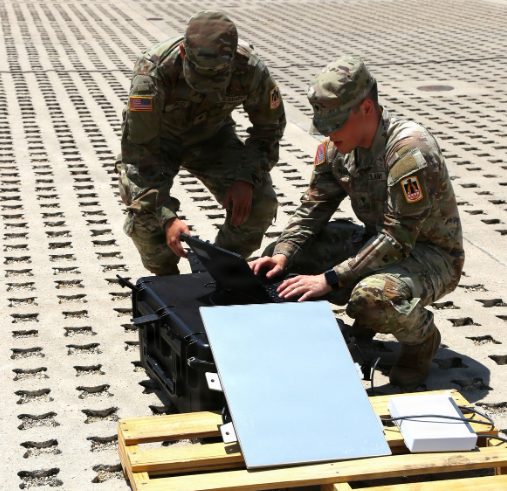
The tactical edge server is equally important. Processing and storing information closer to users can reduce dependence on remote infrastructure and support operations when connectivity to the wider network is limited.
This becomes increasingly important as the Army moves toward data-heavy command and control applications. NGC2 is intended to connect applications with a common data layer rather than treating every warfighting function as an isolated information system.
3. Scale and sustainment
The long-term test will be whether the Army can field, train and sustain the architecture across the force without recreating the complexity it is attempting to remove.
The Army says the common baseline should reduce training requirements because Soldiers moving between units will encounter more familiar equipment and configurations. It also expects to reduce maintenance and logistics burdens associated with WIN-T.
Whether those benefits materialize at service scale will depend on procurement schedules, software integration, cybersecurity requirements, satellite-service availability, training capacity and life-cycle costs.
What This Means for Future Armored Operations
The III Armored Corps fielding illustrates a broader shift in how the Army views command and control.
The network is no longer simply a communications utility supporting maneuver units. It is becoming part of the combat architecture that links sensors, commanders, data, applications and effectors.
That makes network speed and resilience operational factors rather than purely technical specifications.
For an armored corps, the ability to move a command node, reconnect through another transport pathway and continue accessing data can directly affect how quickly headquarters can adjust to changing battlefield conditions. The new architecture is intended to support that cycle without requiring the physical footprint associated with older tactical network systems.
The Army’s NGC2 effort is already moving beyond experimentation. In June 2026, the service reported that 4th Infantry Division had advanced NGC2 from proof of concept to division-level experimentation using commercial prototype technologies.
The Fort Hood fielding adds another piece to that transition by establishing a more mobile transport and infrastructure layer for a major armored formation.
The immediate result is therefore less about a single new satellite terminal than about changing the underlying architecture of Army command and control. The Army is replacing large legacy network infrastructure with a more distributed model built around multiple communications pathways, tactical computing and an architecture intended to support continuously updated data and applications.
The central challenge now is scale. The Army has demonstrated that the new architecture can be fielded to operational formations, but GAO’s recent assessment shows that the service still needs clearer cost and schedule visibility to demonstrate how quickly that model can reach the wider force.