Executive Summary
- Coyote Storm 26.2 brought Airmen from across the 355th Wing together at Davis-Monthan Air Force Base, Arizona, from Sept. 14-17 to practice operating in a contested environment under the Air Expeditionary Wing 2.0 framework.
- Training extended beyond aircraft operations. Medical personnel rehearsed casualty care and stabilization, rescue forces practiced rapid airpower generation, and wing staff personnel exercised command and control functions.
- The exercise illustrates the central change behind AEW 2.0: Airmen are intended to build deployment relationships and train as an integrated team before reaching a contingency location, rather than assembling much of the deployed force after arrival.
Coyote Storm 26.2 Tests Air Expeditionary Wing 2.0 Readiness
U.S. Airmen from the 355th Wing used Coyote Storm 26.2 at Davis-Monthan Air Force Base, Arizona, Sept. 14-17 to rehearse how a wing-level force can operate in a contested environment while integrating aviation, rescue, medical, command and support functions under the Air Expeditionary Wing 2.0 concept. The exercise is part of the Air Force’s broader shift toward generating deployable forces that train together before deployment rather than relying primarily on personnel assembled for an individual contingency.
The exercise matters because AEW 2.0 is not primarily a new aircraft or weapon program. It is a change in how the Air Force organizes, trains and presents combat power. The service says the construct is intended to provide a modular and scalable wing-level unit capable of command and control and projecting platform-agnostic airpower in different theaters.
Coyote Storm 26.2 Puts AEW 2.0 Into Practice
Coyote Storm 26.2 involved personnel across the 355th Wing, including aviators, medical personnel and other supporting elements. The Air Force said the training was designed to build flexibility, readiness, resilience and teamwork for operations in a contested environment.
The exercise followed Coyote Storm 26.1 at Tyndall Air Force Base, Florida, in July. That earlier event also focused on the Mission Ready Airman concept and the ability of personnel to operate beyond their traditional specialties when circumstances require it.
The progression from Coyote Storm 26.1 to 26.2 provides an important distinction. The exercises are not simply individual skills events. They are intended to develop familiarity between different functional areas before those personnel are required to operate together during a deployment.
That is particularly relevant to distributed operations, where communications, medical response, logistics, security, maintenance and command decisions can become tightly connected.
Medical Readiness Becomes a Wing-Level Requirement
Medical training during Coyote Storm 26.2 highlighted one of the less visible challenges of operating from contested or austere locations.
Staff Sgt. Madison Cromer of the 355th Operational Medical Readiness Squadron said the scope of medical work changes substantially in a deployed environment. Training scenarios included emergency care and stabilization, improvised tourniquets, ruggedized intravenous equipment and using available clothing and equipment to address simulated injuries.
The exercise also focused on the reality that medical personnel may not be the first people to reach a casualty.
That makes basic lifesaving skills among non-medical Airmen operationally relevant. Cromer said the unit historically had not trained non-medics for mass-casualty situations to the same extent, while emphasizing that personnel outside the medical field could arrive first at an incident.
DVIDS imagery from the exercise separately shows 355th Medical Group personnel coordinating simulated medical procedures and preparing sites for simulated intravenous treatment.
Why This Matters in a Contested Environment
A contested airbase presents a different medical problem from a normal peacetime installation.
A strike, accident or other emergency could create casualties while simultaneously disrupting transportation, communications or access to medical facilities. The ability to stabilize personnel at the point of injury therefore becomes part of the broader force-generation problem.
The Air Force has not released a quantitative assessment from Coyote Storm 26.2 showing casualty-treatment times, survival rates or other performance measurements. Such metrics should not be inferred from the exercise.
The more important observable development is organizational. Medical readiness is being incorporated into a broader wing-level training construct rather than treated solely as a specialist function.
HH-60W Operations Link Rescue Capability to AEW 2.0
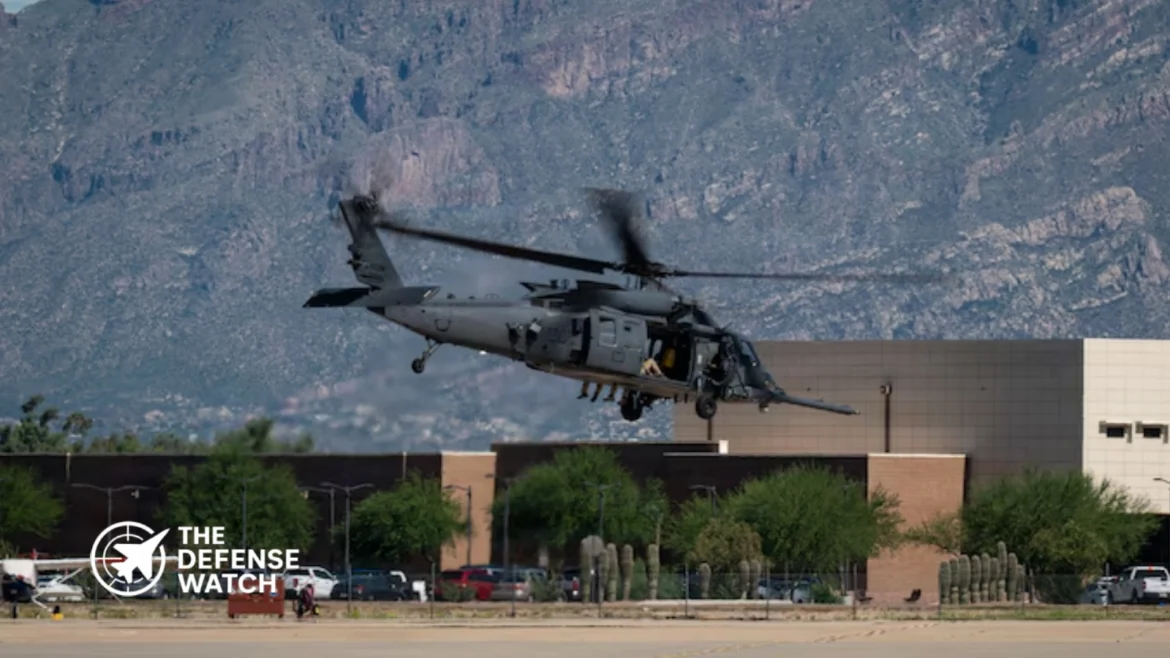
Coyote Storm 26.2 also included the 55th Rescue Generation Squadron and HH-60W Jolly Green II operations.
Official imagery shows an HH-60W preparing for flight during the exercise, with the Air Force describing the activity as part of rapid airpower generation and AEW 2.0 readiness. Another exercise image shows combat rescue personnel and a pararescueman conducting loadout drills.
This is significant because combat rescue introduces another layer of coordination. Aircraft generation, rescue crews, medical support, command and control and casualty handling have to connect within the same operational system.
The exercise therefore provides a practical test of whether a wing can function as an integrated organization rather than as a collection of specialized units.
That distinction is central to the Air Force’s AEW 2.0 concept.
AEW 2.0 Changes How the Air Force Builds Deployable Forces
The Air Force announced AEW 2.0 in January 2026 as a new wing-level unit of action, with implementation planned for fiscal year 2027. The service described the concept as an evolution from several earlier force-presentation models, including the Expeditionary Air Base, Air Task Force and Deployable Combat Wing approaches.
One of the most significant differences is the amount of time available for the force to train together before deployment.
Under the Air Force’s stated model, an AEW 2.0 is formed approximately 18 months before deployment. Its capabilities-based components can then train and certify as a cohesive unit.
| AEW 2.0 element | Air Force approach | Operational purpose |
|---|---|---|
| Force organization | Modular, scalable wing-level unit | Tailor forces to theater requirements |
| Pre-deployment teaming | Approximately 18 months before deployment | Build familiarity between functional teams |
| Training | Integrated across capabilities | Develop common procedures before deployment |
| Command and control | Wing Operations Centers at deployed locations | Support distributed command functions |
| Force presentation | Capabilities-based packages | Provide required combat and support functions |
| Host-wing capacity | Preserve in-garrison responsibilities | Balance deployment and homeland requirements |
The Air Force says AEW 2.0 will use Wing Operations Centers rather than A-Staffs at deployed locations. It also retains group command opportunities at deployed locations.
From Individual Readiness to Collective Readiness
The distinction between individual readiness and collective readiness is important.
A technically proficient maintainer, medic, pilot, security specialist or commander can still encounter friction when operating with personnel and organizations they have never trained alongside. Procedures, communications, authorities and decision-making relationships can take time to establish.
AEW 2.0 attempts to move some of that integration work to the pre-deployment period.
Coyote Storm 26.2 demonstrates how that approach can extend beyond the aircraft and maintenance communities. Medical personnel, rescue forces and wing staff were incorporated into the same training environment, giving them exposure to the operational demands faced by the wider organization.
The Air Force’s earlier Coyote Storm 26.1 exercise similarly emphasized established relationships before deployment. Personnel from the 355th Wing described the objective as arriving in theater with teams already familiar with one another and their respective responsibilities.
Command and Control Is a Critical Part of the Model
Chaplain Capt. Mark Wagner participated in Coyote Storm 26.2 as a member of the Wing Operations Center, providing an example of how the exercise extended into command and control.
Wagner said the WOC environment allowed him to observe combat search and rescue operations while developing a better understanding of how commanders make decisions under pressure.
The broader significance is that AEW 2.0 treats command and support functions as part of the operational architecture.
That matters in distributed operations. A deployed wing cannot depend on a large rear-area structure to solve every problem if the force is operating from austere or dispersed locations. Commanders need personnel who understand the operational environment and can provide their specialized functions within that structure.
The Air Force’s decision to use Wing Operations Centers at deployed locations is therefore more than an administrative change. It reflects an effort to align command processes with the conditions under which expeditionary forces are expected to operate.
What Coyote Storm 26.2 Does Not Yet Demonstrate
The exercise provides evidence of training activity, but it does not by itself establish how AEW 2.0 would perform during a major conflict.
Publicly available information on Coyote Storm 26.2 does not provide detailed measures for sortie generation, communications resilience, logistics throughput, aircraft availability, casualty evacuation time or command-and-control performance.
Those limitations are important when evaluating the exercise.
The value of Coyote Storm 26.2 is therefore best understood as evidence of the Air Force’s training direction rather than as a quantified demonstration of combat effectiveness.
The Air Force has already used other exercises to test the broader AEW 2.0 framework. In June, the 34th Combat Training Squadron led what the Air Mobility Command described as its first combat-ready AEW 2.0 certification during STORM FLAG 26-07. That exercise included austere landing zones, contested resupply and combat survival training, and the participating wing was declared ready for combat operations after meeting mission-essential training tasks.
Strategic Implications for Distributed Air Operations
The underlying issue is force generation.
Modern air operations increasingly require aircraft and personnel to operate despite threats to fixed bases, logistics networks and command systems. The Air Force is responding not only through aircraft modernization, but also by changing how its people are organized and trained.
AEW 2.0 addresses one part of that problem by attempting to reduce the integration burden immediately before or after deployment.
Coyote Storm 26.2 shows how that concept reaches into functions that are easy to overlook when discussing airpower. A deployable wing needs aircraft and maintainers, but it also needs medical support, rescue capability, command and control, security, logistics and personnel capable of functioning under degraded conditions.
The model does not eliminate the physical constraints of contested operations. It cannot by itself solve long-range logistics, base survivability, communications disruption or adversary attacks on airfields.
What it can do is shift part of the readiness problem from the deployment phase into the training cycle.
That is the central operational logic behind Coyote Storm 26.2 and AEW 2.0.
Bottom Line
Coyote Storm 26.2 at Davis-Monthan was a practical demonstration of the Air Force’s effort to make expeditionary readiness a collective capability rather than a collection of individual qualifications.
The exercise brought medical, rescue and command personnel into a common training environment while reinforcing the Mission Ready Airman concept.
The larger change is AEW 2.0. By forming deployable wing structures well before deployment and allowing personnel to train together, the Air Force is attempting to arrive in theater with more established relationships and procedures already in place. The concept is scheduled for implementation in fiscal year 2027.
Coyote Storm 26.2 does not provide enough public data to quantify the combat advantage produced by that approach. It does, however, show how the Air Force is translating AEW 2.0 from an organizational concept into recurring, cross-functional training at the wing level.