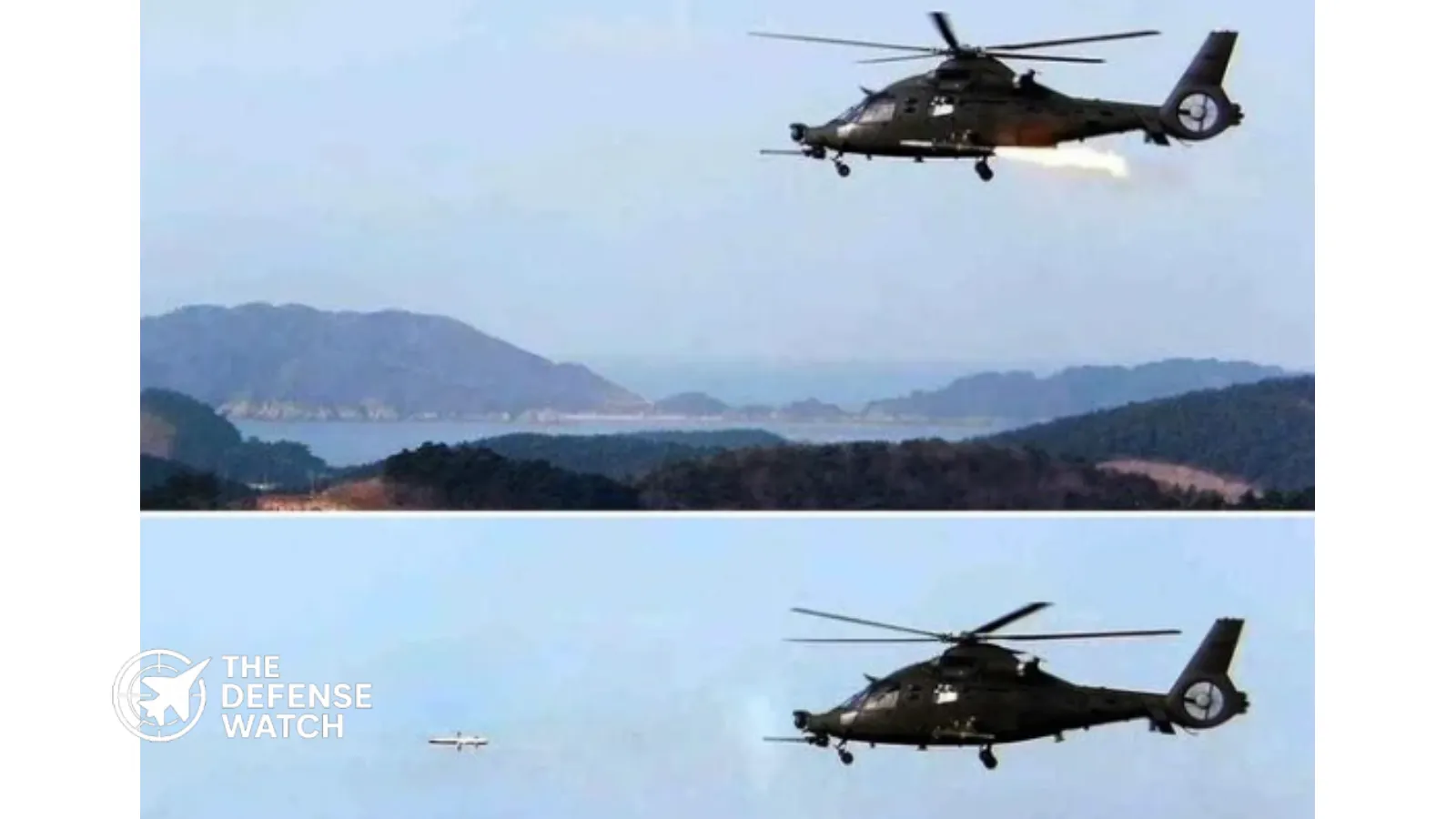
- South Korea has completed final combat suitability certification for the Cheongeom air launched anti tank guided missile.
- The missile features fire and forget and fire and update targeting with AI assisted image recognition.
- Cheongeom will arm the Republic of Korea’s Light Armed Helicopter fleet.
- The missile program began in 2015 under a development project worth roughly KRW180 billion.
- The system marks South Korea’s first domestically developed helicopter launched anti tank missile.
South Korea Completes Cheongeom Missile Final Certification
The Cheongeom missile has completed final certification after passing a combat suitability assessment conducted by South Korea’s Defense Acquisition Program Administration (DAPA). The milestone clears the way for operational deployment of the domestically developed air launched anti tank guided missile on the Republic of Korea’s Light Armed Helicopter fleet.
South Korea began development of the Cheongeom system in 2015 as part of a national effort to expand indigenous precision strike capabilities and reduce reliance on imported weapons. The missile was developed jointly by the Agency for Defense Development and defense contractor Hanwha Defense.
The Big Picture
South Korea’s defense modernization strategy increasingly focuses on domestic development of advanced precision weapons and missile systems. This approach reflects Seoul’s need to maintain technological independence while responding to rapidly evolving threats in Northeast Asia.
North Korea’s large inventory of armored vehicles, artillery, and mobile missile launchers continues to drive the Republic of Korea’s demand for precision strike systems capable of rapid targeting and engagement. Air launched anti tank weapons remain a key element of that capability.
At the same time, the Indo Pacific security environment has intensified competition among regional military powers. South Korea has accelerated development of indigenous platforms ranging from the KF 21 Boramae fighter to long range cruise missiles and missile defense systems.
The Cheongeom missile program fits within this broader effort to strengthen domestic defense manufacturing while expanding operational flexibility for the Republic of Korea Armed Forces.
What’s Happening
South Korea’s Defense Acquisition Program Administration announced that the Cheongeom air launched anti tank guided missile successfully completed its combat suitability evaluation in December.
The Cheongeom missile will primarily equip the Light Armed Helicopter developed by Korea Aerospace Industries for the Republic of Korea Army.
Key characteristics of the missile include:
- Diameter of about 150 mm
- Total weight of roughly 35 kg
- Modular design with seeker, propulsion, control system, and battery section
- Mid body thrust control nozzles for maneuverability
The missile supports both fire and forget and fire and update engagement modes. This allows operators to launch the missile and allow autonomous targeting, or to redirect the missile toward a new target after launch if battlefield conditions change.
DAPA also stated that the Cheongeom missile incorporates artificial intelligence based image recognition technology. The guidance system was trained using more than 800,000 frames of target imagery to enable automatic identification of fixed targets in emergency situations.
Officials indicated that the missile’s armor penetration capability is comparable to the US made AGM 114 Hellfire II, one of the most widely used helicopter launched anti armor weapons in Western militaries.
Why It Matters
The certification of the Cheongeom missile marks a significant milestone for South Korea’s indigenous precision strike ecosystem.
Historically, many helicopter launched anti tank missiles used by South Korea were imported systems, primarily from the United States. Developing a domestic equivalent provides several operational advantages.
First, it improves supply chain security. Domestic production reduces dependency on foreign suppliers during periods of crisis or export restrictions.
Second, local development enables integration with Korean designed platforms. The Light Armed Helicopter program required a weapon system optimized for the aircraft’s weight, targeting systems, and mission profiles.
Third, the missile demonstrates South Korea’s growing competence in advanced guidance technologies such as artificial intelligence assisted targeting.
These technologies are becoming increasingly important as modern battlefields become saturated with electronic warfare and countermeasure systems.
Strategic Implications
The Cheongeom missile strengthens South Korea’s ability to conduct rapid anti armor operations during high intensity conflict scenarios on the Korean Peninsula.
Helicopter launched anti tank weapons provide a critical layer of defense against armored breakthroughs and mobile missile launchers. They allow attack helicopters to strike enemy formations at stand off distances while remaining outside the range of many ground based weapons.
The system also contributes to South Korea’s layered deterrence strategy, which combines missile defense, precision strike, and rapid response forces.
More broadly, the program reinforces South Korea’s ambition to become a major exporter of advanced defense technology. Korean defense firms have recently secured export contracts for missile defense systems, armored vehicles, and artillery platforms across Europe and the Middle East.
A domestically developed helicopter launched missile expands the country’s export portfolio.
Competitor View
Regional competitors are closely monitoring South Korea’s rapid progress in missile and precision strike technology.
North Korea has prioritized armored maneuver units and mobile missile launchers as part of its asymmetric military strategy. Weapons such as the Cheongeom missile directly target those capabilities by enabling precision strikes against armored formations.
China may also view South Korea’s expanding indigenous missile ecosystem as part of a broader regional trend toward advanced stand off precision weapons.
Several Asian militaries are investing heavily in similar systems to improve anti armor and precision strike capabilities in high intensity conflict scenarios.
What To Watch Next
With the Cheongeom missile now certified, attention will shift toward full operational deployment.
Key milestones to watch include:
- Integration with Light Armed Helicopter squadrons
- Initial operational capability within the Republic of Korea Army
- Potential export marketing by South Korean defense firms
- Development of variants for ground or unmanned platforms
Defense industry reporting also indicates that lighter variants could eventually support infantry or armored vehicle applications, expanding the missile’s operational use cases.
Capability Gap
The Cheongeom missile was designed to address a specific operational gap in South Korea’s helicopter strike capability.
Attack helicopters require lightweight precision weapons capable of engaging modern armored vehicles equipped with reactive armor and countermeasures.
Imported systems such as the Hellfire missile provided that capability, but they limited South Korea’s control over production timelines and technological upgrades.
Developing the Cheongeom system domestically ensures that the Republic of Korea Armed Forces can adapt guidance software, targeting algorithms, and warhead designs based on evolving operational requirements.
However, the missile remains primarily optimized for helicopter platforms. Expanding its use to ground units or unmanned systems would require additional development and testing.
The Bottom Line
The certification of the Cheongeom missile strengthens South Korea’s indigenous precision strike capabilities and marks another step in Seoul’s broader effort to build a self reliant and export capable defense industry.