










@2026 – All Right Reserved. TheDefenseWatch.com
- Home
- Defense Systems
- Tanks & Armored Vehicles
- Type 10 Battle Tank (Japan)
Type 10 Battle Tank (Japan)
Defense Systems Full Specifications
1. General Information
| Vehicle Name | Type 10 (Hitomaru) |
| Type / Role | Main Battle Tank (MBT) |
| Manufacturer | Mitsubishi Heavy Industries |
| Country of Origin | Japan |
| In Service | Yes |
| Year Introduced | 2012 |
| Unit Cost | ≈ USD 8.4–11.3 million |
| Crew | 3 (Commander, Gunner, Driver) |
2. Dimensions & Weight
| Length (Gun Forward) | 9.42–9.485 m |
| Width | 3.24 m |
| Height | 2.30 m |
| Weight | 40 t (basic) / 44 t (standard) / 48 t (full) |
| Ground Clearance | Adjustable (hydropneumatic) |
| Chassis Material | Steel with modular composite |
3. Performance
| Engine Type | Diesel V8 (MHI 8VA34WTK) |
| Engine Power | 1,200 hp |
| Power-to-Weight Ratio | ≈27 hp/tonne |
| Transmission | Continuously variable (HMT) |
| Maximum Speed (Road) | 70 km/h |
| Maximum Speed (Off-Road) | Not publicly specified |
| Operational Range | 440–500 km |
| Suspension Type | Hydropneumatic |
4. Armament
| Main Gun | 120 mm L/44 smoothbore (Japan Steel Works) |
| Ammunition Capacity | ≈36 rounds (14 in autoloader) |
| Secondary Armament | 1 × 12.7 mm M2HB, 1 × 7.62 mm Type 74 |
| Gun Elevation/Depression | Not publicly detailed |
| Fire Control System | Digital FCS with hunter-killer |
| Stabilization | Dual-axis |
| Rate of Fire | ≈ every 3.5 seconds (autoloader) |
5. Protection & Armor
| Armor Type | Modular ceramic composite |
| Reactive Armor | Configurable modules |
| Active Protection System (APS) | Soft-kill standard; hard-kill under evaluation |
| NBC Protection | Yes |
| Smoke Grenade Launchers | Yes |
| Fire Suppression System | Automatic |
| Mine Protection | Reinforced design |
6. Mobility & Capability
| Maximum Gradient | 60% |
| Side Slope | ≈40% |
| Trench Crossing | ≈2.8 m |
| Vertical Obstacle | ≈1.1 m |
| Fording Depth | ≈1.75 m |
| Turning Radius | Neutral steer capable |
| Amphibious Capability | No |
7. Sensors & Electronics
| Fire Control Computer | Yes |
| Thermal Imaging | Commander & Gunner |
| Night Vision | Yes |
| Laser Rangefinder | Yes |
| Ballistic Computer | Yes |
| Communication System | Secure tactical / C4I |
| Battlefield Management System | Integrated |
8. Operational Info
| Service Branch | Japan Ground Self-Defense Force |
| Primary Operator | Japan |
| Combat Experience | None (training only) |
| Upgrade Packages | APS and RWS under study |
| Export Status | Restricted |
| Production Status | Low-rate ongoing |
PROS
- High power-to-weight ratio (≈27 hp/t) and equal forward/reverse speed for rapid repositioning
- Modular armor allows mission-specific weight and protection trade-offs
- Compact dimensions enable use of more Japanese bridges and roads than heavier Western MBTs
- Advanced hydropneumatic suspension improves gun stability and terrain adaptability
- Integrated C4I and 360° sensors enhance situational awareness
CONS
- Limited hard-kill active protection system (APS) as standard fit
- Lower production numbers keep unit cost relatively high
- No combat experience outside training and exercises
- Lighter armor package offers less absolute protection than heavier peers (Abrams, Leopard 2)
- Export restricted by Japanese policy, limiting global operator base
Type 10 Hitomaru: Japan’s Agile 4th-Gen MBT
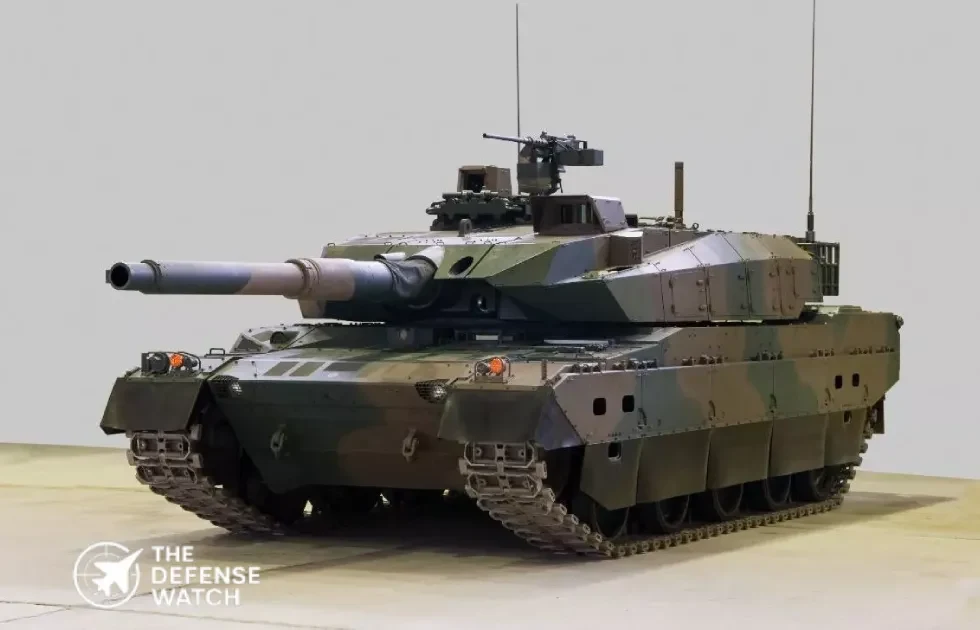
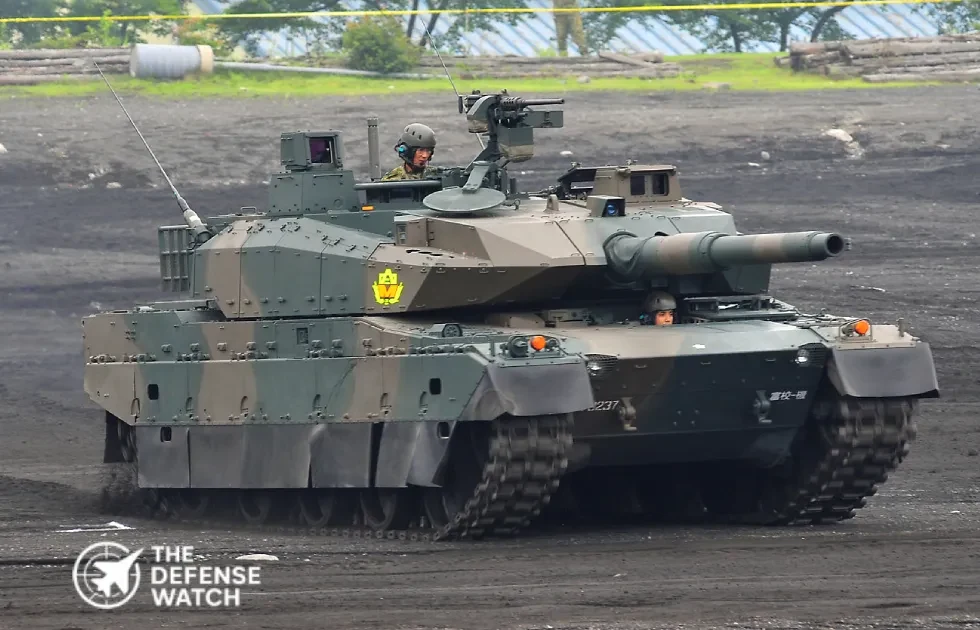
The Type 10, known as Hitomaru, is Japan’s fourth-generation main battle tank designed for the Japan Ground Self-Defense Force. Introduced to address the limitations of the Type 74 and Type 90, it prioritizes mobility across Japan’s constrained road and bridge networks while delivering modern firepower and networked battlefield awareness. Its compact size and adjustable weight make it one of the lightest modern MBTs, optimized for rapid deployment in mountainous and island terrain.
Manufacturer
Mitsubishi Heavy Industries produces the Type 10, with the 120 mm main gun supplied by Japan Steel Works. Development began in the late 1990s under the TK-X program; the tank formally entered service in January 2012. Over 100 units have been built, with low-rate production continuing to sustain industrial capacity.
Speed and Range
A 1,200 hp Mitsubishi 8VA34WTK V8 diesel engine paired with a continuously variable transmission (CVT) enables a top speed of 70 km/h in both forward and reverse. Operational range is approximately 440–500 km. Hydropneumatic suspension allows the hull to raise, lower, or tilt for better gun elevation, improved off-road performance, and reduced silhouette.
Cost/Price
Unit cost has varied with production volume. Early estimates were around $6.5–8.4 million; more recent figures place it near $11.3 million (2022), reflecting low annual production rates. Development costs totaled roughly ¥48.4 billion.
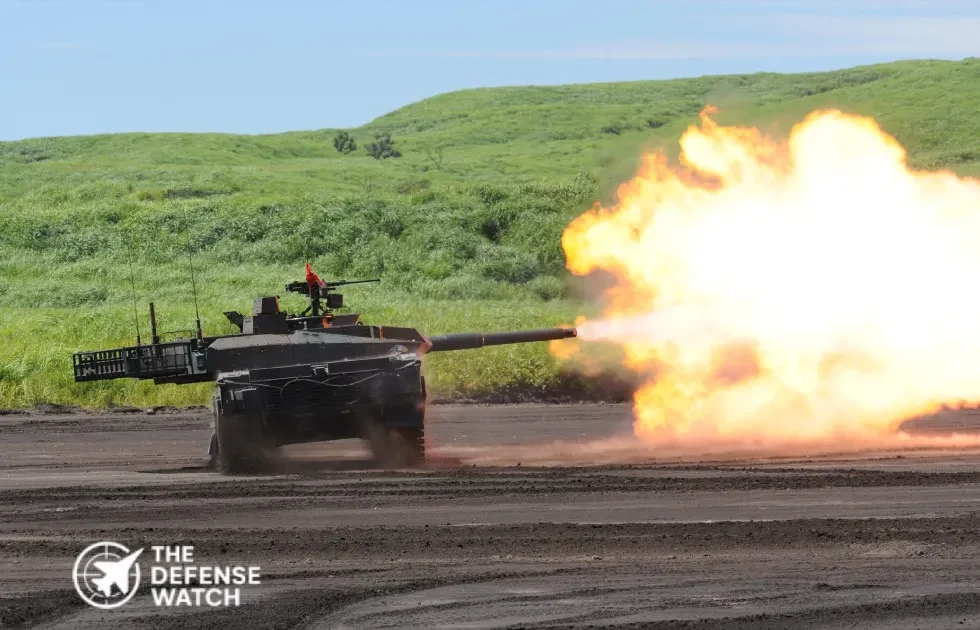
The Type 10 carries a Japan Steel Works 120 mm L/44 smoothbore gun with an autoloader (14 rounds ready), firing NATO-standard and Japanese Type 10 APFSDS ammunition. Secondary armament includes a coaxial 7.62 mm Type 74 machine gun and a roof-mounted 12.7 mm M2HB. Modular ceramic composite armor can be configured for basic (≈40 t), standard (≈44 t), or full (≈48 t) protection. Advanced C4I systems, 360-degree day/night sensors, and laser warning receivers support networked operations. No major combat success stories exist, as the Type 10 has not been deployed in overseas conflicts; its design success lies in meeting Japan’s specific mobility and infrastructure requirements.
Disclaimer Note
The information provided on TheDefenseWatch.com is for general informational purposes only. While we strive to ensure the accuracy, completeness, and timeliness of our content regarding defense and aerospace products, technologies, and specifications, we cannot guarantee that all information is 100% accurate or up-to-date due to the evolving nature of military technology and classified data.TheDefenseWatch.com does not warrant the reliability, suitability, or availability of the information for any specific purpose. Users are advised to consult official sources, such as manufacturers, government publications, or defense agencies, for precise and verified data before making decisions based on our content.We are not affiliated with any defense manufacturers, governments, or military organizations mentioned. Opinions, reviews, and ratings reflect expert analysis but are subjective and should not be considered endorsements. TheDefenseWatch.com is not responsible for any errors, omissions, or consequences arising from the use of this website’s content.External links are provided for convenience and do not imply endorsement. TheDefenseWatch.com reserves the right to update or modify content without prior notice. By using this website, you agree to our Privacy & Cookies Policy.
More Defense Systems from Mitsubishi Heavy Industries
New Arrivals
Popular Comparisons
-
 Su-57 Fighter Jet vs J-20 Fighter Jet: Stealth and Air Combat Compared
View Comparison →
Su-57 Fighter Jet vs J-20 Fighter Jet: Stealth and Air Combat Compared
View Comparison → -
Mirage 2000 vs Tejas Mk1A: Legacy Combat Power vs Indigenous Modernization
View Comparison →
-
Rafale Fighter Jet vs F-22 Raptor: Which Air Dominance Fighter Has the Edge?
View Comparison →
-
Tejas Fighter Jet vs. Rafale Fighter Jet: India’s Indigenous Fighter Meets France’s Proven Multirole Combat Aircraft
View Comparison →
-
F-22 Raptor vs. F-35 Joint Strike Fighter: Which Fifth Generation Fighter Has the Edge?
View Comparison →
-
F-35A vs. F-22 Raptor: Which U.S. Stealth Fighter Dominates Modern Air Combat?
View Comparison →
-
AGM-114 Hellfire vs. AGM-179 JAGM: Which U.S. Precision Missile Is Better?
View Comparison →
-
Patriot (PAC-3) vs. THAAD: Complete Missile Defense System Comparison, Capabilities, Range, and Strategic Roles
View Comparison →
-
AIM-120 AMRAAM vs. AIM-9X Sidewinder: Complete Air-to-Air Missile Comparison, Range, Speed, and Combat Roles
View Comparison →
-
BGM-109 Tomahawk vs. AGM-158 JASSM: Which Long Range Precision Strike Missile Offers Greater Strategic Advantage?
View Comparison →
- U.S. Air Force Plans Major F-15EX Technical Refresh as Production Expands

- Eutelsat Orders 229 OneWeb Satellites To Extend LEO Network Through 2034
- Australia Declares JASSM-ER and LRASM Operational on F/A-18F Super Hornets
- GCAP Electronics Contract Advances Integrated Sensing And Communications For Sixth Generation Fighter
- Northrop Grumman Expands B-21 Raider Production With New Utah Facility
- Kongsberg Integrates Echodyne Radar With PROTECTOR Stations for Counter-UAS Missio
- Anthropic Says Yemen Weapons Cell Used Claude Code to Develop Missile Guidance Software
- Northrop Grumman Expands Air Defense and Weapons Collaboration Across Central Europe
- Rolls-Royce B-52 Engine Contract Rises To $3.04 Billion
- General Dynamics Secures $184.25 Million NGEAU Contract For Navy Growler Upgrades