










@2026 – All Right Reserved. TheDefenseWatch.com
- Home
- Defense Systems
- Fighter Jets
- JF-17 Thunder Fighter Jet
JF-17 Thunder Fighter Jet
Defense Systems Full Specifications
General Information
| Name | JF-17 Thunder / FC-1 Xiaolong |
| Manufacturer | Pakistan Aeronautical Complex (PAC) & Chengdu Aircraft Industry Group (CAIG) |
| Country of Origin | Pakistan / China |
| Type / Role | Multirole Fighter |
| Generation | 4.5th |
| Status | Active Service |
| First Flight | August 25, 2003 |
| Introduction / In Service Since | 2010 |
| Number Built | 175+ units |
| Operators | Pakistan, Myanmar, Nigeria, Azerbaijan |
Dimensions & Structure
| Length | 14.33 m (47 ft) |
| Wingspan | 9.44 m (31 ft) |
| Height | 4.57 m (15 ft) |
| Wing Area | 24.4 m² (263 sq ft) |
| Empty Weight | 6,586 kg (14,520 lbs) |
| Maximum Takeoff Weight (MTOW) | 13,500 kg (29,762 lbs) |
| Internal Weapons Bay | None |
| External Hardpoints | 8 (including wingtip rails) |
Performance
| Maximum Speed | Mach 1.8 (1,910 km/h / 1,187 mph) |
| Range | 3,482 km (2,164 mi) with external drop tanks |
| Combat Radius | 900 km (560 mi) on internal fuel |
| Service Ceiling | 16,916 m (55,500 ft) |
| Rate of Climb | 300 m/s (59,000 ft/min) |
| Thrust-to-Weight Ratio | 1.07 (with full afterburner) |
| G Limits | +8 / -3 |
Powerplant
| Engine Type | Klimov RD-93MA afterburning turbofan |
| No. of Engines | 1 |
| Thrust (each) | 50.4 kN dry / 91.2 kN with afterburner |
| Thrust Vectoring | No |
| Fuel Capacity | 2,268 kg (5,000 lbs) internal |
Armament
| Gun | 1 × 23 mm GSh-23-2 twin-barrel autocannon |
| Missiles (Air-to-Air) | PL-5E, PL-10, PL-12, PL-15E (BVR) |
| Missiles (Air-to-Ground) | Ra'ad ALCM, CM-400AKG, C-802AK Anti-Ship |
| Bombs | LT-2 (Laser-guided), LS-6 (GPS-guided), Mk-82/84 |
| Hardpoints | 8 |
| Payload Capacity | 3,600 kg (7,936 lbs) |
Avionics & Systems
| Radar | KLJ-7A Active Electronically Scanned Array (AESA) |
| Radar Range | 160–170 km (against fighter-sized target) |
| Electronic Warfare (EW) System | Integrated digital EW suite & Missile Approach Warning System |
| Targeting System | Aselsan ASELPOD / WMD-7 targeting pods |
| Helmet Display | Helmet-Mounted Display and Sight (HMD/S) |
| Navigation | INS + GPS/Beidou satellite navigation |
| Autopilot / AI Assistance | Three-axis digital Fly-By-Wire (FBW) system |
| Communication | Secure, jam-resistant tactical data link |
Stealth & Technology
| Radar Cross Section (RCS) | Reduced frontal RCS compared to older blocks |
| Stealth Features | Radar-absorbent material coatings & minor airframe shaping |
| Infrared Signature Reduction | Limited |
| Sensor Fusion | Partial multi-sensor architecture |
| Networking Capabilities | Real-time command data sharing with ground/AWACS |
Variants
| Special Export Versions | JF-17N (Nigeria) – customized avionics and weapon suite; JF-17M (Myanmar) – tailored for local integration; JF-17E (Export) – export-optimized with optional Western avionics and weapon compatibility. |
Operational History
| Major Conflicts / Deployments | Operation Swift Retort (2019), Counter-insurgency ops |
| Notable Operators | Pakistan Air Force, Azerbaijan Air Force |
| Combat Proven? | Yes |
| Mission Types | Air Defense, Interdiction, Close Air Support, Anti-Ship Strike |
Cost & Program
| Unit Cost | $25 million – $35 million (estimated variant dependent) |
| Development Cost | $500 million (jointly shared initial program) |
| Program Name | Super-7 / JF-17 Thunder Program |
| Funding Countries | Pakistan and China |
Additional Information
| Upgrades Planned | Enhanced software integration and localized missile adaptations. |
| Future Replacement | Project AZM Next-Gen Fighter / Fifth-Gen acquisitions. |
| Export Restrictions | Subject to joint approval by Pakistan and China. |
| Notable Achievements | Successful integration of true long-range PL-15E BVR system. |
| Competitors | HAL Tejas (India), JAS 39 Gripen (Sweden), F-16 Fighting Falcon (USA) |
PROS
- Unmatched Cost-Efficiency: Provides near-peer 4.5-generation capabilities at a fraction of the cost of Western equivalents.
- Advanced Radar Technology: Equipped with the KLJ-7A AESA radar for superior tracking and electronic counter-countermeasures (ECCM).
- Diverse Weapon Payload: Features 8 external hardpoints compatible with a vast array of laser-guided, anti-ship, and BVR missiles.
- High Operational Availability: Formulated with modular open architecture avionics for quick servicing and simplified maintenance.
- No Political Strings Attached: Offers a highly strategic option for non-NATO buyers looking to bypass restrictive Western export licenses.
CONS
- Single-Engine Redundancy: Lacks the powerplant redundancy found in heavier, twin-engine fighter platforms.
- Limited Payload Capacity: Restricted to a maximum external payload of 3,600 kg (7,936 lbs) due to its lightweight structural design.
- Short Internal Range: Dependent on external drop tanks for long-range deployment or sustained air patrols.
- Minimal Stealth Characteristics: Possesses a standard fourth-generation airframe structure with limited radar-cross-section (RCS) reductions.
- Smaller Radar Aperture: The compact nose cone restricts the physical size and ultimate power processing of the array compared to heavy fighters.
JF-17 Thunder: Pakistan’s Multirole Fighter Powerhouse
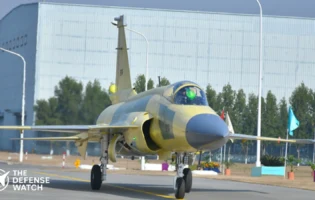
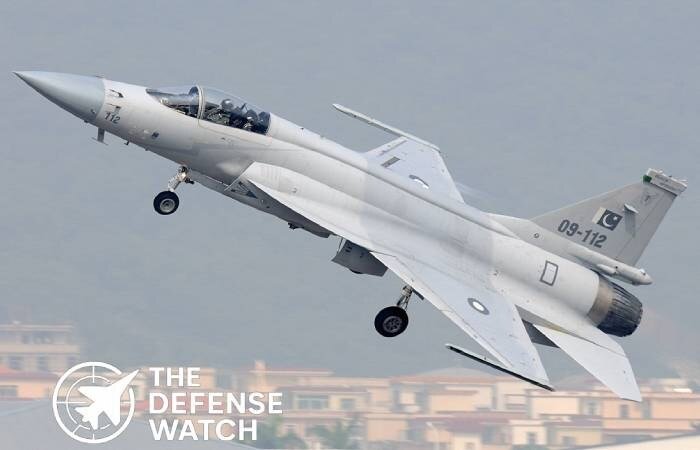
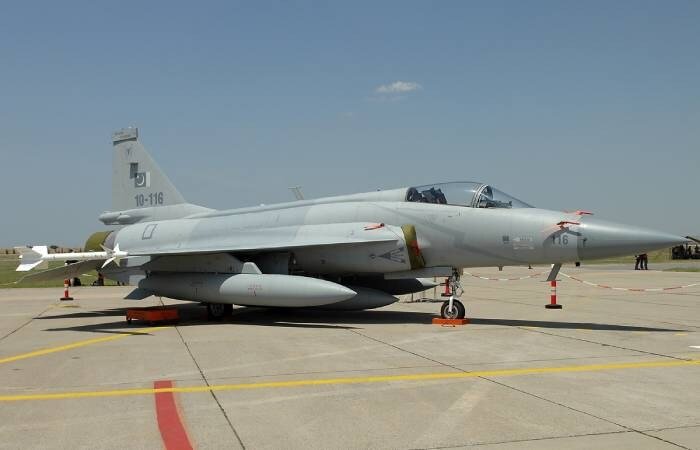
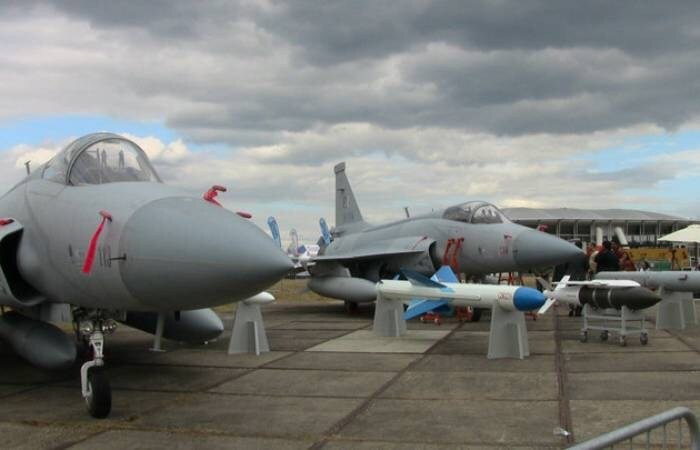
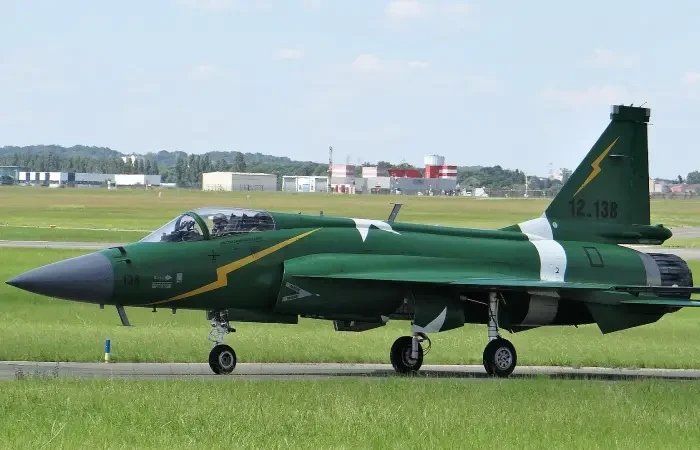
The CAC/PAC JF-17 Thunder (designated as the FC-1 Xiaolong in China) is a lightweight, single-engine, multirole combat aircraft designed to deliver high-performance aerial capabilities at an unmatched budget. Jointly developed and manufactured by the Pakistan Aeronautical Complex (PAC) and China’s Chengdu Aircraft Corporation (CAC), the aircraft serves as the backbone of the Pakistan Air Force (PAF) while steadily gaining traction in the global export market.
Engineered for strategic versatility, the latest Block 3 variant elevates the platform to a 4.5-generation fighter standard. It seamlessly handles diverse mission profiles, including air-to-air interception, precision ground attack, tactical reconnaissance, and maritime strike operations. Powered by an advanced Klimov RD-93MA afterburning turbofan engine, the JF-17 Thunder achieves a maximum speed of Mach 1.8 and reaches a service ceiling of 55,500 feet. It features a commendable internal ferry range of approximately 1,118 miles (1,800 km), which extends to over 2,160 miles (3,482 km) with external drop tanks, allowing for an operational combat radius of 560 miles (900 km).
What truly sets the modern JF-17 apart is its elite integration of Western-style ergonomics and Chinese digital warfare technology. The cockpit features a wide-angle holographic Head-Up Display (HUD), three large multifunction color displays, and a Helmet Mounted Display and Sight (HMD/S) system. This is paired with the cutting-edge KLJ-7A Active Electronically Scanned Array (AESA) fire-control radar, giving the jet a formidable detection range of up to 105 miles (170 km). Despite its advanced electronic warfare suites, digital fly-by-wire system, and compatibility with sophisticated beyond-visual-range (BVR) missiles like the PL-15, the JF-17 maintains an incredibly low procurement unit cost of $25 million to $35 million. This balance of advanced lethal technology and fiscal efficiency makes it an exceptionally disruptive asset in modern military aviation.
Variants
| Field | Example |
|---|---|
| JF-17 Block I | Initial production variant |
| JF-17 Block II | Improved avionics and refueling |
| JF-17 Block III | AESA radar, BVR missiles, IRST |
| JF-17B | Twin-seat trainer and strike variant |
Disclaimer Note
The information provided on TheDefenseWatch.com is for general informational purposes only. While we strive to ensure the accuracy, completeness, and timeliness of our content regarding defense and aerospace products, technologies, and specifications, we cannot guarantee that all information is 100% accurate or up-to-date due to the evolving nature of military technology and classified data.TheDefenseWatch.com does not warrant the reliability, suitability, or availability of the information for any specific purpose. Users are advised to consult official sources, such as manufacturers, government publications, or defense agencies, for precise and verified data before making decisions based on our content.We are not affiliated with any defense manufacturers, governments, or military organizations mentioned. Opinions, reviews, and ratings reflect expert analysis but are subjective and should not be considered endorsements. TheDefenseWatch.com is not responsible for any errors, omissions, or consequences arising from the use of this website’s content.External links are provided for convenience and do not imply endorsement. TheDefenseWatch.com reserves the right to update or modify content without prior notice. By using this website, you agree to our Privacy & Cookies Policy.
More Defense Systems from PAC - Pakistan Aeronautical Complex
New Arrivals
-
 PAC-2 Patriot Missile System
-
Patriot PAC-3 Missile Defense System
-
EA-18G Growler
-
J-50 Fighter Jet
-
Northrop Grumman GHOST-R GEO Recon Satellite
-
A-50 Mainstay Aircraft
-
Spanish EF-18 Hornet Fighter
-
Trident II D5 Missile
-
B-21 Raider Bomber
-
F-47 Fighter Jet
-
F-35i Adir Fighter Jet
-
Type 99B Main Battle Tank
Popular Comparisons
-
 Tejas Fighter Jet vs F-16 Fighting Falcon: Capability Compared
View Comparison →
Tejas Fighter Jet vs F-16 Fighting Falcon: Capability Compared
View Comparison → -
Rafale Fighter Jet vs F-16 Fighting Falcon : Which Fighter Has the Edge?
View Comparison →
-
Su-57 Fighter Jet vs J-20 Fighter Jet: Stealth and Air Combat Compared
View Comparison →
-
Mirage 2000 vs Tejas Mk1A: Legacy Combat Power vs Indigenous Modernization
View Comparison →
-
Rafale Fighter Jet vs F-22 Raptor: Which Air Dominance Fighter Has the Edge?
View Comparison →
-
Tejas Fighter Jet vs. Rafale Fighter Jet: India’s Indigenous Fighter Meets France’s Proven Multirole Combat Aircraft
View Comparison →
-
F-22 Raptor vs. F-35 Joint Strike Fighter: Which Fifth Generation Fighter Has the Edge?
View Comparison →
-
F-35A vs. F-22 Raptor: Which U.S. Stealth Fighter Dominates Modern Air Combat?
View Comparison →
-
AGM-114 Hellfire vs. AGM-179 JAGM: Which U.S. Precision Missile Is Better?
View Comparison →
-
Patriot (PAC-3) vs. THAAD: Complete Missile Defense System Comparison, Capabilities, Range, and Strategic Roles
View Comparison →
- X-Planes in the Drone Era: Why Experimental Aircraft Still Matter

- France to Deploy Troops, Radar and Air Defense to Protect Saudi Yanbu Oil Hub
- Greek-Operated Patriot Intercepts Ballistic Missile and Drone Over Saudi Arabia
- Raytheon Wins $50.1 Million Navy Order for EA-18G Next Generation Jammer Repairs
- Stark Aerospace Wins $114 Million MK 41 VLS Canister Contract
- Northrop Grumman Wins $123.8M F-35 APG-85 Lot 7 Radar Contract
- Leonardo, Fincantieri Win €3.7B Contract for Two Italian Navy DDX Destroyers
- Finnish President Urges Musk to Expand Starlink Access for Ukraine to Target Russian Missile Launchers
- MV-22B Osprey Completes First Navy Sonobuoy Acceptance Test
- Saab expands Swedish space role through new partnerships with SSC Space, OHB Sweden and Ericsson