
- Home
- Defense Systems
- Compare
- F-35A vs. F-22 Raptor: Which U.S. Stealth Fighter Dominates Modern Air Combat?
F-35A vs. F-22 Raptor: Which U.S. Stealth Fighter Dominates Modern Air Combat?
F-35A vs. F-22 Raptor: America’s Two Fifth-Generation Fighters Compared
Executive Summary & Tactical Overview
The Lockheed Martin F-22 Raptor and F-35A Lightning II represent the United States’ most advanced fifth-generation combat aircraft, but they were built around different operational philosophies. The F-22 was engineered primarily for air superiority, emphasizing unmatched stealth, supercruise, and close-range agility. The F-35A, by contrast, is a true multirole platform that integrates advanced sensors, electronic warfare capabilities, precision strike, and network-centric warfare into a single aircraft.
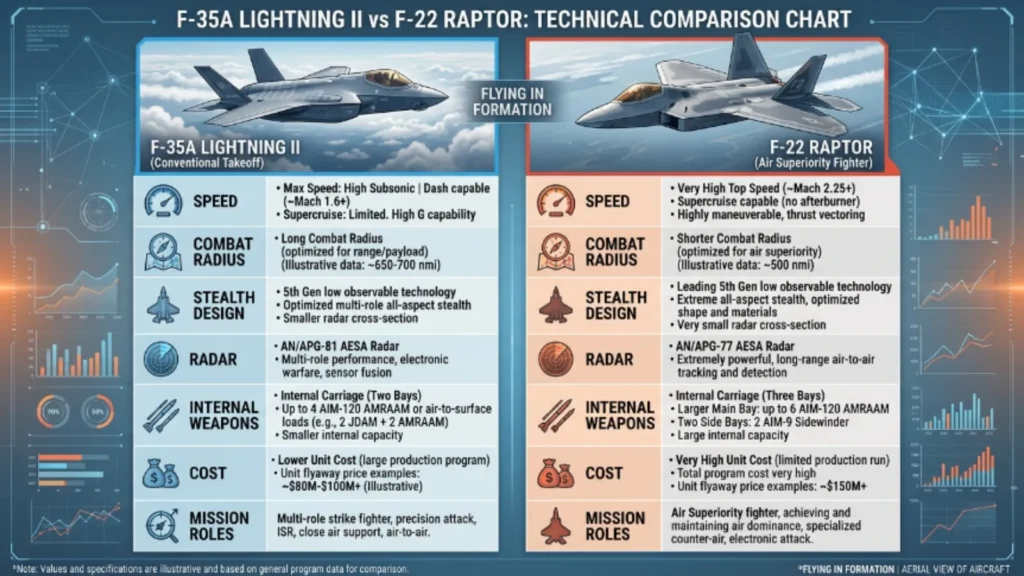
Rather than replacing one another, these fighters complement each other. The F-22 secures control of the skies, while the F-35A extends battlefield awareness and delivers precision effects across air, land, and maritime domains.
Key Takeaways
Primary Edge (F-35A):
- Superior sensor fusion, electronic warfare, precision strike, and multi-domain networking.
Primary Edge (F-22):
- Best-in-class air superiority with exceptional stealth, supercruise, maneuverability, and high-speed interception.
Strategic Context:
- The F-22 dominates in pure air combat against advanced fighters.
- The F-35A excels in integrated coalition operations requiring intelligence, surveillance, precision strike, and data sharing.
Technical Specifications Matrix
| Specification | F-35A Lightning II | F-22 Raptor |
|---|---|---|
| Generation / Type | Fifth-generation multirole fighter | Fifth-generation air superiority fighter |
| Manufacturer | Lockheed Martin | Lockheed Martin |
| Primary Mission | Strike, ISR, Air Defense, Electronic Warfare | Air Dominance |
| Crew | 1 | 1 |
| Maximum Speed | Mach 1.6 | Mach 2.25+ |
| Supercruise | No | Yes (Mach 1.5+) |
| Combat Radius | ~670 nautical miles (1,240 km) | ~590 nautical miles (1,090 km) |
| Ferry Range | ~1,350 nautical miles | ~1,600+ nautical miles |
| Service Ceiling | 50,000 ft | 65,000 ft |
| Internal Weapons Capacity | Up to 5,700 lb | Up to 5,000 lb |
| Maximum Payload | Approximately 18,000 lb | Approximately 20,000 lb |
| Radar | AN/APG-81 AESA | AN/APG-77 AESA |
| Electro-Optical System | EOTS + DAS | Limited IR capability |
| Sensor Fusion | Industry-leading | Advanced but less comprehensive |
| Electronic Warfare | AN/ASQ-239 suite | Defensive EW suite |
| Data Sharing | MADL, Link 16 | Link 16 (receive), IFDL |
| Stealth Design | Very Low Observable | Extremely Low Observable |
| Estimated Unit Cost | Approximately $82 million | Estimated over $140 million (production cost basis) |
Deep Dive Analysis
1. Stealth and Survivability
Both aircraft are among the world’s most difficult combat aircraft to detect, but their stealth priorities differ.
The F-22 was optimized specifically for defeating enemy fighters. Its shaping, radar-absorbing materials, internal weapon bays, and engine inlet design collectively produce one of the lowest radar cross sections ever achieved by an operational fighter. Combined with supercruise and extreme maneuverability through thrust-vectoring nozzles, the aircraft can engage opponents before they detect it.
The F-35A also features advanced low observable characteristics but balances stealth with multirole versatility. Its internal fuel capacity, integrated sensors, and electronic warfare suite enable it to penetrate sophisticated integrated air defense systems while conducting strike missions. Unlike the F-22, the F-35A relies more heavily on electronic attack, passive sensing, and networked operations to enhance survivability.
Advantage: F-22 for pure stealth and air combat survivability.
2. Sensors, Radar and Targeting Capabilities
This is where the F-35A establishes a clear technological advantage.
The AN/APG-81 AESA radar works alongside the Distributed Aperture System (DAS), Electro-Optical Targeting System (EOTS), and AN/ASQ-239 electronic warfare suite. These systems are fused into a single pilot display, reducing workload while providing an exceptionally detailed picture of the battlespace.
The F-35A can detect, classify, track, and share targets across multiple domains simultaneously. Through the Multifunction Advanced Data Link (MADL), it exchanges secure information with other F-35s while also supporting Link 16 connectivity with allied forces.
The F-22’s AN/APG-77 AESA radar remains one of the most capable air-to-air radars ever fielded. It excels at long-range fighter detection while maintaining low probability of intercept. However, its sensor fusion architecture reflects an earlier generation and lacks the same degree of integrated battlespace awareness offered by the F-35A.
Advantage: F-35A.
3. Weapons, Mission Flexibility and Operational Employment
The F-22 was designed primarily to destroy enemy fighters. Its standard internal air-to-air configuration includes AIM-120 AMRAAM and AIM-9X missiles, supported by a 20 mm M61A2 cannon. Although later upgrades added limited precision strike capability, the aircraft remains focused on achieving and maintaining air superiority.
The F-35A was built from the outset as a multirole combat platform. It can employ a wide array of precision-guided munitions, including JDAMs, Small Diameter Bombs, AGM-158 JASSM, anti-radiation weapons, and modern air-to-air missiles. Future upgrades will expand its arsenal to include additional long-range and collaborative weapons.
Operationally, the F-35A has become the backbone of numerous allied air forces, with widespread adoption across NATO and Indo-Pacific partners. The F-22, while unmatched in its specialized role, remains exclusive to the U.S. Air Force and was produced in limited numbers.
Advantage: F-35A for mission flexibility and global interoperability.
Strategic Verdict and Tactical Scenarios
The F-35A and F-22 should not be viewed as direct competitors. They were designed to perform complementary missions within the U.S. Air Force’s broader combat architecture.
When the F-35A Prevails
- Precision strike against heavily defended targets.
- Joint operations requiring sensor fusion and battlefield networking.
- Electronic warfare and suppression of enemy air defenses.
- Coalition operations with allied air forces.
- Multi-role missions combining reconnaissance and strike.
When the F-22 Prevails
- Air superiority campaigns.
- Beyond-visual-range fighter engagements.
- High-speed interception missions.
- Countering advanced enemy fighters.
- Establishing air dominance before follow-on operations.
Final Assessment
The F-22 Raptor remains the benchmark for dedicated air superiority, combining exceptional stealth, supercruise, high-altitude performance, and unmatched maneuverability to dominate contested airspace. For missions centered on defeating enemy fighters and securing control of the skies, it continues to set the standard.
The F-35A Lightning II, however, represents the broader future of air warfare. Its strength lies in integrating advanced sensors, electronic warfare, precision strike, and secure networking into a single platform capable of operating across multiple mission sets. In modern coalition operations, where information sharing and multi-domain coordination are critical, the F-35A offers capabilities that extend well beyond traditional fighter performance.
While the F-22 remains the superior air-to-air specialist, the F-35A provides greater overall operational versatility, making the two aircraft complementary pillars of U.S. and allied airpower rather than direct replacements for one another.
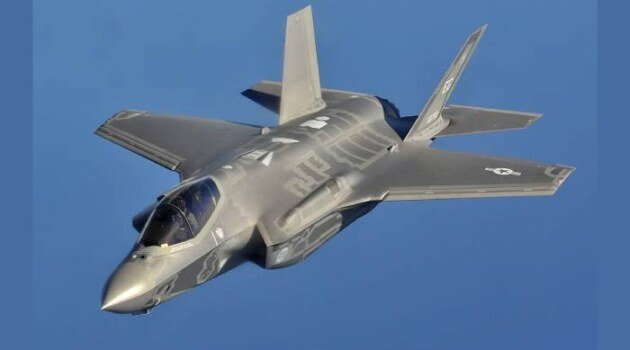
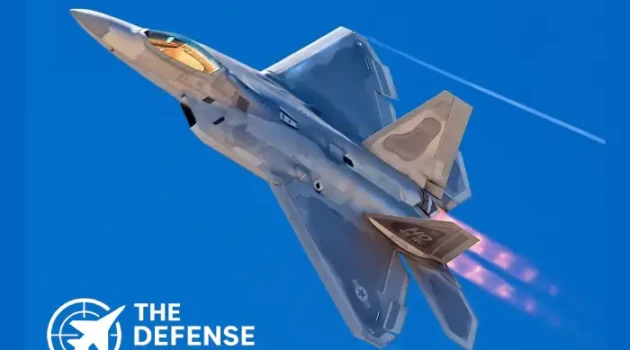
| |
| Price | |
| Our Rating | |
| Manufacturer | Lockheed Martin Lockheed Martin |
| Category | Fighter Jets Fighter Jets |
General Information
| Name | F-35A Lightning II F-22 Raptor |
| Manufacturer | Lockheed Martin Lockheed Martin, Boeing Defense |
| Country of Origin | United States United States |
| Type / Role | Stealth Multirole Fighter Air Superiority Stealth Fighter |
| Generation | 5th Generation Fifth Generation |
| Status | In Service In active service |
| First Flight | December 15, 2006 September 7, 1997 |
| Introduction / In Service Since | 2016 December 15, 2005 |
| Number Built | 1,200+ (all variants) 187 operational units |
| Operators | USAF, UK, Italy, Japan, Australia, Israel, and others United States Air Force |
Dimensions & Structure
| Length | 51.4 ft (15.67 m) 62 ft (18.9 m) |
| Wingspan | 35 ft (10.7 m) 44.5 ft (13.6 m) |
| Height | 14.4 ft (4.38 m) 16.7 ft (5.1 m) |
| Wing Area | 460 sq ft (42.7 m²) 840 sq ft (78 m²) |
| Empty Weight | 29,300 lb (13,290 kg) 43,340 lb (19,700 kg) |
| Maximum Takeoff Weight (MTOW) | 0,000 lb (31,800 kg) 83,500 lb (38,000 kg) |
| Internal Weapons Bay | 2 bays (4 hardpoints) 3 total (1 centerline, 2 side) |
| External Hardpoints | 6 4 (non-stealth configuration) |
Performance
| Maximum Speed | Mach 1.6 Mach 2.25 (2,414 km/h) |
| Range | 1,380 miles (2,220 km) 1,840 miles (2,960 km) |
| Combat Radius | 670 nmi (1,240 km) 530 miles (850 km) |
| Service Ceiling | 50,000 ft (15,240 m) 65,000 ft (19,800 m) |
| Rate of Climb | 45,000 ft/min 62,000 ft/min (315 m/s) |
| Thrust-to-Weight Ratio | 1.07 1.26 |
| G Limits | +9 +9 G |
Powerplant
| Engine Type | Pratt & Whitney F135-PW-100 Pratt & Whitney F119-PW-100 turbofan |
| No. of Engines | 1 2 |
| Thrust (each) | 43,000 lbf (191 kN) with afterburner 35,000 lbf (156 kN) |
| Thrust Vectoring | No Yes (2D pitch vectoring) |
| Fuel Capacity | 18,498 lb (8,382 kg) internal 18,000 lb (8,200 kg) internal |
Armament
| Gun | GAU-22/A 25mm cannon 1× M61A2 Vulcan 20mm cannon |
| Missiles (Air-to-Air) | AIM-120 AMRAAM, AIM-9X Sidewinder AIM-120 AMRAAM, AIM-9 Sidewinder |
| Missiles (Air-to-Ground) | AGM-154 JSOW, AGM-158 JASSM JDAM, SDB |
| Bombs | JDAM, Paveway II/III, SDB GBU-32 JDAM, GBU-39 SDB |
| Hardpoints | 10 (4 internal, 6 external) 4 external (optional) |
| Payload Capacity | 18,000 lb (8,160 kg) 18,000 lb (8,200 kg) |
Avionics & Systems
| Radar | AN/APG-81 AESA AN/APG-77 AESA radar |
| Radar Range | 150+ miles 125+ miles (200+ km) |
| Electronic Warfare (EW) System | AN/ASQ-239 Barracuda AN/ALR-94 suite |
| Targeting System | EOTS (Electro-Optical Targeting System) Integrated multi-sensor fusion |
| Helmet Display | Gen III HMDS Standard HUD (no HMD in baseline) |
| Navigation | GPS/INS with Terrain Following GPS/INS |
| Autopilot / AI Assistance | Autonomous mission management Digital fly-by-wire |
| Communication | Multifunction Advanced Datalink (MADL), Link 16 Intra-flight data link, secure comms |
Stealth & Technology
| Radar Cross Section (RCS) | ~0.001 m² ~0.0001 m² |
| Stealth Features | RAM coatings, internal weapons, edge alignment Radar-absorbent materials, internal weapons |
| Infrared Signature Reduction | Yes Engine exhaust shielding |
| Sensor Fusion | Full 360° situational integration Yes |
| Networking Capabilities | C4ISR-enabled with allied interoperability Limited Link-16, proprietary data link |
Variants
| Special Export Versions | F-35I (Israel), F-35A (Japan), F-35A (Finland) None (export restricted) |
Operational History
| Major Conflicts / Deployments | Syria, Middle East operations Syria (2014–present) |
| Notable Operators | USAF, RAF, RAAF, IAF USAF (Air Combat Command, PACAF) |
| Combat Proven? | Yes Yes |
| Mission Types | Air superiority, strike, ISR, SEAD Air superiority, interception, precision strike |
Cost & Program
| Unit Cost | $82.5 million (Lot 18) ~$150 million (flyaway) |
| Development Cost | Over $400 billion (program total) ~$67 billion (program total) |
| Program Name | Joint Strike Fighter (JSF) Advanced Tactical Fighter (ATF) |
| Funding Countries | USA, UK, Italy, Netherlands, Australia, others United States only |
Additional Information
| Upgrades Planned | Block 4 software/hardware upgrade Avionics, radar, networking, sensors |
| Future Replacement | None (expected to serve beyond 2070) NGAD (Next Generation Air Dominance) |
| Export Restrictions | Limited to U.S. allies U.S. Congress export ban |
| Notable Achievements | Widest deployed 5th-gen jet First operational 5th-gen fighter |
| Competitors | Su-57, J-20, FC-31 F-35 Lightning II, Su-57, J-20 |

|
Disclaimer Note
The information provided on TheDefenseWatch.com is for general informational purposes only. While we strive to ensure the accuracy, completeness, and timeliness of our content regarding defense and aerospace products, technologies, and specifications, we cannot guarantee that all information is 100% accurate or up-to-date due to the evolving nature of military technology and classified data.TheDefenseWatch.com does not warrant the reliability, suitability, or availability of the information for any specific purpose. Users are advised to consult official sources, such as manufacturers, government publications, or defense agencies, for precise and verified data before making decisions based on our content.We are not affiliated with any defense manufacturers, governments, or military organizations mentioned. Opinions, reviews, and ratings reflect expert analysis but are subjective and should not be considered endorsements. TheDefenseWatch.com is not responsible for any errors, omissions, or consequences arising from the use of this website’s content.External links are provided for convenience and do not imply endorsement. TheDefenseWatch.com reserves the right to update or modify content without prior notice. By using this website, you agree to our Privacy & Cookies Policy.
New Arrivals

Popular Comparisons
-
 J-10C vs JF-17 Thunder: Which Fighter Is More Capable?
View Comparison →
J-10C vs JF-17 Thunder: Which Fighter Is More Capable?
View Comparison → -
Tejas vs Gripen: Key Differences and Capabilities
View Comparison →
-
Tejas vs MiG-21 Bison: How India Replaced Its Iconic Supersonic Fighter
View Comparison →
-
F-35 vs F-16: Stealth, Sensors and Combat Roles
View Comparison →
-
Tejas Fighter Jet vs F-16 Fighting Falcon: Capability Compared
View Comparison →
-
Rafale Fighter Jet vs F-16 Fighting Falcon : Which Fighter Has the Edge?
View Comparison →
-
Su-57 Fighter Jet vs J-20 Fighter Jet: Stealth and Air Combat Compared
View Comparison →
-
Mirage 2000 vs Tejas Mk1A: Legacy Combat Power vs Indigenous Modernization
View Comparison →
-
Rafale Fighter Jet vs F-22 Raptor: Which Air Dominance Fighter Has the Edge?
View Comparison →
-
Tejas Fighter Jet vs. Rafale Fighter Jet: India’s Indigenous Fighter Meets France’s Proven Multirole Combat Aircraft
View Comparison →


- Most Advanced Fighter Jet in the World in 2026: F-22 vs. F-35 vs. J-20

- Lockheed Martin Wins $88.6 Million Navy Contract for Radiant Mercury Systems
- Pentagon Uses Department of War Name to Reinforce Message to Adversaries
- Israel’s Military Chief Reportedly Opposed Pre-Election Strike on Iran
- Canada Receives First Two F-35 Fighters as Review of 72 Aircraft Continues
- Lockheed Martin Completes $3.45 Billion Ultra Maritime Acquisition
- Lockheed Martin Advances Ramjet-Powered PrSM Increment 4 Missile
- USAF Thunderbirds Conduct Aerial Refueling Over Gulf Coast
- Saudi, Turkish and Pakistani Officials to Meet Iran in Tehran
- IDF Chief Reportedly Resists Netanyahu Order Over Iran as Israeli Election Nears






Fighter Jets
-
 F-100 Super Sabre
-
North American F-86 Sabre
-
Northrop YF-23 Fighter
-
Rafale F5 Fighter
-
SU-57 Felon Stealth Fighter
-
Boeing F/A-XX Fighter
-
JF-17 Thunder Fighter Jet
-
F-47 Fighter Jet
-
MIG-31 Fighter Jet
-
J-10CE Fighter Jet
-
Chengdu J-10 Fighter Jet
-
Chengdu J-10C Fighter Jet
-
Gripen E Fighter Jet
-
Tejas Mk1A Fighter Jet
-
Tejas Mk‑2 Fighter Jet
-
F-16V Viper Block 70 Fighter Jet
-
F-15EX Eagle II Fighter
-
F-15E Strike Eagle Fighter
-
F/A-18E/F Super Hornet Fighter Jet
-
Saab Gripen F Fighter Jet
-
JAS 39E/F Gripen Fighter Jet
-
JAS 39 Gripen Fighter Jet
-
F-35A Lightning II Fighter Jet
-
F/A-18F Super Hornet







Recent Compares
-
J-10C vs JF-17 Thunder: Which Fighter Is More Capable?
View Comparison →
-
Tejas vs Gripen: Key Differences and Capabilities
View Comparison →
-
Tejas vs MiG-21 Bison: How India Replaced Its Iconic Supersonic Fighter
View Comparison →
-
F-35 vs F-16: Stealth, Sensors and Combat Roles
View Comparison →
-
Tejas Fighter Jet vs F-16 Fighting Falcon: Capability Compared
View Comparison →
Latest Defense Systems
10 Compares Defense Systems
-
J-10C vs JF-17 Thunder: Which Fighter Is More Capable?
View Comparison →
-
Tejas vs Gripen: Key Differences and Capabilities
View Comparison →
-
Tejas vs MiG-21 Bison: How India Replaced Its Iconic Supersonic Fighter
View Comparison →
-
F-35 vs F-16: Stealth, Sensors and Combat Roles
View Comparison →
-
Tejas Fighter Jet vs F-16 Fighting Falcon: Capability Compared
View Comparison →
-
Rafale Fighter Jet vs F-16 Fighting Falcon : Which Fighter Has the Edge?
View Comparison →
-
Su-57 Fighter Jet vs J-20 Fighter Jet: Stealth and Air Combat Compared
View Comparison →
-
Mirage 2000 vs Tejas Mk1A: Legacy Combat Power vs Indigenous Modernization
View Comparison →
-
Rafale Fighter Jet vs F-22 Raptor: Which Air Dominance Fighter Has the Edge?
View Comparison →
-
Tejas Fighter Jet vs. Rafale Fighter Jet: India’s Indigenous Fighter Meets France’s Proven Multirole Combat Aircraft
View Comparison →
- Most Advanced Fighter Jet in the World in 2026: F-22 vs. F-35 vs. J-20
- Lockheed Martin Wins $88.6 Million Navy Contract for Radiant Mercury Systems
- Pentagon Uses Department of War Name to Reinforce Message to Adversaries
- Israel’s Military Chief Reportedly Opposed Pre-Election Strike on Iran
- Canada Receives First Two F-35 Fighters as Review of 72 Aircraft Continues