














@2026 – All Right Reserved. TheDefenseWatch.com
- Home
- Defense Systems
- Bombers & Strategic Aircraft
- RC-135 Reconnaissance Aircraft
RC-135 Reconnaissance Aircraft
Defense Systems Full Specifications
1. General Information
| Name | RC-135 Rivet Joint |
| Manufacturer | Boeing |
| Country of Origin | United States |
| Introduction / In Service Since | 1960s / Active |
| Status | Operational |
| Category | Signals Intelligence (SIGINT) Aircraft |
| Crew | 27-30 |
| Unit Cost | Estimated $200M-$300M+ (modernized aircraft value) |
2. Dimensions & Structure
| Length | 136 ft 7 in (41.6 m) |
| Wingspan | 130 ft 10 in (39.9 m) |
| Height | 41 ft 8 in (12.7 m) |
| Wing Area | 2,433 sq ft (226 m²) |
| Empty Weight | Approx. 124,000 lb (56,246 kg) |
| Maximum Takeoff Weight (MTOW) | 297,000 lb (134,717 kg) |
3. Performance
| Maximum Speed | 580 mph (933 km/h) |
| Range | 3,400+ miles (5,500+ km) |
| Combat Radius | Mission-dependent |
| Service Ceiling | 50,000 ft (15,240 m) |
| Rate of Climb | Approx. 4,900 ft/min |
4. Powerplant
| Engine Type | 4 × F108-CF-201 Turbofan |
| Thrust (per engine) | 21,634 lbf |
| Total Thrust | 86,536 lbf |
5. Payload & Armament
| Internal Payload Capacity | Intelligence equipment and operators |
| Weapons Bay | None |
| Compatible Weapons | None |
| Hardpoints | None |
6. Avionics & Systems
| Radar System | Classified ISR mission sensors |
| Navigation | Advanced GPS/INS Navigation Suite |
| Electronic Warfare (EW) | Comprehensive SIGINT and ELINT Systems |
| Stealth Features | None |
7. Operational History
| Primary Operator | U.S. Air Force |
| Conflict Usage | Cold War, Gulf War, Iraq, Afghanistan, Indo-Pacific Operations |
| Notable Missions | Strategic surveillance and electronic intelligence collection worldwide |
8. Additional Information
| Variants | RC-135V, RC-135W, RC-135U, RC-135S |
| Successor / Future Replacement | No direct replacement currently announced |
| Notable Features | Real-time SIGINT and ELINT collection |
| Estimated Operational Life | Beyond 2035 with upgrades |
PROS
- Exceptional signals intelligence collection capability
- Long endurance with aerial refueling support
- Proven operational record across multiple decades
- Advanced electronic surveillance and analysis systems
- Provides real-time intelligence to commanders
CONS
- High operating and maintenance costs
- Aging airframe design
- Requires large specialized crew
- Non-stealth platform vulnerable in contested airspace
- Dependent on escort and support assets in high-threat environments
RC-135 Rivet Joint: America’s Premier Intelligence Aircraft
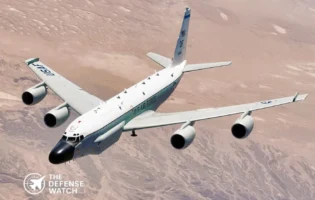
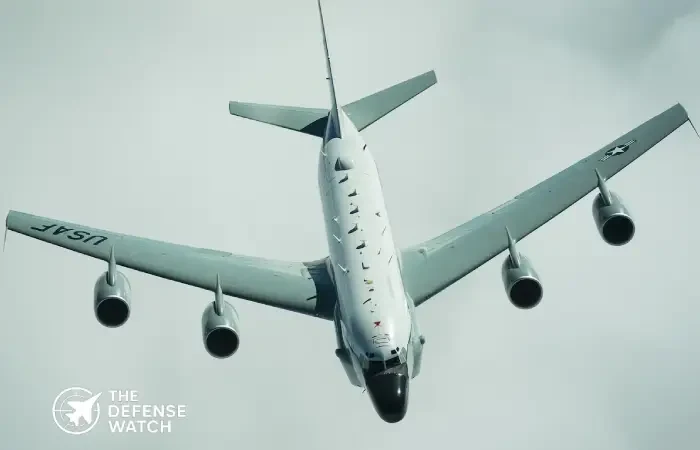
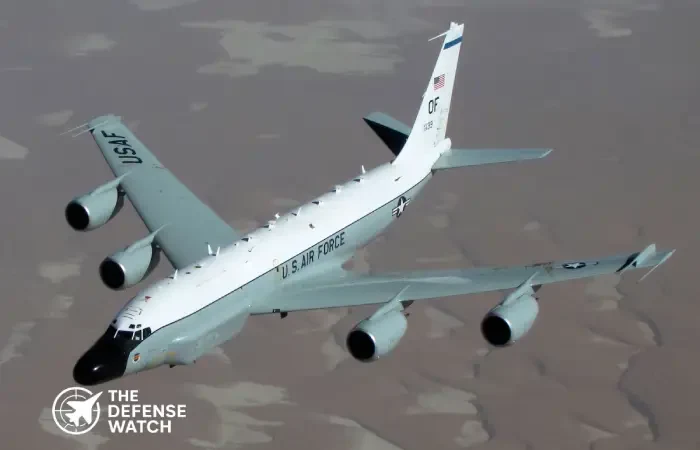
The RC-135 Rivet Joint is one of the United States Air Force’s most important intelligence, surveillance, and reconnaissance (ISR) aircraft. Developed from the Boeing C-135 airframe, the aircraft is designed to collect, analyze, and transmit electronic intelligence (ELINT) and signals intelligence (SIGINT) from hostile or strategic targets. Operating worldwide, the RC-135 provides commanders with real-time battlefield awareness and strategic intelligence.
Unlike combat aircraft, the RC-135 carries no offensive weapons. Its mission focuses on detecting radar emissions, communications signals, and other electronic activities that reveal enemy capabilities and intentions. The aircraft has played a critical role in conflicts and monitoring operations from the Cold War to modern-day military deployments.
Manufacturer
The RC-135 was manufactured by Boeing and modified by several defense contractors, including L3Harris Technologies. It originated in the United States and entered operational service during the 1960s. Continuous upgrades have kept the platform relevant despite its age, allowing it to remain a cornerstone of U.S. airborne intelligence operations.
Speed and Range
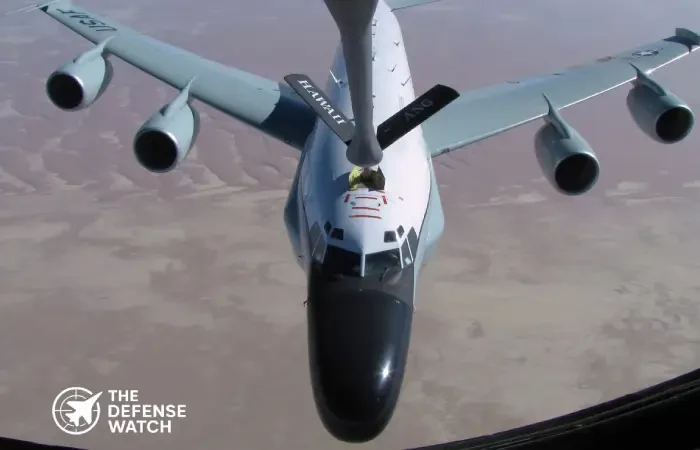
Powered by four CFM International F108-CF-201 turbofan engines, the RC-135 can reach speeds of approximately 580 mph (933 km/h). The aircraft has an operational range exceeding 3,400 miles (5,500 km) without refueling and can remain airborne for extended periods with aerial refueling support. Its endurance allows it to monitor large areas and conduct long-duration intelligence missions far from home bases.
Cost/Price
The exact cost of individual RC-135 aircraft varies because most airframes have undergone extensive modernization programs. Modern upgrades and mission systems can push the value of a fully equipped RC-135 into several hundred million dollars. Operating costs are also significant due to the aircraft’s specialized sensors, crew requirements, and maintenance demands.
The RC-135 remains a vital intelligence asset for the United States, providing strategic and tactical information that supports military planning, crisis response, and global security operations.
Disclaimer Note
The information provided on TheDefenseWatch.com is for general informational purposes only. While we strive to ensure the accuracy, completeness, and timeliness of our content regarding defense and aerospace products, technologies, and specifications, we cannot guarantee that all information is 100% accurate or up-to-date due to the evolving nature of military technology and classified data.TheDefenseWatch.com does not warrant the reliability, suitability, or availability of the information for any specific purpose. Users are advised to consult official sources, such as manufacturers, government publications, or defense agencies, for precise and verified data before making decisions based on our content.We are not affiliated with any defense manufacturers, governments, or military organizations mentioned. Opinions, reviews, and ratings reflect expert analysis but are subjective and should not be considered endorsements. TheDefenseWatch.com is not responsible for any errors, omissions, or consequences arising from the use of this website’s content.External links are provided for convenience and do not imply endorsement. TheDefenseWatch.com reserves the right to update or modify content without prior notice. By using this website, you agree to our Privacy & Cookies Policy.
New Arrivals
Popular Comparisons
-
 Su-57 Fighter Jet vs J-20 Fighter Jet: Stealth and Air Combat Compared
View Comparison →
Su-57 Fighter Jet vs J-20 Fighter Jet: Stealth and Air Combat Compared
View Comparison → -
Mirage 2000 vs Tejas Mk1A: Legacy Combat Power vs Indigenous Modernization
View Comparison →
-
Rafale Fighter Jet vs F-22 Raptor: Which Air Dominance Fighter Has the Edge?
View Comparison →
-
Tejas Fighter Jet vs. Rafale Fighter Jet: India’s Indigenous Fighter Meets France’s Proven Multirole Combat Aircraft
View Comparison →
-
F-22 Raptor vs. F-35 Joint Strike Fighter: Which Fifth Generation Fighter Has the Edge?
View Comparison →
-
F-35A vs. F-22 Raptor: Which U.S. Stealth Fighter Dominates Modern Air Combat?
View Comparison →
-
AGM-114 Hellfire vs. AGM-179 JAGM: Which U.S. Precision Missile Is Better?
View Comparison →
-
Patriot (PAC-3) vs. THAAD: Complete Missile Defense System Comparison, Capabilities, Range, and Strategic Roles
View Comparison →
-
AIM-120 AMRAAM vs. AIM-9X Sidewinder: Complete Air-to-Air Missile Comparison, Range, Speed, and Combat Roles
View Comparison →
-
BGM-109 Tomahawk vs. AGM-158 JASSM: Which Long Range Precision Strike Missile Offers Greater Strategic Advantage?
View Comparison →
- U.S. Air Force Plans Major F-15EX Technical Refresh as Production Expands

- Eutelsat Orders 229 OneWeb Satellites To Extend LEO Network Through 2034
- Australia Declares JASSM-ER and LRASM Operational on F/A-18F Super Hornets
- GCAP Electronics Contract Advances Integrated Sensing And Communications For Sixth Generation Fighter
- Northrop Grumman Expands B-21 Raider Production With New Utah Facility
- Kongsberg Integrates Echodyne Radar With PROTECTOR Stations for Counter-UAS Missio
- Anthropic Says Yemen Weapons Cell Used Claude Code to Develop Missile Guidance Software
- Northrop Grumman Expands Air Defense and Weapons Collaboration Across Central Europe
- Rolls-Royce B-52 Engine Contract Rises To $3.04 Billion
- General Dynamics Secures $184.25 Million NGEAU Contract For Navy Growler Upgrades