Executive Summary:
Australia is advancing plans to replace its aging Hawk 127 advanced jet trainer fleet, according to recent reporting by FlightGlobal. The move reflects the Royal Australian Air Force’s need to align pilot training with fifth generation aircraft operations, including the F-35A Lightning II, and with broader allied training standards.
Australia Advances Hawk Trainer Replacement Plans
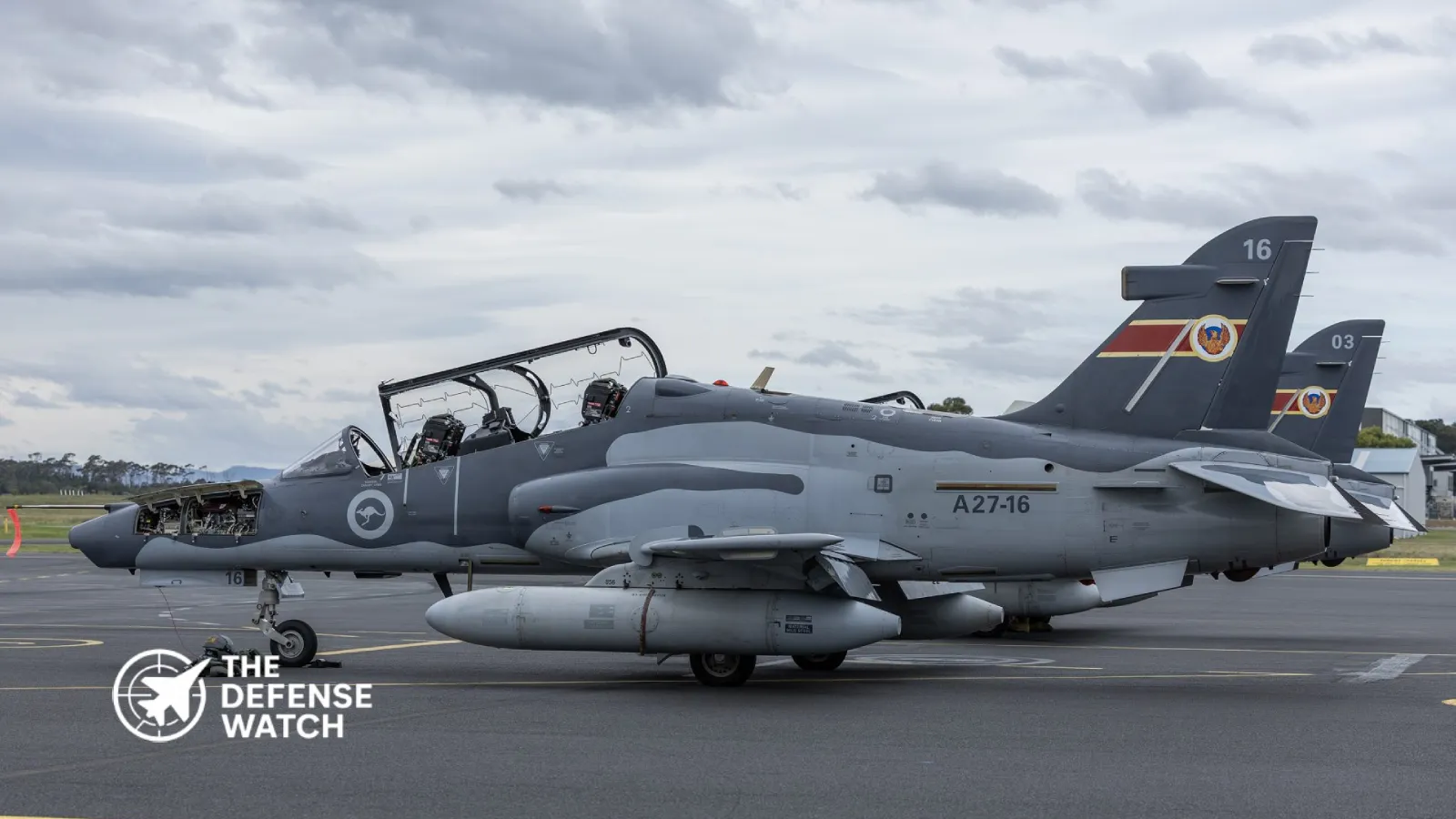
Australia’s Hawk trainer replacement effort has entered a more defined planning phase as the government evaluates options for a successor to the Royal Australian Air Force’s Hawk 127 fleet. The aircraft have been in service since the early 2000s and form the core of Australia’s lead-in fighter training system.
- Australia Advances Hawk Trainer Replacement Plans
- Why Australia Is Looking Beyond The Hawk 127
- The Hawk 127 Fleet In Context
- What Aircraft Could Compete?
- The T-7A Factor
- Analysis: Why This Matters Beyond Training
- The Cost Problem
- The Alliance Problem
- The Industrial Problem
- Timing And Budget Questions
- What To Watch Next
- The Bottom Line
Canberra is considering how a future trainer should support both domestic pilot production and interoperability with allied air forces.
The Hawk 127 is an Australian variant of the BAE Systems Hawk and is operated primarily from RAAF Base Williamtown. It prepares pilots for transition to frontline combat aircraft such as the F/A-18F Super Hornet, EA-18G Growler, and increasingly the F-35A Lightning II.
Why Australia Is Looking Beyond The Hawk 127
The Hawk fleet has undergone upgrades, including avionics improvements, but it was designed around fourth generation fighter training concepts. Modern air combat places greater emphasis on sensor fusion, data links, electronic warfare, and networked operations.
As the RAAF expands its F-35 force and deepens integration with U.S. and regional partners, training requirements are changing. A replacement aircraft would likely need to support:
- Advanced embedded simulation
- Secure tactical data links
- Electronic warfare training
- Synthetic threat environments
- Lower operating costs than legacy trainers
These capabilities are increasingly viewed as essential for preparing pilots before they enter expensive frontline aircraft.
The Hawk 127 Fleet In Context
Australia originally acquired 33 Hawk 127s, and the type has been sustained through a long-term support arrangement with BAE Systems Australia.
| Category | Hawk 127 |
|---|---|
| Role | Lead-in fighter trainer |
| Manufacturer | BAE Systems |
| Australian service entry | Early 2000s |
| Primary operator | Royal Australian Air Force |
| Main training base | RAAF Base Williamtown |
The fleet remains operational, but planners are assessing what should replace it over the longer term.
What Aircraft Could Compete?
Australian officials have not announced a formal competition, but several advanced jet trainers are prominent in the global market.
| Aircraft | Manufacturer | Current International Users |
|---|---|---|
| M-346 Master | Leonardo | Italy, Singapore, Israel, others |
| T-7A Red Hawk | Boeing / Saab | United States (in introduction) |
| T-50 Golden Eagle | KAI | South Korea, Indonesia, Thailand, others |
| Hürjet | Turkish Aerospace | Turkey (development / introduction) |
Each aircraft offers different strengths in performance, simulation integration, industrial participation, and support arrangements.
The T-7A Factor
One of the most strategically interesting possibilities is the Boeing-Saab T-7A Red Hawk, which is being introduced for the U.S. Air Force.
For Australia, selecting a trainer aligned with the United States could offer advantages in:
- Shared training concepts
- Common simulation architectures
- Future software upgrades
- Potential cooperation on pilot training
However, the T-7A program is still progressing through U.S. fielding, and export timelines remain an important consideration.
Analysis: Why This Matters Beyond Training
The Hawk replacement is not simply an aircraft procurement decision. It is a signal about how Australia intends to generate combat airpower over the next three decades.
The Cost Problem
Frontline fighters such as the F-35 are expensive to operate. The more training that can be conducted in a high fidelity trainer or simulator, the lower the wear and operating burden on combat aircraft.
A modern trainer can absorb a significant portion of:
- Basic tactical intercepts
- Formation training
- Sensor management drills
- Electronic warfare scenarios
- Mission rehearsal
This is becoming a standard approach among advanced air forces.
The Alliance Problem
Australia increasingly trains with the United States, Japan, and other regional partners. A trainer with compatible data links and simulation standards could make multinational training more efficient.
In a potential Indo-Pacific contingency, interoperability begins long before combat operations; it begins in the training pipeline.
The Industrial Problem
Australia has placed growing emphasis on domestic defense industry participation. Any future trainer acquisition is likely to involve negotiations over:
- Sustainment work
- Software support
- Training systems integration
- Local manufacturing content
That could become a decisive factor alongside aircraft performance.
Timing And Budget Questions
Canberra has not publicly committed to a procurement schedule or budget for the Hawk replacement.
Australia’s broader defense modernization agenda already includes major investments in:
- F-35A Lightning II fighters
- AUKUS submarine programs
- Guided weapons manufacturing
- Air and missile defense
- Autonomous systems
The trainer program will therefore compete for funding within a crowded modernization portfolio.
What To Watch Next
Key indicators that the program is moving toward a formal acquisition phase include:
- Release of a request for information (RFI)
- Industry engagement events
- Inclusion in future Australian defense budget documents
- Statements from the Department of Defence
- Expanded analysis of training system requirements
For now, the clearest takeaway is that Australia has moved from simply sustaining the Hawk fleet to actively considering what comes after it.
The Bottom Line
Australia’s Hawk trainer replacement effort reflects a broader shift in military aviation: pilot training is becoming a networked, software-driven capability rather than just a flying syllabus.
The aircraft that eventually succeeds the Hawk 127 will help determine how the RAAF prepares pilots for F-35 operations, how efficiently it generates combat airpower, and how closely it aligns with allied training ecosystems across the Indo-Pacific.
That makes this one of the more strategically significant aviation decisions currently emerging from Canberra, even though the competition has not yet formally begun.