
- Home
- Defense Systems
- Bombers & Strategic Aircraft
- CMV-22B Osprey Aircraft
CMV-22B Osprey Aircraft
Defense Systems Full Specifications
1. General Information
| Name | CMV-22B Osprey |
| Manufacturer | Bell Boeing |
| Country of Origin | United States |
| Introduction / In Service Since | First flight 2020; IOC 2021 |
| Status | In Production / Operational |
| Category | Tiltrotor Transport / COD |
| Crew | 4 |
| Unit Cost | ~$80-110 million (estimated) |
2. Dimensions & Structure
| Length | 57 ft 4 in |
| Wingspan | 83 ft 10 in (rotors extended) |
| Height | 22 ft 1 in |
| Wing Area | 301.4 sq ft |
| Empty Weight | ~31,800-33,000 lb |
| Maximum Takeoff Weight (MTOW) | 52,600 lb (VTOL); 57,000 lb (STOL); 60,500 lb (ferry) |
3. Performance
| Maximum Speed | 275 knots |
| Range | 1,150 nm (cargo mission) |
| Combat Radius | N/A (logistics focus) |
| Service Ceiling | 25,000 ft |
| Rate of Climb | ~4,100 ft/min (airplane mode) |
4. Powerplant
| Engine Type | 2 × Rolls-Royce Liberty AE1107C |
| Thrust (per engine) | 6,200 shp |
| Total Thrust | 12,400 shp |
5. Payload & Armament
| Internal Payload Capacity | 6,000 lb (cargo/personnel); up to 24 troops |
| Weapons Bay | None |
| Compatible Weapons | Limited self-defense options |
| Hardpoints | Cargo hook (10,000 lb) |
6. Avionics & Systems
| Radar System | Multi-mode radar (varies) |
| Navigation | Advanced GPS/INS |
| Electronic Warfare (EW) | Defensive aids suite |
| Stealth Features | Low-observable features limited |
7. Operational History
| Primary Operator | U.S. Navy |
| Conflict Usage | Support operations (early deployments) |
| Notable Missions | Carrier logistics with Carrier Air Wings |
8. Additional Information
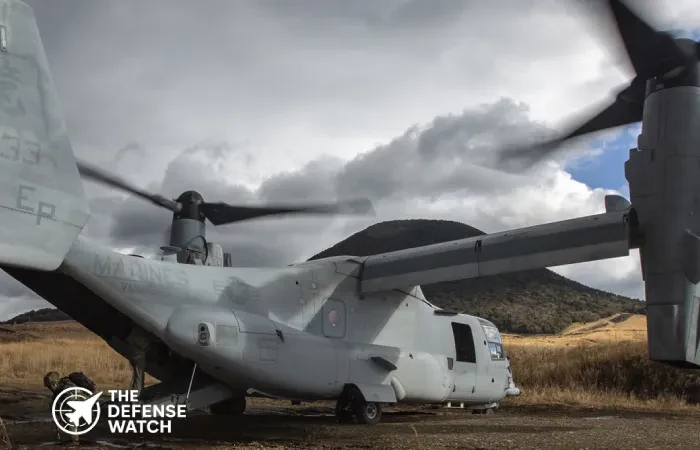
| Variants | MV-22B (USMC), CV-22B (USAF) |
| Successor / Future Replacement | Under evaluation (future programs) |
| Notable Features | Tiltrotor design, extended fuel tanks, PA system |
| Estimated Operational Life | Multi-decade service |
PROS
- Exceptional VTOL/STOL capability enables operations from carriers and small decks without catapults.
- Superior speed and range compared to traditional helicopters for rapid resupply.
- Versatile payload capacity for personnel, cargo, and priority parts delivery.
- Enhanced fuel system and endurance support distributed maritime operations.
- Multi-mission flexibility across logistics, potential medevac, and support roles.
CONS
- Higher acquisition and operating costs relative to legacy fixed-wing COD aircraft.
- Complex tiltrotor mechanics contribute to demanding maintenance requirements.
- Historical safety concerns and mishap rates in the broader V-22 program.
- Larger footprint and rotor considerations limit operations in very confined spaces.
- Vulnerability in high-threat environments without dedicated defensive armament.
CMV-22B Osprey: Navy’s Advanced Tiltrotor COD Aircraft
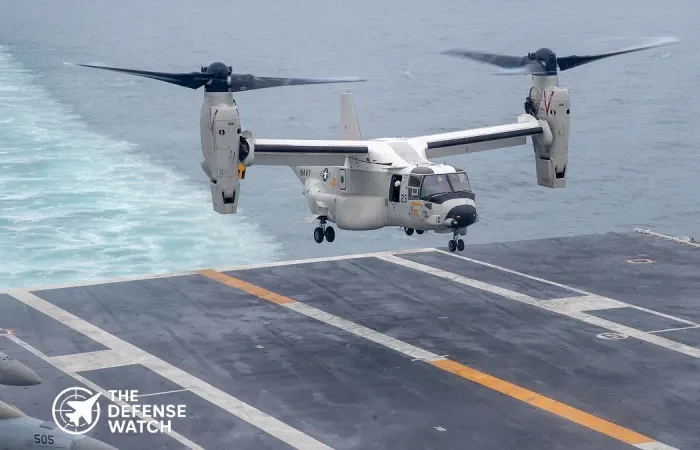
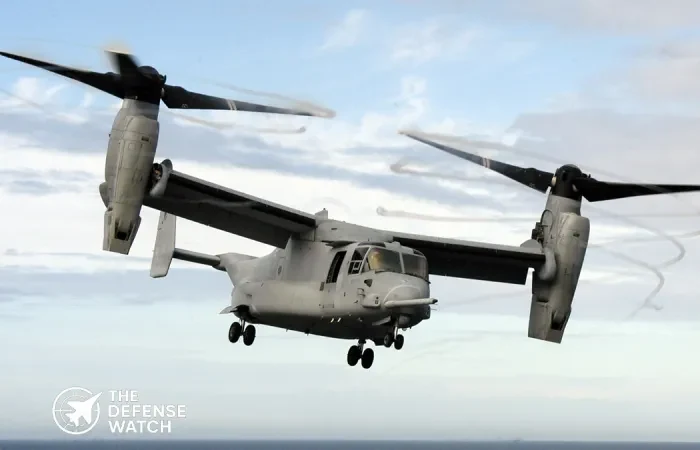
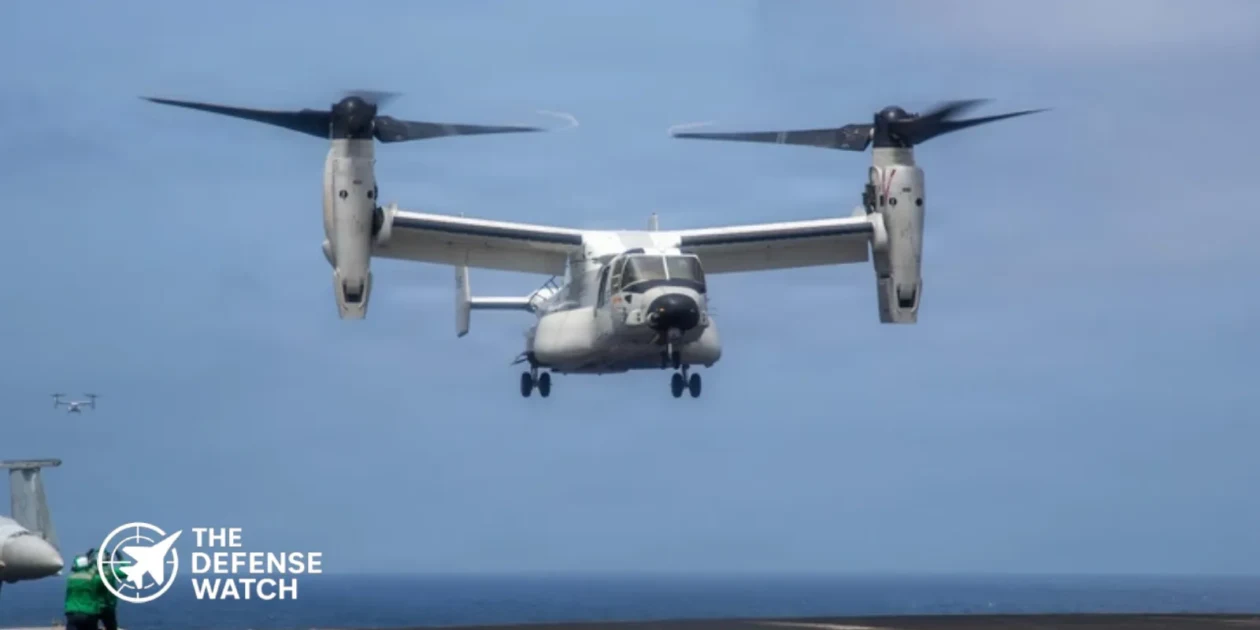
The CMV-22B Osprey represents a revolutionary leap in naval aviation as the U.S. Navy’s dedicated carrier onboard delivery (COD) platform. This tiltrotor aircraft combines the vertical takeoff and landing (VTOL) flexibility of a helicopter with the speed and range of a turboprop fixed-wing aircraft. Designed to operate from aircraft carriers and shore bases, it delivers personnel, high-priority cargo, and critical parts to deployed naval forces, even in contested environments. Entering service in the early 2020s, the CMV-22B enhances fleet logistics by bridging the gap left by the retiring C-2A Greyhound.
Manufacturer
The CMV-22B is produced by the Bell Boeing Joint Program Office, a partnership between Bell Textron (a Textron company) and Boeing. Assembly occurs primarily at Bell’s facility in Amarillo, Texas. It is a specialized variant of the V-22 Osprey family, tailored for Navy requirements with enhanced fuel capacity and logistics-focused modifications.
Speed and Range
Powered by two Rolls-Royce Liberty AE1107C turboshaft engines, the CMV-22B achieves a maximum speed of approximately 275 knots (316 mph) and a cruise speed around 255-269 knots. Its extended-range fuel system enables it to transport up to 6,000 pounds of cargo or personnel over 1,150 nautical miles, significantly outperforming legacy COD platforms. The aircraft offers a service ceiling of 25,000 feet and strong endurance for long-duration missions.
Cost/Price
Unit costs for V-22 variants, including the CMV-22B, typically range from approximately $80-110 million depending on configuration and lot, reflecting the advanced tiltrotor technology and ongoing production efficiencies.
The CMV-22B’s hybrid design allows rapid transition between helicopter and airplane modes, making it ideal for austere operations and shipboard integration. It supports up to 23-24 passengers plus crew, features improved cargo handling systems, and includes beyond-line-of-sight communications for reliable fleet connectivity. Operational since achieving Initial Operational Capability in 2021, it equips squadrons like VRM-30 and provides flexible logistics for carrier strike groups.
Disclaimer Note
The information provided on TheDefenseWatch.com is for general informational purposes only. While we strive to ensure the accuracy, completeness, and timeliness of our content regarding defense and aerospace products, technologies, and specifications, we cannot guarantee that all information is 100% accurate or up-to-date due to the evolving nature of military technology and classified data.TheDefenseWatch.com does not warrant the reliability, suitability, or availability of the information for any specific purpose. Users are advised to consult official sources, such as manufacturers, government publications, or defense agencies, for precise and verified data before making decisions based on our content.We are not affiliated with any defense manufacturers, governments, or military organizations mentioned. Opinions, reviews, and ratings reflect expert analysis but are subjective and should not be considered endorsements. TheDefenseWatch.com is not responsible for any errors, omissions, or consequences arising from the use of this website’s content.External links are provided for convenience and do not imply endorsement. TheDefenseWatch.com reserves the right to update or modify content without prior notice. By using this website, you agree to our Privacy & Cookies Policy.
More Defense Systems from Bell Boeing
New Arrivals






Popular Comparisons
-
 Tejas vs Gripen: Key Differences and Capabilities
View Comparison →
Tejas vs Gripen: Key Differences and Capabilities
View Comparison → -
Tejas vs MiG-21 Bison: How India Replaced Its Iconic Supersonic Fighter
View Comparison →
-
F-35 vs F-16: Stealth, Sensors and Combat Roles
View Comparison →
-
Tejas Fighter Jet vs F-16 Fighting Falcon: Capability Compared
View Comparison →
-
Rafale Fighter Jet vs F-16 Fighting Falcon : Which Fighter Has the Edge?
View Comparison →
-
Su-57 Fighter Jet vs J-20 Fighter Jet: Stealth and Air Combat Compared
View Comparison →
-
Mirage 2000 vs Tejas Mk1A: Legacy Combat Power vs Indigenous Modernization
View Comparison →
-
Rafale Fighter Jet vs F-22 Raptor: Which Air Dominance Fighter Has the Edge?
View Comparison →
-
Tejas Fighter Jet vs. Rafale Fighter Jet: India’s Indigenous Fighter Meets France’s Proven Multirole Combat Aircraft
View Comparison →
-
F-22 Raptor vs. F-35 Joint Strike Fighter: Which Fifth Generation Fighter Has the Edge?
View Comparison →


- USS Oregon Visits Norway as U.S. Navy Maintains High North Presence

- Lockheed Martin Unveils PAC-3 Edge Interceptor for U.S. Army
- Northrop Grumman Completes B-2 Spirit of Kitty Hawk Overhaul
- Army Report Finds Systemic Failures Behind Fatal 2025 Midair Collision
- Lockheed Martin to Supply Black Hawk Training Systems to Philippine Air Force
- US Air Force Expands B-21 Raider Production Capacity by 25%
- Boeing Wins $10.9 Million VC-25B Test Maintenance Contract Modification
- Raytheon Wins $6.34 Billion Contract for SM-3 Block IB Missile Production
- USS Abraham Lincoln CO Addresses Crew Welfare Concerns After 322-Day Deployment
- General Dynamics, Primordial Labs to Add Voice Control to Abrams and XM30









Fighter Jets
-
 MIG-31 Fighter Jet
-
J-10CE Fighter Jet
-
Chengdu J-10 Fighter Jet
-
Chengdu J-10C Fighter Jet
-
Gripen E Fighter Jet
-
Tejas Mk1A Fighter Jet
-
Tejas Mk‑2 Fighter Jet
-
F-16V Viper Block 70 Fighter Jet
-
F-15EX Eagle II Fighter
-
Boeing F/A-XX Fighter
-
F-15E Strike Eagle Fighter
-
F/A-18E/F Super Hornet Fighter Jet
-
Saab Gripen F Fighter Jet
-
JAS 39E/F Gripen Fighter Jet
-
JAS 39 Gripen Fighter Jet
-
F-35A Lightning II Fighter Jet
-
F/A-18F Super Hornet
-
J-50 Fighter Jet
-
Spanish EF-18 Hornet Fighter
-
F-47 Fighter Jet
-
F-35i Adir Fighter Jet
-
F-16 Fighting Falcon
-
AIDC T-5 Brave Eagle
-
F-CK-1 Ching-Kuo Fighter







Recent Compares
-
Tejas vs Gripen: Key Differences and Capabilities
View Comparison →
-
Tejas vs MiG-21 Bison: How India Replaced Its Iconic Supersonic Fighter
View Comparison →
-
F-35 vs F-16: Stealth, Sensors and Combat Roles
View Comparison →
-
Tejas Fighter Jet vs F-16 Fighting Falcon: Capability Compared
View Comparison →
-
Rafale Fighter Jet vs F-16 Fighting Falcon : Which Fighter Has the Edge?
View Comparison →
Latest Defense Systems
10 Compares Defense Systems
-
Tejas vs Gripen: Key Differences and Capabilities
View Comparison →
-
Tejas vs MiG-21 Bison: How India Replaced Its Iconic Supersonic Fighter
View Comparison →
-
F-35 vs F-16: Stealth, Sensors and Combat Roles
View Comparison →
-
Tejas Fighter Jet vs F-16 Fighting Falcon: Capability Compared
View Comparison →
-
Rafale Fighter Jet vs F-16 Fighting Falcon : Which Fighter Has the Edge?
View Comparison →
-
Su-57 Fighter Jet vs J-20 Fighter Jet: Stealth and Air Combat Compared
View Comparison →
-
Mirage 2000 vs Tejas Mk1A: Legacy Combat Power vs Indigenous Modernization
View Comparison →
-
Rafale Fighter Jet vs F-22 Raptor: Which Air Dominance Fighter Has the Edge?
View Comparison →
-
Tejas Fighter Jet vs. Rafale Fighter Jet: India’s Indigenous Fighter Meets France’s Proven Multirole Combat Aircraft
View Comparison →
-
F-22 Raptor vs. F-35 Joint Strike Fighter: Which Fifth Generation Fighter Has the Edge?
View Comparison →
- USS Oregon Visits Norway as U.S. Navy Maintains High North Presence
- Lockheed Martin Unveils PAC-3 Edge Interceptor for U.S. Army
- Northrop Grumman Completes B-2 Spirit of Kitty Hawk Overhaul
- Army Report Finds Systemic Failures Behind Fatal 2025 Midair Collision
- Lockheed Martin to Supply Black Hawk Training Systems to Philippine Air Force