









@2026 – All Right Reserved. TheDefenseWatch.com
- Home
- Defense Systems
- Bombers & Strategic Aircraft
- Skyraider II Aircraft
Skyraider II Aircraft
Defense Systems Full Specifications
1. General Information
| Name | Skyraider II |
| Manufacturer | L3Harris Technologies / Air Tractor |
| Country of Origin | United States |
| Introduction / In Service Since | Expected mid 2020s |
| Status | Development / Procurement Phase |
| Category | Light Attack / Armed Reconnaissance |
| Crew | 1 |
| Unit Cost | $20 million to $25 million |
2. Dimensions & Structure
| Length | Approx. 35 ft |
| Wingspan | Approx. 59 ft |
| Height | Approx. 13 ft |
| Wing Area | Not publicly disclosed |
| Empty Weight | Approx. 10,000 lb |
| Maximum Takeoff Weight (MTOW) | Approx. 16,000 lb |
3. Performance
| Maximum Speed | 394 mph |
| Range | 1,300+ miles |
| Combat Radius | Approx. 600 miles |
| Service Ceiling | 35,000 ft |
| Rate of Climb | Approx. 4,000 ft/min |
4. Powerplant
| Engine Type | 1 × Pratt & Whitney PT6A turboprop |
| Thrust (per engine) | Approx. 1,600 shp |
| Total Thrust | Approx. 1,600 shp |
5. Payload & Armament
| Internal Payload Capacity | Limited |
| Weapons Bay | None |
| Compatible Weapons | Precision guided bombs, rockets, gun pods, AGM missiles |
| Hardpoints | Multiple external hardpoints |
6. Avionics & Systems
| Radar System | Mission dependent targeting systems |
| Navigation | GPS / INS navigation |
| Electronic Warfare (EW) | Defensive countermeasure suite |
| Stealth Features | Non stealth design |
7. Operational History
| Primary Operator | Potential U.S. Special Operations Forces |
| Conflict Usage | Intended for low intensity conflicts |
| Notable Missions | Armed overwatch and ISR operations |
8. Additional Information
| Variants | Mission specific configurations planned |
| Successor / Future Replacement | Not determined |
| Notable Features | STOL capability and long endurance |
| Estimated Operational Life | 20+ years |
PROS
- Lower operating cost than fighter jets
- Long endurance for ISR missions
- STOL capability from austere runways
- Suitable for counterinsurgency operations
- Flexible weapons and sensor integration
CONS
- Limited speed compared to jet aircraft
- Reduced survivability in high threat airspace
- Smaller payload than multirole fighters
- Vulnerable to advanced air defense systems
- Limited air to air combat capability
OA-1K Skyraider II Light Attack Aircraft
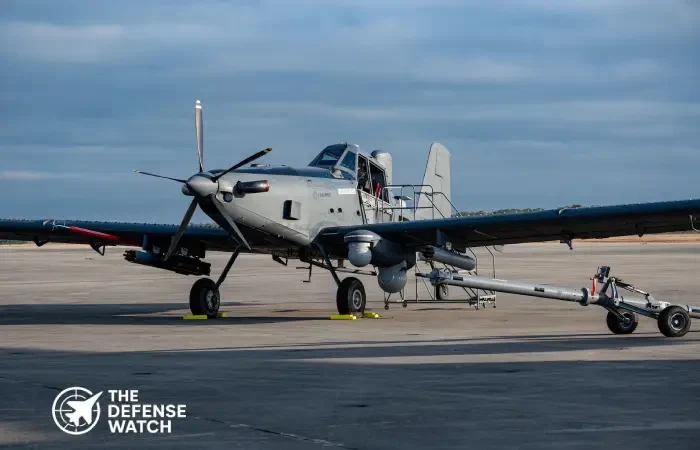
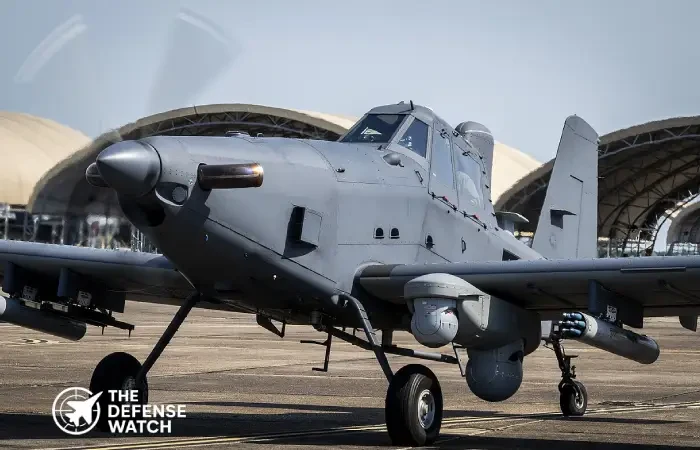
The Skyraider II is a modern light attack and intelligence, surveillance, and reconnaissance aircraft developed for low intensity combat environments and irregular warfare missions. Built to support close air support, border security, armed overwatch, and special operations, the aircraft combines proven turboprop performance with advanced mission systems. Its design reflects the growing demand for affordable and flexible aircraft capable of operating from austere airfields while delivering precision strike capability.
The aircraft draws inspiration from the legendary A 1 Skyraider used during the Korean and Vietnam Wars, but introduces modern avionics, digital targeting systems, and improved survivability for current battlefield requirements. The Skyraider II is expected to support U.S. and allied operations where high end fighter jets may be too costly or operationally unnecessary.
Manufacturer
The Skyraider II is manufactured by L3Harris Technologies in partnership with Air Tractor in the United States. The platform is based on the Air Tractor AT 802 airframe, which has been adapted into a militarized configuration for armed reconnaissance and strike missions.
The aircraft is designed to provide long endurance operations, rapid deployment capability, and lower operating costs compared to fast jet platforms. It supports precision guided munitions, electro optical sensors, secure communications, and mission planning systems.
Speed and Range
The OA-1K Skyraider II has an estimated maximum speed of around 394 mph (634 km/h) and an operational range exceeding 1,300 miles depending on mission configuration. Its turboprop engine allows extended loiter time, making it suitable for persistent overwatch and counterinsurgency operations.
The aircraft can operate from short and unprepared runways, providing flexibility for expeditionary missions in remote regions. Its endurance and payload capacity make it valuable for prolonged surveillance and strike support operations.
Cost/Price
The estimated unit cost of the Skyraider II is believed to range between $20 million and $25 million, depending on mission equipment and weapons integration. Compared to advanced fighter aircraft, the platform offers significantly lower acquisition and operating costs while maintaining effective strike and ISR capability.
Disclaimer Note
The information provided on TheDefenseWatch.com is for general informational purposes only. While we strive to ensure the accuracy, completeness, and timeliness of our content regarding defense and aerospace products, technologies, and specifications, we cannot guarantee that all information is 100% accurate or up-to-date due to the evolving nature of military technology and classified data.TheDefenseWatch.com does not warrant the reliability, suitability, or availability of the information for any specific purpose. Users are advised to consult official sources, such as manufacturers, government publications, or defense agencies, for precise and verified data before making decisions based on our content.We are not affiliated with any defense manufacturers, governments, or military organizations mentioned. Opinions, reviews, and ratings reflect expert analysis but are subjective and should not be considered endorsements. TheDefenseWatch.com is not responsible for any errors, omissions, or consequences arising from the use of this website’s content.External links are provided for convenience and do not imply endorsement. TheDefenseWatch.com reserves the right to update or modify content without prior notice. By using this website, you agree to our Privacy & Cookies Policy.
More Defense Systems from L3Harris Technologies
New Arrivals
Popular Comparisons
-
 Tejas vs Gripen: Key Differences and Capabilities
View Comparison →
Tejas vs Gripen: Key Differences and Capabilities
View Comparison → -
Tejas vs MiG-21 Bison: How India Replaced Its Iconic Supersonic Fighter
View Comparison →
-
F-35 vs F-16: Stealth, Sensors and Combat Roles
View Comparison →
-
Tejas Fighter Jet vs F-16 Fighting Falcon: Capability Compared
View Comparison →
-
Rafale Fighter Jet vs F-16 Fighting Falcon : Which Fighter Has the Edge?
View Comparison →
-
Su-57 Fighter Jet vs J-20 Fighter Jet: Stealth and Air Combat Compared
View Comparison →
-
Mirage 2000 vs Tejas Mk1A: Legacy Combat Power vs Indigenous Modernization
View Comparison →
-
Rafale Fighter Jet vs F-22 Raptor: Which Air Dominance Fighter Has the Edge?
View Comparison →
-
Tejas Fighter Jet vs. Rafale Fighter Jet: India’s Indigenous Fighter Meets France’s Proven Multirole Combat Aircraft
View Comparison →
-
F-22 Raptor vs. F-35 Joint Strike Fighter: Which Fifth Generation Fighter Has the Edge?
View Comparison →
- F-15E Shot Down Over Iran: How the Dude 44 Crew Was Brought Home

- Operation Mount Hope III: How Two Night Stalker Chinooks Carried a Libyan Hind Out of Chad
- North Korea Fires Ballistic Missile From Wonsan Toward East Sea
- BAE Systems Wins $70.5 Million Trident II D5 Support Contract
- Saudi Arabia Weighs Yemen Offensive to Retake Bab el-Mandeb
- L3Harris Expands WESCAM Manufacturing Focus for Mission-Ready EO/IR Systems
- Northrop Grumman Unveils FORTITUDE RF Chip for Faster Defense Systems
- Northrop Grumman YFQ-48A Talon Blue Completes Autonomous Flight Test
- U.S. Warns Defense Industry Lacks Capacity for Rapid Weapons Surge
- NATO Uses B-1B Bomber in Baltic Air Defense Training