
- Home
- Defense Systems
- Compare
- FQ-42A Dark Merlin vs XQ-58A Valkyrie: Advanced CCA Loyal Wingman Showdown for Future Air Dominance
FQ-42A Dark Merlin vs XQ-58A Valkyrie: Advanced CCA Loyal Wingman Showdown for Future Air Dominance
1. Executive Summary / Tactical Overview
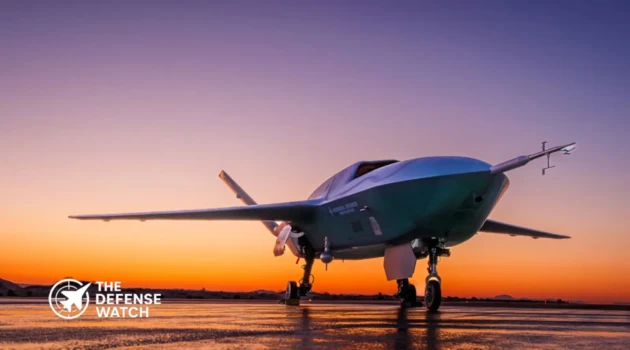
The FQ-42A Dark Merlin represents a purpose-built, fighter-oriented Collaborative Combat Aircraft (CCA) from General Atomics, optimized for high-performance manned-unmanned teaming (MUM-T) with platforms like the F-35 and future NGAD fighters. It emphasizes stealth, agility, autonomy, and air-to-air capabilities as affordable mass in contested airspace.
In contrast, the Kratos XQ-58A Valkyrie is a pioneering low-cost attritable loyal wingman, focused on long-range, high-subsonic operations with flexible payload options for strike, ISR, and collaborative missions. While Valkyrie offers proven cost-effectiveness and range, Dark Merlin advances toward more exquisite fighter-like performance and survivability.
2. Technical Specifications Table
| Metric | FQ-42A Dark Merlin (YFQ-42A) | XQ-58A Valkyrie |
|---|---|---|
| Generation/Role | Next-gen CCA / Loyal Wingman (Fighter-oriented) | Low-cost Attritable CCA / Loyal Wingman |
| Max Speed | High-subsonic to transonic / Mach ~1 class | ~Mach 0.85–0.9 (up to ~652 mph) |
| Combat Radius / Range | ~700–1,200+ nmi (estimated) | ~3,000 nmi / 3,500+ miles |
| Altitude | Up to ~45,000+ ft (fighter-like) | Up to 45,000 ft |
| Payload | Internal weapons bay (e.g., 2+ AIM-120 AMRAAMs); modular ~1,500+ kg est. | 600 lb internal + 600 lb external (~272 kg each) |
| Dimensions (approx.) | Length ~35–40 ft, Wingspan ~25–30 ft | Length 30 ft, Wingspan 27 ft |
| Propulsion | Single turbofan (advanced, low-observable) | Williams FJ33 turbofan (~2,000 lbf) |
| Key Features | Enhanced stealth (serrated inlet, V-tails), advanced autonomy, Gambit core modularity | Runway-independent ops, attritable/low-cost, flexible mission kits |
| Status | Flight testing (production-representative); Increment 1 CCA | Operational testing since 2019; in production variants |
Note: Dark Merlin specs are partially estimated/classified as a newer program; Valkyrie data from public sources.
3. Key Capability Pillars
Stealth & Survivability: Dark Merlin builds on the XQ-67A predecessor with low-observable features like a serrated dorsal engine inlet (B-2 style), V-tails, internal weapons bay, and optimized shaping for reduced radar cross-section—aligning it closely with crewed 5th-gen fighters for penetrating A2/AD environments. The XQ-58A Valkyrie incorporates stealthy design for its class but prioritizes affordability and attritability over exquisite survivability, with options for internal bays and external stores that can increase its signature.
Avionics & Sensor Fusion / Autonomy: Both leverage advanced autonomy for teaming with manned fighters, but Dark Merlin features GA-ASI’s mature autonomy architecture (demonstrated in live flights with mission systems) and modular integration for superior human-machine teaming in complex scenarios. Valkyrie has demonstrated AI-piloted autonomous operations and open mission systems, excelling in long-endurance collaborative roles but generally positioned as a more cost-effective complement rather than a near-peer fighter surrogate.
Payload & Mission Profiles: Dark Merlin focuses on internal carriage for stealthy air-to-air missions (e.g., AMRAAMs), with modular Gambit-series adaptability for rapid reconfiguration. Valkyrie offers greater flexibility with combined internal/external payload (up to 1,200 lb total) for multi-role strike, ISR, or SEAD, supporting longer-range “magazine depth” at lower unit cost. Valkyrie suits high-volume, attritable swarm or deep-strike profiles; Dark Merlin leans toward higher-end, survivable escort and air superiority augmentation.
4. Strategic Verdict
The FQ-42A Dark Merlin is favored in highly contested anti-access/area-denial (A2/AD) environments where stealth, agility, and seamless integration with F-35/NGAD fighters provide decisive survivability and air-to-air lethality—delivering “affordable mass” with fighter-class performance.
The XQ-58A Valkyrie shines in high-tempo operations requiring extended range, lower costs, and attritable numbers for overwhelming force, such as long-range strike packages, ISR, or distributed operations where losing platforms is more acceptable. Together, they represent complementary layers in the USAF’s CCA ecosystem, enhancing overall fleet resilience against peer adversaries. Dark Merlin pushes the high-end edge, while Valkyrie scales the quantity advantage.

| |
| Price | |
| Our Rating | |
| Manufacturer | General Atomics Aeronautical Systems Kratos Defense & Security Solutions |
| Category | Attack & Multirole Drones (UAVs) Attack & Multirole Drones (UAVs) |
1. General Information
| Name | FQ-42A Dark Merlin XQ-58A Valkyrie |
| Manufacturer | General Atomics Aeronautical Systems Kratos Defense & Security Solutions |
| Country of Origin | United States United States |
| Type / Role | Collaborative Combat Aircraft (UCAV) Stealth Loyal-Wingman Combat UAV |
| First Flight / Introduced | August 2025 2019 |
| Status | In Production / Flight Testing Testing / Limited Evaluation |
| Unit Cost | Undisclosed (affordable mass focus) USD 2–4 Million (Approx.) |
2. Performance
| Maximum Speed | Mach 1 class ~Mach 0.72 |
| Cruise Speed | High subsonic High-Subsonic |
| Operational Range | ~1,500 km 3,000+ km |
| Endurance | 6–8 hours 8–10 hours (est.) |
| Service Ceiling | ~45,000 ft+ ~45,000 ft |
| Rate of Climb | N/A (Not Disclosed) |
3. Dimensions
| Length | Fighter-like scale 28 ft (8.5 m) |
| Wingspan | Slender, swept wings 22 ft (6.7 m) |
| Height | ~6 ft (1.8 m) |
| Maximum Takeoff Weight (MTOW) | V-tail, single engine ~2,722 kg |
4. Payload & Armament
| Payload Capacity | ~1,500 kg (internal) 272 kg (600 lb) |
| Hardpoints | 2 internal bays |
| Weapons | AIM-120 AMRAAM (planned); modular options Small Diameter Bombs, Precision-Guided Munitions |
| Sensors | Advanced EO/IR, radar, autonomy suite EO/IR, EW Payloads, ISR Modules |
| Avionics | AI-driven mission autonomy AI-Assisted Mission System, GPS/INS, Secure Datalinks |
5. Propulsion
| Engine Type | Turbofan jet engine Turbofan (Specific undisclosed) |
| Engine Power | Classified |
| Propeller Type | N/A (Jet-powered) |
6. Communication & Control
| Control Type | Semi-autonomous / MUM-T Remote / Autonomous AI-Assisted |
| Data Link Range | Secure beyond-line-of-sight Secure LOS / SATCOM BLOS |
| Navigation | GPS / INS |
| Ground Control Station | Mobile or Fixed Control Unit |
7. Operational Use
| Primary Users | United States Air Force United States Air Force |
| Combat Proven | In testing / Early deployment path No (Testing Phase) |
| Notable Operations | Loyal Wingman Trials, Autonomous Tests |


|
Disclaimer Note
The information provided on TheDefenseWatch.com is for general informational purposes only. While we strive to ensure the accuracy, completeness, and timeliness of our content regarding defense and aerospace products, technologies, and specifications, we cannot guarantee that all information is 100% accurate or up-to-date due to the evolving nature of military technology and classified data.TheDefenseWatch.com does not warrant the reliability, suitability, or availability of the information for any specific purpose. Users are advised to consult official sources, such as manufacturers, government publications, or defense agencies, for precise and verified data before making decisions based on our content.We are not affiliated with any defense manufacturers, governments, or military organizations mentioned. Opinions, reviews, and ratings reflect expert analysis but are subjective and should not be considered endorsements. TheDefenseWatch.com is not responsible for any errors, omissions, or consequences arising from the use of this website’s content.External links are provided for convenience and do not imply endorsement. TheDefenseWatch.com reserves the right to update or modify content without prior notice. By using this website, you agree to our Privacy & Cookies Policy.
New Arrivals












Popular Comparisons
-
 J-10C vs JF-17 Thunder: Which Fighter Is More Capable?
View Comparison →
-
Tejas vs Gripen: Key Differences and Capabilities
View Comparison →
-
Tejas vs MiG-21 Bison: How India Replaced Its Iconic Supersonic Fighter
View Comparison →
-
F-35 vs F-16: Stealth, Sensors and Combat Roles
View Comparison →
-
Tejas Fighter Jet vs F-16 Fighting Falcon: Capability Compared
View Comparison →
-
Rafale Fighter Jet vs F-16 Fighting Falcon : Which Fighter Has the Edge?
View Comparison →
-
Su-57 Fighter Jet vs J-20 Fighter Jet: Stealth and Air Combat Compared
View Comparison →
-
Mirage 2000 vs Tejas Mk1A: Legacy Combat Power vs Indigenous Modernization
View Comparison →
-
Rafale Fighter Jet vs F-22 Raptor: Which Air Dominance Fighter Has the Edge?
View Comparison →
-
Tejas Fighter Jet vs. Rafale Fighter Jet: India’s Indigenous Fighter Meets France’s Proven Multirole Combat Aircraft
View Comparison →


- Marine One Explained: The Presidential Helicopter, Its Fleet and the VH-92A Transition

- Sikorsky Wins South Korea Contract for Four S-92A+ Presidential Helicopters
- Saudi Arabia Intercepts Missiles Targeting Riyadh as Aramco Building Is Damaged
- US Approves Potential $1.08 Billion Black Hawk Helicopter Sale to Mexico
- NASA Completes Final ISS Solar Array Installation, Raising Station Power Capacity by 30%
- USA vs China Military: Comparing Global Military Power in 2026
- USA vs UK Army: How U.S. and British Ground Forces Compare in 2026
- Saab Wins SEK 2 Billion Contract to Equip Sweden’s Four New FDI Frigates
- F-47 Fighter May Fly With Interim Engine as Next-Generation Propulsion Program Falls Behind Schedule
- UK Says F-35 Agreement Guarantees Access to U.S. Support System





Fighter Jets
-
 F-47A Fighter Jet
-
F-100 Super Sabre
-
North American F-86 Sabre
-
Northrop YF-23 Fighter
-
Rafale F5 Fighter
-
SU-57 Felon Stealth Fighter
-
Boeing F/A-XX Fighter
-
JF-17 Thunder Fighter Jet
-
F-47 Fighter Jet
-
MIG-31 Fighter Jet
-
J-10CE Fighter Jet
-
Chengdu J-10 Fighter Jet
-
Chengdu J-10C Fighter Jet
-
Gripen E Fighter Jet
-
Tejas Mk1A Fighter Jet
-
Tejas Mk‑2 Fighter Jet
-
F-16V Viper Block 70 Fighter Jet
-
F-15EX Eagle II Fighter
-
F-15E Strike Eagle Fighter
-
F/A-18E/F Super Hornet Fighter Jet
-
Saab Gripen F Fighter Jet
-
JAS 39E/F Gripen Fighter Jet
-
JAS 39 Gripen Fighter Jet
-
F-35A Lightning II Fighter Jet











Recent Compares
-
J-10C vs JF-17 Thunder: Which Fighter Is More Capable?
View Comparison →
-
Tejas vs Gripen: Key Differences and Capabilities
View Comparison →
-
Tejas vs MiG-21 Bison: How India Replaced Its Iconic Supersonic Fighter
View Comparison →
-
F-35 vs F-16: Stealth, Sensors and Combat Roles
View Comparison →
-
Tejas Fighter Jet vs F-16 Fighting Falcon: Capability Compared
View Comparison →
Latest Defense Systems
10 Compares Defense Systems
-
J-10C vs JF-17 Thunder: Which Fighter Is More Capable?
View Comparison →
-
Tejas vs Gripen: Key Differences and Capabilities
View Comparison →
-
Tejas vs MiG-21 Bison: How India Replaced Its Iconic Supersonic Fighter
View Comparison →
-
F-35 vs F-16: Stealth, Sensors and Combat Roles
View Comparison →
-
Tejas Fighter Jet vs F-16 Fighting Falcon: Capability Compared
View Comparison →
-
Rafale Fighter Jet vs F-16 Fighting Falcon : Which Fighter Has the Edge?
View Comparison →
-
Su-57 Fighter Jet vs J-20 Fighter Jet: Stealth and Air Combat Compared
View Comparison →
-
Mirage 2000 vs Tejas Mk1A: Legacy Combat Power vs Indigenous Modernization
View Comparison →
-
Rafale Fighter Jet vs F-22 Raptor: Which Air Dominance Fighter Has the Edge?
View Comparison →
-
Tejas Fighter Jet vs. Rafale Fighter Jet: India’s Indigenous Fighter Meets France’s Proven Multirole Combat Aircraft
View Comparison →
- Marine One Explained: The Presidential Helicopter, Its Fleet and the VH-92A Transition
- Sikorsky Wins South Korea Contract for Four S-92A+ Presidential Helicopters
- Saudi Arabia Intercepts Missiles Targeting Riyadh as Aramco Building Is Damaged
- US Approves Potential $1.08 Billion Black Hawk Helicopter Sale to Mexico
- NASA Completes Final ISS Solar Array Installation, Raising Station Power Capacity by 30%