
- Home
- Defense Systems
- Missiles & Precision Weapons
- APKWS-II Missile
APKWS-II Missile


Defense Systems Full Specifications
1. General Information
| Name / Designation | APKWS-II (AGR-19/AGR-20/AGR-21 variants) |
| Type / Role | Precision-guided 2.75-inch rocket, air-to-ground/anti-personnel/light armor/counter-UAS |
| Country of Origin | United States |
| Manufacturer | BAE Systems |
| Service Entry / Year Introduced | 2012 |
| Operational Status | Active |
2. Performance & Range
| Range | 1.1–5 km (rotary-wing); 2–11+ km (fixed-wing) |
| Speed | ~Mach 2.9 (max) |
| Ceiling / Altitude Limit | Platform-dependent, suitable for low-to-medium altitude |
| Accuracy (CEP) | <1 meter |
| Warhead Type | High Explosive, Fragmentation, Penetrating |
3. Guidance & Targeting
| Guidance System | Semi-active laser homing (primary); dual-mode with IR |
| Targeting Mode | Laser designation (semi-active) |
| Launch Platform Compatibility | Helicopters (AH-64, UH-1Y, MH-60), Fixed-wing (A-10, F-16, AV-8B) |
| Seeker Type | Distributed Aperture Semi-Active Laser Seeker (DASALS) |
4. Physical Characteristics
| Length | ~1.88 m (full round) |
| Diameter | 70 mm (2.75 in) |
| Wingspan | ~24.3 cm (9.55 in) |
| Launch Weight | ~15 kg (32–35 lb) |
| Propulsion | Solid-fuel rocket (Mk66 Mod 4) |
5. Warhead & Payload
| Warhead Weight | ~4–5 kg (10 lb class HE) |
| Explosive Type | High Explosive / Fragmentation / Penetrator |
| Detonation Mechanism | Impact / Proximity |
| Payload Options | HE, Armor-piercing, Illumination, White Phosphorus |
6. Operational Use & Capabilities
| Operational Range Type | Short to Medium |
| Deployment Platform | Air (primary) |
| Target Types | Light vehicles, personnel, soft targets, small UAVs |
| Combat Proven | Yes |
| Users / Operators | United States (primary), select allies |
PROS
- Highly cost-effective compared to traditional precision missiles, enabling higher sortie munitions loads.
- Exceptional accuracy with low collateral damage, ideal for urban or close-support environments.
- Leverages existing Hydra 70 inventory for logistics simplicity and rapid deployment.
- Compatible with a wide array of rotary- and fixed-wing platforms, including drones.
- Combat-proven with rapid integration across U.S. services and growing counter-UAS utility.
CONS
- Requires line-of-sight laser designation, limiting use in obscured or high-threat environments.
- Shorter range than larger missiles like Hellfire, constraining standoff capability.
- Subsonic-to-supersonic speed profile makes it less effective against fast-maneuvering high-altitude targets.
- Dependent on clear weather conditions for optimal laser performance.
- Warhead yield is smaller, reducing effectiveness against heavily armored or hardened targets.
APKWS-II Laser-Guided Rocket: Precision Strike System
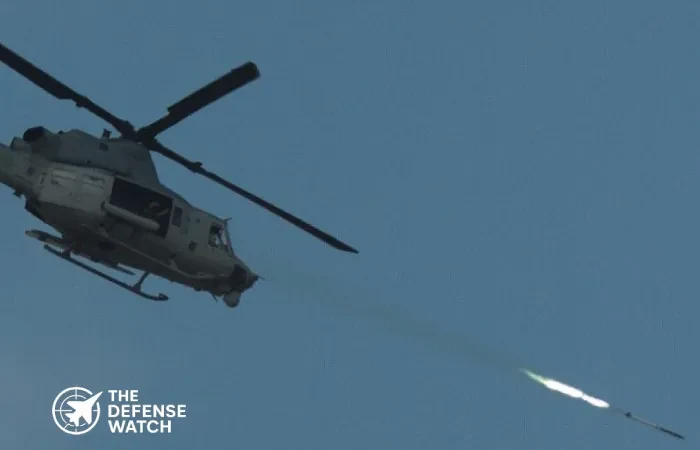
The APKWS-II (Advanced Precision Kill Weapon System II) represents a cost-effective evolution in tactical air-to-ground weaponry. By adding a mid-body laser guidance kit to existing unguided Hydra 70 2.75-inch rockets, it transforms inexpensive rockets into precision-guided munitions (PGMs) capable of engaging soft and lightly armored targets with minimal collateral damage. This system fills the critical capability gap between unguided rockets and more expensive missiles like the AGM-114 Hellfire, offering U.S. and allied forces a flexible, high-volume precision strike option suitable for close air support, counter-insurgency, and emerging counter-UAS roles.
Manufacturer
BAE Systems serves as the primary contractor for the APKWS-II. Developed in collaboration with the U.S. Navy and other services, the system entered production around 2011, with initial operational capability achieved in 2012 on Marine Corps helicopters. It has since been integrated across multiple platforms.
Speed and Range
The APKWS-II achieves a maximum speed of approximately 1,000 m/s (Mach 2.9). Effective range varies by launch platform: 1.1–5 km from rotary-wing aircraft and up to 2–11+ km from fixed-wing platforms, with some reports exceeding 12 km under optimal conditions. Its semi-active laser homing provides high accuracy, often with a CEP under 1 meter.
Cost/Price
The guidance kit is priced affordably, typically in the $15,000–$28,000 range per unit (with full rounds adding several thousand more), making it roughly one-third the cost of comparable laser-guided munitions while leveraging legacy rocket motors and warheads.
The APKWS-II uses a Distributed Aperture Semi-Active Laser Seeker (DASALS) that threads between the warhead and Mk66 Mod 4 rocket motor. It maintains compatibility with standard 2.75-inch launchers and supports various warheads, including high-explosive, armor-penetrating, and illumination types. Combat-proven in operations like Enduring Freedom, it equips platforms such as the AH-64 Apache, MH-60 helicopters, A-10 Thunderbolt II, F-16, and AV-8B Harrier. Recent dual-mode variants incorporating infrared seekers enhance multi-target engagement, particularly against drone swarms. Its low weight (around 15 kg) allows platforms to carry significantly more rounds than heavier missiles.
Disclaimer Note
The information provided on TheDefenseWatch.com is for general informational purposes only. While we strive to ensure the accuracy, completeness, and timeliness of our content regarding defense and aerospace products, technologies, and specifications, we cannot guarantee that all information is 100% accurate or up-to-date due to the evolving nature of military technology and classified data.TheDefenseWatch.com does not warrant the reliability, suitability, or availability of the information for any specific purpose. Users are advised to consult official sources, such as manufacturers, government publications, or defense agencies, for precise and verified data before making decisions based on our content.We are not affiliated with any defense manufacturers, governments, or military organizations mentioned. Opinions, reviews, and ratings reflect expert analysis but are subjective and should not be considered endorsements. TheDefenseWatch.com is not responsible for any errors, omissions, or consequences arising from the use of this website’s content.External links are provided for convenience and do not imply endorsement. TheDefenseWatch.com reserves the right to update or modify content without prior notice. By using this website, you agree to our Privacy & Cookies Policy.




New Arrivals






Popular Comparisons
-
 Tejas vs Gripen: Key Differences and Capabilities
View Comparison →
Tejas vs Gripen: Key Differences and Capabilities
View Comparison → -
Tejas vs MiG-21 Bison: How India Replaced Its Iconic Supersonic Fighter
View Comparison →
-
F-35 vs F-16: Stealth, Sensors and Combat Roles
View Comparison →
-
Tejas Fighter Jet vs F-16 Fighting Falcon: Capability Compared
View Comparison →
-
Rafale Fighter Jet vs F-16 Fighting Falcon : Which Fighter Has the Edge?
View Comparison →
-
Su-57 Fighter Jet vs J-20 Fighter Jet: Stealth and Air Combat Compared
View Comparison →
-
Mirage 2000 vs Tejas Mk1A: Legacy Combat Power vs Indigenous Modernization
View Comparison →
-
Rafale Fighter Jet vs F-22 Raptor: Which Air Dominance Fighter Has the Edge?
View Comparison →
-
Tejas Fighter Jet vs. Rafale Fighter Jet: India’s Indigenous Fighter Meets France’s Proven Multirole Combat Aircraft
View Comparison →
-
F-22 Raptor vs. F-35 Joint Strike Fighter: Which Fifth Generation Fighter Has the Edge?
View Comparison →


- Lockheed Martin Wins $16.1 Million Contract Modification for F-35 Processor Support

- Lockheed Martin Wins $74.3 Million Contract Modification for AN/SLQ-32(V)6 Electronic Warfare Systems
- Hegseth Says Autonomous Warfare Has Long Been the Pentagon’s End Goal
- US Rejects Automatic Body Camera Activation for ICE Officers
- Iron Dome Architect Develops New Counter-Swarm Drone Defense System
- U.S. Navy Conducts First F-35C Landing on USS John F. Kennedy
- Huntington Ingalls Wins $56.2 Million Contract for Foreign Nuclear Submarine Support
- US Forces Disable Cargo Ship Attempting to Evade Iran Blockade
- Netherlands Deploys Nuclear-Capable F-35s for NATO Steadfast Noon
- Pakistan Tests Extended-Range Fatah-2 Hypersonic Ballistic Missile







Fighter Jets
-
 MIG-31 Fighter Jet
-
J-10CE Fighter Jet
-
Chengdu J-10 Fighter Jet
-
Chengdu J-10C Fighter Jet
-
Gripen E Fighter Jet
-
Tejas Mk1A Fighter Jet
-
Tejas Mk‑2 Fighter Jet
-
F-16V Viper Block 70 Fighter Jet
-
F-15EX Eagle II Fighter
-
Boeing F/A-XX Fighter
-
F-15E Strike Eagle Fighter
-
F/A-18E/F Super Hornet Fighter Jet
-
Saab Gripen F Fighter Jet
-
JAS 39E/F Gripen Fighter Jet
-
JAS 39 Gripen Fighter Jet
-
F-35A Lightning II Fighter Jet
-
F/A-18F Super Hornet
-
J-50 Fighter Jet
-
Spanish EF-18 Hornet Fighter
-
F-47 Fighter Jet
-
F-35i Adir Fighter Jet
-
F-16 Fighting Falcon
-
AIDC T-5 Brave Eagle
-
F-CK-1 Ching-Kuo Fighter









Recent Compares
-
Tejas vs Gripen: Key Differences and Capabilities
View Comparison →
-
Tejas vs MiG-21 Bison: How India Replaced Its Iconic Supersonic Fighter
View Comparison →
-
F-35 vs F-16: Stealth, Sensors and Combat Roles
View Comparison →
-
Tejas Fighter Jet vs F-16 Fighting Falcon: Capability Compared
View Comparison →
-
Rafale Fighter Jet vs F-16 Fighting Falcon : Which Fighter Has the Edge?
View Comparison →
Latest Defense Systems
10 Compares Defense Systems
-
Tejas vs Gripen: Key Differences and Capabilities
View Comparison →
-
Tejas vs MiG-21 Bison: How India Replaced Its Iconic Supersonic Fighter
View Comparison →
-
F-35 vs F-16: Stealth, Sensors and Combat Roles
View Comparison →
-
Tejas Fighter Jet vs F-16 Fighting Falcon: Capability Compared
View Comparison →
-
Rafale Fighter Jet vs F-16 Fighting Falcon : Which Fighter Has the Edge?
View Comparison →
-
Su-57 Fighter Jet vs J-20 Fighter Jet: Stealth and Air Combat Compared
View Comparison →
-
Mirage 2000 vs Tejas Mk1A: Legacy Combat Power vs Indigenous Modernization
View Comparison →
-
Rafale Fighter Jet vs F-22 Raptor: Which Air Dominance Fighter Has the Edge?
View Comparison →
-
Tejas Fighter Jet vs. Rafale Fighter Jet: India’s Indigenous Fighter Meets France’s Proven Multirole Combat Aircraft
View Comparison →
-
F-22 Raptor vs. F-35 Joint Strike Fighter: Which Fifth Generation Fighter Has the Edge?
View Comparison →
- Lockheed Martin Wins $16.1 Million Contract Modification for F-35 Processor Support
- Lockheed Martin Wins $74.3 Million Contract Modification for AN/SLQ-32(V)6 Electronic Warfare Systems
- Hegseth Says Autonomous Warfare Has Long Been the Pentagon’s End Goal
- US Rejects Automatic Body Camera Activation for ICE Officers
- Iron Dome Architect Develops New Counter-Swarm Drone Defense System