












@2026 – All Right Reserved. TheDefenseWatch.com
- Home
- Defense Systems
- Missiles & Precision Weapons
- AIM-132 ASRAAM Missile
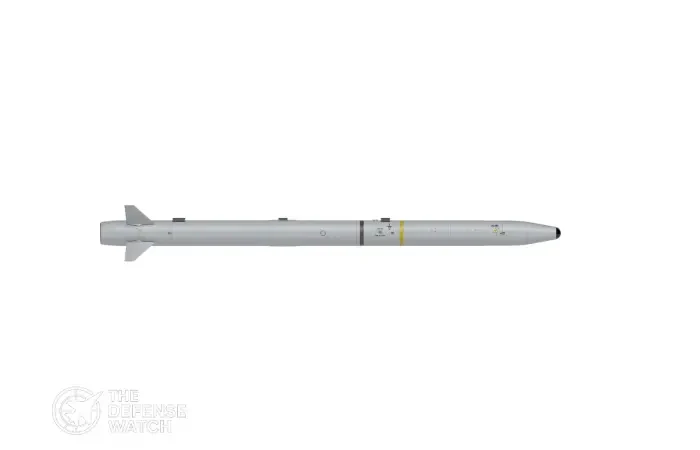
AIM-132 ASRAAM Missile
Defense Systems Full Specifications
1. General Information
| Name / Designation | AIM-132 ASRAAM |
| Type / Role | Short-Range Air-to-Air Missile (WVR), Imaging Infrared Homing |
| Country of Origin | United Kingdom |
| Manufacturer | MBDA UK |
| Service Entry / Year Introduced | 1998 / 2002 (RAF operational) |
| Operational Status | Active |
2. Performance & Range
| Range | >25 km (air-to-air), up to ~50 km reported; 15 km surface-launched |
| Speed | Mach 3+ |
| Ceiling / Altitude Limit | Compatible with fighter operational altitudes |
| Accuracy (CEP) | High precision via IIR seeker |
| Warhead Type | Blast-fragmentation |
3. Guidance & Targeting
| Guidance System | Imaging Infrared (IIR), Strapdown Inertial |
| Targeting Mode | Fire-and-Forget, Lock-On Before/After Launch |
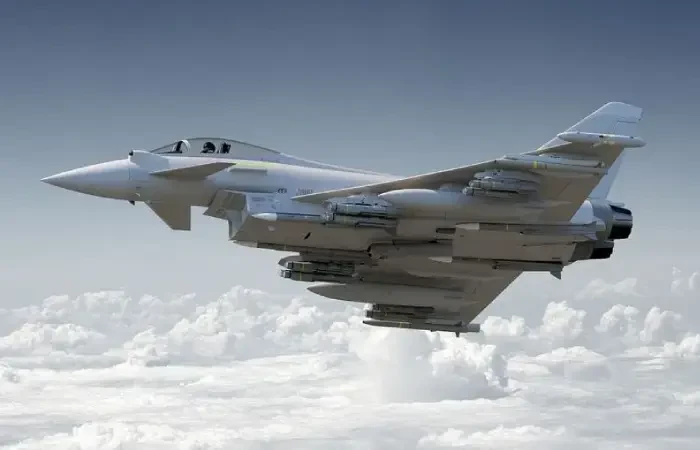
| Launch Platform Compatibility | Fighter Jet (Typhoon, F-35, etc.), Surface Launcher |
| Seeker Type | 128×128 element focal plane array IIR |
4. Physical Characteristics
| Length | 2.9 m |
| Diameter | 166 mm |
| Wingspan | Not applicable (tail-controlled) |
| Launch Weight | 88 kg |
| Propulsion | Dual-burn high-impulse solid rocket motor |
5. Warhead & Payload
| Warhead Weight | 10 kg |
| Explosive Type | Blast-fragmentation |
| Detonation Mechanism | Laser proximity / Impact |
| Payload Options | Single conventional warhead |
6. Operational Use & Capabilities
| Operational Range Type | Short (with extended capability) |
| Deployment Platform | Air, Ground/Surface |
| Target Types | Aircraft, UAVs/Drones |
| Combat Proven | Yes |
| Users / Operators | United Kingdom, India, Ukraine, Qatar, Oman (Turkey planned) |
PROS
- Exceptional kinematic performance with Mach 3+ speed and extended range for a short-range missile.
- Advanced IIR seeker with strong resistance to countermeasures and high off-boresight capability.
- True fire-and-forget operation with LOAL support for enhanced pilot safety.
- High maneuverability (up to 50g) enabled by aerodynamic design and tail control.
- Versatile integration across modern fighters like Typhoon and F-35, plus surface-launch options.
CONS
- Lacks thrust vectoring, potentially limiting extreme close-range agility compared to some rivals.
- Higher unit cost relative to legacy Sidewinder variants.
- Larger diameter and weight may impose minor carriage constraints on certain platforms.
- Development experienced delays and cost overruns in its early phases.
- Limited public data on latest Block upgrades may affect export transparency.
AIM-132 ASRAAM: Advanced Short-Range Air-to-Air Missile
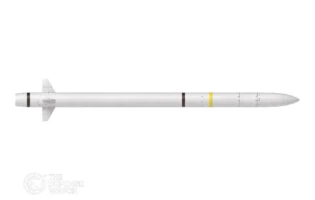
The AIM-132 ASRAAM (Advanced Short Range Air-to-Air Missile) represents a significant evolution in short-range air-to-air weaponry. Designed primarily for the Royal Air Force to replace the AIM-9 Sidewinder, this British missile emphasizes high speed, extended engagement range, and exceptional countermeasures resistance. It enables pilots to engage threats at distances traditionally associated with beyond-visual-range (BVR) missiles while retaining the agility required for close-in dogfights. Its “fire-and-forget” design allows immediate evasion after launch, enhancing pilot survivability in contested airspace.
Manufacturer
MBDA UK serves as the primary manufacturer and developer of the ASRAAM. Originally a collaborative European program involving British Aerospace (now BAE Systems) and other partners, it entered RAF service around 2002 after development challenges. The missile reflects UK expertise in infrared seeker technology and solid rocket propulsion.
Speed and Range
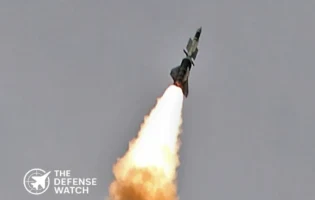
The ASRAAM achieves a maximum speed of Mach 3+ thanks to its dual-burn, high-impulse solid rocket motor and low-drag aerodynamic design. This provides rapid acceleration and sustained energy for maneuvering. Its operational air-to-air range exceeds 25 km (with some sources citing up to 50 km under optimal conditions), far surpassing traditional short-range missiles. Surface-launched variants reach approximately 15 km. The missile supports lock-on after launch (LOAL) and high off-boresight angles (up to 90 degrees), allowing engagements from awkward positions.
Cost/Price
Unit costs for the ASRAAM are estimated around £200,000 (approximately $225,000–$250,000 USD depending on exchange rates and batch). This positions it competitively within modern Western infrared missile programs, balancing advanced seeker technology with production economics.
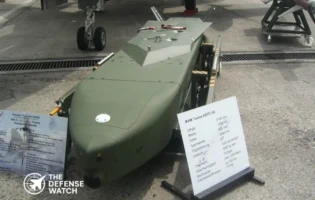
The ASRAAM features an imaging infrared (IIR) seeker with a 128×128 focal plane array, offering high-resolution targeting, excellent infrared countermeasures (IRCCM) resistance, and the ability to discriminate specific target areas such as cockpits or engines. It carries a 10 kg blast-fragmentation warhead with laser proximity and impact fuzing. The missile is compatible with platforms including the Eurofighter Typhoon and F-35 Lightning II, and has seen adaptations for surface launch in systems like Ukraine’s Raven. It has been combat-proven, including RAF use against drones.
Disclaimer Note
The information provided on TheDefenseWatch.com is for general informational purposes only. While we strive to ensure the accuracy, completeness, and timeliness of our content regarding defense and aerospace products, technologies, and specifications, we cannot guarantee that all information is 100% accurate or up-to-date due to the evolving nature of military technology and classified data.TheDefenseWatch.com does not warrant the reliability, suitability, or availability of the information for any specific purpose. Users are advised to consult official sources, such as manufacturers, government publications, or defense agencies, for precise and verified data before making decisions based on our content.We are not affiliated with any defense manufacturers, governments, or military organizations mentioned. Opinions, reviews, and ratings reflect expert analysis but are subjective and should not be considered endorsements. TheDefenseWatch.com is not responsible for any errors, omissions, or consequences arising from the use of this website’s content.External links are provided for convenience and do not imply endorsement. TheDefenseWatch.com reserves the right to update or modify content without prior notice. By using this website, you agree to our Privacy & Cookies Policy.
New Arrivals
-
 PAC-2 Patriot Missile System
-
Patriot PAC-3 Missile Defense System
-
EA-18G Growler
-
J-50 Fighter Jet
-
Northrop Grumman GHOST-R GEO Recon Satellite
-
A-50 Mainstay Aircraft
-
Spanish EF-18 Hornet Fighter
-
Trident II D5 Missile
-
B-21 Raider Bomber
-
F-47 Fighter Jet
-
F-35i Adir Fighter Jet
-
Type 99B Main Battle Tank
Popular Comparisons
-
 Tejas Fighter Jet vs F-16 Fighting Falcon: Capability Compared
View Comparison →
Tejas Fighter Jet vs F-16 Fighting Falcon: Capability Compared
View Comparison → -
Rafale Fighter Jet vs F-16 Fighting Falcon : Which Fighter Has the Edge?
View Comparison →
-
Su-57 Fighter Jet vs J-20 Fighter Jet: Stealth and Air Combat Compared
View Comparison →
-
Mirage 2000 vs Tejas Mk1A: Legacy Combat Power vs Indigenous Modernization
View Comparison →
-
Rafale Fighter Jet vs F-22 Raptor: Which Air Dominance Fighter Has the Edge?
View Comparison →
-
Tejas Fighter Jet vs. Rafale Fighter Jet: India’s Indigenous Fighter Meets France’s Proven Multirole Combat Aircraft
View Comparison →
-
F-22 Raptor vs. F-35 Joint Strike Fighter: Which Fifth Generation Fighter Has the Edge?
View Comparison →
-
F-35A vs. F-22 Raptor: Which U.S. Stealth Fighter Dominates Modern Air Combat?
View Comparison →
-
AGM-114 Hellfire vs. AGM-179 JAGM: Which U.S. Precision Missile Is Better?
View Comparison →
-
Patriot (PAC-3) vs. THAAD: Complete Missile Defense System Comparison, Capabilities, Range, and Strategic Roles
View Comparison →
- X-Planes in the Drone Era: Why Experimental Aircraft Still Matter

- France to Deploy Troops, Radar and Air Defense to Protect Saudi Yanbu Oil Hub
- Greek-Operated Patriot Intercepts Ballistic Missile and Drone Over Saudi Arabia
- Raytheon Wins $50.1 Million Navy Order for EA-18G Next Generation Jammer Repairs
- Stark Aerospace Wins $114 Million MK 41 VLS Canister Contract
- Northrop Grumman Wins $123.8M F-35 APG-85 Lot 7 Radar Contract
- Leonardo, Fincantieri Win €3.7B Contract for Two Italian Navy DDX Destroyers
- Finnish President Urges Musk to Expand Starlink Access for Ukraine to Target Russian Missile Launchers
- MV-22B Osprey Completes First Navy Sonobuoy Acceptance Test
- Saab expands Swedish space role through new partnerships with SSC Space, OHB Sweden and Ericsson