Executive Summary:
Saudi Arabia, Pakistan, and Turkey signed the Mecca Joint Defence Agreement on Aug. 7, 2026, a trilateral pact stipulating that an armed attack on any one signatory will be treated as an attack on all three. The deal, sealed in Islam’s holiest city as the Iran war and Houthi missile fire continue to threaten Gulf oil infrastructure, brings together a nuclear-armed Pakistan, NATO member Turkey, and the Arab world’s largest economy — a combination that is already being read in Tehran, Tel Aviv, and New Delhi as a fundamental shift in Middle East security architecture.
A New Collective Defense Bloc Takes Shape In Mecca
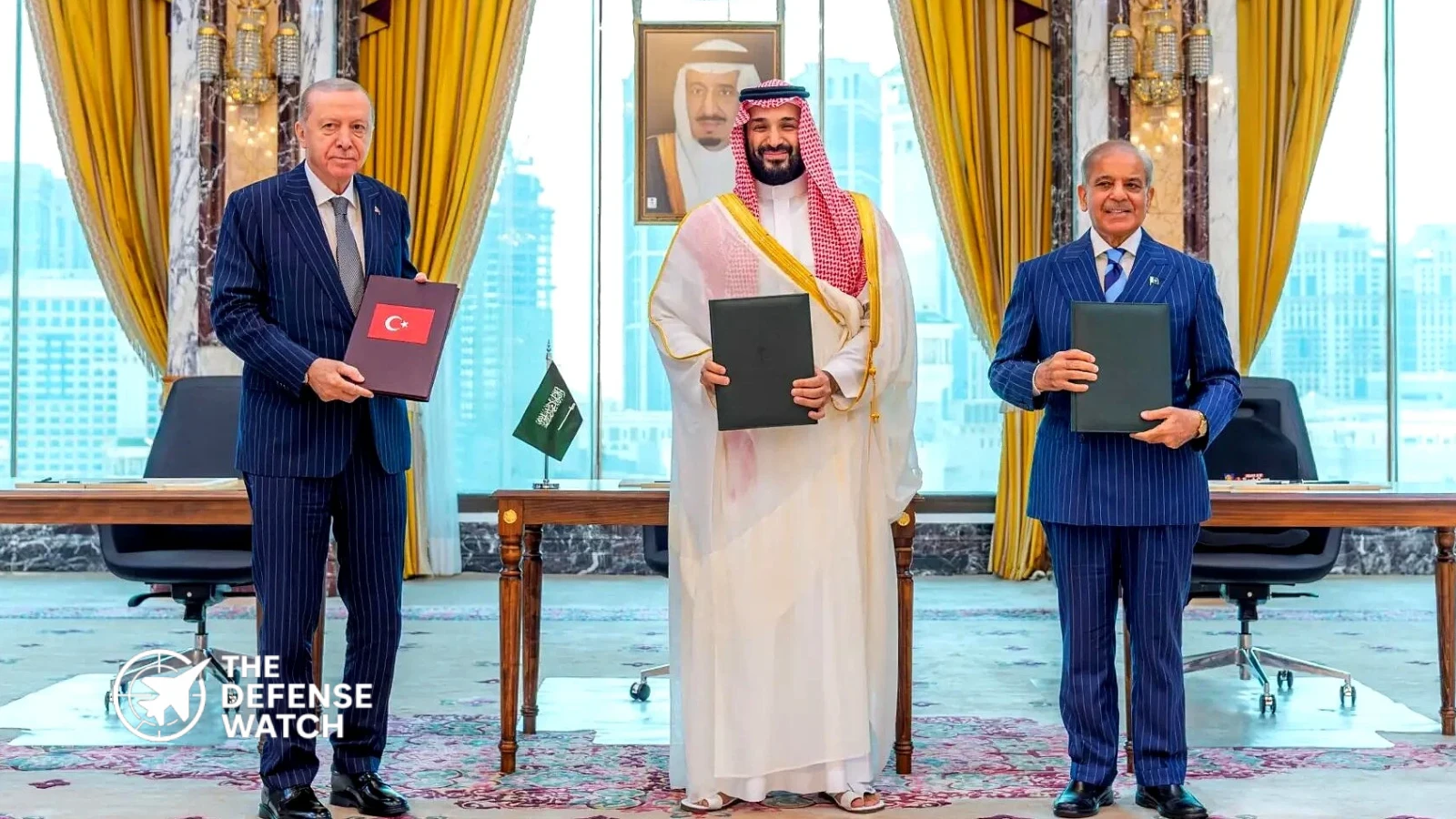
The Mecca Defense Pact became reality on Aug. 7, when Saudi Crown Prince Mohammed bin Salman, Turkish President Recep Tayyip Erdogan, and Pakistani Prime Minister Shehbaz Sharif signed the trilateral agreement at al-Safa Palace in Mecca. The signing followed nearly a year of negotiation and came a day after Sharif, joined by Pakistani army chief Field Marshal Asim Munir, performed Umrah at Islam’s holiest site.
The core provision is unambiguous: an armed attack against any one of the three states will be regarded as an attack against them all. Pakistan’s Foreign Ministry framed the language as intended to “strengthen collective deterrence,” a formulation that closely mirrors NATO’s Article 5 mutual-defense clause. A Turkish official told Reuters the pact remains open to additional regional members, raising the possibility that the current trilateral framework could expand into a broader coalition.
Unlike NATO’s founding treaty, the Mecca Joint Defence Agreement does not specify the military actions each signatory would be obligated to take if a partner came under attack — a deliberate ambiguity that gives all three governments room to calibrate their response short of automatic military intervention.
Why Now: The Iran War Is The Backdrop
The timing is inseparable from the regional war that has run since the United States and Israel struck Iran on Feb. 28, 2026. In the months since, Iran and allied forces — including Houthi fighters in Yemen and Shia militias in Iraq — have launched attacks on Saudi Arabia and other Gulf states, including Kuwait, Bahrain, Qatar, the UAE, Oman, and Jordan, disrupting energy shipments and closing off much of the Strait of Hormuz at various points.
For Riyadh, the conflict has directly imperiled oil exports and the kingdom’s Vision 2030 development agenda while raising pointed questions about the durability of its long-standing US security guarantee. Analysts at the Atlantic Council noted that Gulf states are increasingly reluctant to bank on Washington’s protection, particularly given what Saudi officials view as an unpredictable American posture under the current administration.
The Mecca pact builds directly on a bilateral Strategic Mutual Defence Agreement that Saudi Arabia and Pakistan signed in September 2025, which already contained similar aggression-against-one, aggression-against-both language. Turkey’s formal accession this month converts that bilateral arrangement into a three-way structure spanning South Asia, the Gulf, and NATO’s southeastern flank.
What Each Country Brings To The Table
The Mecca Defense Pact draws its geopolitical weight from the complementary military and economic assets each signatory contributes:
- Pakistan — The only nuclear-armed Muslim-majority state, with a large, combat-experienced military and a domestic fighter jet program. Islamabad co-produces the JF-17 Thunder with China and has decades of experience training and advising Saudi forces.
- Turkey — NATO’s second-largest military by personnel, with an expanding indigenous defense industrial base spanning armed drones, licensed F-16 production, and an in-development fifth-generation fighter program.
- Saudi Arabia — The Arab world’s largest economy and a top global oil exporter, offering substantial financial and technology-investment capacity to underwrite joint defense-industrial projects with its two partners.
Rich Outzen, a nonresident senior fellow at the Atlantic Council’s Turkey Program, said the agreement carries “military operational, defense industrial, and diplomatic advantages” for each signatory, with Turkish defense manufacturers positioned to benefit from expanded commercial access to Gulf markets.
The Nuclear Umbrella Question
No provision of the Mecca Joint Defence Agreement explicitly extends Pakistan’s nuclear deterrent to Saudi Arabia or Turkey, and Islamabad has previously stated that nuclear weapons were “not on the radar” in its bilateral pact with Riyadh. Pakistan notably did not intervene militarily when Iran struck Saudi Arabia following the earlier 2025 agreement.
Still, defense analysts argue the ambiguity itself functions as a deterrent. Mansoor Ahmed of the Australian National University’s Strategic and Defence Studies Centre said Pakistan’s nuclear posture remains oriented primarily toward the perceived threat from India rather than any Middle Eastern contingency. But as regional commentary has noted, any adversary weighing a major strike on Saudi Arabia or Turkey must now factor in that a nuclear-armed state has formally declared such an attack to be an attack on itself — even without a codified extended-deterrence commitment.
Middle East Security Implications
Regional reaction has split along familiar fault lines. Iranian state media previously characterized the 2025 Saudi-Pakistan precursor pact as non-threatening, even describing it as a possible step toward a broader regional security framework. Analysts now suggest Tehran faces a starkly different calculus: a nuclear-armed Pakistan and NATO’s second-largest military anchored on either side of Iranian territory, both backed by Gulf financing.Israel has not issued an official government response to the Mecca Defense Pact. Analysts described the timing as significant given Israel’s stalled normalization track with Saudi Arabia and its deteriorating relationship with Turkey. A security architecture built on Islamic solidarity rather than the Abraham Accords framework is, by definition, one Israeli intelligence services cannot directly monitor or shape from the inside.Gulf policy analysts have also floated comparisons to a “Sunni NATO,” though officials from all three signatory states have publicly insisted the pact is defensive in nature and not directed at any specific country.
Pakistan Economy: The Financial Dividend
For Pakistan, the strategic upside may be matched — or exceeded — by the economic one. Together, Pakistan, Saudi Arabia, and Turkey represent a combined economic bloc worth more than $3 trillion: Turkey’s economy is valued at roughly $1.4 trillion, Saudi Arabia’s at nearly $1.28 trillion, and Pakistan’s at approximately $410-420 billion.Riyadh has already signaled intent to deepen its financial footprint in Pakistan through the Special Investment Facilitation Council, with plans for up to $10 billion in investment across mining, oil refining, petrochemicals, renewable energy, agriculture, logistics, tourism, ports, and digital infrastructure. Flagship projects under discussion include Saudi participation in the Reko Diq copper and gold project and a proposed oil refinery and petrochemical complex.A Pakistani security official told Middle East Eye that the country’s military strength “is becoming an economic asset as well as a strategic one” — a framing that captures how Islamabad’s defense-pact currency is increasingly convertible into Gulf capital at a moment when Pakistan is working to stabilize growth, expand exports, and shore up energy security.
Expert Analysis: Impact On The Global Defense Sector
Set aside the mutual-defense clause for a moment, and the more consequential story for the global arms market is industrial, not military. The Mecca pact formalizes a defense-industrial integration track that has been building since at least 2023, and it is already narrowing the gap between US/Western arms suppliers and a rising Turkish-Gulf production axis.
Turkey’s export curve is the pact’s real leverage
Turkish defense and aerospace exports hit a record $10.054 billion in 2025, up 48.8% year-on-year, and the country logged another $5.79 billion in the first seven months of 2026 alone — a 26.2% year-on-year increase. Baykar, the maker of the Bayraktar and Akinci drone families, generated $2.2 billion in export revenue in 2025, or 88% of its total sales. That trajectory is precisely what Riyadh is now buying into: since 2023, Saudi Arabian Military Industries (SAMI) has signed successive localization deals with Baykar and, more recently, with ULAQ Global Autonomous Systems for unmanned surface vessels — and Ankara has separately discussed a defense package worth as much as $6 billion covering warships, armor, and missiles, alongside potential Saudi participation in Turkey’s KAAN fifth-generation fighter program.
Localization, not just sales, is the shift worth watching
Saudi Arabia’s Vision 2030 defense-localization target sits near 25% of procurement spending sourced domestically, and the Mecca framework gives Riyadh a formal channel to embed Turkish production know-how — drone airframes, sensors, and eventually naval systems — inside Saudi industry rather than simply importing finished platforms. Turkey is already building four MILGEM-derived Jinnah-class frigates for the Pakistan Navy, split between shipyards in Istanbul and Karachi, a template that could plausibly extend to Saudi yards. For a Western defense industrial base accustomed to Gulf states as pure end-users, that is a structural change in the customer relationship, not a one-off contract.
The pact narrows, without closing, the gap with US and European suppliers
Riyadh, Ankara, and Islamabad remain heavily dependent on American and European platforms — F-15s, Patriot batteries, and Eurofighters in the Saudi inventory; F-16s and NATO interoperability in Turkey’s; and a mixed US-Chinese-European inventory in Pakistan’s. Nothing in the Mecca agreement displaces those relationships in the near term. What it does is give the three signatories a pooled alternative supply chain for categories — armed drones, unmanned surface vessels, frigates, potentially fighter aircraft — where US and European export controls, end-user agreements, and political conditionality have historically constrained Gulf and South Asian buyers. Saudi officials have been explicit that the goal is “sustainable, self-reliant capabilities,” not a bloc built around any single adversary.
For Western primes, the practical read is competitive pressure at the margins, not displacement
Turkish drone and naval platforms are materially cheaper than comparable Western systems and now come with a credible path to co-production inside the buyer’s own borders — a proposition few US or European suppliers currently match in the Gulf. Expect continued Saudi and Pakistani diversification toward Turkish unmanned systems and naval hulls in the near term, with the fighter-aircraft and air-defense segments remaining the primary battleground where US and European suppliers still hold a durable technological edge.
Regional Order And What Comes Next
Whether the Mecca Joint Defence Agreement evolves into a durable, institutionalized security bloc — or remains a symbolically weighty but operationally vague declaration — will depend on follow-through that has not yet been tested in combat. The agreement’s open-ended language leaves open both an expansion to additional Muslim-majority states and the question of how member militaries would actually respond if the mutual-defense clause were invoked.
For now, the pact formalizes something that has been building for years: growing security coordination among regional middle powers unwilling to rely solely on Washington, at a moment when the Iran war has made that calculation harder to avoid.