
- Home
- Defense Systems
- Compare
- Patriot (PAC-3) vs. THAAD: Complete Missile Defense System Comparison, Capabilities, Range, and Strategic Roles
Patriot (PAC-3) vs. THAAD: Complete Missile Defense System Comparison, Capabilities, Range, and Strategic Roles
Patriot (PAC-3) vs. THAAD: High Level Comparison
1. Executive Summary / Tactical Overview
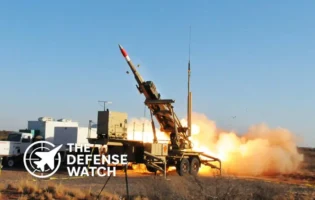
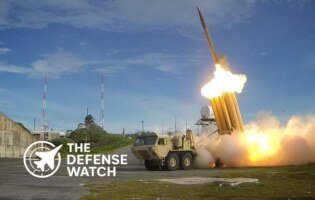
The Patriot Advanced Capability 3 (PAC-3) and the Terminal High Altitude Area Defense (THAAD) system are two of the United States’ most important air and missile defense systems, but they serve different missions within a layered defense architecture.
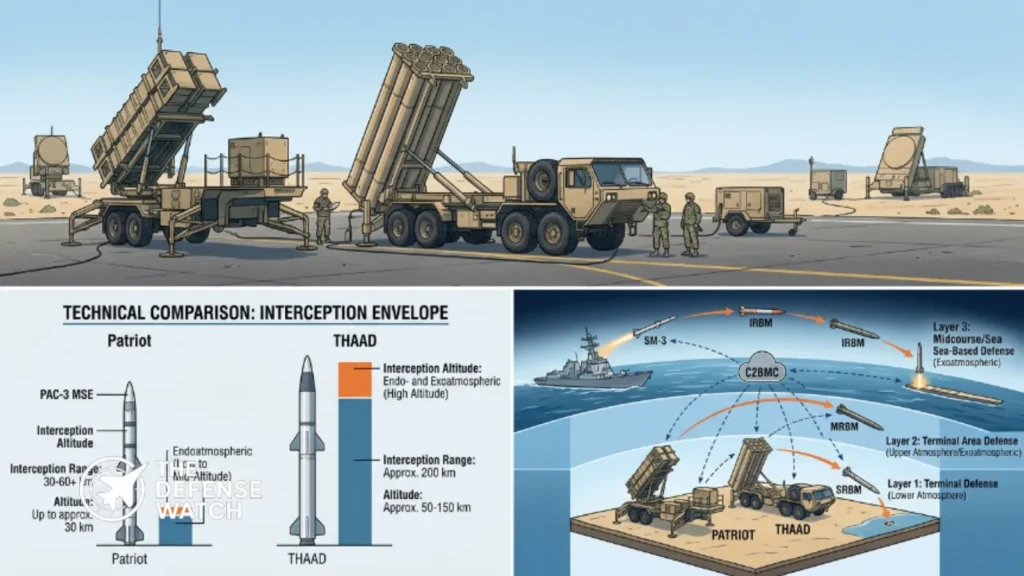
Patriot PAC-3 specializes in defending military bases, cities, and critical infrastructure from short range ballistic missiles, cruise missiles, aircraft, and drones at relatively lower altitudes. THAAD extends the defensive shield by intercepting medium and intermediate range ballistic missiles at much higher altitudes, including outside the Earth’s atmosphere. Together, they provide overlapping protection against modern missile threats.
2. Technical Specifications Table
| Metric | Patriot PAC-3 MSE | THAAD |
|---|---|---|
| Manufacturer | Lockheed Martin (PAC-3), Raytheon (System) | Lockheed Martin |
| Primary Mission | Point and area air defense | High altitude ballistic missile defense |
| Operational Layer | Lower tier | Upper tier |
| Missile Type | PAC-3 MSE Hit-to-Kill | THAAD Interceptor Hit-to-Kill |
| Intercept Range | Approximately 60 to 100 km against ballistic missiles | Approximately 200 km |
| Intercept Altitude | Up to about 35 km | Up to approximately 150 km |
| Maximum Target Type | SRBM, Cruise Missiles, Aircraft, UAVs | MRBM and IRBM |
| Radar | AN/MPQ-65 AESA Radar | AN/TPY-2 X-Band Radar |
| Guidance | Active Radar Homing | Infrared Seeker |
| Kill Mechanism | Hit-to-Kill | Hit-to-Kill |
| Launcher Capacity | Up to 16 PAC-3 MSE missiles | 8 THAAD interceptors |
| Mobility | Highly mobile | Highly mobile |
| Country of Origin | United States | United States |
3. Key Capability Pillars
Layered Missile Defense
Patriot PAC-3 protects against incoming threats during the terminal phase at relatively low altitude. It acts as the last defensive shield for military installations, airports, command centers, and population centers.
THAAD intercepts ballistic missiles much earlier during their terminal descent, often outside the atmosphere. This provides another engagement opportunity before threats can reach Patriot defended areas.
Winner: THAAD for long range ballistic missile defense.
Radar and Detection
Patriot employs the AN/MPQ-65 multifunction phased array radar capable of tracking aircraft, cruise missiles, drones, and ballistic missiles simultaneously.
THAAD uses the AN/TPY-2 X-Band radar, one of the world’s most powerful ballistic missile tracking radars. It detects threats hundreds of kilometers away and provides fire control data across the broader missile defense network.
Winner: THAAD.
Missile Performance
PAC-3 MSE uses a compact interceptor with excellent maneuverability. It is optimized to destroy fast maneuvering ballistic missiles while also engaging cruise missiles and aircraft.
THAAD interceptors are much larger and designed specifically for high altitude exo atmospheric engagements against medium and intermediate range ballistic missiles.
Winner: Depends on mission.
- Patriot for multi mission defense.
- THAAD for high altitude ballistic missile interception.
Target Coverage
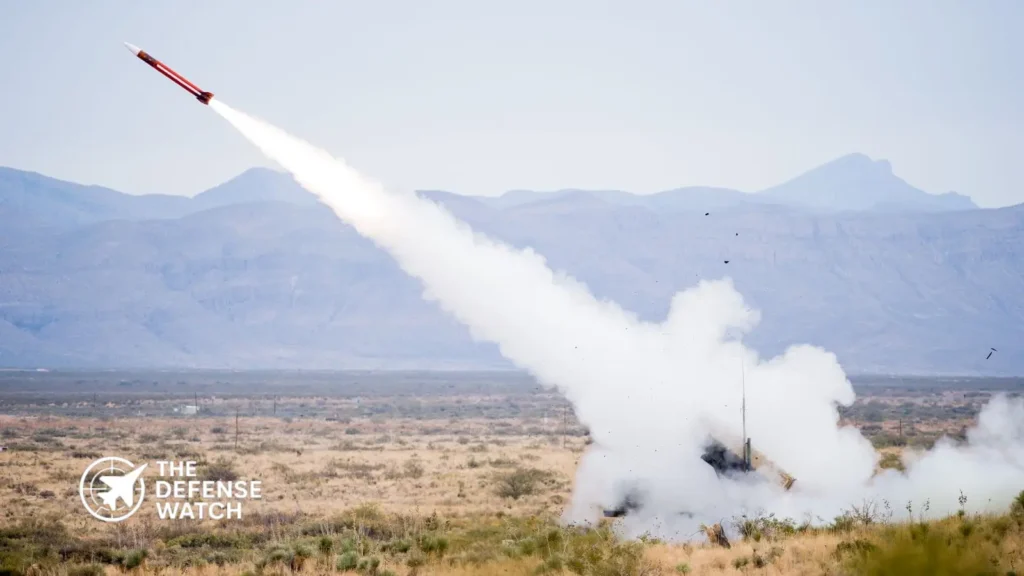
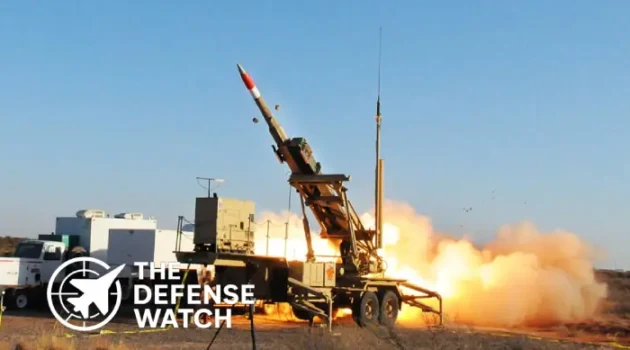
Patriot PAC-3
Effective Against:
- Tactical ballistic missiles
- Cruise missiles
- Fighter aircraft
- Helicopters
- Drones
- UAV swarms
THAAD
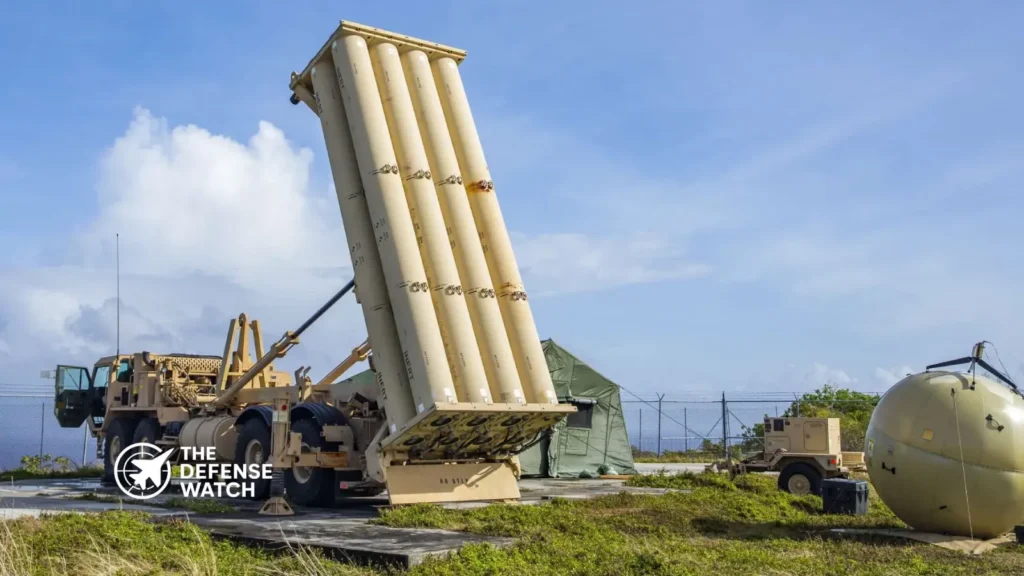
Effective Against:
- Short range ballistic missiles
- Medium range ballistic missiles
- Intermediate range ballistic missiles
Not designed primarily for:
- Aircraft
- Cruise missiles
- Small drones
Winner: Patriot for versatility.
Mobility and Deployment
Both systems are road mobile and can deploy rapidly.
Patriot batteries are generally easier to integrate into existing air defense networks and are widely deployed with NATO allies.
THAAD batteries require larger deployment areas but provide regional missile defense coverage over significantly greater distances.
Combat Experience
Patriot
Combat Proven:
- Gulf War
- Iraq
- Saudi Arabia
- Ukraine support
- Israel
- Multiple missile intercept operations
THAAD
Operational deployments include:
- South Korea
- Guam
- United Arab Emirates
- Israel
- Extensive testing with a very high intercept success rate
Patriot has considerably more real world combat experience.
Winner: Patriot.
Cost Comparison
| Category | Patriot PAC-3 | THAAD |
|---|---|---|
| Battery Cost | Approximately $1 billion | Approximately $2.5 to $3 billion |
| Missile Cost | Around $5 to $7 million | Around $12 to $18 million |
| Coverage Area | Smaller | Much larger |
THAAD offers greater defended area but at substantially higher acquisition and operating costs.
4. Strategic Verdict
Patriot PAC-3 and THAAD are not competitors in the traditional sense. Instead, they are complementary systems that form the backbone of the United States’ layered missile defense strategy.
Choose Patriot PAC-3 if the mission requires defending military bases, critical infrastructure, airports, or urban areas against a broad range of threats, including ballistic missiles, cruise missiles, aircraft, and drones. Its versatility, extensive combat record, and lower cost make it the preferred lower tier defense system.
Choose THAAD when the priority is regional defense against medium and intermediate range ballistic missiles. Its long engagement range, high intercept altitude, and powerful AN/TPY-2 radar allow it to destroy incoming missiles earlier, reducing the risk to assets protected by lower tier systems.
The strongest defense combines both systems. THAAD engages ballistic missiles at high altitude, while Patriot PAC-3 provides a final layer of protection against any threats that penetrate the upper tier, creating one of the most capable integrated missile defense architectures in the world.

| |
| Price | |
| Our Rating | |
| Manufacturer | Raytheon Technologies Lockheed Martin |
| Category | Defense Systems Defense Systems |
1. General Information
| System Name | MIM-104 Patriot PAC-3 Terminal High Altitude Area Defense (THAAD) |
| Manufacturer | Raytheon Technologies Lockheed Martin |
| Country of Origin | United States United States |
| Type / Role | Surface-to-Air Missile (SAM) System Anti-Ballistic Missile Defense System |
| In Service | Yes Yes |
| Year Introduced | 1981 2008 |
| Unit Cost | USD 1 Billion (Estimated per Battery) USD 800M–1B (per battery) |
2. Performance & Capabilities
| Maximum Engagement Range | 160 km 200 km |
| Maximum Engagement Altitude | 24 km 150 km |
| Target Types | Aircraft, Ballistic Missiles, Cruise Missiles, UAVs SRBM, MRBM, IRBM |
| Interception Probability | 90% (Short-Range Missiles) 90% (under test conditions) |
| Reaction Time | 9–15 seconds < 15 seconds |
| Radar Detection Range | 150–300 km Up to 1,000 km |
3. Missile Specifications
| Missile Type | PAC-3 MSE / GEM-T THAAD Interceptor Missile |
| Missile Length | 5.0 m 6.17 m |
| Missile Weight | 312 kg 900 kg |
| Warhead Type | Fragmentation / Proximity Fuse Kinetic Kill Vehicle |
| Warhead Weight | 90 kg N/A (Hit-to-Kill) |
| Speed | Mach 4.5 Mach 8+ |
4. Radar & Fire Control
| Radar Type | Active Electronically Scanned Array (AESA) Radar X-Band AESA Radar |
| Radar Name | AN/MPQ-65 AN/TPY-2 |
| Detection Range | 150–180 km Up to 1,000 km |
| Tracking Capacity | 125+ Targets 100+ Targets |
| Guidance System | Command + Semi-Active Radar Homing Inertial + Terminal IR Seeker |
| Fire Control System | Automated Digital Fire Control System Automated Command and Control |
5. Launcher & Mobility
| Launcher Type | Mobile / Truck-Mounted Mobile / Truck-Mounted |
| No. of Missiles per Launcher | 4–16 8 |
| Reload Time | 30–60 minutes 30–60 minutes |
| Mobility Platform | M983 HEMTT Truck / Tatra 8x8 Oshkosh M1120 HEMTT Truck |
| Crew Required | 3–5 personnel 3–5 personnel |
6. Command & Control
| C2 System | Integrated command and control for real-time engagement THAAD Fire Control and Communications |
| Connectivity | Secure, encrypted data links Link-16 / SATCOM / BMDS Integration |
| Network Capability | Network-centric, interoperable with allied systems Yes (Multi-Tier Integration) |
| Operation Mode | Autonomous, semi-autonomous, networked Autonomous / Networked / Manual Override |
7. Operational Use
| Primary Operator | USA, Germany, Japan, Israel, South Korea USA, UAE, South Korea, Saudi Arabia, Japan |
| Combat Proven | Yes Yes |
| Conflict History | Iraq War, Yemen, Ukraine Deployed in Middle East and Pacific Deterrence Ops |
| Notable Feature | Multi-Layered Defense Capability High-Altitude Intercept with Kinetic Kill Vehicle |
|
Disclaimer Note
The information provided on TheDefenseWatch.com is for general informational purposes only. While we strive to ensure the accuracy, completeness, and timeliness of our content regarding defense and aerospace products, technologies, and specifications, we cannot guarantee that all information is 100% accurate or up-to-date due to the evolving nature of military technology and classified data.TheDefenseWatch.com does not warrant the reliability, suitability, or availability of the information for any specific purpose. Users are advised to consult official sources, such as manufacturers, government publications, or defense agencies, for precise and verified data before making decisions based on our content.We are not affiliated with any defense manufacturers, governments, or military organizations mentioned. Opinions, reviews, and ratings reflect expert analysis but are subjective and should not be considered endorsements. TheDefenseWatch.com is not responsible for any errors, omissions, or consequences arising from the use of this website’s content.External links are provided for convenience and do not imply endorsement. TheDefenseWatch.com reserves the right to update or modify content without prior notice. By using this website, you agree to our Privacy & Cookies Policy.
New Arrivals

Popular Comparisons
-
 J-10C vs JF-17 Thunder: Which Fighter Is More Capable?
View Comparison →
J-10C vs JF-17 Thunder: Which Fighter Is More Capable?
View Comparison → -
Tejas vs Gripen: Key Differences and Capabilities
View Comparison →
-
Tejas vs MiG-21 Bison: How India Replaced Its Iconic Supersonic Fighter
View Comparison →
-
F-35 vs F-16: Stealth, Sensors and Combat Roles
View Comparison →
-
Tejas Fighter Jet vs F-16 Fighting Falcon: Capability Compared
View Comparison →
-
Rafale Fighter Jet vs F-16 Fighting Falcon : Which Fighter Has the Edge?
View Comparison →
-
Su-57 Fighter Jet vs J-20 Fighter Jet: Stealth and Air Combat Compared
View Comparison →
-
Mirage 2000 vs Tejas Mk1A: Legacy Combat Power vs Indigenous Modernization
View Comparison →
-
Rafale Fighter Jet vs F-22 Raptor: Which Air Dominance Fighter Has the Edge?
View Comparison →
-
Tejas Fighter Jet vs. Rafale Fighter Jet: India’s Indigenous Fighter Meets France’s Proven Multirole Combat Aircraft
View Comparison →


- DIA 2026 Space Report Warns China May Field Orbital Directed-Energy Weapons by Late 2020s

- Boeing Advances Second MQ-25 Stingray Toward Testing for U.S. Navy
- Saab Unveils Sea Giraffe AMB D Radar With 250-Kilometer Air Surveillance Range
- Most Advanced Fighter Jet in the World in 2026: F-22 vs. F-35 vs. J-20
- Lockheed Martin Wins $88.6 Million Navy Contract for Radiant Mercury Systems
- Pentagon Uses Department of War Name to Reinforce Message to Adversaries
- Israel’s Military Chief Reportedly Opposed Pre-Election Strike on Iran
- Canada Receives First Two F-35 Fighters as Review of 72 Aircraft Continues
- Lockheed Martin Completes $3.45 Billion Ultra Maritime Acquisition
- Lockheed Martin Advances Ramjet-Powered PrSM Increment 4 Missile





Fighter Jets
-
 F-100 Super Sabre
-
North American F-86 Sabre
-
Northrop YF-23 Fighter
-
Rafale F5 Fighter
-
SU-57 Felon Stealth Fighter
-
Boeing F/A-XX Fighter
-
JF-17 Thunder Fighter Jet
-
F-47 Fighter Jet
-
MIG-31 Fighter Jet
-
J-10CE Fighter Jet
-
Chengdu J-10 Fighter Jet
-
Chengdu J-10C Fighter Jet
-
Gripen E Fighter Jet
-
Tejas Mk1A Fighter Jet
-
Tejas Mk‑2 Fighter Jet
-
F-16V Viper Block 70 Fighter Jet
-
F-15EX Eagle II Fighter
-
F-15E Strike Eagle Fighter
-
F/A-18E/F Super Hornet Fighter Jet
-
Saab Gripen F Fighter Jet
-
JAS 39E/F Gripen Fighter Jet
-
JAS 39 Gripen Fighter Jet
-
F-35A Lightning II Fighter Jet
-
F/A-18F Super Hornet







Recent Compares
-
J-10C vs JF-17 Thunder: Which Fighter Is More Capable?
View Comparison →
-
Tejas vs Gripen: Key Differences and Capabilities
View Comparison →
-
Tejas vs MiG-21 Bison: How India Replaced Its Iconic Supersonic Fighter
View Comparison →
-
F-35 vs F-16: Stealth, Sensors and Combat Roles
View Comparison →
-
Tejas Fighter Jet vs F-16 Fighting Falcon: Capability Compared
View Comparison →
Latest Defense Systems
10 Compares Defense Systems
-
J-10C vs JF-17 Thunder: Which Fighter Is More Capable?
View Comparison →
-
Tejas vs Gripen: Key Differences and Capabilities
View Comparison →
-
Tejas vs MiG-21 Bison: How India Replaced Its Iconic Supersonic Fighter
View Comparison →
-
F-35 vs F-16: Stealth, Sensors and Combat Roles
View Comparison →
-
Tejas Fighter Jet vs F-16 Fighting Falcon: Capability Compared
View Comparison →
-
Rafale Fighter Jet vs F-16 Fighting Falcon : Which Fighter Has the Edge?
View Comparison →
-
Su-57 Fighter Jet vs J-20 Fighter Jet: Stealth and Air Combat Compared
View Comparison →
-
Mirage 2000 vs Tejas Mk1A: Legacy Combat Power vs Indigenous Modernization
View Comparison →
-
Rafale Fighter Jet vs F-22 Raptor: Which Air Dominance Fighter Has the Edge?
View Comparison →
-
Tejas Fighter Jet vs. Rafale Fighter Jet: India’s Indigenous Fighter Meets France’s Proven Multirole Combat Aircraft
View Comparison →
- DIA 2026 Space Report Warns China May Field Orbital Directed-Energy Weapons by Late 2020s
- Boeing Advances Second MQ-25 Stingray Toward Testing for U.S. Navy
- Saab Unveils Sea Giraffe AMB D Radar With 250-Kilometer Air Surveillance Range
- Most Advanced Fighter Jet in the World in 2026: F-22 vs. F-35 vs. J-20
- Lockheed Martin Wins $88.6 Million Navy Contract for Radiant Mercury Systems