














@2026 – All Right Reserved. TheDefenseWatch.com
- Home
- Defense Systems
- Missiles & Precision Weapons
- China JL-1 Air-Launched Ballistic Missile
China JL-1 Air-Launched Ballistic Missile
Defense Systems Full Specifications
1. General Information
| Name / Designation | JL-1 (Jing Lei-1 / Thunderclap-1) |
| Type / Role | Air-Launched Ballistic Missile (ALBM), Nuclear-Capable Strategic Strike |
| Country of Origin | China |
| Manufacturer | Chinese state defense industry (CASIC-linked) |
| Service Entry / Year Introduced | Publicly unveiled 2025; development tracked from late 2010s |
| Operational Status | Entering/Active service (assessed) |
2. Performance & Range
| Range | Claimed ~8,000 km (platform-inclusive); missile intrinsic range assessed ~3,000 km class |
| Speed | Hypersonic |
| Ceiling / Altitude Limit | Ballistic trajectory (high altitude) |
| Accuracy (CEP) | Not publicly disclosed |
| Warhead Type | Nuclear-capable; possible conventional |
3. Guidance & Targeting
| Guidance System | Inertial; assessed terminal maneuvering capability |
| Targeting Mode | Pre-programmed / fire-and-forget with maneuvering RV |
| Launch Platform Compatibility | H-6N strategic bomber (semi-recessed carriage) |
| Seeker Type | Assessed MARV or HGV configuration |
4. Physical Characteristics
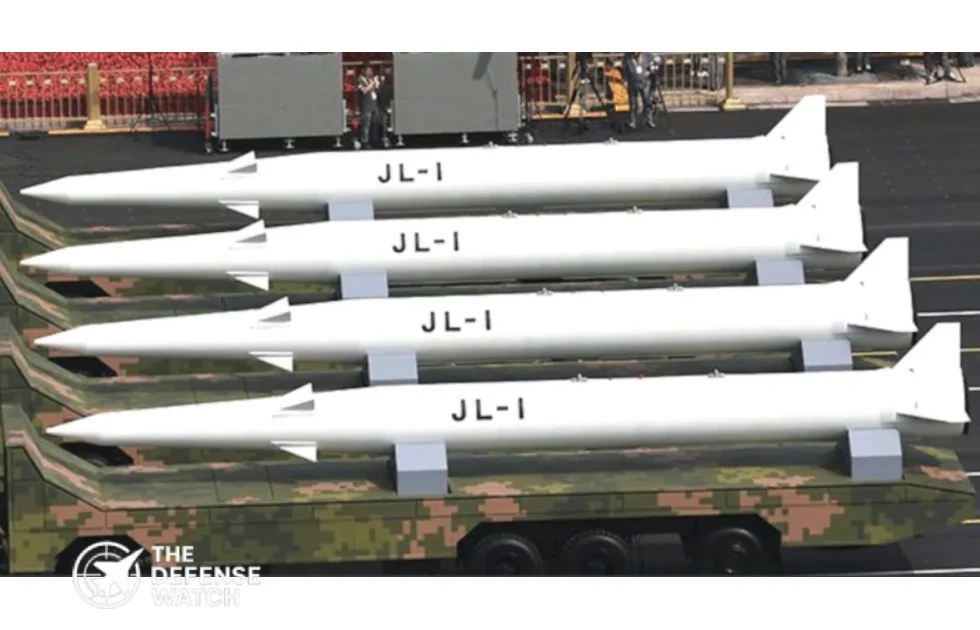
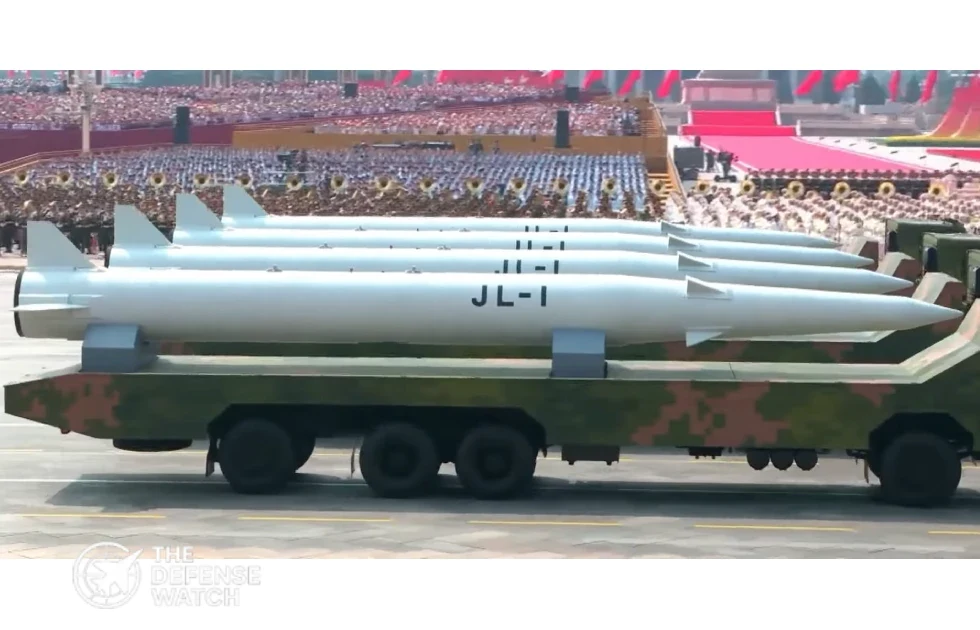
| Length | Approximately 10–15 m class (estimated from DF-21 lineage and imagery) |
| Diameter | Not publicly disclosed |
| Wingspan | Control surfaces present (air-launched configuration) |
| Launch Weight | Not publicly disclosed |
| Propulsion | Two-stage solid-fuel (assessed) |
5. Warhead & Payload
| Warhead Weight | Not publicly disclosed |
| Explosive Type | Nuclear (primary); possible conventional |
| Detonation Mechanism | Not publicly disclosed |
| Payload Options | Nuclear; possible conventional |
6. Operational Use & Capabilities
| Operational Range Type | Long |
| Deployment Platform | Air (H-6N bomber) |
| Target Types | Strategic fixed targets, potential anti-ship |
| Combat Proven | No (publicly) |
| Users / Operators | People’s Liberation Army Air Force (China) |
PROS
- Completes China’s nuclear triad with an airborne delivery option
- Standoff launch from H-6N reduces exposure of the bomber to terminal defenses
- Hypersonic speed and potential terminal maneuverability increase penetration potential
- Dual nuclear/conventional capability supports flexible targeting
- Mobile air-launched platform offers geographic flexibility and recall options
CONS
- Dependent on the non-stealthy, subsonic H-6N platform for launch
- Exact range, accuracy, and warhead details remain classified or estimated
- Limited open-source confirmation of inventory size and full operational status
- Vulnerability of the bomber force to modern air defenses and fighter interception
- Potential for dual-use ambiguity that complicates escalation control
China JL-1 Air-Launched Ballistic Missile
The JL-1 (Chinese: 惊雷-1, Jing Lei-1 or “Thunderclap-1”) is a nuclear-capable air-launched ballistic missile (ALBM) developed by China for the People’s Liberation Army Air Force. Unveiled publicly during the 2025 China Victory Day Parade, it forms the airborne leg of China’s nuclear triad alongside land-based intercontinental ballistic missiles and submarine-launched systems. Designed as a standoff weapon, the JL-1 is carried by the Xi’an H-6N strategic bomber and enables long-range precision or strategic strikes while keeping the launch aircraft outside many air-defense envelopes.
Manufacturer
The missile is a product of China’s state defense industry, with development linked to entities associated with the China Aerospace Science and Industry Corporation (CASIC) and related research institutes. It is widely assessed as an air-launched derivative of the DF-21 medium-range ballistic missile family (previously tracked in open sources as KF-21 or NATO CH-AS-X-13). Public details on the exact production facility remain limited, consistent with the classification of strategic systems.
Speed and Range
Chinese state media have reported a range of approximately 8,000 km, a figure that appears to incorporate the launch altitude, speed, and potential aerial-refueling contribution of the H-6N platform. Independent assessments generally place the missile’s intrinsic range in the 3,000 km class, with actual combat reach dependent on release conditions, trajectory, and payload. The weapon is described as capable of hypersonic speeds with terminal maneuverability, potentially employing a maneuverable reentry vehicle (MARV) or hypersonic glide vehicle configuration to complicate interception.
Cost/Price
Unit cost and production figures for the JL-1 have not been publicly released by Chinese authorities. As a strategic nuclear-capable system, pricing is not disclosed in open sources.
The JL-1 enhances China’s ability to conduct airborne nuclear or conventional long-range strikes, particularly in the Indo-Pacific region, while adding a mobile, recallable element to its strategic deterrent posture. Operational details continue to be refined through testing and integration with the H-6N fleet.
Disclaimer Note
The information provided on TheDefenseWatch.com is for general informational purposes only. While we strive to ensure the accuracy, completeness, and timeliness of our content regarding defense and aerospace products, technologies, and specifications, we cannot guarantee that all information is 100% accurate or up-to-date due to the evolving nature of military technology and classified data.TheDefenseWatch.com does not warrant the reliability, suitability, or availability of the information for any specific purpose. Users are advised to consult official sources, such as manufacturers, government publications, or defense agencies, for precise and verified data before making decisions based on our content.We are not affiliated with any defense manufacturers, governments, or military organizations mentioned. Opinions, reviews, and ratings reflect expert analysis but are subjective and should not be considered endorsements. TheDefenseWatch.com is not responsible for any errors, omissions, or consequences arising from the use of this website’s content.External links are provided for convenience and do not imply endorsement. TheDefenseWatch.com reserves the right to update or modify content without prior notice. By using this website, you agree to our Privacy & Cookies Policy.
More Defense Systems from China Aerospace Science and Industry Corporation (CASIC)
New Arrivals
Popular Comparisons
-
 Tejas Fighter Jet vs F-16 Fighting Falcon: Capability Compared
View Comparison →
Tejas Fighter Jet vs F-16 Fighting Falcon: Capability Compared
View Comparison → -
Rafale Fighter Jet vs F-16 Fighting Falcon : Which Fighter Has the Edge?
View Comparison →
-
Su-57 Fighter Jet vs J-20 Fighter Jet: Stealth and Air Combat Compared
View Comparison →
-
Mirage 2000 vs Tejas Mk1A: Legacy Combat Power vs Indigenous Modernization
View Comparison →
-
Rafale Fighter Jet vs F-22 Raptor: Which Air Dominance Fighter Has the Edge?
View Comparison →
-
Tejas Fighter Jet vs. Rafale Fighter Jet: India’s Indigenous Fighter Meets France’s Proven Multirole Combat Aircraft
View Comparison →
-
F-22 Raptor vs. F-35 Joint Strike Fighter: Which Fifth Generation Fighter Has the Edge?
View Comparison →
-
F-35A vs. F-22 Raptor: Which U.S. Stealth Fighter Dominates Modern Air Combat?
View Comparison →
-
AGM-114 Hellfire vs. AGM-179 JAGM: Which U.S. Precision Missile Is Better?
View Comparison →
-
Patriot (PAC-3) vs. THAAD: Complete Missile Defense System Comparison, Capabilities, Range, and Strategic Roles
View Comparison →
- Bell Boeing Wins $19.8M V-22 Tactical Software Support Contract

- Honeywell Wins $53.9M Navy Contract for WSN-7 Gyro Components
- Lockheed Martin Wins $76.6M Trident II D5LE2 Development Contract
- Lockheed Martin Gets $871.2M F-35 Site Support Contract Increase
- Pete Hegseth Texas Enlistment Ceremony: Hegseth Tells Military Families, We Have Their Back
- U.S., Denmark and Greenland Reach Security Agreement to Expand American Military Presence
- SpaceX Wins Three More NASA Crew Missions in $946 Million ISS Contract
- U.S. Clears Potential $24.3 Billion F-35 Sale to Saudi Arabia
- Type 99B Tank Training Shows China’s Shift Toward Networked Armored Warfare
- JRC Integrated Systems Gets $47.4M SLCM-N Support Contract