Executive Summary:
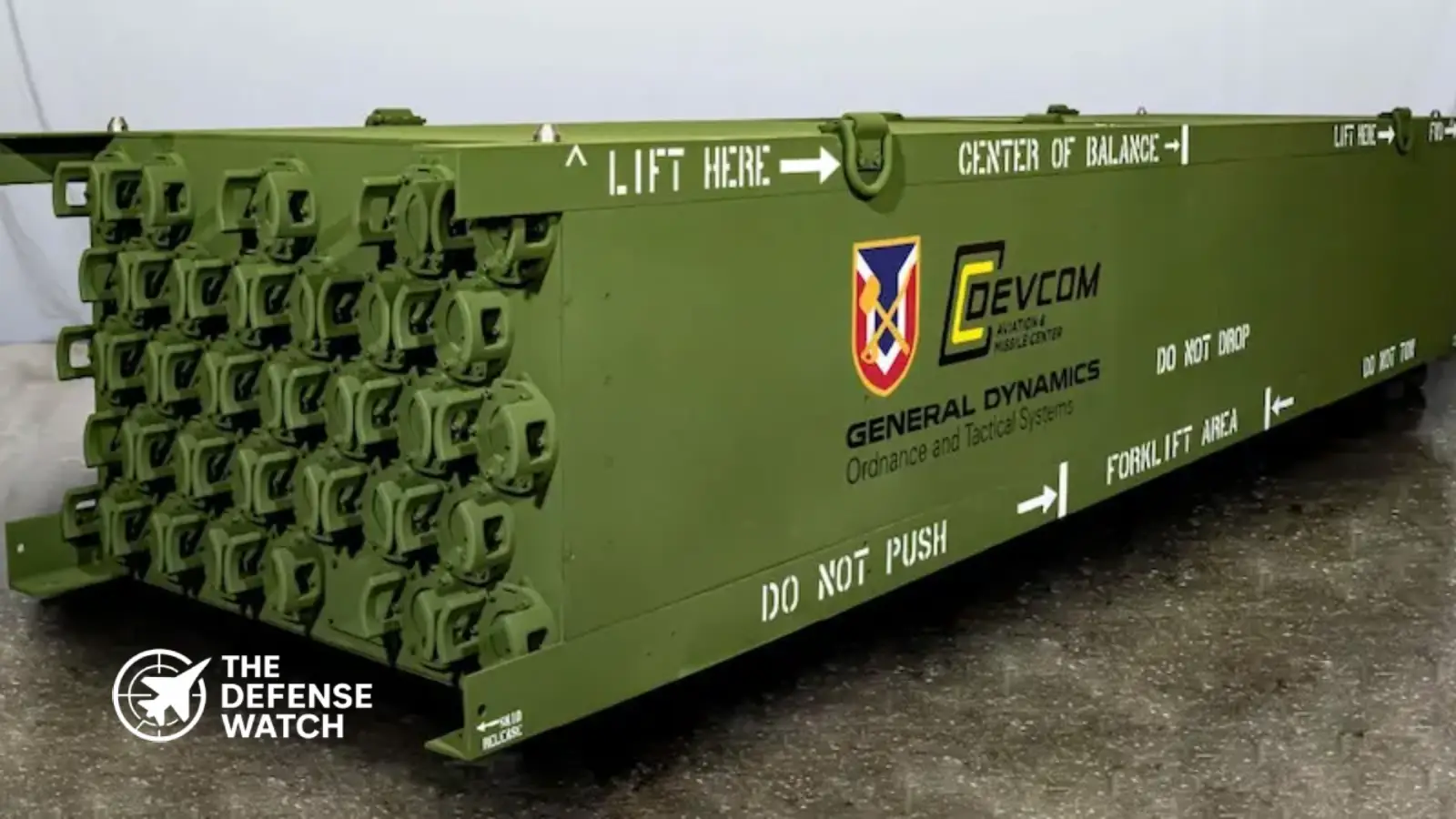
General Dynamics Ordnance and Tactical Systems (GDOTS) has completed the first successful firing test of a 4.75-inch solid rocket motor developed in partnership with the U.S. Army Combat Capabilities Development Command Aviation & Missile Center. The test supports the Army’s Direct Support Fires Technology initiative, which aims to deliver affordable, high-volume precision fires while significantly increasing launcher magazine depth for future battlefield operations.
General Dynamics Tests 4.75-Inch Rocket Motor For U.S. Army Direct Support Fires Program
General Dynamics Ordnance and Tactical Systems (GDOTS) has successfully conducted the first industry-led firing test of the U.S. Army’s 4.75-inch solid rocket motor, marking a key milestone in the Army’s effort to field affordable, high-volume precision fires for future conflicts.
The test was conducted on June 17 at GDOTS’ facility in Camden, Arkansas. According to the company, the rocket motor’s performance fell within one percent of analytical predictions, validating both the Army’s design work and the manufacturing approach used by General Dynamics.
The rocket motor was designed by the U.S. Army Combat Capabilities Development Command (DEVCOM) Aviation & Missile Center and manufactured and tested by GDOTS under the Army’s Direct Support Fires Technology (DSFT) initiative.
What Is The Direct Support Fires Technology Program?
The Direct Support Fires Technology program is part of the Army’s broader modernization effort focused on increasing the volume, responsiveness, and affordability of long-range fires.
According to DEVCOM Aviation & Missile Center documentation, DSFT is intended to provide a scalable rocket capability capable of delivering large numbers of effects on the battlefield while maintaining compatibility with existing launch platforms. The concept emphasizes higher rocket throughput, extended range, and greater battlefield saturation compared with current systems.
The Army has stated that DSFT could enable launch pods carrying up to 30 rockets, dramatically increasing available firepower without requiring entirely new launch vehicles. Current HIMARS launch pods typically carry six Guided Multiple Launch Rocket System (GMLRS) rockets.
Test Results Demonstrate Design Maturity
The successful firing test represents the first time an industry partner has tested the Army-developed 4.75-inch rocket motor design.
According to General Dynamics, the test achieved performance results within one percent of expected analytical models, a level of accuracy that suggests the design is progressing through development with relatively low technical risk.
Chris Haynes, Senior Vice President and General Manager of General Dynamics Ordnance and Tactical Systems, described the event as an important demonstration of cooperation between industry and government research organizations.
The result provides early evidence that the smaller rocket form factor can deliver the performance required for future tactical artillery applications while remaining compatible with existing production methods.
Why The 4.75-Inch Rocket Matters
The significance of the 4.75-inch rocket motor extends beyond a single technology demonstration.
Modern conflicts have highlighted the importance of sustaining large volumes of precision fires over extended periods. The war in Ukraine, along with increasing concerns about potential high-intensity conflicts in the Indo-Pacific, has driven renewed interest in what U.S. defense planners often describe as “affordable mass.
Smaller precision-guided rockets could allow commanders to engage more targets without increasing launcher size or logistics requirements.
Potential Operational Advantages
| Capability | Current GMLRS Pod | Proposed 4.75-Inch Concept |
|---|---|---|
| Rockets per HIMARS pod | 6 | Up to 30 |
| Launcher footprint | Existing | Existing |
| Precision engagement | Yes | Intended |
| Magazine depth | Limited | Significantly increased |
The Army’s objective is not simply to reduce rocket size. Instead, the goal is to increase the number of precision effects available to commanders while preserving range, accuracy, and lethality.
Strengthening The U.S. Rocket Motor Industrial Base
The program also reflects a broader Pentagon effort to expand domestic solid rocket motor production capacity.
Demand for rocket motors has increased sharply in recent years as the United States replenishes stocks transferred to allies while preparing for potential future conflicts. Industry capacity has struggled to keep pace with growing demand for missile and rocket propulsion systems.
The Department of Defense has therefore encouraged additional manufacturers to enter the rocket motor market, reducing reliance on a limited number of traditional suppliers.
General Dynamics has already partnered with Lockheed Martin to expand production of solid rocket motors used in precision-guided munitions. Initial efforts have focused on motors for the Guided Multiple Launch Rocket System, with potential expansion into additional missile programs.
Strategic Implications For Future Warfare
The successful test highlights a growing shift in U.S. military thinking.
For more than two decades, precision strike programs largely emphasized increasingly sophisticated and expensive weapons. Recent operational lessons have reinforced the need for both precision and quantity.
A launcher capable of carrying significantly more guided rockets could provide greater battlefield persistence, improved target coverage, and enhanced survivability by reducing the frequency of reload operations.
The concept also aligns with emerging U.S. Army modernization priorities that seek to combine precision engagement with the ability to generate sustained fires against large numbers of targets across distributed battlefields.
If future testing confirms projected performance, the 4.75-inch rocket motor could become a foundational component of next-generation artillery and missile systems designed for large-scale combat operations.
What Comes Next
The successful firing test represents an early but important step in the maturation of the 4.75-inch rocket motor program.
Additional development, qualification, and integration testing will be required before any operational deployment decisions are made. Future testing is expected to evaluate propulsion performance, guidance integration, production scalability, and compatibility with existing launch platforms.
For the Army, the ultimate objective remains clear: deliver greater volumes of affordable precision fires while strengthening the industrial base needed to sustain long-term military readiness.
Get real time update about this post category directly on your device, subscribe now.