
- Home
- Defense Systems
- Bombers & Strategic Aircraft
- B-17 Flying Fortress
B-17 Flying Fortress
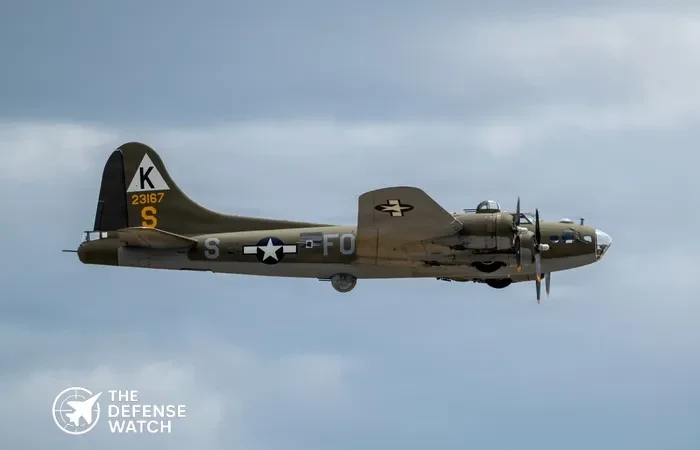
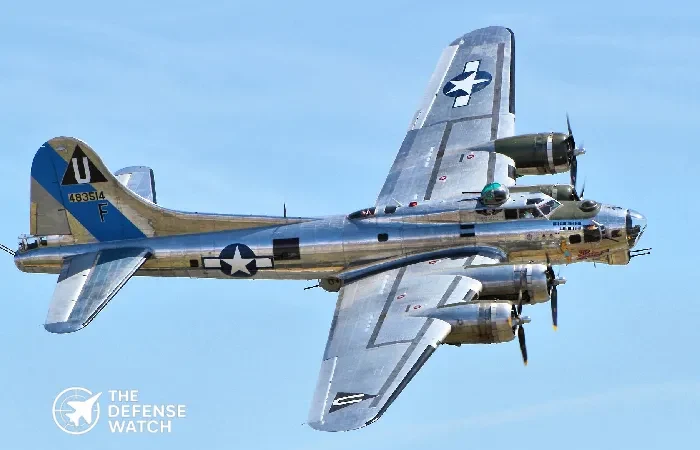
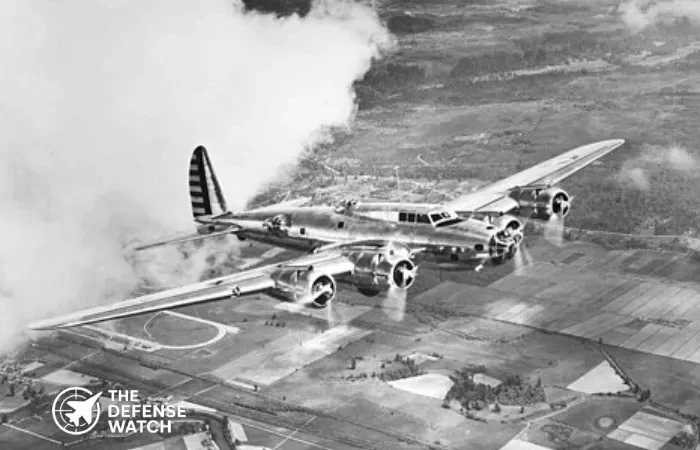
Defense Systems Full Specifications
1. General Information
| Name | Boeing B-17 Flying Fortress |
| Manufacturer | Boeing (also Douglas and Vega production) |
| Country of Origin | United States |
| Introduction / In Service Since | 1938 |
| Status | Retired |
| Category | Heavy Strategic Bomber |
| Crew | 10 |
| Unit Cost | Approximately US$238,000 (1945) |
2. Dimensions & Structure
| Length | 74 ft 4 in (22.66 m) |
| Wingspan | 103 ft 9 in (31.65 m) |
| Height | 19 ft 1 in (5.82 m) |
| Wing Area | 1,420 sq ft (131.9 m²) |
| Empty Weight | 36,135 lb (16,391 kg) |
| Maximum Takeoff Weight (MTOW) | 65,500 lb (29,710 kg) |
3. Performance
| Maximum Speed | 287 mph (462 km/h) |
| Range | 2,000 mi (3,219 km) ferry |
| Combat Radius | Approximately 1,000 mi (1,609 km), mission dependent |
| Service Ceiling | 35,600 ft (10,850 m) |
| Rate of Climb | 900 ft/min (4.6 m/s) |
4. Powerplant
| Engine Type | 4 × Wright R-1820-97 Cyclone radial piston engines |
| Thrust (per engine) | Not applicable, 1,200 hp each |
| Total Thrust | Not applicable, total 4,800 hp |
5. Payload & Armament
| Internal Payload Capacity | Up to 17,600 lb (7,983 kg) bombs |
| Weapons Bay | Internal bomb bay |
| Compatible Weapons | General purpose bombs, incendiary bombs, fragmentation bombs |
| Hardpoints | None |
6. Avionics & Systems
| Radar System | None (later variants carried basic radar/navigation aids) |
| Navigation | Celestial, radio navigation, Norden bombsight |
| Electronic Warfare (EW) | Limited wartime ECM on late variants |
| Stealth Features | None |
7. Operational History
| Primary Operator | United States Army Air Forces |
| Conflict Usage | World War II |
| Notable Missions | Schweinfurt Regensburg raids, Combined Bomber Offensive, European Strategic Bombing Campaign |
8. Additional Information
| Variants | B-17A, B-17B, B-17C, B-17D, B-17E, B-17F, B-17G |
| Successor / Future Replacement | Boeing B-29 Superfortress |
| Notable Features | Heavy defensive guns, durable airframe, Norden bombsight |
| Estimated Operational Life | 1938 to 1960s (secondary operators), preserved in museums today |
PROS
- Highly durable airframe capable of surviving significant battle damage.
- Strong defensive armament for its era.
- Excellent high altitude bombing capability.
- Proven strategic bomber with extensive combat record.
- Reliable four engine design with long operational history.
CONS
- Slower than modern military aircraft.
- No stealth or electronic warfare capability.
- Required a large crew and extensive maintenance.
- Vulnerable to advanced jet fighters and modern air defenses.
- Limited payload compared to later heavy bombers.
Boeing B-17 Flying Fortress Strategic Bomber
The Boeing B-17 Flying Fortress is one of the most iconic heavy bombers in aviation history. Developed for the United States Army Air Corps during the 1930s, the aircraft became a symbol of American strategic bombing operations throughout World War II. Known for its rugged construction, extensive defensive armament, and ability to survive heavy battle damage, the B-17 earned the nickname Flying Fortress because of its numerous machine gun positions.
Manufacturer
The B-17 was designed and manufactured by Boeing, with additional production by Douglas Aircraft Company and Vega Aircraft Corporation (a Lockheed subsidiary) to meet wartime demand. More than 12,700 aircraft were produced between 1936 and 1945.
Speed and Range
Powered by four Wright R-1820 Cyclone radial piston engines, the B-17 achieved a maximum speed of approximately 287 mph (462 km/h). It had a ferry range of about 2,000 miles (3,219 km), enabling long-range bombing missions across Europe and the Pacific. The aircraft typically operated at high altitudes, where its defensive guns and formation tactics helped improve survivability.
Cost / Price
During World War II, a B-17G Flying Fortress cost approximately US$238,000 in 1945 dollars. Adjusted for inflation, this would equal several million U.S. dollars today. Since the aircraft is no longer in production, surviving examples are preserved in museums or operated by historical aviation organizations.
The B-17 could carry up to 17,600 pounds (7,983 kg) of bombs on short-range missions, although typical combat loads were lower for long-range operations. It played a decisive role in the Allied daylight strategic bombing campaign against Germany, targeting industrial centers, transportation infrastructure, and military facilities. Although later replaced by more advanced bombers such as the B-29 Superfortress, the Flying Fortress remains an enduring symbol of U.S. air power and military aviation history.
Disclaimer Note
The information provided on TheDefenseWatch.com is for general informational purposes only. While we strive to ensure the accuracy, completeness, and timeliness of our content regarding defense and aerospace products, technologies, and specifications, we cannot guarantee that all information is 100% accurate or up-to-date due to the evolving nature of military technology and classified data.TheDefenseWatch.com does not warrant the reliability, suitability, or availability of the information for any specific purpose. Users are advised to consult official sources, such as manufacturers, government publications, or defense agencies, for precise and verified data before making decisions based on our content.We are not affiliated with any defense manufacturers, governments, or military organizations mentioned. Opinions, reviews, and ratings reflect expert analysis but are subjective and should not be considered endorsements. TheDefenseWatch.com is not responsible for any errors, omissions, or consequences arising from the use of this website’s content.External links are provided for convenience and do not imply endorsement. TheDefenseWatch.com reserves the right to update or modify content without prior notice. By using this website, you agree to our Privacy & Cookies Policy.
New Arrivals

Popular Comparisons
-
 J-10C vs JF-17 Thunder: Which Fighter Is More Capable?
View Comparison →
J-10C vs JF-17 Thunder: Which Fighter Is More Capable?
View Comparison → -
Tejas vs Gripen: Key Differences and Capabilities
View Comparison →
-
Tejas vs MiG-21 Bison: How India Replaced Its Iconic Supersonic Fighter
View Comparison →
-
F-35 vs F-16: Stealth, Sensors and Combat Roles
View Comparison →
-
Tejas Fighter Jet vs F-16 Fighting Falcon: Capability Compared
View Comparison →
-
Rafale Fighter Jet vs F-16 Fighting Falcon : Which Fighter Has the Edge?
View Comparison →
-
Su-57 Fighter Jet vs J-20 Fighter Jet: Stealth and Air Combat Compared
View Comparison →
-
Mirage 2000 vs Tejas Mk1A: Legacy Combat Power vs Indigenous Modernization
View Comparison →
-
Rafale Fighter Jet vs F-22 Raptor: Which Air Dominance Fighter Has the Edge?
View Comparison →
-
Tejas Fighter Jet vs. Rafale Fighter Jet: India’s Indigenous Fighter Meets France’s Proven Multirole Combat Aircraft
View Comparison →


- Pratt & Whitney Begins $100 Million Polish Expansion for F-35 Engine Parts

- Northrop Grumman Wins $43.9 Million Contract for Trident II Rocket Motor Facilities
- Ukraine Drone Strikes Disrupt Russian Data Centers, Raising Questions About AI Infrastructure Security
- Lockheed Martin Wins $114.6 Million Contract to Redesign F-35 Navigation Systems
- Project Agincourt Pushes Pentagon to Speed Up Autonomous Weapons Fielding
- Northrop Grumman Factory Expansion Aims to Increase B-21 Raider Production
- France Orders Four More SAMP/T NG Air Defense Systems
- France and UAE Revive Rafale F5 Fighter Development Partnership
- P-800 Oniks Missile: Range, Speed and BrahMos Comparison
- Ukrainian Drone Unit Caused 70% of Simulated U.S. Brigade Casualties in Germany Exercise


Fighter Jets
-
 F-100 Super Sabre
-
North American F-86 Sabre
-
Northrop YF-23 Fighter
-
Rafale F5 Fighter
-
SU-57 Felon Stealth Fighter
-
Boeing F/A-XX Fighter
-
JF-17 Thunder Fighter Jet
-
F-47 Fighter Jet
-
MIG-31 Fighter Jet
-
J-10CE Fighter Jet
-
Chengdu J-10 Fighter Jet
-
Chengdu J-10C Fighter Jet
-
Gripen E Fighter Jet
-
Tejas Mk1A Fighter Jet
-
Tejas Mk‑2 Fighter Jet
-
F-16V Viper Block 70 Fighter Jet
-
F-15EX Eagle II Fighter
-
F-15E Strike Eagle Fighter
-
F/A-18E/F Super Hornet Fighter Jet
-
Saab Gripen F Fighter Jet
-
JAS 39E/F Gripen Fighter Jet
-
JAS 39 Gripen Fighter Jet
-
F-35A Lightning II Fighter Jet
-
F/A-18F Super Hornet







Recent Compares
-
J-10C vs JF-17 Thunder: Which Fighter Is More Capable?
View Comparison →
-
Tejas vs Gripen: Key Differences and Capabilities
View Comparison →
-
Tejas vs MiG-21 Bison: How India Replaced Its Iconic Supersonic Fighter
View Comparison →
-
F-35 vs F-16: Stealth, Sensors and Combat Roles
View Comparison →
-
Tejas Fighter Jet vs F-16 Fighting Falcon: Capability Compared
View Comparison →
Latest Defense Systems
10 Compares Defense Systems
-
J-10C vs JF-17 Thunder: Which Fighter Is More Capable?
View Comparison →
-
Tejas vs Gripen: Key Differences and Capabilities
View Comparison →
-
Tejas vs MiG-21 Bison: How India Replaced Its Iconic Supersonic Fighter
View Comparison →
-
F-35 vs F-16: Stealth, Sensors and Combat Roles
View Comparison →
-
Tejas Fighter Jet vs F-16 Fighting Falcon: Capability Compared
View Comparison →
-
Rafale Fighter Jet vs F-16 Fighting Falcon : Which Fighter Has the Edge?
View Comparison →
-
Su-57 Fighter Jet vs J-20 Fighter Jet: Stealth and Air Combat Compared
View Comparison →
-
Mirage 2000 vs Tejas Mk1A: Legacy Combat Power vs Indigenous Modernization
View Comparison →
-
Rafale Fighter Jet vs F-22 Raptor: Which Air Dominance Fighter Has the Edge?
View Comparison →
-
Tejas Fighter Jet vs. Rafale Fighter Jet: India’s Indigenous Fighter Meets France’s Proven Multirole Combat Aircraft
View Comparison →
- Pratt & Whitney Begins $100 Million Polish Expansion for F-35 Engine Parts
- Northrop Grumman Wins $43.9 Million Contract for Trident II Rocket Motor Facilities
- Ukraine Drone Strikes Disrupt Russian Data Centers, Raising Questions About AI Infrastructure Security
- Lockheed Martin Wins $114.6 Million Contract to Redesign F-35 Navigation Systems
- Project Agincourt Pushes Pentagon to Speed Up Autonomous Weapons Fielding