(adsbygoogle = window.adsbygoogle || []).push({});Executive Summary:
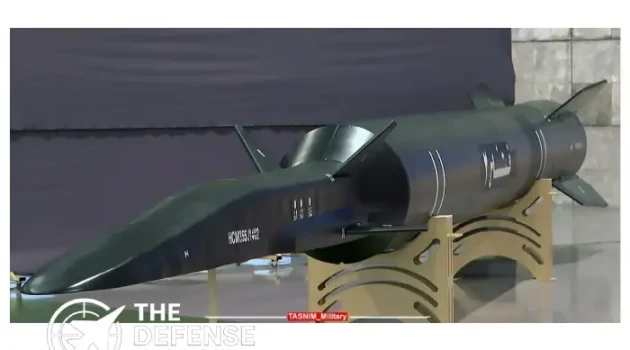
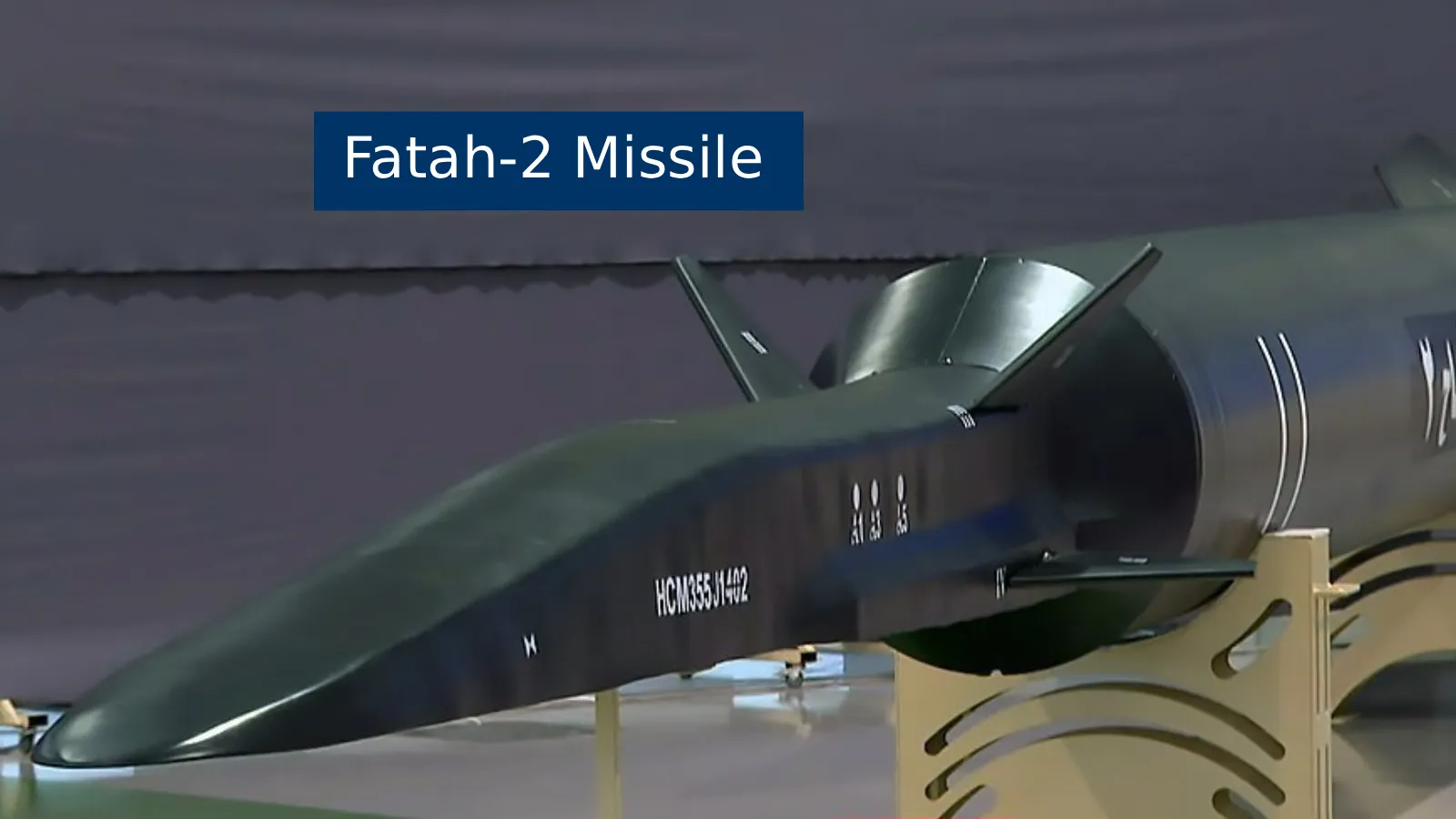
The Fatah-2 is Iran’s second-generation hypersonic weapon, pairing a boosted rocket stage with a maneuverable glide vehicle that Iranian sources claim can reach Mach 13-15 across a reported 1,400-1,500 km range. Its terminal-phase maneuverability, not just its speed, is what forces layered air-defense networks like Patriot, THAAD, and Iron Dome to rewrite their intercept math in real time.
A missile that can cross the length of the Persian Gulf in under ten minutes doesn’t need to be perfectly accurate. It just needs to arrive before the defense grid finishes deciding what it’s looking at.
That’s the Fatah-2’s entire pitch. Unveiled by the IRGC Aerospace Force in November 2023 as the successor to the original Fatah-1, the system swaps a conventional reentry vehicle for a hypersonic glide vehicle (HGV) — a payload built to skip, bank, and juke through the upper atmosphere instead of falling along a predictable arc.
Technical Analysis: The Deep Dive
Publicly reported figures put the Fatah-2 at a two-stage design: a rocket booster stage gets the glide vehicle up to speed, then a second-stage HGV — described in Iranian and open-source reporting as liquid-fueled with throttleable thrust — takes over for the maneuvering terminal run. That throttle control matters more than the headline speed number.
A fixed-thrust glide vehicle still telegraphs a rough flight corridor. A vehicle that can vary its own thrust mid-glide can dodge inside that corridor, forcing an interceptor to solve a moving target problem rather than a predicted-intercept-point problem. That’s the core reason analysts keep comparing it to systems like China’s DF-ZF or Russia’s Avangard rather than to a standard MRBM.
Range estimates cluster between 1,400 and 1,500 km, which covers every US installation in the Gulf, most of Israel, and parts of the Arabian Sea from launch points inside Iran. Warhead reporting varies by source, generally in the 200-500 kg class, with both high-explosive and penetrator variants described. The launch platform is a road-mobile transporter-erector-launcher (TEL), which is arguably as strategically relevant as the missile’s flight profile — a mobile launcher is a much harder pre-emptive target than a fixed silo.
Fatah-2: Reported Specifications at a Glance
(adsbygoogle = window.adsbygoogle || []).push({});Metric Reported Figure Strategic Implication Top speed Mach 13-15 (~16,000-18,500 km/h) Compresses defender decision time to seconds Operational range 1,400-1,500 km Covers Gulf bases, Israel, Arabian Sea shipping lanes Propulsion Solid-fuel booster + liquid-fuel HGV stage Throttleable terminal-phase maneuvering Warhead class ~200-500 kg (HE / penetrator variants reported) Flexible against hardened vs. soft targets Launch platform Road-mobile TEL Difficult to preemptively locate and strike Guidance INS, with reported potential for satellite updates Terminal accuracy less predictable than pure ballistic systems The Insight: What Esports Aggression Teaches Us About Glide-Vehicle Doctrine
Watch a top-tier Call of Duty player run an aggressive rush strategy and you’ll notice something: the advantage isn’t raw movement speed, it’s unpredictability under time pressure. The defender knows an attack is coming. They just can’t compute the exact angle in time to set up a clean counter.
The Fatah-2 runs the same playbook at a geopolitical scale. Iron Dome, Patriot PAC-3, and THAAD were all built around predicting a ballistic path early and committing an interceptor to a calculated point in space. A glide vehicle that changes altitude and heading mid-flight breaks that commitment — the interceptor battery is essentially forced into a read-and-react posture instead of a solve-and-fire one, the same tempo problem an aggressive entry fragger creates for a defending team that’s used to holding angles.
atOptions = { ‘key’ : ‘e7d18db8b7513fb2a224cf4c3f18bbf0’, ‘format’ : ‘iframe’, ‘height’ : 90, ‘width’ : 728, ‘params’ : {} };The crossover isn’t just a metaphor for engagement copy. Western missile-defense planners increasingly borrow real-time tracking and prediction concepts from adaptive gaming AI research when modeling how to intercept maneuvering threats — because both problems boil down to the same question: how fast can a defender update its model of an opponent that refuses to move in a straight line.
A real hypersonic weapon is a serious challenge for any interceptor — the maneuverability at low altitude is what breaks the traditional tracking calculation.” — paraphrased from defense analyst commentary on the Fatah-2’s intercept profile
Why This Matters Now
Iran has publicly capped its declared missile range at roughly 2,000 km, but the Fatah-2 doesn’t need to exceed that ceiling to reshape the regional threat picture. Inside 1,500 km, it already reaches every hardened air base, naval anchorage, and population center that matters to US Central Command and Israeli air defense planners.
The bigger story is proliferation logic. Once one regional actor fields a maneuvering glide vehicle at this range class, the incentive for neighbors to either match it or radically upgrade layered defenses accelerates fast. The Fatah-2 isn’t just a missile — it’s a preview of what every mid-tier military in the region is about to be pressured into building or buying next.
FAQs
What is the range of the Fatah-2 missile?Reported figures put the Fatah-2’s operational range at approximately 1,400 to 1,500 km, sufficient to reach US bases across the Gulf and most of Israel from Iranian territory.
How fast is the Fatah-2 missile?Iranian sources and independent defense outlets report a terminal speed between Mach 13 and Mach 15 — roughly 16,000 to 18,500 km/h — during the hypersonic glide vehicle’s final approach.
Can Patriot or Iron Dome intercept the Fatah-2?Analysts note the missile’s mid-flight maneuverability, rather than speed alone, is what complicates intercepts by systems built around predicting a fixed ballistic trajectory, including Patriot PAC-3, THAAD, and Iron Dome.
Is the Fatah-2 nuclear-capable?Public reporting describes the Fatah-2’s warhead as conventional — high-explosive or penetrator variants in the 200-500 kg class — with no confirmed nuclear payload configuration.