

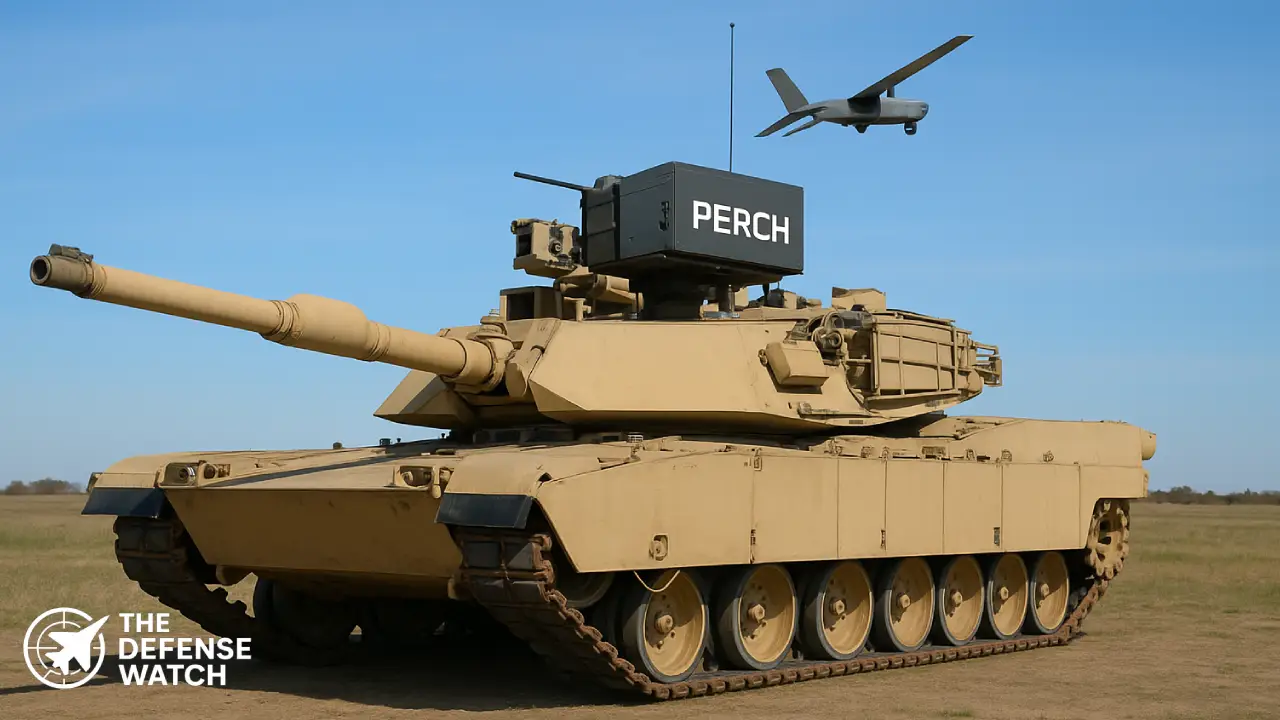
On December 5, 2025, General Dynamics Land Systems (GDLS) announced a successful demonstration of its new modular launcher, PERCH loitering munition launcher, installed on M1A2 SEP V3 Abrams main battle tanks. The live trial took place during the Machine Assisted Rugged Sapper (MARS) event at Fort Hood, Texas. The test saw Abrams tanks deploy AeroVironment Switchblade 300 loitering munition and AeroVironment Switchblade 600 loitering munition, giving the heavy armored vehicles a new beyond-line-of-sight (BLOS) reconnaissance and strike option.
Why This Matters: Context & Background
In recent conflicts, loitering munitions and armed drones have dramatically reshaped the battlefield, enabling forces to hit targets hidden behind terrain or fortifications — often without risking personnel. Tanks, long reliant on direct fire and external reconnaissance, have been exposed during such modern, drone-heavy engagements.
PERCH aims to change that dynamic. By installing a modular launcher directly onto armored platforms, tanks and infantry vehicles can carry and launch loitering munitions independently — turning them into both sensor and shooter nodes.
The demonstration at the MARS event marks the first public evidence that this concept can work under realistic, combat-relevant conditions.
PERCH Launcher: Technical and Operational Details
- The PERCH launcher — an acronym for Precision Effects & Reconnaissance, Canister-Housed — is a modular system co-developed by GDLS and AeroVironment (AV).
- It is designed to house and launch Switchblade loitering munitions (specifically Switchblade 300 and Switchblade 600) from combat vehicles like the M1A2 SEP V3 Abrams and the Stryker infantry carrier vehicle.
- Notably, PERCH requires no welding, cutting, or turret redesign. Instead, it replaces the Abrams’ loader sponson box and bolts directly into existing mounting points — enabling rapid kit installation and preserving the tank’s original protection and systems.
- According to GDLS, future iterations could integrate with onboard vehicle computer systems, allowing seamless control and management of loitering munitions from within the platform.
During the MARS event (Oct 26–30), crews using a PERCH-equipped Abrams conducted a complex obstacle-breaching operation. The tank launched both Switchblade 300 and 600 munitions to perform BLOS reconnaissance and over-the-horizon targeting of high-value targets — all without exposing crew or requiring external ISR (intelligence, surveillance, reconnaissance) assets.
One of the GDLS representatives noted: “PERCH allows units to deploy Switchblade loitering munitions far forward on the battlefield while remaining covered and concealed.”
AV emphasized that integrating Switchblade 300 and 600 via PERCH delivers immediate operational benefits — extending reach and enabling rapid, precise effects from protected positions.
What This Could Mean for Armored Warfare
The successful PERCH trial marks a potentially transformative moment for how armored units operate. Rather than tanks being limited to line-of-sight fire or depending on external drones, they can now carry their own drone strike and reconnaissance capability — creating a more self-sufficient and responsive force.
In doctrine terms, this reflects a growing shift toward distributed, networked fires, where every platform — tank, infantry carrier, or unmanned system — can act as both sensor and shooter.
This could reduce reliance on air assets or artillery for precision strikes, provide rapid response against hidden or fortified threats, and improve survivability by allowing units to engage without exposing themselves.
Moreover, the low-risk, modular installation path means that existing Abrams tanks (and other vehicles) can be upgraded without long downtime or major overhaul — making wide-scale adoption more feasible, should the U.S. Army decide to field PERCH broadly.
What Comes Next
While the demonstration shows promise, PERCH has not yet been formally procured by the U.S. Army.
Further testing under combat-representative conditions — in different environments, threat scenarios, and with full tactical formations — will be necessary to assess reliability, logistics, and integration into existing doctrine.
If performance holds up, this capability could influence future procurement and modernization decisions, not just for the Abrams fleet, but also for other armored and mechanized platforms.


7 comments
[…] internal bay of the drone is designed to carry multiple loitering munitions or reconnaissance drones. These sub drones can be released mid flight and operate independently or […]
[…] Moscows rhetoric signals continued opposition to any Western backed expansion of Ukraines strike capabilities or foreign troop […]
[…] Russian forces appear to have integrated Starlink satellite internet terminals into Shahed-series loitering munitions. Beskrestnov disclosed the assessment via Telegram shortly after being appointed as a defense […]
[…] incoming threats such as anti-tank rockets, anti-tank guided missiles, unmanned aerial systems, loitering munitions and kinetic tank projectiles. The system offers 360-degree protection while keeping weight, volume and power demands […]
[…] According to available details, the new systems will be used to protect critical military units and infrastructure against a wide range of unmanned threats, including small reconnaissance drones and loitering munitions. […]
[…] Counter-UAS Platforms: Specialized counter-unmanned aircraft systems have been deployed to address the growing threat from Iranian-made drones and loitering munitions. […]
[…] Strategic takeaway: route selection is now as critical as strike capability. […]