(adsbygoogle = window.adsbygoogle || []).push({});Executive Summary:
Northrop Grumman announced on June 1, 2026, the successful completion of a key flight test for its Jackal next-generation precision strike missile. The test validated critical flight systems, including propulsion, autopilot performance, and autonomous capabilities. This milestone supports U.S. Army efforts to field affordable, multi-domain strike options capable of operating in GPS-denied and contested electromagnetic environments.
Jackal Precision Strike Missile Advances in Flight Testing
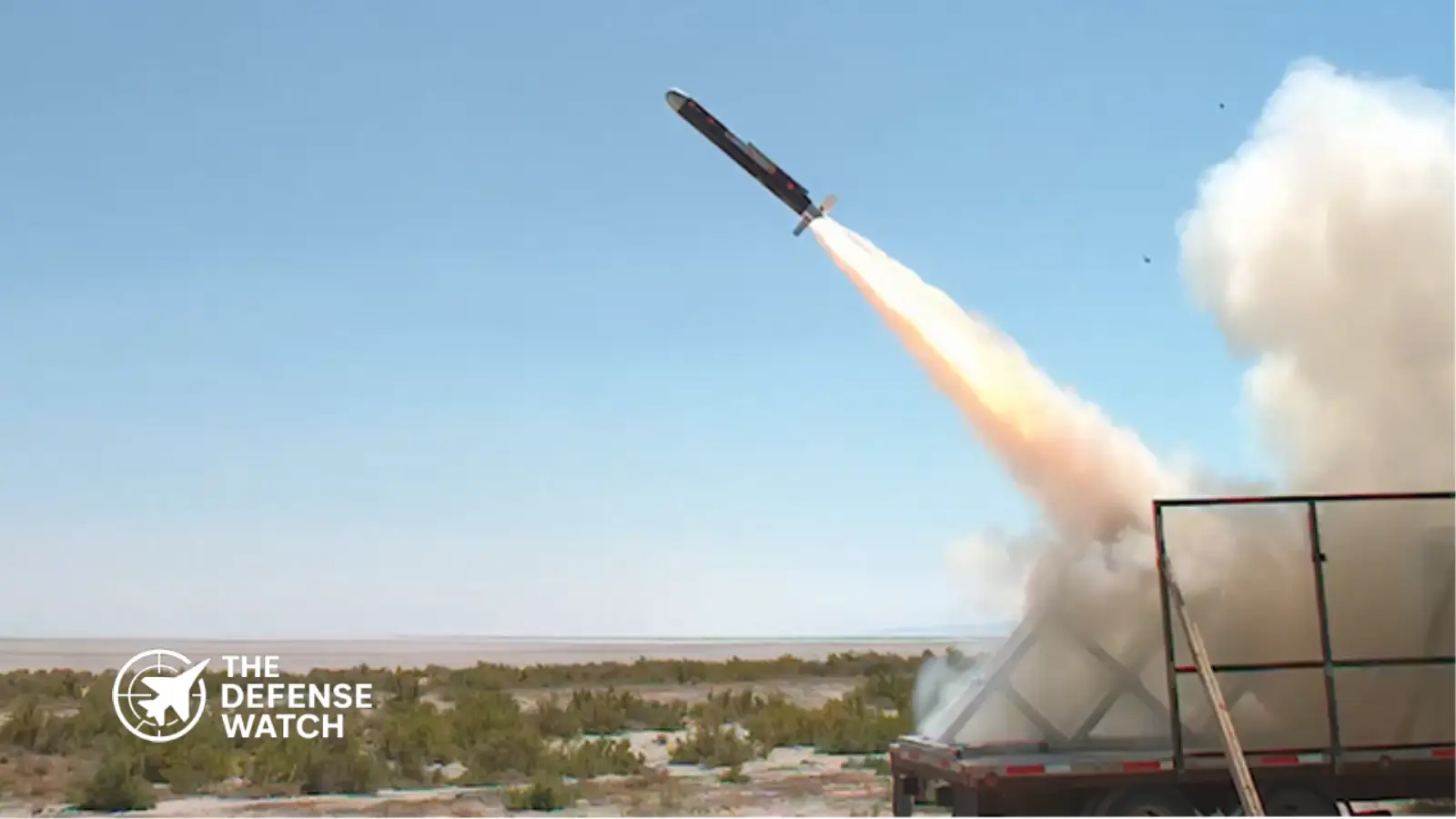
Northrop Grumman completed a key flight test for the Jackal precision strike missile, demonstrating the platform’s flight system readiness, the company announced June 1, 2026.
The test involved multiple flights that showcased rapid turbojet engine start, precise autopilot-controlled flight profiles, and overall system maturity. Jackal is engineered as a compact, affordable weapon for air, land, and sea platforms, with particular emphasis on integration with U.S. Army light tactical vehicles and aerial assets.
Technical Specifications and Capabilities
Jackal is a turbojet-powered missile designed for high subsonic speeds and extended range:
- Speed: Sustains over 300 mph (some references note capability exceeding 400 mph in sprint modes).
- Range: Up to 100 km from surface launch; 125 km from air launch.
- Navigation: Autonomous waypoint navigation with GPS-denied operation.
- Targeting: AI-driven algorithms for target discrimination, automatic recognition, and engagement without continuous line-of-sight from the operator.
- Payload: Modular options supporting lethal warheads as well as non-lethal payloads for ISR or electronic warfare missions.
- Launch Flexibility: Compatible with ground vehicles, aircraft, and maritime platforms.
The missile’s low-altitude flight profile (under 50 meters in some modes) and onboard power generation (up to 1 kW) support advanced electronic warfare packages and modular payloads.
Strategic Context and Operational Relevance
The Jackal program aligns with U.S. military priorities for affordable mass in contested environments. Peer adversaries have invested heavily in integrated air defense systems and electronic warfare capabilities that challenge traditional precision-guided munitions reliant on GPS and datalinks.
By emphasizing autonomy and resilience, Jackal aims to provide maneuver forces with organic, beyond-line-of-sight strike options that reduce dependence on contested satellite navigation and high-value aerial platforms. Its design supports rapid retasking mid-flight and potential future swarm operations.
Analysis: In an era where U.S. forces face sophisticated anti-access/area-denial (A2/AD) networks, systems like Jackal represent a shift toward distributed lethality. Rather than relying solely on expensive, exquisite platforms, the U.S. Army can deploy larger numbers of attritable, intelligent munitions from forward positions. This approach complicates enemy targeting calculus and enables sustained pressure even when communications are degraded. Technical hurdles remain in AI robustness against advanced jamming and decoys, as well as ensuring safe integration with existing Army fire control architectures.
Development Path and Testing
Northrop Grumman conducted multiple flight tests to advance Jackal’s development. The recent milestone focused on propulsion, autonomy, and precision strike operations. Data collected will inform subsequent development phases, including integration testing and expanded mission profiles.
(adsbygoogle = window.adsbygoogle || []).push({});The program builds on Northrop Grumman’s extensive experience in munitions, propulsion, autonomy, and digital engineering. Jackal was publicly unveiled in 2024-2025 and has progressed rapidly through early testing phases.
Implications for U.S. Defense Strategy
Jackal enhances the U.S. military’s ability to maintain overmatch in multi-domain operations. For the Army, it offers a complementary capability to existing systems like GMLRS and ATACMS, filling a niche for lighter, more mobile, and attritable precision effects at the tactical edge.
Its multi-platform compatibility also supports joint operations, potentially integrating with Marine Corps and Navy assets for littoral and maritime strike missions. As defense budgets face scrutiny, the emphasis on affordability and modularity positions Jackal as a scalable solution for high-volume production if required by evolving threats.
(adsbygoogle = window.adsbygoogle || []).push({});- U.S. Army Modernization Alignment: Supports transformation toward lighter, more lethal formations capable of dispersed operations.
- Contested Environment Focus: Directly addresses lessons from ongoing conflicts involving heavy electronic warfare and layered air defenses.
- Industrial Base Benefit: Reinforces Northrop Grumman’s role in advanced weapons development while leveraging modern manufacturing techniques for cost control.