(adsbygoogle = window.adsbygoogle || []).push({});Executive Summary:
Britain’s frontline fighter fleet stands at 158 aircraft in mid-2026 — 111 Eurofighter Typhoons and 47 F-35B Lightning IIs — down from a peak Typhoon order of 137 jets as older Tranche 1 airframes get scrapped. The RAF’s next decade hinges on how fast a stalled second F-35 order and the 2035 Tempest program can replace that shrinking number.
Britain’s entire frontline fighter force could fit inside two and a half US Air Force fighter wings. As of mid-2026, the Royal Air Force fields 158 fast jets — 111 Eurofighter Typhoons and 47 F-35B Lightning IIs. That’s the real number behind a question that gets asked constantly and answered inconsistently.
The confusion is understandable. Older figures still circulating online cite 137 Typhoons, which was the total fleet size before the Ministry of Defence began scrapping early-model aircraft in 2025. The current, accurate count is lower — and shrinking further before it grows again.
The Deep Dive: Typhoon and F-35B, By the Numbers
The Typhoon force was built across three procurement “tranches,” each representing a capability jump over the last. The original order totaled 160 aircraft for the UK, of which 137 were ultimately delivered and entered service: 30 Tranche 1, 67 Tranche 2, and 40 Tranche 3 airframes.
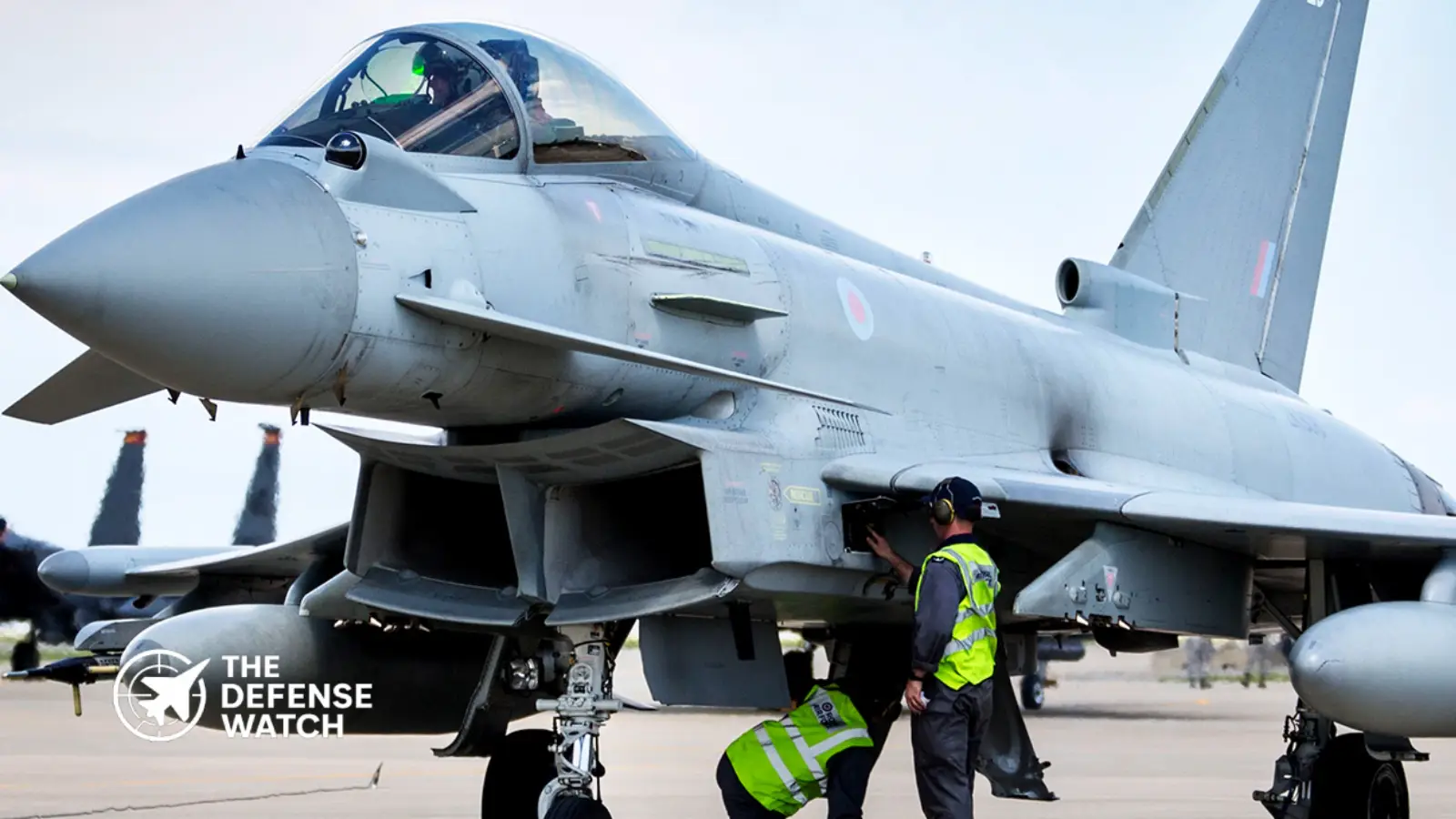
That number is now smaller. In September 2025, Defence Minister Maria Eagle told Parliament that 26 of the 30 Tranche 1 Typhoon aircraft have been scrapped as of that July, with the remaining four held back purely for Quick Reaction Alert duty defending the Falkland Islands until 2027. That leaves the RAF’s active Typhoon count at 111: four aging QRA jets, plus 67 Tranche 2 and 40 Tranche 3 aircraft slated to keep flying until 2040.
(adsbygoogle = window.adsbygoogle || []).push({});The F-35B side of the ledger is more straightforward. The UK’s first procurement batch of 48 Lightning IIs finished delivery in March 2026, eight years after the type first arrived at RAF Marham. One aircraft, BK18, was lost off HMS Queen Elizabeth in 2021, leaving an active fleet of 47. Those jets fly with 617 “Dambusters” Squadron, the Royal Navy’s 809 Naval Air Squadron, and the 207 Squadron training unit — all based at Marham.
A second F-35 order remains stuck in procurement limbo. London’s 2025 Strategic Defence Review confirmed plans for 27 more jets — 15 F-35Bs and, notably, 12 F-35As to restore Britain’s air-delivered nuclear strike role for the first time since the Cold War. None of those 27 have been contracted yet; they’re waiting on the long-delayed Defence Investment Plan.
UK Fast Jet Fleet at a Glance — Mid-2026
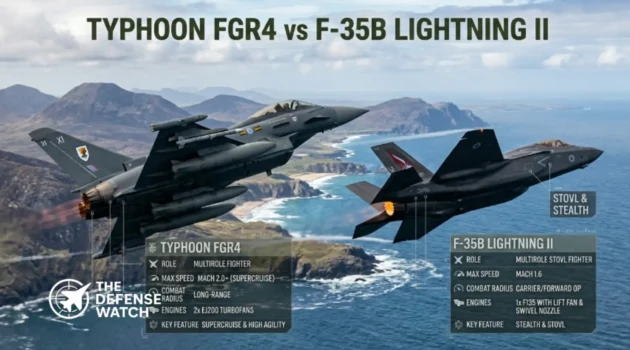
Metric Eurofighter Typhoon FGR4 F-35B Lightning II Active RAF fleet 111 aircraft 47 aircraft Generation 4.5 (non-stealth) 5th-gen, stealth Unit flyaway cost ~$90M–$120M (tranche-dependent) ~$109M (UK pays ~$115M incl. premiums) Top speed Mach 2.0 Mach 1.6 Flight-hour cost ~$20,000–$25,000 ~$33,000–$38,000 Primary role Air defense, QRA, strike Carrier strike, stealth ISR/strike Squadrons 7 frontline + OCU/OEU 617 Sqn, 809 NAS, 207 Sqn (OCU) Planned retirement 2040 Active into the 2040s/50s (Block 4 upgrades pending) (adsbygoogle = window.adsbygoogle || []).push({});Total UK programme costs put this in perspective. Defence Equipment & Support lists the Typhoon’s approved production and in-service support bill at £31.1 billion, with the UK covering roughly 37% of the four-nation Eurofighter consortium’s shared costs. The F-35B side has already cost the UK over $4 billion just for the first 35 jets, before sustainment.
The Crossover Angle: Why Numbers, Not Just Tech, Win Fights
Competitive shooter teams don’t win on raw aim alone — they win on role balance. An entry player pushes first, gathers information, and creates chaos before the enemy team can react. An anchor holds the position, absorbs the counterattack, and closes out the round with firepower the entry role was never built to carry.
That’s almost exactly how the RAF talks about its own fleet. Pilots nickname the F-35B the “Assassin” and the Typhoon the “Thug.” The F-35B goes in first — stealthy, sensor-fused, mapping the battlespace and taking the first quiet shot. The Typhoon follows with the missile capacity, the cannon, and the raw speed to finish what the F-35B started.
The parallel breaks down at scale, though, and that’s the real lesson. A five-person esports roster can field one entry and one anchor and still field a full team. An air force needs dozens of each role available simultaneously — for homeland QRA, NATO air policing, and two active carrier strike groups — or the doctrine collapses under its own math. Britain’s 158 jets are stretched thin precisely because there’s no bench depth behind them.
(adsbygoogle = window.adsbygoogle || []).push({});A fighter fleet’s real strength isn’t which single jet wins a one-on-one dogfight. It’s whether a country can sustain QRA, NATO commitments, and carrier strike group coverage at the same time, for months, without running out of available airframes.
Where the UK’s Jets Rank Globally
The “best fighter jet in the world” debate in 2026 usually comes down to four aircraft: the F-22 Raptor, F-35 Lightning II, J-20 Mighty Dragon, and Su-57 Felon. The UK operates none of the first and exactly one of the second — and that’s not an accident.
Aircraft Operator Est. Active Units (2026) Generation Export Status F-35 (all variants) US-led coalition, 20+ nations ~1,300 5th, stealth Widely exported F-22 Raptor United States ~185–195 5th, stealth Export banned J-20 Mighty Dragon China ~250–300 5th, stealth Export banned Su-57 Felon Russia ~30 5th (debated stealth) Limited interest Eurofighter Typhoon UK, Germany, Italy, Spain + export 600+ worldwide 4.5, non-stealth Widely exported The F-22 is generally judged the superior pure air-superiority dogfighter, but the United States has never sold a single one abroad. That makes the F-35 the practical ceiling for any US ally, the UK included — and explains why London bet its entire fifth-generation strategy on the Lightning II rather than waiting on a jet it could never legally buy.
(adsbygoogle = window.adsbygoogle || []).push({});China’s J-20 outnumbers Russia’s entire Su-57 program roughly tenfold, a gap that says more about industrial capacity than airframe design. Moscow’s struggles to scale Su-57 production past 30 aircraft despite years of development is the same constraint that shapes the UK’s own Typhoon-to-F-35 transition: building a great jet on paper means little if you can’t build enough of them.
The Takeaway
The UK’s fighter fleet sits at 158 jets today, with 111 Typhoons drawing down toward 2040 and 47 F-35Bs waiting on a stalled second order to bring real fifth-generation depth. The aircraft themselves are credible — the F-35B ranks among the world’s most capable fighters by most 2026 assessments, and the upgraded Typhoon still holds its own in regional air defense.
The open question isn’t capability. It’s whether Britain can field enough airframes to use that capability when it actually matters — across home defense, NATO commitments, and two aircraft carriers, all at once, with no real reserve left to call on.