Fastest Fighter Jet in the World
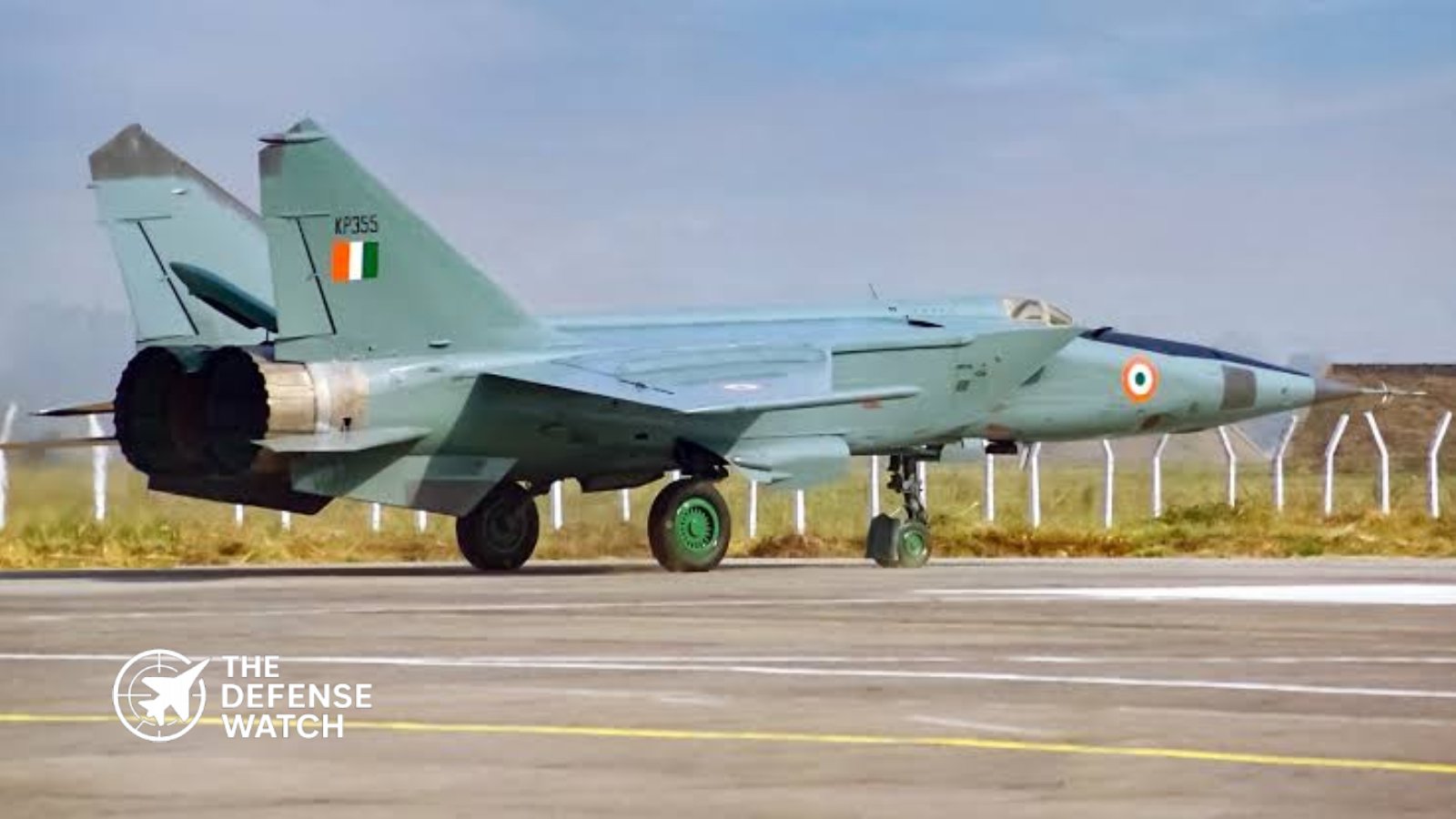
The fastest fighter jet in the world is generally identified as the Soviet-designed Mikoyan-Gurevich MiG-25 Foxbat, a high-speed interceptor that could reach an operational maximum of about Mach 2.83, or roughly 3,000 km/h at altitude. Guinness World Records identifies the MiG-25 as the fastest combat jet, while radar tracking of a reconnaissance version recorded approximately Mach 3.2 under exceptional conditions.
That distinction matters because maximum speed alone does not determine which fighter is most effective in modern air combat. The MiG-25 was designed around a Cold War requirement to intercept high-speed, high-altitude aircraft. Modern fighters such as the F-22 Raptor and F-15EX Eagle II place greater emphasis on stealth, sensors, electronic warfare, networking, weapons range and survivability.
So, what is the fastest fighter jet in the world? If the question is based on maximum speed among purpose-built fighter and interceptor aircraft, the answer remains the MiG-25 Foxbat, with the closely related MiG-31 Foxhound occupying the next position at approximately Mach 2.83.
Takeaways
Speed records tell only part of the story in modern fighter warfare
1. MiG-25 Holds the Speed Crown
The MiG-25 Foxbat is widely recognized as the fastest combat jet, with an operational maximum of about Mach 2.83.
2. Mach 3 Was Possible Under Extreme Conditions
A reconnaissance Foxbat was tracked at approximately Mach 3.2, but sustained operation at that speed could cause severe engine damage.
3. MiG-31 Is the Closest Successor
The MiG-31 Foxhound inherited the high-speed interceptor mission and can reach approximately 3,000 km/h while adding improved radar, range and weapons capabilities.
4. F-15EX Leads Among Modern U.S. Fighters
The F-15EX Eagle II has a published maximum speed of Mach 2.5 and combines high speed with a 29,500-pound weapons payload, AESA radar and electronic warfare capabilities.
5. Speed Is No Longer the Main Measure of Air Superiority
Fifth-generation fighters increasingly trade extreme top speed for stealth, sensor fusion, networking, electronic warfare and long-range weapons.
What Is the Fastest Fighter Jet in the World?
The MiG-25 Foxbat is the strongest answer to the question, what is the fastest fighter jet in the world?
Developed by the Soviet Mikoyan design bureau, the MiG-25 was created primarily as a high-speed interceptor and reconnaissance aircraft. Its design reflected a specific Cold War threat environment in which Soviet air defenses needed to respond to high-altitude, high-speed aircraft.

The aircraft used two powerful R-15-series afterburning turbojets, a large airframe and extensive use of stainless steel to tolerate the thermal loads associated with sustained high-speed flight. Available technical data places the MiG-25’s loaded maximum speed at approximately Mach 2.83, equivalent to around 3,000 km/h at altitude.
The aircraft could theoretically go faster. A reconnaissance Foxbat was tracked at about Mach 3.2 during an emergency high-speed flight. However, this was not a normal operating speed. Exceeding the aircraft’s intended limits could cause extreme engine temperatures and damage.
This distinction is important when comparing the fastest jet fighter plane in the world with other military aircraft.
MiG-25 Foxbat: Engineering Behind the Speed
The MiG-25’s speed came from an unusual combination of power, aerodynamics and mission specialization.
Its two afterburning engines generated enormous thrust, while the airframe was optimized for high-speed flight at altitude. The aircraft was not designed primarily for close-range maneuvering. Instead, its mission was to climb quickly, reach very high speeds and intercept or conduct reconnaissance against aircraft operating at extreme altitude.
The available technical data lists a maximum level speed of approximately Mach 2.83 in a loaded configuration, with an exceptional clean-aircraft figure reaching approximately Mach 3.2. It also records an absolute altitude achievement of approximately 37,650 meters during test operations.
The aircraft carried a powerful radar and could employ several types of air-to-air missiles depending on the variant. Its interceptor versions were built around the idea that speed and altitude could provide the opportunity to engage threats before they reached Soviet airspace.
The design philosophy was very different from that of modern stealth fighters.
Why the MiG-25 Was Built for Speed
During the Cold War, the Soviet Union faced concerns about high-altitude strategic aircraft, including U.S. bombers and reconnaissance platforms.
The response was an interceptor capable of operating at extreme altitude and speed.
The MiG-25 therefore prioritized:
- Very high maximum speed
- High-altitude performance
- Rapid climb
- Powerful radar
- Long-range air-to-air weapons
- Interception of high-speed targets
This explains why the aircraft could outperform many more maneuverable fighters in straight-line speed while being comparatively less effective in a close-range dogfight.
The MiG-25’s development also influenced the next generation of Soviet interceptors.
MiG-31 vs MiG-25: Which Is Faster?
The MiG-31 Foxhound is the direct successor to the MiG-25 interceptor concept and is often listed alongside the Foxbat among the fastest fighter aircraft ever built.
Russian state technology company Rostec states that the MiG-31 can reach approximately 3,000 km/h and operate at altitudes of up to 21 kilometers. The aircraft was developed to replace the MiG-25 in the Soviet air-defense interceptor role.
At maximum published speed, the MiG-31 and MiG-25 are therefore extremely close.
The difference is that the MiG-31 was developed as a more capable combat system rather than simply a faster aircraft. It introduced a two-person crew, improved avionics, longer range and a more advanced interception architecture.
The MiG-31 also became notable for its ability to coordinate with other aircraft and ground-based air-defense assets.
From a pure speed perspective, however, the MiG-25 retains the stronger historical claim to the fastest combat jet record. Guinness World Records specifically identifies the MiG-25 as the fastest combat jet.
Fastest Fighter Jet in the World: How the F-15 Compares
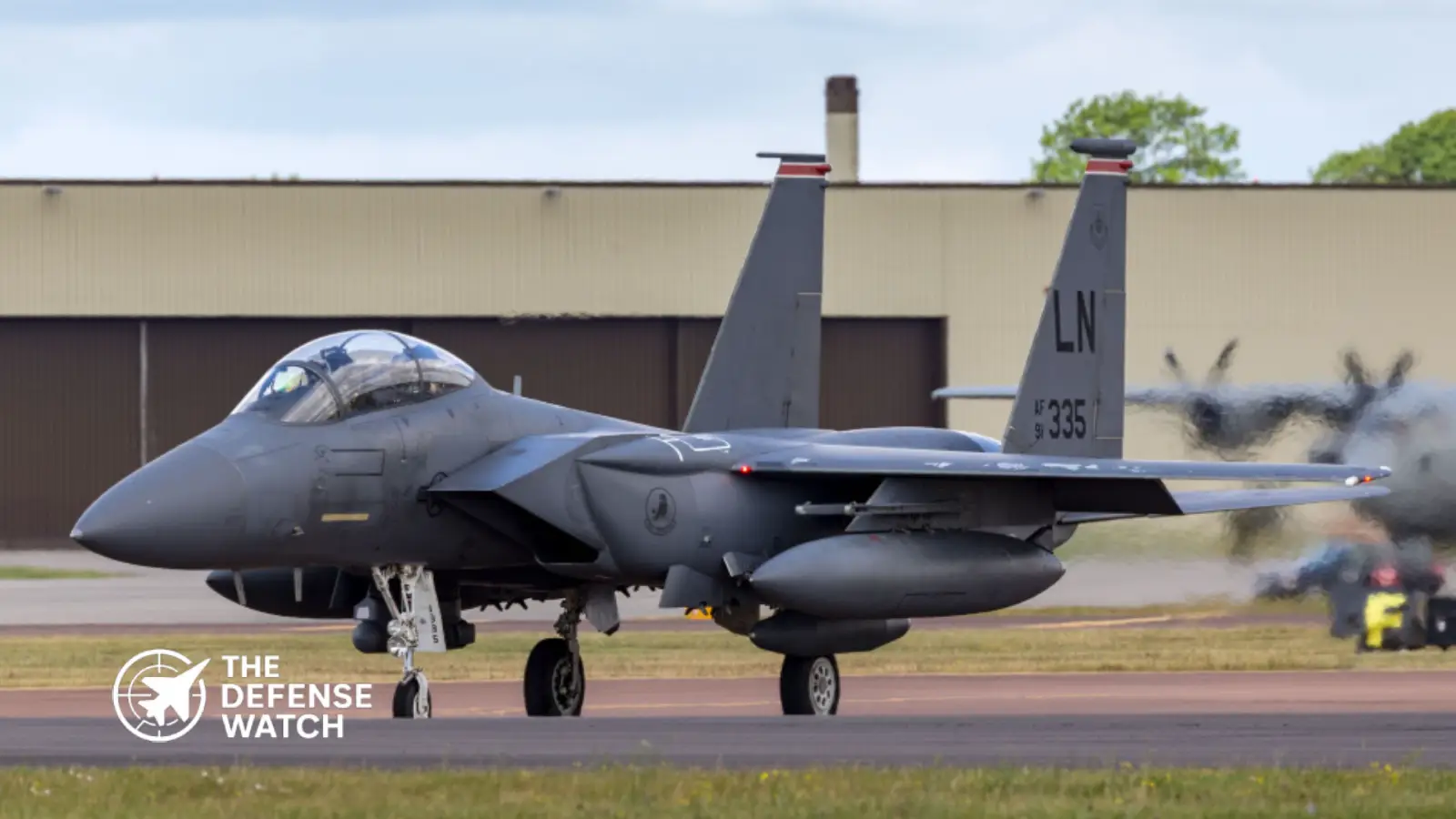
The F-15 Eagle is slower than the MiG-25, but it represents a very different approach to air superiority.
Boeing lists the F-15’s maximum speed at more than Mach 2.5, or more than 1,600 mph. The aircraft was designed as an air-superiority fighter with high thrust, maneuverability, radar capability and substantial weapons capacity.
The latest F-15EX Eagle II retains the high-speed characteristics of the Eagle family. Boeing publishes a maximum speed of Mach 2.5, a maximum payload of 29,500 pounds and a service ceiling of 50,000 feet. The aircraft also incorporates an AESA radar, electronic warfare systems, digital flight controls and an open mission architecture.
This makes the F-15EX particularly relevant to modern air forces.
The MiG-25 was designed to get to a target extremely quickly. The F-15EX is designed to combine speed with long-range weapons, advanced sensors, electronic warfare and networked operations.
That is a major difference between Cold War and modern air combat.
F-22 Raptor: Faster Does Not Always Mean More Capable
The F-22 Raptor illustrates why maximum speed is no longer the sole measure of fighter effectiveness.
The F-22 combines low-observable stealth, supercruise, agility and integrated avionics. Lockheed Martin identifies supercruise as a core capability, allowing the aircraft to sustain supersonic flight without relying on afterburners.
Its maximum speed is generally reported around Mach 2.0 to Mach 2.25, depending on the source and configuration, below the MiG-25’s maximum.
But a modern air-to-air engagement is not simply a race between aircraft.
A fighter may need to:
- Detect an opponent before being detected.
- Establish a firing solution.
- Launch a missile from advantageous geometry.
- Avoid or defeat enemy sensors and weapons.
- Share targeting information with other platforms.
- Survive after weapons employment.
Stealth, sensor fusion, electronic warfare and networking can therefore provide a greater combat advantage than several hundred additional kilometers per hour of maximum speed.
Fastest Fighter Jets Comparison
Aircraft Type Approx. Maximum Speed Primary Design Focus Status MiG-25 Foxbat High-speed interceptor Mach 2.83 operational High-altitude interception Largely retired MiG-31 Foxhound Long-range interceptor Mach 2.83 / 3,000 km/h Long-range air defense In service F-15 Eagle Air-superiority fighter Mach 2.5+ Air superiority and multirole missions In service F-15EX Eagle II Advanced multirole fighter Mach 2.5 Long-range weapons, payload, networking In service Su-27 family Air-superiority fighter About Mach 2.35 Air superiority and maneuverability Multiple variants in service MiG-29 family Multirole fighter About Mach 2.3 Air combat and multirole operations Multiple variants in service F-22 Raptor Fifth-generation air-superiority fighter About Mach 2+ Stealth and air dominance In service Speed figures should be treated as maximum performance figures rather than normal combat speeds. Aircraft often fly substantially slower when carrying weapons, external fuel tanks or other mission equipment.
How Fighter Jet Speed Is Actually Measured
A common mistake in discussions about the fastest fighter jet world rankings is treating every published speed figure as directly comparable.
Aircraft speed depends on:
- Altitude
- Air temperature
- Aircraft weight
- Fuel load
- External weapons
- External fuel tanks
- Engine condition
- Flight profile
- Airframe configuration
Mach number also changes with atmospheric conditions because Mach is based on the local speed of sound.
For this reason, a fighter reaching Mach 2.8 in a high-altitude test configuration does not mean it can sustain Mach 2.8 while carrying a full combat weapons load at low altitude.
The MiG-25 demonstrates this particularly well. Its extraordinary speed was achievable under conditions that imposed significant thermal and mechanical stress on the aircraft and engines.
The F-15EX and the Modern Meaning of Speed
The F-15EX is useful for understanding how the concept of speed has evolved.
Boeing describes the aircraft as a high-energy fighter optimized for large weapons loads, long-range strike and air-dominance missions. Its published specifications include Mach 2.5 maximum speed and a 29,500-pound payload.
The aircraft can also carry large numbers of air-to-air weapons. Boeing states that the F-15EX can accommodate up to 12 AMRAAMs or an equivalent combination of large ordnance, while its AESA radar and electronic warfare suite support operations in contested environments.
This creates a different kind of speed advantage.
The aircraft’s high-energy performance can help it reposition rapidly, extend weapon engagement opportunities and maintain energy during combat. But its value comes from the combination of speed, range, payload, sensors and networking.
Boeing is also positioning the F-15EX as a platform capable of working with future collaborative combat aircraft and other networked systems.
Why the Fastest Fighter Jet Is Not Automatically the Best Fighter
The MiG-25’s record demonstrates the limits of using one specification to rank combat aircraft.
A fighter’s effectiveness can depend on several interconnected capabilities:
Stealth
Low observability can reduce the range at which an opponent detects and tracks the aircraft.
Sensors
Modern AESA radars and distributed sensors provide improved target detection, tracking and identification.
Electronic Warfare
Electronic warfare can interfere with enemy radars, communications and targeting systems, helping an aircraft operate inside contested environments.
Weapons
Long-range air-to-air missiles can allow a fighter to attack without entering a traditional visual-range dogfight.
Networking
Modern fighters increasingly operate as nodes in a wider combat network involving aircraft, satellites, drones, ships and ground systems.
Sensor Fusion
The ability to combine information from multiple sensors can give pilots a more complete picture of the battlespace.
These factors explain why a Mach 2-class fifth-generation fighter can have a greater combat advantage than an older Mach 3-class interceptor in many scenarios.
The Strategic Legacy of the MiG-25
The MiG-25 remains important because it represented an extreme solution to a specific strategic problem.
Its speed, altitude and radar performance were designed around the possibility of confronting high-altitude strategic aircraft.
The aircraft also had an important indirect effect on U.S. fighter development. Western assessments of the Foxbat contributed to concerns about Soviet air-superiority capabilities and influenced the thinking that surrounded the development of the F-15.
The resulting F-15 became one of the most successful air-superiority fighters in aviation history.
Boeing’s modern F-15EX continues that lineage, combining the basic high-energy characteristics of the Eagle with modern avionics, electronic warfare and networked warfare capabilities.
What About the Fastest Jet Fighter Plane in the World Today?
If the question is strictly about maximum fighter or interceptor speed, the MiG-25 remains the key answer.
If the question is about the fastest widely deployed modern fighter, the answer changes.
The F-15 family remains one of the fastest major fighter families in active service, with the F-15EX officially listed by Boeing at Mach 2.5. The MiG-31 also retains a maximum speed of approximately 3,000 km/h and remains an important high-speed interceptor platform.
The distinction between historical speed records and current combat relevance is essential.
The MiG-25 is the stronger answer to the historical speed question. The MiG-31 is the more relevant successor to the Soviet high-speed interceptor concept. The F-15EX represents the modern U.S. approach to combining high speed with weapons capacity, networking and electronic warfare.
Challenges of Extreme Speed
Mach 3-class flight creates severe engineering problems.
As aircraft speed increases, aerodynamic heating rises dramatically. Engine components face greater thermal loads, while air intakes must manage enormous quantities of air at high Mach numbers.
The MiG-25’s experience demonstrated these limitations.
Its engines could support extraordinary speeds, but prolonged operation at the extreme end of the envelope could result in severe engine damage. This is one reason the aircraft’s practical operational limit was lower than the highest speed ever recorded by the type.
Extreme speed also carries penalties in:
- Fuel consumption
- Engine life
- Maintenance requirements
- Airframe heating
- Weapon integration
- Maneuverability
- Operating cost
Modern fighter development therefore generally seeks a balance rather than maximum speed at any cost.
The Future of Fighter Speed
The future of combat aviation is unlikely to be determined by maximum Mach number alone.
Sixth-generation fighter programs are expected to emphasize integrated sensors, low observability, electronic warfare, autonomous systems, long-range weapons and manned-unmanned teaming.
Speed will remain important because it affects reaction time, energy, range and survivability. But the more important question will increasingly be how quickly an aircraft can sense, decide, communicate and engage.
That is particularly relevant as air forces develop collaborative combat aircraft and other autonomous systems.
Boeing describes the F-15EX as having a growth path toward collaborative combat aircraft and manned-unmanned teaming, demonstrating how fighter operations are moving toward networked formations rather than isolated aircraft.
The result is a shift from speed as an isolated performance statistic toward speed as part of a broader kill chain.
Conclusion: Is the MiG-25 Still the Fastest Fighter Jet in the World?
Yes, with an important qualification.
The MiG-25 Foxbat remains the best-supported answer to the question, what is the fastest fighter jet in the world? Guinness World Records identifies the MiG-25 as the fastest combat jet, while its operational performance is generally cited at approximately Mach 2.83. A reconnaissance version was tracked at approximately Mach 3.2, but that was not a normal sustainable operating speed.
The MiG-31 comes very close, with a published maximum speed of approximately 3,000 km/h, while the F-15 family reaches approximately Mach 2.5.
Yet the fastest fighter jet is not necessarily the most capable fighter.
Modern air superiority increasingly depends on stealth, sensor fusion, electronic warfare, network connectivity, weapons range and the ability to operate as part of a wider multi-domain force.
The MiG-25 therefore remains a remarkable answer to the speed question, but modern air warfare has moved beyond the simple pursuit of maximum Mach number. The defining competition is now about who can detect first, decide first, engage first and survive inside an increasingly contested battlespace.
A WW1 map of Europe provides a visual explanation of how a regional crisis in the Balkans developed into a major European war and eventually a global conflict. In 1914, Europe was divided by complex political and military relationships, with Germany and Austria-Hungary forming the core of the Central Powers and France, Great Britain, and Russia forming the principal members of the opposing Entente coalition.
Takeaways
Key facts from the World War I map of Europe
1. Europe Was Divided by Rival Coalitions
Germany and Austria-Hungary formed the core of the Central Powers, while France, Great Britain, Russia, and later Italy and the United States were among the principal Allied powers.
2. Italy Did Not Enter the War With Germany
Although Italy belonged to the prewar Triple Alliance, it remained neutral in 1914 and entered the war against Austria-Hungary in 1915 alongside the Entente powers.
3. The Western Front Became a Trench-Warfare System
After the German advance was halted in 1914, the Western Front developed into an extensive system of trenches and fortified positions across Belgium and northern France.
4. Brest-Litovsk Changed the Eastern Front
The Treaty of Brest-Litovsk, signed on March 3, 1918, formally ended the war between Soviet Russia and the Central Powers and allowed Germany to redeploy forces toward the Western Front.
5. The Political Map Changed After the War
The German, Austro-Hungarian, Ottoman, and Russian imperial systems were fundamentally transformed or collapsed, producing major political and territorial changes across Europe and the Middle East.
The geography of the conflict changed repeatedly between 1914 and 1918. Major fronts developed across Belgium and France, Eastern Europe, the Italian Alps, the Balkans, and territories controlled by the Ottoman Empire. Fighting also extended into Africa, the Middle East, Asia, and the Pacific, making World War I a genuinely global conflict.
A World War 1 map of Europe therefore needs to be understood as more than a political map. It shows the relationship between national borders, alliances, military fronts, transportation routes, strategic geography, and the collapse of several major empires.
World War I Alliances Map
The alliance system was one of the most important factors shaping the geographic spread of the war.
Before the conflict, Germany, Austria-Hungary, and Italy were members of the Triple Alliance. However, this did not mean that all three countries entered World War I on the same side.
Central Powers
The Central Powers developed around:
- Germany
- Austria-Hungary
- Ottoman Empire
- Bulgaria
Germany and Austria-Hungary were the principal Central Powers in the opening phase of the European conflict. The Ottoman Empire joined the war in late 1914, while Bulgaria entered the conflict in 1915.
Allied Powers
The Allied coalition developed around:
- France
- Great Britain
- Russia
- Serbia
- Belgium
- Italy
- Romania
- Greece
- United States
- Japan
- Other Allied and Associated states
The membership of the Allied coalition changed during the war as individual countries entered or left the conflict.

Image Source : World History Encyclopedia Italy’s Position in the Alliance System
Italy requires special attention when reading a World War 1 alliances map.
Italy was a member of the prewar Triple Alliance with Germany and Austria-Hungary, but it declared neutrality when war began in 1914. It later entered the conflict against Austria-Hungary after signing the Treaty of London with Britain, France, and Russia in April 1915. The agreement committed Italy to join the war alongside the Entente powers.
This distinction is important because a map showing the prewar alliance system and a map showing the wartime coalitions are not necessarily showing the same political arrangement.
Major Fronts on a WW1 Map
The major fronts of World War I developed in very different geographic environments. Their characteristics were influenced by terrain, transportation networks, military objectives, fortifications, and the availability of manpower and supplies.
Western Front
The Western Front became the best-known battlefield of World War I.
It stretched primarily through Belgium and northern France, where German forces confronted French, British, Belgian, and later American forces. After the initial German advance was stopped in 1914, the front developed into a heavily fortified system dominated by trenches, artillery, machine guns, barbed wire, and defensive positions.
The First Battle of the Marne in September 1914 prevented the German advance from achieving a rapid decision in France. The opposing armies subsequently established extensive trench systems extending from the North Sea toward the Swiss frontier.
The Western Front remained relatively stable geographically for much of the war, but this apparent lack of movement concealed enormous battles and casualties.
Major operations included:
- First Battle of the Marne
- Battle of Verdun
- Battle of the Somme
- Third Battle of Ypres
- German Spring Offensive
- Hundred Days Offensive
The Western Front illustrates how industrialized firepower made offensive operations extremely difficult when attacking prepared defensive positions.
Eastern Front
The Eastern Front covered a much larger geographic area than the Western Front.
German and Austro-Hungarian forces fought Russian armies across Eastern Europe. The front extended across areas that today include parts of Poland, the Baltic region, Ukraine, Belarus, and surrounding territories.
Unlike the Western Front, the Eastern Front remained considerably more mobile. Large distances, fewer continuous defensive systems, and the scale of the theater allowed armies to conduct major movements and retreats.
Russia’s military position deteriorated during the later stages of the war amid military losses, economic problems, political instability, and revolution.
The Bolshevik Revolution of 1917 fundamentally changed Russia’s participation in the war. Negotiations between Soviet Russia and the Central Powers resulted in the Treaty of Brest-Litovsk, signed on March 3, 1918. The agreement formally ended the war between Soviet Russia and the Central Powers. U.S. diplomatic records document the signing and subsequent ratification of the treaty in March 1918.
Russia’s withdrawal enabled Germany to redeploy forces from the Eastern Front toward the Western Front. This contributed to Germany’s ability to launch its major 1918 offensive in the west.
The strategic effect was significant, although the German offensive ultimately failed to achieve a decisive victory.
Italian Front
Italy entered World War I on the Allied side in 1915 and opened a new major front against Austria-Hungary.
The Italian Front developed largely along the mountainous border between Italy and Austria-Hungary. Fighting took place across the Alps and around the Isonzo River, where difficult terrain imposed severe limitations on movement and logistics.
Mountain warfare created different tactical problems from those found on the Western Front. Troops had to operate in high-altitude environments where weather, terrain, transportation, artillery positioning, and supply routes could determine the feasibility of military operations.
The Italian Front is therefore an important feature of a world war one map because it demonstrates how geography directly influenced military operations.
Balkan Front
The Balkans were central to the origins of World War I.
Austria-Hungary declared war on Serbia in July 1914 following the assassination of Archduke Franz Ferdinand and the subsequent diplomatic crisis. The fighting soon expanded as the major European powers became involved.
Serbia initially resisted Austro-Hungarian attacks, but the strategic situation changed after Bulgaria joined the Central Powers in 1915. Central Powers forces subsequently defeated Serbia and occupied much of its territory.
The Allies established a major military presence around Salonika in Greece. The resulting Macedonian Front remained active until 1918.
The Balkan theater demonstrates why a WW1 map of Europe cannot be understood simply through the Western and Eastern Fronts. Southeastern Europe was strategically important because of its location between Central Europe, the Mediterranean, the Ottoman Empire, and the Russian sphere.
Ottoman Fronts
The Ottoman Empire entered the war on the side of the Central Powers in 1914.
This expanded the geographic scope of the conflict considerably. Ottoman forces confronted Allied troops in several theaters, including:
- Gallipoli
- Mesopotamia
- Sinai and Palestine
- The Caucasus
- Arabian Peninsula
The Gallipoli campaign became one of the most important Allied operations against the Ottoman Empire. Allied forces attempted to force a route through the Dardanelles and gain access toward Constantinople, but the campaign ended with an Allied withdrawal.
Elsewhere, British and Allied forces fought Ottoman troops in Mesopotamia and Palestine. These operations contributed to the eventual collapse of Ottoman control over large parts of the Middle East.
World War 1 Map of Europe in 1914
A World War 1 map of Europe from 1914 looks substantially different from the political map of Europe today.
The German Empire occupied much of Central Europe, while Austria-Hungary controlled a large multinational empire stretching across Central and Southeastern Europe. The Russian Empire extended across Eastern Europe, while the Ottoman Empire still controlled important territory around the Balkans and the Middle East.
France and Germany shared a strategically important border, while Belgium occupied a critical position between Germany and France.
This geography was central to German military planning. Germany faced the possibility of a major war against both France in the west and Russia in the east.
The strategic problem of fighting on two major fronts influenced German planning throughout the conflict.
The Western Front and German Strategy
Germany’s geographic position created a difficult strategic problem.
France was located immediately to Germany’s west, while Russia’s enormous territory extended across the east. A prolonged simultaneous war against both powers risked dividing German military resources.
German planners therefore sought a rapid decision against France before concentrating greater forces against Russia.
The opening campaign in the west did not produce the expected decisive result. The German advance was halted during the First Battle of the Marne, after which the opposing forces established defensive positions extending across much of northern France and Belgium.
The result was a prolonged war of attrition.
How the Map Changed From 1914 to 1918
The political and military map changed considerably during the four years of fighting.
1914
The war began in Europe following the crisis between Austria-Hungary and Serbia. Germany declared war on Russia and France and invaded Belgium as part of its western campaign.
The German advance into France was stopped at the Marne, and the Western Front began to stabilize into a continuous trench system.
1915
Italy entered the war against Austria-Hungary.
Bulgaria joined the Central Powers, and the defeat of Serbia expanded Central Powers control in the Balkans.
The Gallipoli campaign also took place during this period.
1916
The Western Front saw major battles at Verdun and the Somme.
The Italian Front continued to consume large numbers of troops and resources, while fighting also continued across the Eastern and Ottoman theaters.
1917
The United States entered the war against Germany.
At the same time, Russia experienced two revolutions, eventually bringing the Bolsheviks to power.
The Russian military effort began moving toward withdrawal from the war.
1918
The Treaty of Brest-Litovsk was signed on March 3, formally ending the war between Soviet Russia and the Central Powers. The United States Office of the Historian records the treaty as part of the March 1918 diplomatic developments and identifies March 3 as the signing date.
Germany subsequently transferred substantial forces from the Eastern Front toward the Western Front.
Germany launched its major Spring Offensive in March 1918, initially achieving significant advances but ultimately failing to produce a decisive victory.
The Allies then launched a series of offensives that pushed German forces back.
The war ended with the Armistice of November 11, 1918.
The Political Map After World War I
The end of the fighting did not simply restore the prewar map.
Four major empires were fundamentally transformed or collapsed during and after the war:
- German Empire
- Austro-Hungarian Empire
- Ottoman Empire
- Russian Empire
New political arrangements emerged across Central and Eastern Europe.
The postwar settlement created or restored states including Poland, Czechoslovakia, and the Kingdom of Serbs, Croats and Slovenes, while the borders of existing states were also substantially changed.
The Treaty of Versailles and other postwar agreements attempted to establish a new political order.
The Treaty of Versailles later formally required Germany to accept the abrogation of the Brest-Litovsk treaties.
This means that a WW1 world map can represent several different moments: Europe before the war, Europe during the fighting, and Europe after the collapse of the old imperial system.
Why a World War I Map Matters
A map is particularly useful for understanding World War I because geography affected nearly every major strategic decision.
Germany’s central position created the danger of a two-front war. Belgium’s location made it strategically important to German operations against France. The Alps shaped the Italian Front, while the Balkans connected Central Europe to the Mediterranean and Ottoman territories.
Russia’s geographic depth created a very different operational environment from the Western Front. The Ottoman Empire’s location opened additional fronts in the Middle East and around the Dardanelles.
The war also demonstrated how modern industrial warfare could make relatively small changes in territorial control extremely costly.
A front line might move only a few miles while armies expended enormous quantities of ammunition, equipment, and manpower.
Reading a WW1 World Map
When examining a WW1 world map, readers should distinguish between several different types of information.
Political Borders
Political maps show the territory controlled by states and empires. These borders did not necessarily represent the exact position of military forces.
Military Fronts
Front lines show where opposing forces were engaged or where military positions were established. These could change rapidly during offensives.
Alliances
Alliance maps show political and military relationships. They should be dated because countries changed their position during the war.
Occupied Territories
Occupation does not necessarily mean that an area became part of the occupying country. Military occupation and permanent territorial sovereignty were different concepts.
Colonial Territories
European imperial powers also drew military resources from overseas territories. Troops from colonies and dominions participated in several theaters, helping make World War I a global conflict.
Strategic Assessment
The geography shown on a World War I map explains why the conflict became so difficult to resolve.
The Central Powers were positioned in the center of Europe and faced enemies on multiple fronts. The Allies, meanwhile, could draw on resources and manpower from several major powers and their overseas territories.
The war also exposed the limitations of prewar assumptions about rapid military campaigns. Industrial firepower, defensive fortifications, machine guns, artillery, barbed wire, and increasingly sophisticated logistics made decisive breakthroughs extremely difficult on several fronts.
The Eastern Front was more mobile than the Western Front, but its collapse did not produce the strategic result Germany needed. The Treaty of Brest-Litovsk allowed Germany to concentrate forces in the west, but the subsequent 1918 offensive failed to defeat the Allied armies before American manpower and material resources could have a decisive effect on the balance of the conflict.
The final map of Europe was therefore shaped by both military operations and political collapse. World War I destroyed or transformed several imperial systems and established political conditions that would influence European security for decades.
Why AESA Radar Matters in Modern Warfare
AESA radar, short for Active Electronically Scanned Array radar, has become one of the most important sensor technologies in modern military aviation, air defense and naval warfare. Instead of mechanically moving a radar antenna to point its beam, an AESA system uses numerous electronic transmit and receive elements to steer radar energy rapidly across the battlespace.
That difference has major operational consequences.
Modern forces increasingly operate in environments filled with low observable aircraft, cruise missiles, unmanned aerial systems, electronic jamming, long range weapons and dense electromagnetic activity. In such conditions, radar is no longer simply a device for finding aircraft. It is part of a larger network of sensors, weapons, electronic warfare systems and command and control architecture.
Takeaways
Why AESA radar has become a core technology for modern military sensing
1. Electronic Beam Steering
AESA radar uses multiple transmit and receive modules to steer the radar beam electronically, allowing extremely rapid changes in direction without mechanically rotating the antenna.
2. Multifunction Sensing
Modern AESA systems can support air to air, air to ground and surveillance functions while rapidly switching between different tasks and targets.
3. Better Survivability
Advanced waveforms, electronic protection and low probability of intercept techniques can make AESA equipped platforms more difficult for hostile forces to detect, classify or jam.
4. Reduced Mechanical Complexity
The absence of a mechanically scanned antenna reduces dependence on moving components and can improve reliability, maintainability and graceful degradation when individual modules experience faults.
5. Central to Networked Warfare
AESA radar is increasingly integrated with electronic warfare, infrared sensors, datalinks, command systems and weapons to create a broader picture of the battlespace.
AESA technology supports that shift by allowing a radar to perform several functions with high speed and flexibility. Depending on the design, a single array can support air to air detection, air to ground mapping, maritime surveillance, target tracking, electronic support and electronic attack functions.
The technology is now deployed across multiple generations of military systems. Northrop Grumman, RTX’s Raytheon business, Lockheed Martin, Leonardo and other major defense companies are developing AESA based systems for fighters, ground based air defense and naval platforms. Northrop Grumman, for example, supplies the AN/APG-81 AESA radar for the F-35 Lightning II and the AN/APG-77 for the F-22 Raptor.
What Is an AESA Radar?
An AESA radar consists of a large number of individual transmit/receive modules, often abbreviated as T/R modules. These modules work together as an electronically controlled array.
Traditional mechanically scanned radars generally move an antenna or reflector to change the direction of the radar beam. AESA systems instead control the phase and amplitude of signals across their individual modules.
By adjusting these signals, the radar can direct and shape its beam without physically moving the antenna.
This allows the radar to rapidly shift between different portions of the sky or surface environment. It can also allocate radar resources to different missions according to the tactical situation.
Northrop Grumman describes AESA arrays as using miniature transmit/receive modules that are electronically steered together, allowing nearly instantaneous beam repositioning. The company also notes that AESA systems eliminate the moving parts associated with mechanically scanned designs.
The practical result is not simply a faster radar. It is a more flexible sensor.

Image : Northrop Grumman How AESA Radar Works
The basic operating process involves several major stages.
1. Signal Generation
The radar generates radio frequency energy using an exciter and associated processing hardware.
2. Transmission Through T/R Modules
The signal is distributed across many individual transmit/receive modules. Each module can contribute a controlled amount of energy to the overall radar beam.
3. Electronic Beam Steering
The radar adjusts the phase relationships between signals from individual modules. This causes the combined electromagnetic energy to reinforce in the desired direction.
The beam can therefore be moved without physically turning the antenna.
4. Echo Reception
When the radar signal encounters an object, part of the energy is reflected back toward the array.
The T/R modules receive the returning signals and send information to the radar’s digital processing architecture.
5. Signal Processing
Advanced processors analyze the returned signals to determine information such as range, direction, velocity and other target characteristics.
Modern processing techniques also help distinguish genuine targets from clutter, interference and electronic deception.
6. Track Formation
The radar can combine successive detections into tracks. Multiple tracks can be maintained simultaneously, allowing crews and combat systems to build a broader picture of the battlespace.
Key Technical Advantages of AESA Radar
The most important advantage of AESA technology is flexibility.
Rapid Beam Steering
Because the radar does not depend on mechanical antenna movement, its beam can shift rapidly between targets and search sectors.
This is especially valuable when an aircraft faces multiple threats approaching from different directions.
Multifunction Operation
A modern AESA radar can perform several missions using software controlled waveforms and signal processing.
Depending on the system, these can include:
- Air to air search
- Air to air target tracking
- Air combat support
- Air to ground mapping
- Maritime surveillance
- Synthetic aperture radar imaging
- Ground moving target indication
- Terrain mapping
- Electronic support
- Electronic attack
- Missile support and target illumination functions
The AN/APG-81 on the F-35 is an example of this multifunction approach. Northrop Grumman states that the radar supports air to air and air to ground missions and includes synthetic aperture radar mapping and electronic warfare functions.
Electronic Protection
Modern combat aircraft can encounter hostile jamming and other forms of electromagnetic interference.
AESA radars can use techniques such as agile waveforms, adaptive beam control, frequency management and advanced signal processing to maintain radar performance in contested electromagnetic environments.
Exact techniques and performance parameters are frequently classified, so public sources do not provide a complete picture of the electronic warfare capabilities of operational AESA systems.
Reliability
The absence of a mechanically rotating antenna can reduce mechanical failure points.
Northrop Grumman says the solid state architecture of the AN/APG-81, combined with replaceable subassemblies, has improved reliability and maintenance characteristics compared with legacy systems.
AESA Radar and Gallium Nitride
One of the important developments in modern radar engineering is the growing use of gallium nitride, or GaN, semiconductor technology.
Earlier AESA generations commonly relied on gallium arsenide, or GaAs, semiconductor technology. GaN offers higher power density and can improve efficiency and thermal performance when appropriately integrated into a radar design.
The technology is increasingly appearing in modern radar upgrades.
RTX’s APG-82(V)X AESA radar, for example, uses GaN technology and is designed to provide advanced air to air, air to ground and electronic warfare capabilities for fighter aircraft.
Lockheed Martin’s TPY-4 ground based radar also uses GaN transmitter technology alongside an AESA architecture and advanced digital processing.
However, GaN does not automatically make every radar superior. Radar performance depends on the complete system, including antenna size, power generation, cooling, receiver sensitivity, processing, waveform design, software and integration.
AESA Radar on Fifth Generation Fighters
The relationship between AESA radar and fifth generation aircraft is particularly important.
F-35 AN/APG-81
The F-35 Lightning II uses Northrop Grumman’s AN/APG-81 AESA radar as a central component of its sensor suite.
The radar is integrated with the aircraft’s other sensors and mission systems rather than operating as an isolated sensor. This allows radar information to contribute to the aircraft’s broader sensor fusion architecture.
Northrop Grumman says more than 1,000 APG-81 radars had been produced and delivered by December 2022. The company also identifies the radar as a key component of the F-35’s advanced sensor suite.
F-22 AN/APG-77
The F-22 Raptor uses the AN/APG-77 AESA radar.
It was developed around the requirements of a stealth air superiority fighter, where detection, tracking, electronic protection and emissions management are closely connected to survivability.
Northrop Grumman identifies the APG-77 and APG-81 as its AESA fire control radar systems for the F-22 and F-35 respectively.
F-16 AESA Upgrades
AESA technology is not limited to fifth generation aircraft.
The AN/APG-83 Scalable Agile Beam Radar, or SABR, provides modern AESA capability to upgraded F-16 fleets. Northrop Grumman says the system has been deployed in nine countries and is designed to provide a modern radar capability without requiring replacement of the entire aircraft.
This is strategically important because radar modernization can extend the useful combat life of existing fourth generation fleets.
AESA Radar in Naval Warfare
AESA technology has also become a major part of modern naval air defense.
Warships increasingly require sensors capable of tracking aircraft, cruise missiles, ballistic missile related threats and other objects while operating in complex electromagnetic environments.
The U.S. Navy’s SPY-6 family is a major example of the broader move toward modern digital array radar technology.
RTX announced in July 2026 that Raytheon received a $1.8 billion contract extension for SPY-6 radar hardware production and sustainment, with options that could increase the cumulative value to $3.3 billion.
The significance extends beyond the radar itself. Modern naval radar systems feed combat management systems and contribute to integrated air and missile defense networks.
AESA Radar in Ground Based Air Defense
AESA technology is also changing ground based air surveillance and counterfire systems.
The U.S. Army’s AN/TPQ-53 radar uses a software controlled AESA architecture and supports counterfire target acquisition, counter UAS operations and aircraft surveillance. Lockheed Martin says the system has been deployed in combat since 2010.
The U.S. Marine Corps’ AN/TPS-80 G/ATOR is another example. Northrop Grumman describes it as a multifunction radar capable of air surveillance, air defense and counterfire target acquisition. The system is designed to integrate with U.S., NATO and other command and control architectures.
This multifunction approach can reduce the need for separate sensors performing narrowly defined missions.
AESA Radar and Stealth Aircraft
AESA radar does not defeat stealth by itself.
Stealth aircraft are designed to reduce their radar cross section and control how electromagnetic energy is reflected toward hostile sensors.
The detection problem depends on many variables, including:
- Radar frequency
- Antenna aperture
- Transmitter power
- Target radar cross section
- Aspect angle
- Atmospheric conditions
- Signal processing
- Electronic warfare activity
- Target behavior
- Radar operating mode
An AESA radar can provide important advantages in detection and tracking, but claims that any specific AESA system can detect a particular stealth aircraft at a fixed publicized distance should be treated carefully.
Actual detection and engagement ranges are highly scenario dependent and many relevant parameters remain classified.
Low Probability of Intercept and Electronic Warfare
One of the most discussed AESA characteristics is low probability of intercept, or LPI, although the term should not be treated as meaning invisible radar emissions.
The objective is to make radar transmissions harder for an opposing electronic support system to detect, recognize and exploit.
This can involve combinations of waveform agility, frequency management, beam control, transmission scheduling and signal characteristics.
A modern AESA radar may also contribute directly to electronic warfare.
Northrop Grumman says the F-35’s AN/APG-81 can operate as an electronic warfare aperture and support electronic protection, electronic attack and electronic support functions.
This convergence between radar and electronic warfare is one of the most important trends in modern combat aviation.
AESA Radar vs. Mechanically Scanned Radar
Characteristic AESA Radar Mechanically Scanned Radar Beam steering Electronic Mechanical Moving antenna components Generally no Yes Beam repositioning Very rapid Slower Multifunction capability High on modern systems Varies by design Electronic warfare integration Strong potential More limited on legacy designs Reliability Generally improved by solid state architecture More mechanical wear points Upgrade path Strong software and hardware potential Often constrained by legacy architecture Maintenance Modular designs can simplify repair Mechanical components can increase maintenance burden Cost High acquisition cost Often lower for legacy systems Modern contested environment Designed for high flexibility Performance depends heavily on generation and upgrade level The comparison should not be interpreted as meaning every AESA radar automatically outperforms every mechanically scanned radar. Radar performance is determined by the complete architecture and mission requirements.
AESA Radar: Key Data Summary
System Platform / Domain Developer or Manufacturer Major Function Technology Status AN/APG-81 F-35 Northrop Grumman Air to air, air to ground, EW AESA Operational AN/APG-77 F-22 Northrop Grumman Air superiority and multifunction sensing AESA Operational AN/APG-83 SABR F-16 Northrop Grumman Fighter modernization AESA Operational and deployed APG-82(V)X F-15 RTX Raytheon Air superiority and multifunction sensing AESA with GaN Development and modernization SPY-6 family U.S. Navy surface fleet RTX Raytheon Air and missile defense Digital array radar Production and deployment AN/TPQ-53 U.S. Army Lockheed Martin Counterfire and counter UAS AESA Operational AN/TPS-80 G/ATOR U.S. Marine Corps Northrop Grumman Air defense and counterfire AESA Operational ECRS Mk0 Eurofighter Typhoon Leonardo and European industry Air surveillance and multifunction sensing AESA In service Public specifications for military AESA systems are often incomplete. Exact detection ranges, effective radiated power, sensitivity, electronic attack performance and detailed waveform characteristics are commonly classified or vary with operational configuration.
AESA Radar and NATO Networked Warfare
The value of an AESA radar increasingly depends on what happens to the information after detection.
Modern military operations are moving toward networked architectures in which aircraft, ships, ground radars, satellites, command centers and weapons systems exchange information.
This creates a distinction between sensor performance and kill chain performance.
A radar may detect and track a target, but the wider military system must then distribute, validate and act on that information.
A modern AESA sensor can therefore become one node in a larger network that includes:
- Fighter aircraft
- Airborne early warning aircraft
- Ground based air defense
- Naval combat systems
- Electronic warfare platforms
- Unmanned systems
- Command and control centers
- Tactical datalinks
- Precision weapons
Northrop Grumman emphasizes open architectures and interoperability across its modern radar portfolio, while its G/ATOR system is designed to operate with U.S., NATO and other command and control systems.

Image : Northrop Grumman Operational Advantages in a Contested Electromagnetic Environment
Near peer warfare places increasing pressure on military sensors.
Potential threats include:
- Electronic jamming
- Deception techniques
- Passive detection systems
- Anti radiation weapons
- Long range precision fires
- Unmanned aerial systems
- Low observable aircraft
- Cruise missiles
- Hypersonic weapons
- Dense civilian and military electromagnetic activity
A modern AESA radar can help address some of these challenges through rapid beam management, frequency agility, advanced signal processing and electronic protection.
But AESA is not a standalone solution.
Survivability increasingly depends on emissions control, distributed sensing, mobility, deception, redundancy and networking.
Limitations and Challenges
Despite its advantages, AESA radar comes with significant engineering and procurement challenges.
Cost and Complexity
AESA arrays contain large numbers of sophisticated semiconductor modules and associated electronics.
The system also requires advanced cooling, power management, processing and software.
Thermal Management
High power electronics generate heat. Aircraft designers must balance radar performance against the limited electrical power and cooling capacity available on a fighter aircraft.
Software Dependence
Modern radar performance increasingly depends on software.
That creates opportunities for rapid capability upgrades but also introduces development, testing, cybersecurity and sustainment challenges.
Maintenance and Supply Chain
Although AESA eliminates many mechanical components, individual electronic modules and other components can still fail.
Large military fleets also require long term access to specialized semiconductor and electronic manufacturing capacity.
Classified Performance
Public comparisons are often difficult because key performance data remains classified.
This makes it risky to rank national radar systems using a single advertised detection range or power figure.
Future of AESA Radar
The next stage of AESA development is likely to involve greater integration between radar, electronic warfare and other sensors.
The distinction between radar and electronic warfare equipment is already becoming less clear.
Future systems are expected to place greater emphasis on:
- Digital beamforming
- GaN based transmit technology
- Advanced signal processing
- Artificial intelligence assisted signal classification
- Distributed sensing
- Multifunction apertures
- Electronic attack from radar apertures
- Open mission systems
- Software defined capabilities
- Sensor fusion
- Cooperative engagement
This trend is visible in current modernization programs.
RTX’s APG-82(V)X combines AESA technology, GaN and electronic warfare functions, while Northrop Grumman continues to develop AESA architectures for air, land and maritime applications.
The larger direction is clear: future radar systems will increasingly operate as software intensive multifunction sensors rather than standalone search devices.
Analytical Conclusion
AESA radar has moved from being a premium technology found mainly on advanced fighter aircraft to becoming a major architecture for modern military sensing across air, land and sea domains.
Its advantages come from the combination of electronic beam steering, solid state technology, rapid signal processing, multifunction operation and integration with electronic warfare and networked command systems.
For fighter aircraft, AESA can improve situational awareness and support air to air and air to ground missions. For ground forces, it can combine surveillance, counterfire and counter UAS functions. For naval forces, modern array radars are becoming central to integrated air and missile defense.
The strategic importance of AESA radar therefore extends beyond the radar antenna itself. Its real value emerges when the sensor is connected to a wider combat architecture capable of turning detection into a decision and, when authorized, a weapon engagement.
As the United States, NATO allies and other advanced militaries prepare for increasingly contested electromagnetic environments, AESA technology will remain a central component of military modernization. The next generation will likely focus less on simply detecting farther and more on processing information faster, surviving electronic attack, sharing data across domains and performing multiple missions from a common aperture.
When a strike package crosses into contested airspace, the first aircraft the enemy’s air defense network “sees” clearly is often not the one carrying bombs. It’s the one carrying noise. For half a century, that noise generator has, more often than not, been the AN/ALQ-99 Tactical Jamming System — a pod-mounted electronic attack suite that has flown escort for nearly every major American and allied air campaign since Vietnam, from Operation Desert Storm’s opening night to the suppression runs supporting recent strikes on Iranian-linked targets in the Middle East.
The ALQ-99 Tactical Jamming System is an externally carried, modular electronic warfare pod designed to intercept, identify, and jam hostile radar and communications signals across a wide swath of the electromagnetic spectrum. Its core mission is threefold: radar jamming to blind surface-to-air missile (SAM) and anti-aircraft artillery (AAA) fire-control systems, communications jamming to sever the links between ground controllers and shooters, and signal intercept to map an adversary’s Integrated Air Defense System (IADS) in real time. It is the physical embodiment of Suppression of Enemy Air Defenses (SEAD) and Airborne Electronic Attack (AEA) doctrine — and it is now, finally, being retired.
This article breaks down how the ALQ-99 works, where it has fought, and what replaces it.
Takeaways
The AN/ALQ-99 Tactical Jamming System’s legacy and transition to the Next Generation Jammer
1. Three Platforms, Five Decades
The ALQ-99 has flown on the EA-6B Prowler, EF-111A Raven, and now the EA-18G Growler, spanning combat from Vietnam through recent Middle East operations.
2. Full-Spectrum Coverage
Its modular pods span Bands 1 through 10, roughly 64 MHz to 20 GHz, letting mission planners tailor jamming loadouts to specific SAM and communications threats.
3. RAT-Powered, Pod-Based Design
Each pod is self-powered by a Ram Air Turbine (RAT) generator, carrying two ~1 kW transmitter modules and a universal exciter tied to the aircrew’s mission computer.
4. Aging Against AESA Threats
The ALQ-99’s analog, mechanically-tuned architecture struggles against modern AESA radars capable of rapid frequency-hopping and low-probability-of-intercept waveforms.
5. Handoff to the Next Generation Jammer
Raytheon’s AN/ALQ-249 (NGJ-MB) reached IOC in December 2024, with L3Harris’s AN/ALQ-266 (NGJ-LB) following — a phased, multi-year fleet transition already underway.
What Is the AN/ALQ-99 Tactical Jamming System?
Under the Joint Electronics Type Designation System (JETDS), “AN/ALQ-99” designates an Army-Navy airborne piece of special countermeasures equipment — the 99th such design registered. In practice, the ALQ-99 is not a single box but a system architecture: a fin-tip receiver pod for signal intercept paired with one or more under-wing transmitter pods that generate the actual jamming energy. That distributed design is the source of both its greatest strength — mission-tailored flexibility — and its greatest long-term liability, which we’ll cover below.
Historical Context & Development
Origins at Airborne Instruments Laboratory
The ALQ-99 traces its lineage to the Airborne Instruments Laboratory (AIL), a Long Island, New York-based electronics house that pioneered early airborne countermeasures work for the U.S. Navy in the 1960s. AIL’s design was later carried forward and continuously updated by EDO Corporation, which itself was absorbed into ITT and, ultimately, L3Harris — the company responsible for sustaining the ALQ-99 fleet today. The system entered operational use in the early 1970s, purpose-built for an emerging threat: dense, radar-guided Soviet-supplied SAM belts.
Three Airframes, One Mission
The ALQ-99 has flown on three very different platforms across its service life:
- EA-6B Prowler — The U.S. Navy and Marine Corps workhorse, carrying up to five ALQ-99 pods on external hardpoints. The Prowler was the ALQ-99’s primary home for over 30 years and the last U.S. Marine Corps EA-6Bs remained in service into the 2010s.
- EF-111A Raven — The U.S. Air Force’s “Spark Vark,” a modified F-111 fighter-bomber that carried a specialized variant, the ALQ-99E, internally mounted with up to ten transmitters for standoff and escort jamming.
- EA-18G Growler — The current U.S. Navy platform, a modified two-seat F/A-18F Super Hornet that inherited the ALQ-99 pod architecture and paired it with the far more capable AN/ALQ-218 receiver system (see below). The Growler is also the sole export operator’s platform: the Royal Australian Air Force flies 12 EA-18Gs from RAAF Base Amberley.
Combat Record
The ALQ-99’s operational résumé reads like a history of American airpower itself:
- Vietnam — Early EA-6A/EA-6B variants provided initial jamming support against North Vietnamese SA-2 batteries.
- Gulf War (1991) — EA-6B and EF-111A crews flew persistent SEAD escort during Operation Desert Storm, systematically degrading Iraq’s dense, French- and Soviet-built IADS ahead of coalition strike packages.
- Kosovo (1999, Operation Allied Force) — NATO’s air campaign leaned heavily on ALQ-99-equipped Prowlers to suppress Yugoslav SA-3 and SA-6 systems, becoming a case study in modern coalition electronic attack.
- Operation Iraqi Freedom (2003) — EA-6Bs again spearheaded jamming and communications denial ahead of the invasion’s opening strikes.
- Post-2015 operations — EA-18Gs carrying ALQ-99 pods (increasingly mixed with newer AN/ALQ-249 Next Generation Jammer pods) have supported strike packages in the Middle East, including recent operations countering Houthi and Iranian-linked air defense and drone threats.
Technical Architecture & How It Works
Pod Design
Each externally carried ALQ-99 transmitter pod is a self-contained electrical generating and broadcasting unit, built around four core elements:
- Ram Air Turbine (RAT) generator — A small propeller-like turbine at the nose of the pod, spun by the aircraft’s own forward airspeed to generate onboard electrical power without drawing from the host aircraft’s systems.
- Transmitter modules — Each pod houses two selectable transmitter modules, each capable of roughly 1 kW continuous-wave output, tuned to specific frequency sub-bands.
- Universal exciter — The interface between the onboard mission computer and the transmitters, controlling waveform generation and steering jamming energy toward designated threats.
- High-gain antennas — Directional antennas that focus jamming power toward specific emitters rather than broadcasting omnidirectionally, improving both effectiveness and jamming-to-signal ratio.
Frequency Coverage: Bands 1 Through 10
The ALQ-99’s defining technical feature is its modular, open-architecture band coverage, spanning roughly 64 MHz to 20 GHz — from VHF communications frequencies up through the Ku-band radars used by modern fire-control and engagement radars. Because no single pod carries every band, mission planners “mix and match” pods across an aircraft’s hardpoints — typically three to five on an EA-6B — to tailor coverage to the specific SAM and communications threats expected on a given sortie.
Core Operating Modes
- Spot jamming — Concentrating all available power against a single, precisely identified threat frequency for maximum disruptive effect.
- Barrage jamming — Spreading jamming energy across a wide frequency range simultaneously, sacrificing power density for broad coverage against multiple or unknown emitters.
- Swept jamming — Rapidly scanning a narrow, high-power jamming beam back and forth across a frequency range, blending some of barrage jamming’s coverage with spot jamming’s power concentration.
Integration With the AN/ALQ-218 Receiver
On the EA-18G Growler, the ALQ-99’s transmitter pods work in tandem with the AN/ALQ-218 wideband receiver system, mounted in wingtip pods. The ALQ-218 performs the detection, geolocation, and classification of hostile emitters, then cues the ALQ-99 transmitters onto the correct frequency and bearing — a sensor-shooter loop that turns raw signal intercept into targeted jamming within seconds.
Strengths & Operational Impact
The ALQ-99’s enduring value comes down to two overlapping mission sets:
- SEAD (Suppression of Enemy Air Defenses) — By denying SAM operators a clean radar picture or a functioning communications link to their command network, the ALQ-99 buys strike aircraft the seconds they need to ingress, deliver ordnance, and egress before a fire-control solution can be built.
- Airborne Electronic Attack (AEA) — Beyond pure suppression, the ALQ-99 supports both escort jamming (flying directly with the strike package) and standoff jamming (operating from a protected distance while still projecting jamming power into the target area), giving mission planners flexibility depending on threat density and aircraft survivability requirements.
In both roles, the ALQ-99 has functioned as a force multiplier disproportionate to its numbers — a handful of jamming aircraft routinely enabling strike packages many times their size to operate with survivable loss rates against dense, professionally operated air defenses.
Modern Limitations & the Transition to NGJ
No system stays state-of-the-art forever, and the ALQ-99’s age is now its defining constraint.
- Mechanical and maintenance burden — The Ram Air Turbine design, while elegantly self-sufficient, is mechanically complex, generates drag, and requires significant sustainment effort on an airframe fleet that has now been in service for over five decades.
- Power and bandwidth ceilings — At roughly 1 kW per transmitter module, the ALQ-99’s analog, mechanically-tuned architecture struggles to generate the power density and agility needed against the newest threats.
- The AESA problem — Modern adversary radars increasingly use Active Electronically Scanned Array (AESA) technology capable of rapid frequency-hopping and low-probability-of-intercept waveforms. Against these threats, the ALQ-99’s older analog transmitters and mechanically-steered response times are simply too slow.
Enter the Next Generation Jammer (NGJ)
The U.S. Navy’s answer is the Next Generation Jammer (NGJ) family, an all-digital, AESA-based replacement built around three frequency segments:
- NGJ-Mid-Band (NGJ-MB / AN/ALQ-249) — Built by Raytheon (RTX), this is the lead element, having achieved initial operational capability in December 2024 — formally announced by NAVAIR in early January 2025 following VAQ-133’s combat deployment aboard USS Abraham Lincoln — and is now in full production, with lot-five production funded and full fielding targeted for 2027. RTX is also developing an extended variant, NGJ-MBX, to address threats the baseline system cannot yet counter.
- NGJ-Low Band (NGJ-LB / AN/ALQ-266) — Awarded to L3Harris after a lengthy competitive protest process, this segment covers lower-frequency communications and early-warning radar threats and remains in final design.
- NGJ-High Band (NGJ-HB) — The least mature segment, lacking a dedicated Navy budget line for several years and effectively in limbo as of 2026.
The transition is happening incrementally rather than all at once: EA-18G Growlers have been photographed flying with mixed loadouts — one ALQ-99 pod and one AN/ALQ-249 NGJ-MB pod under opposite wings — reflecting a fleet-wide changeover still years from completion. Australia’s RAAF, a program partner since 2017, received its first NGJ-MB pods in 2025, becoming the first export customer to field the new system.
Gaming Meets the Real Skies: The Electronic Warfare Meta
Anyone who has played a modern combat flight sim or a tactical shooter with an EW mechanic will recognize the ALQ-99’s logic instantly. In DCS World or Arma-style mission design, “jammer” loadouts trade raw firepower for battlefield-shaping utility — they don’t kill anything directly, but they change what the enemy AI can see, track, and engage. That’s precisely the ALQ-99’s real-world value proposition: it’s a support-class asset in a strike package’s “team comp,” functionally closer to a support character disabling enemy vision and abilities than a damage dealer. Esports strategy games built around information denial — fog-of-war manipulation, vision-blocking wards, radar-jamming abilities in titles like Battlefield‘s EW-equipped vehicles — are, in miniature, modeling the same asymmetric logic that made a jamming pod worth escorting a $100-million strike package across contested airspace for 50 years.
Technical Specification Summary
Attribute AN/ALQ-99 Tactical Jamming System Platform compatibility EA-6B Prowler, EF-111A Raven (ALQ-99E variant), EA-18G Growler Frequency range Approx. 64 MHz – 20 GHz (Bands 1–10, VHF through Ku-band) Configuration Modular pod-based; 3–5 pods typical on EA-6B/EA-18G Power source Ram Air Turbine (RAT) generator, self-contained per pod Transmitter output Approx. 1 kW continuous wave per module (two modules per pod) Primary function Radar jamming, communications jamming, radar signal intercept Paired receiver system AN/ALQ-218 (on EA-18G Growler) Manufacturer(s) Airborne Instruments Laboratory (origin); EDO Corp; ITT; now L3Harris In-service era Early 1970s – present (transitioning out) Replacement program Next Generation Jammer: NGJ-MB (AN/ALQ-249, Raytheon), NGJ-LB (AN/ALQ-266, L3Harris), NGJ-HB (unfunded) FAQs
What does the ALQ-99 actually jam?It jams hostile radar systems (particularly SAM and AAA fire-control radars) and enemy communications and data links, while also performing signal intercept to characterize an adversary’s air defense network.
Is the ALQ-99 still in service?Yes. As of 2026, ALQ-99 pods remain in active use on U.S. Navy and Royal Australian Air Force EA-18G Growlers, often flying in mixed loadouts alongside newer AN/ALQ-249 Next Generation Jammer Mid-Band pods during the fleet transition.
What replaced the EA-6B Prowler and its ALQ-99 pods?The EA-6B was retired from U.S. Navy and Marine Corps service, with its electronic attack mission fully transferred to the EA-18G Growler, which continues to carry ALQ-99 pods while transitioning to the Next Generation Jammer.
Why is the Next Generation Jammer replacing the ALQ-99?The ALQ-99’s mechanically-tuned, analog transmitter architecture cannot match the speed and power density needed to counter modern AESA-based radars with frequency-hopping, low-probability-of-intercept waveforms. The NGJ’s all-digital, AESA-based design is built specifically to counter that threat.
Conclusion
Few pieces of hardware have shaped the outcome of modern air campaigns as consistently, and as invisibly, as the AN/ALQ-99 Tactical Jamming System. From its origins at Airborne Instruments Laboratory through five decades of continuous combat use aboard the Prowler, the Raven, and now the Growler, the ALQ-99 has been the electromagnetic shield behind nearly every major American and NATO strike package since Vietnam. Its retirement, now underway through the Next Generation Jammer program, doesn’t diminish that legacy — it confirms it. The ALQ-99 set the template for what airborne electronic attack should look like; the AESA-based systems replacing it are simply the next chapter of a mission the ALQ-99 spent 50 years defining.
The Fighters That Never Were: 10 Cancelled Combat Aircraft of the 1980s
The 1980s were the high-water mark of Cold War aerospace spending. Defense budgets in Washington, Paris, Tel Aviv, and Pretoria swelled to fund next-generation fighters, and manufacturers chased every conceivable performance edge — composite airframes, digital fly-by-wire, thrust vectoring, and radar-guided missiles married to airframes barely out of the wind tunnel. Yet even in an era of seemingly bottomless procurement budgets, a striking number of genuinely capable combat aircraft were cancelled before a single squadron ever flew them operationally. Some fell to politics, some to economics, and some simply to bad timing as the Cold War wound down faster than their development schedules. Here are ten of the wildest.
Key Takeaways
- All ten aircraft were cancelled despite reaching prototype or flight-test stage — engineering success did not guarantee program survival in a politically crowded 1980s fighter market.
- Several cancelled designs, notably the IAI Lavi and Dassault Mirage 4000, directly shaped later production fighters including the Rafale and Typhoon.
- Export-market politics, not technical inferiority, killed several of the most capable designs, including the Northrop F-20 Tigershark and IAI Super Phantom.
- Nations cut off from top-tier Western fighters — Israel, South Africa, and Switzerland’s private ALR venture — repeatedly turned to indigenous development, a pattern still visible in fighter programs today.
Strategic Brief Details Scope 10 cancelled fixed-wing combat aircraft programs Era / Theater 1970s development through 1991, United States, France, Israel, South Africa, Switzerland Programs Covered USAF, US Navy, French Air Force, Israeli Air Force, South African Air Force, and one private Swiss venture Common Thread Advanced avionics, engines, or airframe concepts overtaken by cost, politics, or the Cold War’s sudden end Key Platforms & Tech Supersonic derivatives, canard-delta fly-by-wire, thrust-vectored VTOL, conformal fuel tanks, composite airframes Programmatic Outcome All ten were cancelled, though several bequeathed technology to aircraft that did enter service Strategic Background & Operational Context
By the late 1970s, the fighter and attack aircraft that had fought Vietnam, the 1973 Yom Kippur War, and assorted Cold War proxy conflicts were aging out. Air forces on both sides of the Iron Curtain, along with export customers locked out of top-tier US hardware by arms-control politics, all wanted the next leap: faster, longer-ranged, more survivable, and increasingly digital aircraft. That demand produced an extraordinary wave of prototypes and paper studies.
But 1980s defense procurement was also brutally competitive. The US alone was running parallel efforts to replace the F-4 Phantom II, extend the reach of the A-7 Corsair II, and answer emerging Warsaw Pact threats — while allies and semi-aligned states such as Israel and apartheid-era South Africa pursued indigenous programs precisely because Washington and Paris periodically cut off access to frontline hardware. Each of the ten aircraft below was killed for a different reason: budget discipline, an in-house rival winning a fly-off, an export ban, or the simple fact that the Berlin Wall fell before the paperwork was finished.
Engineering & Technological Innovation
10. Vought YA-7F “Strikefighter”
The A-7 Corsair II had been a workhorse for the US Navy and, later, the Air Force, flying a total of 12,928 combat sorties during the Vietnam War while suffering only six losses — the lowest of any U.S. fighter. When the Air Force worried the A-10 was too slow for battlefield interdiction, Vought proposed stretching and re-engining the airframe. The result, first flown in November 1989, was supersonic at Mach 1.2, with greatly improved maneuverability and a bombload exceeding 17,000 lb. It arrived just as the Cold War was ending and the Air National Guard was already standardizing on the F-16, and the Strikefighter never entered production.

Image : USAF 9. Vought/General Dynamics Model 1600 series
Before the F/A-18 Hornet won the US Navy’s carrier-fighter competition, General Dynamics and Vought pitched a navalized F-16 as a cheaper, lighter alternative to the F-14 Tomcat for replacing the F-4 and A-7 aboard carriers. The proposed 1600 would have differed from the land-based F-16 with a beefier undercarriage and the ability to carry AIM-7 Sparrow missiles, a capability the Air Force’s own F-16 only gained years later. The Navy passed on it in 1975, instead choosing the twin-engined Hornet derived from the Northrop F-18L — though the concept lingered into early-1980s naval fighter studies before being fully shelved.

Image: US Navy 8. General Dynamics F-16XL
Borrowing the cranked-delta wing concepts explored for supersonic transports, General Dynamics built two F-16XL demonstrators to test whether the shape could benefit a fighter-bomber. The first F-16XL flew in 1982, delivering a 25% improvement in supersonic lift-to-drag ratio and an 11% gain subsonically, along with an 82% increase in internal fuel and double the ordnance load carried 40% further than a standard F-16. It was a serious contender for the Air Force’s Enhanced Tactical Fighter requirement to replace the F-111, but lost to the F-15E Strike Eagle — a derivative that shared far more parts commonality with its parent design and therefore promised lower risk. The XL airframes lived on as NASA research aircraft into the 1990s.

Image: Naval General Dynamics 7. Dassault Mirage 4000
France built the beautiful, single-engine Mirage 2000 to succeed its aging Mirage III/5 fleet, but the type lacked the range and payload to replace the Mirage IV strategic bomber or compete for lucrative F-4 replacement contracts abroad. Dassault’s answer was essentially a doubled Mirage 2000: two engines, more fuel, a bigger airframe placing it in the same weight class as the McDonnell Douglas F-15 Eagle and Soviet Su-27 Flanker. First flown in 1979, the Mirage 4000 attracted no domestic order and, despite a genuine export push, no foreign customers either, and was ultimately cancelled — though it continued flying as a testbed supporting Rafale development.

Image: Wikipedia Commons: Mike Freer 6. Northrop F-20 Tigershark
Cold War export rules of the early 1980s blocked several US allies from buying frontline fighters like the F-16, so Northrop modernized its export-friendly F-5E into the F-20 Tigershark. According to F-20 test pilot Paul Metz, the single General Electric F404 engine replacing the F-5E’s twin J85s delivered 60% more combined thrust, pushing top speed to Mach 2.0 with a ceiling above 55,000 ft. The airframe also received modified leading-edge extensions that improved maximum lift coefficient by roughly 12% for only a 1.6% increase in wing area, plus a new AN/APG-67 radar, fly-by-wire controls, and modern multi-function cockpit displays. Despite the technical package, Washington ultimately favored continued F-16 export sales, and the program was cancelled after just three F-20 prototypes were built.

Image: Wikipedia Commons: Nnam 5. Rockwell XFV-12
The XFV-12 aimed to leapfrog the Harrier: a Mach 2-capable VTOL fighter armed with radar-guided AIM-7 Sparrow missiles and able to operate from small Sea Control Ships. Its thrust-augmented-wing concept steered exhaust from a single engine through wing- and canard-mounted louvered ducts to generate vertical lift — an elegant idea on paper that, per NASA’s own pre-flight skepticism, never produced sufficient thrust in practice. Built partly from modified F-4 Phantom II and A-4 Skyhawk components to control costs, the sole prototype never achieved a free vertical takeoff, and the program was abandoned.

Image: Wikipedia Commons: Nnam 4. ALR Piranha 6
A privately funded Swiss venture launched in 1977, the Piranha targeted budget-conscious air forces that couldn’t afford a Mirage or F-16. Its planned maximum take-off weight of 6,900 kg was roughly half that of the lightest fighter in production at the time, the Saab Gripen. Armed with a single Oerlikon KCA 30 mm cannon and Magic II or ASRAAM missiles, it was intended to reach Mach 2.2 — an ambitious target for so light an airframe. Lacking Swiss government backing, ALR could not sustain the project on private capital alone.

Image: Wikipedia Commons: Hornet Driver 3. IAI Super Phantom
By the 1980s the F-4 Phantom II’s thirsty, smoky J79 engines were a liability against modern turbofans. Israel Aircraft Industries proposed re-engining Phantoms with the Pratt & Whitney PW1120 — a derivative of the F100 developed for the Lavi program — promising a 25% increase in dry thrust and 30% more in reheat, plus a 1,100 US-gallon conformal fuel tank for extended range. An earlier American version of the concept had been shelved over fears it would cannibalize F-15 and F/A-18 sales. IAI unveiled its own Super Phantom at the 1987 Paris Air Show, but it too failed to secure orders and was cancelled.

Image: Wikipedia Commons: Oren Rozen 2. Atlas Carver
International arms embargoes over apartheid left South Africa unable to buy Western fighters even as Angola fielded Soviet-supplied MiG-23s. Atlas Aircraft Corporation’s Carver was a locally designed lightweight fighter resembling the Mirage 2000, blending LERX styling reminiscent of the F/A-18 Hornet with composite structures and indigenous weapons. Lacking a domestic jet-engine industry, South Africa attempted to covertly obtain French Snecma M53 or M88 engine technology and was forced to fall back on the elderly Atar turbojet, which struggled to meet payload-range targets. The program was cancelled in 1991 as the threat environment eased and, following South Africa’s political transition, sanctions lifted enough for the country to buy the Swedish Gripen instead.

Image: Teasel Studio 1. IAI Lavi
Israel’s most ambitious cancelled fighter grew out of the cooling of French-Israeli relations after the 1967 Six-Day War, when Paris embargoed Mirage deliveries and pushed Israel toward domestic fighter development. The Lavi used an aerodynamically unstable canard-delta configuration controlled through a digital fly-by-wire system, with a structure making extensive use of composite materials — an approach broadly parallel to Britain’s contemporary BAe EAP demonstrator, with both aircraft making their first flights within months of each other in 1986. The canard-delta layout later matured into the Dassault Rafale and Eurofighter Typhoon, though both of those aircraft carry a greater degree of aerodynamic instability and higher thrust-to-weight ratios than the Lavi ever achieved. Facing enormous US pressure over cost and competition with American fighter exports, Israel cancelled the Lavi in 1987. In its place, Israel secured deep access to advanced US hardware, eventually including more than 100 F-16I Sufa jets — a Block 52 derivative substantially customized with Israeli avionics.

Image: Wikipedia Commons: Bukvoed Mission Execution & Key Sorties
Taken together, these programs followed a familiar arc: promising first flight, an intense flight-test campaign chasing a genuinely difficult technical goal, and then a political or budgetary decision that killed the program regardless of engineering merit. The F-16XL and Lavi both flew extensively and generated data still cited in aerodynamics literature. The Tigershark and Super Phantom both reached the export air-show circuit before losing out to incumbent US platforms. The XFV-12, by contrast, never got off the ground in the literal sense — its thrust-augmentation system simply couldn’t generate enough vertical lift, ending the program at the test-stand stage rather than in a policy meeting.
Tactical Outcome & Operational Assessment
None of the ten entered squadron service, but “cancelled” did not always mean “wasted.” The F-16XL’s aerodynamic data fed directly into later high-speed research programs. The Mirage 4000 and Lavi both handed proven subsystems and design philosophy to aircraft that did reach production — the Rafale in France’s case, and a substantially more capable indigenous Israeli avionics industry in Israel’s. The F-20 Tigershark and Super Phantom illustrate a recurring pattern in Cold War arms sales: technically excellent aircraft losing not to a superior rival design, but to the political and industrial gravity of an incumbent program already generating export revenue. The Carver and Piranha, by contrast, show how badly a lack of a domestic engine industry or government funding commitment can strangle even a sound airframe concept.
The Modern Connection: Lineage to 21st-Century Warfare
The Lavi’s canard-delta, fly-by-wire approach is now the baseline configuration for two of Europe’s premier fighters, the Rafale and Typhoon, both of which push the instability and thrust-to-weight envelope further than Israel’s cancelled jet ever did. The F-16XL’s cranked-arrow research quietly informed decades of subsequent high-speed aerodynamic design work at NASA. And the underlying logic behind the Super Phantom and Carver — squeezing modern performance out of existing airframes or working around embargoes with indigenous engineering — is precisely the calculus driving today’s mid-life upgrade programs and third-country fighter developments, from re-engined legacy platforms to nations pursuing indigenous fighters after being denied access to top-tier Western export models.
Sim & Strategy-Game Crossover: Flying the Fighters That Never Were
For strategic-gaming and esports audiences, several of these cancelled jets have a surprising second life in the simulation world. War Thunder and DCS World communities have long lobbied for playable variants of the F-16XL and Rockwell XFV-12, prizing the former’s real flight-test aerodynamic data and the latter’s genuinely bizarre thrust-vectoring VTOL mechanics as unique gameplay challenges. The IAI Lavi’s canard-delta handling characteristics are frequently compared by sim pilots to the Rafale and Gripen already modeled in modern combat-flight titles, giving armchair strategists a rough feel for what Israel’s cancelled fighter might have flown like. It’s a reminder that these programs, though killed on paper decades ago, continue to shape how a new generation understands Cold War airpower.
FAQs
Why were so many capable fighter aircraft cancelled in the 1980s?Most fell to a combination of Cold War export politics, competition from cheaper incumbent programs, and — for several late-decade projects — the sudden collapse of the threat environment as the Cold War ended faster than development schedules could adapt.
Did any technology from these cancelled aircraft reach service?Yes. The IAI Lavi’s canard-delta, fly-by-wire design philosophy informed the Dassault Rafale and Eurofighter Typhoon, while the Dassault Mirage 4000 continued flying as a testbed supporting Rafale development, and the General Dynamics F-16XL’s aerodynamic research fed later NASA supersonic studies.
Which of these ten aircraft came closest to entering production?The Northrop F-20 Tigershark and IAI Lavi progressed furthest, with multiple flying prototypes, extensive test campaigns, and serious export or domestic-order prospects before political decisions ended each program.
Was the Rockwell XFV-12 ever able to take off vertically?No. Its thrust-augmented-wing system never generated sufficient lift for a free vertical takeoff, and the sole prototype was limited to tethered ground testing before the program was abandoned.
Operation Catapult: The Royal Navy’s Pre-Emptive Strike on the French Fleet
On the morning of July 3, 1940, Royal Navy signalmen aboard Force H’s flagship handed French Admiral Marcel-Bruno Gensoul an ultimatum he had nine hours to answer. By 5:54 that evening, the guns of HMS Hood, Resolution, and Valiant had turned on ships that three weeks earlier had been fighting alongside Britain against the same enemy. Operation Catapult remains one of the most controversial command decisions of the Second World War — and one of the clearest historical case studies in the logic, and the cost, of pre-emptive naval action against a nominally friendly force.
Key Takeaways
- Operation Catapult was a unilateral British strike on the French fleet at Mers-el-Kébir on July 3, 1940, launched to prevent Germany or Italy from absorbing France’s warships after the armistice.
- The attack killed roughly 1,297 French sailors, destroyed the battleship Bretagne, and damaged Dunkerque and Provence, while Strasbourg escaped to Toulon.
- Parallel actions at Alexandria (negotiated demilitarization) and in British home ports (peaceful seizure) show violence was not the inevitable outcome of the broader denial strategy.
- Catapult remains a foundational case study in pre-emptive capability-denial doctrine, echoed in later strikes like Osirak and al-Kibar and in modern compressed-decision-window strike doctrine.
At-a-Glance: Strategic Brief
Strategic Brief Details Codename / Mission Operation Catapult Date / Theater July 3, 1940 (main action) / Mers-el-Kébir naval base, near Oran, French Algeria Executing Force(s) Royal Navy Force H — Battlecruiser HMS Hood, battleships HMS Resolution and HMS Valiant, carrier HMS Ark Royal, supporting cruisers and destroyers, under Vice-Admiral Sir James Somerville Primary Target French Marine Nationale capital ships of the Force de Raid, under Vice-Admiral Marcel-Bruno Gensoul Key Platforms & Tech 15-inch naval gunnery, carrier-launched Fairey Swordfish torpedo bombers, coordinated multi-port simultaneous action (Mers-el-Kébir, Alexandria, Plymouth, Portsmouth) Mission Outcome Tactical success — French battleship Bretagne destroyed, Dunkerque and Provence damaged/grounded; strategic outcome contested — achieved fleet neutralization but inflicted lasting diplomatic damage on Anglo-French relations Strategic Background & Operational Context
The armistice France signed with Germany on June 22, 1940 placed London in an impossible strategic position. Article 8 of the armistice required French warships to return to their peacetime ports and be demobilized under German or Italian supervision, with Berlin publicly pledging it would not use the fleet for its own purposes. The British War Cabinet did not, and could not afford to, take that pledge at face value.
The Marine Nationale in June 1940 was the fourth-largest navy in the world, and a significant fraction of its most modern surface combatants — including the fast battleships Dunkerque and Strasbourg — were concentrated at Mers-el-Kébir, the fortified anchorage west of Oran on the Algerian coast. If those hulls were seized intact by the Kriegsmarine or the Regia Marina, the naval balance in the Atlantic and Mediterranean would shift catastrophically against Britain at the precise moment the Royal Navy was bracing for a possible German invasion and needed every asset available to maintain its blockade and control the sea lines of communication.

Winston Churchill, newly installed as Prime Minister and facing France’s collapse, framed the decision starkly to the War Cabinet: better to alienate a defeated ally than risk the German or Italian navy absorbing a fleet that could contest Royal Navy dominance of the Mediterranean and threaten the Atlantic convoy routes. The operation was conceived not as an act of war against France, but as a unilateral insurance policy against a scenario British planners judged unacceptable — a textbook case of a state acting on worst-case capability assessment rather than waiting to confirm hostile intent.
Diplomatic Framework & the Ultimatum
Force H’s commander, Vice-Admiral Sir James Somerville, was personally uneasy with the assignment, reportedly calling it the most hateful task of his career. The Admiralty’s plan nonetheless required him to present Admiral Gensoul with a formal set of options rather than attack without warning, an important distinction that shaped both the operation’s legal framing and its historical reception.
The ultimatum, delivered via Captain Cedric Holland (who had served as naval attaché in Paris and knew several French officers personally), offered Gensoul four choices: sail and join the Royal Navy to continue the fight against Germany and Italy; sail with reduced crews to a British port for internment; sail to a French port in the West Indies such as Martinique, where the ships could be demilitarized under American observation; or scuttle the fleet within six hours. Gensoul, constrained by orders from the Vichy Admiralty and skeptical of British intentions, offered only a partial and unsatisfactory counter-proposal, and communications delays compounded the impasse. When the deadline lapsed without resolution, Somerville executed his standing orders from London.
Simultaneously, British forces moved against French naval assets elsewhere: ships in Portsmouth and Plymouth were boarded and seized without significant resistance, while at Alexandria, Admiral Andrew Cunningham negotiated a peaceful demilitarization of the French squadron there with Admiral René-Emile Godfroy — a far less bloody outcome that stands in direct contrast to Mers-el-Kébir and is frequently cited by historians as evidence that violence was not the inevitable result of Catapult’s underlying strategic logic, but a product of the specific breakdown in communication and trust at Oran.
Mission Execution & Key Sorties
At 17:54 on July 3, Force H opened fire from a range of roughly 17,500 yards. The action lasted approximately ten minutes but was catastrophic for the anchored French squadron, which had limited room to maneuver inside the harbor and was caught largely at moorings.
The battleship Bretagne suffered a magazine explosion and capsized rapidly, taking roughly 977 of her crew down with her — the single largest loss of life in the engagement. Dunkerque was heavily damaged and ran aground to avoid sinking; she would be struck again several days later by a follow-up strike from Swordfish torpedo bombers launched from Ark Royal on July 6, targeting the ship as she lay disabled. Provence was damaged and beached. The modern battleship Strasbourg, along with several destroyers, managed to escape the harbor under fire, evading pursuit by Hood and reaching Toulon — a fact later cited by critics as evidence the operation had failed to achieve total fleet neutralization even as it achieved its broader deterrent aim.

In total, the action killed approximately 1,297 French sailors and wounded roughly 350 more, casualties on a scale that shocked the Vichy government and French public opinion, and that Admiral Gensoul’s own after-action reporting to Vichy amplified in ways that hardened French resentment toward Britain for years afterward.
Tactical Outcome & Operational Assessment
Judged narrowly against its stated objective — preventing the German or Italian navies from operationally absorbing the French capital ship force at Mers-el-Kébir — Operation Catapult succeeded. The core of the anchored squadron was put out of action, and no French warship at Mers-el-Kébir was subsequently used by the Axis. Combined with the parallel seizures and internments in British ports and the negotiated demilitarization at Alexandria, Catapult removed a substantial fraction of the Marine Nationale’s most capable hulls from any near-term contest for naval supremacy.
The operational assessment is less clean when the escape of Strasbourg and her escorts is weighed alongside the diplomatic fallout. Vichy France severed relations with Britain, and the raid became a durable propaganda tool for the collaborationist government, used to characterize Britain as a treacherous former ally rather than a co-belligerent. Some historians argue the human cost at Mers-el-Kébir was disproportionate given that a negotiated demilitarization — as achieved at Alexandria and in British home ports — was demonstrably possible under different command conditions. Others, including Churchill himself in later writings, argued the operation’s real value was demonstrative: it signaled to Roosevelt’s still-neutral United States, and to the world, that Britain intended to fight on alone and would take extreme measures to deny Germany any path to naval parity in the Atlantic, a signal credited with influencing early American assessments of British resolve.
Engineering & Technological Context
Catapult was not a technology-driven operation in the sense of novel ordnance or guidance systems; its significance lies instead in coordinated multi-theater execution and in the doctrine of pre-emption it embodied. The action combined conventional main-battery naval gunfire from Hood‘s 15-inch guns and the Queen Elizabeth-class battleships’ 15-inch batteries with carrier aviation, using Ark Royal‘s Fairey Swordfish biplane torpedo bombers for the follow-up strike against the grounded Dunkerque — an early operational example of carrier air power being used to finish off a target initially engaged by surface gunnery, a combined-arms naval pattern that would recur throughout the Mediterranean and Pacific campaigns.
The wider significance was doctrinal rather than mechanical: Catapult established a precedent for unilateral, time-boxed ultimatum-then-strike action against a fleet-in-being belonging to a state not formally at war with the acting power, justified purely on the denial of future adversary capability.
The Modern Connection: Lineage to 21st-Century Warfare
Operation Catapult is a foundational case study in what modern strategists call “counter-proliferation through fleet or capability denial” — acting to neutralize a military asset before it can be captured, transferred, or weaponized by a third party, rather than in response to a completed attack. The core logic recurs throughout the nuclear and missile age: the 1981 Israeli strike on Iraq’s Osirak reactor, the 2007 Israeli strike on Syria’s al-Kibar facility, and ongoing debates over pre-emptive strikes against adversary hypersonic or nuclear infrastructure all trace back to the same strategic calculus Churchill’s War Cabinet applied to the French fleet — deny the capability now, absorb the diplomatic and moral cost, rather than risk it later in the hands of a more dangerous actor.
The Mers-el-Kébir ultimatum-and-deadline structure also anticipates the modern “decision window” problem central to today’s loitering-munition and hypersonic-strike doctrine. Just as Somerville was forced to act within a compressed timeline against a target whose intentions were genuinely ambiguous, modern commanders operating short-notice strike platforms — from MQ-9 Reaper-launched precision munitions to naval long-range anti-ship missiles — increasingly face compressed rules-of-engagement windows where the cost of inaction (an adversary capability escaping intact, as Strasbourg did) must be weighed in real time against the cost of a strike against an ambiguous or friendly-flagged target, an ethical and legal tension modern NATO targeting directives explicitly try to codify in ways 1940 planners had to improvise.
Finally, the contrast between the bloodless outcome at Alexandria and the bloody one at Mers-el-Kébir remains a case study taught in modern naval staff colleges on the disproportionate weight that trust, personal rapport between commanders, and communication reliability carry in de-escalating a crisis — a lesson with direct relevance to today’s tense naval standoffs in contested waters such as the Taiwan Strait and the South China Sea, where miscommunication between opposing task force commanders carries similarly catastrophic escalation risk.
From the Bridge to the Battle Map: A Wargaming Perspective
For strategy gamers who have run the Mers-el-Kébir scenario in titles like War Thunder‘s naval mode or Rule the Waves, Operation Catapult plays out as a brutal lesson in the “sitting duck” problem: French capital ships anchored in a confined harbor, without sea room to maneuver or build speed, face devastating fire-control solutions from an attacker firing from open water — the naval equivalent of an ambush on a choke point in a real-time strategy title. Community after-action reports on Mers-el-Kébir scenarios consistently note that Strasbourg‘s escape hinged on a narrow window between the harbor’s exit channel and Force H’s covering position, mirroring the real engagement’s central tactical fact: proximity to open water, not raw firepower, determined which French ships survived the opening minutes.
FAQs
Why did Britain attack a fleet belonging to a country it wasn’t at war with?France had signed an armistice with Germany, and the British War Cabinet judged the risk of the French fleet falling into Axis hands too great to accept on the basis of German assurances alone. Catapult was framed as a pre-emptive denial-of-capability operation, not an act of war against the French people.
Did all of the French fleet get destroyed at Mers-el-Kébir?No. The battleship Bretagne was destroyed and Dunkerque and Provence were damaged and beached, but the fast battleship Strasbourg and several escorting destroyers escaped the harbor and reached Toulon.
How did the outcome at Alexandria differ from Mers-el-Kébir?At Alexandria, Admiral Andrew Cunningham negotiated a peaceful demilitarization of the French squadron with Admiral René-Emile Godfroy, avoiding bloodshed entirely — a contrast historians use to argue the violence at Mers-el-Kébir stemmed from a specific breakdown in trust and communication rather than being inherent to the operation’s goals.
How many French sailors died in the attack?Approximately 1,297 French sailors were killed and around 350 wounded, with the majority of deaths occurring aboard the battleship Bretagne when she capsized.
Does Operation Catapult have any modern parallels?Yes. Strategists frequently cite it alongside the 1981 Israeli strike on Iraq’s Osirak reactor and the 2007 strike on Syria’s al-Kibar facility as an early example of pre-emptive capability-denial strikes carried out to prevent an adversary from acquiring a strategic asset.
At just after midnight on May 17, 1943, a specially modified Avro Lancaster dropped its altitude to sixty feet above the black water of the Möhne See, held that height on spotlight cross-beams alone, and released a five-tonne cylinder spinning backward at 500 RPM. It skipped four times across the reservoir, struck the dam wall, sank, and detonated against the masonry at the depth Barnes Wallis had calculated it needed to fail structurally. Within minutes, one of the largest dams in Europe was breached and 330 million tonnes of water were pouring into the Ruhr valley below. Operation Chastise — the raid the press would immortalize as “the Dambusters” — remains one of the most audacious precision-strike missions ever flown, and its engineering logic still echoes through how modern militaries think about standoff weapons, low-observable delivery profiles, and infrastructure targeting.
Key Takeaways
- Operation Chastise (May 16–17, 1943) breached the Möhne and Eder dams using Barnes Wallis’ backspin “Upkeep” bouncing mine, delivered by specially modified Type 464 Provisioning Avro Lancasters flying at just sixty feet.
- The Sorpe dam, arguably the most strategically important target, was damaged but never breached — a reminder that even a successful raid can leave its highest-value objective unmet.
- Losses were severe: eight of nineteen aircraft failed to return, and 53 of 133 aircrew were killed, underscoring the real cost of early precision-strike doctrine before stand-off weapons existed.
- The raid’s core logic — engineering the weapon and delivery profile as one system to defeat a hardened target with a small precision force rather than mass bombing — directly foreshadows modern PGM, bunker-buster, and loitering-munition doctrine.
At-a-Glance Executive Summary
Strategic Brief Details Codename / Mission Operation Chastise Date / Theater Night of May 16–17, 1943; Ruhr industrial region, Nazi Germany Executing Force(s) No. 617 Squadron, RAF Bomber Command (newly formed for this mission), under Wing Commander Guy Gibson Primary Target Möhne, Eder, and Sorpe dams, feeding the Ruhr valley’s hydroelectric and industrial water supply Key Platforms & Tech Avro Lancaster B Mk.III (Type 464 Provisioning), “Upkeep” backspin bouncing mine, dual-spotlight altimetry, Y-shaped release calipers Mission Outcome Möhne and Eder dams breached; Sorpe damaged but held; significant short-term flooding and industrial disruption; heavy aircrew losses; long-term strategic effect limited but propaganda and doctrinal impact substantial Strategic Background & Operational Context
By 1943, RAF Bomber Command’s area-bombing campaign against the Ruhr — Germany’s industrial heartland — was grinding through heavy losses for uneven strategic return. British planners had studied the Ruhr’s dam system since before the war, recognizing that the Möhne, Eder, and Sorpe dams didn’t just hold back water; they underpinned hydroelectric generation, canal transport, and the cooling and process water that steel and munitions plants across the region depended on. Conventional bombing couldn’t crack reinforced gravity dams of that scale — the ordnance of the day lacked both the accuracy and the specific delivery geometry needed to place a large enough charge directly against the wall at depth, where water pressure would do the rest of the structural work.

That bottleneck — the need for pinpoint delivery of a large charge against a hardened, water-defended target without the aircraft flying close enough to be destroyed by torpedo nets or flak — was the problem engineer Barnes Neville Wallis set out to solve. His answer, developed initially through his “Upkeep” and “Highball” weapon programs, was not a smarter guidance system but a smarter physics trick: skip the bomb across the water like a stone, let torpedo nets become irrelevant, and use backspin to keep the weapon hugging the dam face as it sank to a pre-set depth before detonating. Air Chief Marshal Arthur “Bomber” Harris was skeptical of diverting scarce heavy bombers to a single-target special mission, but Chief of the Air Staff Sir Charles Portal and Wallis’ persistent lobbying secured approval in early 1943, giving planners barely two months to form a squadron, modify aircraft, and train crews before the reservoirs reached the water levels needed for the raid to work.
Engineering & Technological Innovation
The mission lived or died on three interlocking pieces of improvised engineering, each addressing a specific tactical constraint:
The Upkeep weapon
Wallis’ bouncing mine was a 9,250-lb cylindrical depth charge containing roughly 6,600 lbs of Torpex explosive, spun backward at approximately 500 RPM by a belt-driven motor mounted in the Lancaster’s modified bomb bay before release. The backspin served two purposes: it let the weapon skip across the water surface in a controlled series of bounces to clear anti-torpedo nets strung in front of the dams, and after the final bounce it caused the mine to roll down the face of the dam wall itself, holding contact until a hydrostatic pistol detonated it at the pre-calculated depth — deep enough for water pressure to amplify the blast against the structure.
The Type 464 Provisioning Lancaster
Standard Avro Lancaster B Mk.IIIs were extensively modified by Avro under the “Type 464 Provisioning” designation: bomb-bay doors were removed entirely to accommodate the Upkeep’s dimensions, a caliper-and-belt release mechanism was fitted to spin the weapon before drop, the mid-upper gun turret was deleted to save weight and drag, and a spotlight altimetry system was installed — two lights mounted in the nose and rear fuselage, angled so their beams converged into a single point on the water only when the aircraft was flying at exactly sixty feet, the release altitude the weapon’s skip physics required.
Precision delivery under fire
Sixty feet is below the effective engagement envelope of most flak fire-control solutions of the era, but it also left crews with virtually no margin for error over blacked-out, unfamiliar terrain at night, navigating largely by dead reckoning and map-reading at low level. A calibrated bombsight — initially an improvised wooden triangle with sighting pins, later refined — let the bomb aimer judge release distance by aligning the dam’s flanking towers, a detail as low-tech as the guidance system was high-concept, and a reminder that 1943-era “precision” still depended on a human eye at the critical moment.
Mission Execution & Key Sorties
No. 617 Squadron formed at RAF Scampton in March 1943 under 24-year-old Wing Commander Guy Gibson, who handpicked crews from experienced bomber units and drove an intense, compressed training program of nighttime low-level flying across British reservoirs chosen for their resemblance to the German targets. Nineteen Lancasters took off in three waves on the night of May 16, flying at extremely low altitude across occupied Europe to avoid radar detection — a profile that itself proved lethal, as several aircraft were lost to high-tension power lines and flak before reaching their targets.
The first wave of nine aircraft, led by Gibson, attacked the Möhne dam. Gibson’s own Upkeep breached the dam on the fifth attacking run after earlier drops failed to hold contact with the wall; remarkably, he then flew a decoy pass alongside the next attacking aircraft to draw flak fire away from it, a tactic he repeated for subsequent runs. With the Möhne breached, the surviving aircraft of the first wave proceeded to the Eder dam, which lacked flak defenses entirely — its remote valley location had been considered protection enough — but presented brutal approach geometry, requiring a steep dive after crossing a ridgeline followed by an immediate pull-up. The Eder was breached after several runs by the remaining aircraft.
The second wave, tasked with the Sorpe dam — an earthen embankment dam requiring a different attack profile with no backspin — suffered heavy losses en route and only a single aircraft reached the target, scoring a hit that damaged but did not breach the structure. A third, reserve wave was scrambled after the raid was already underway, attacking secondary targets including the Sorpe and Ennepe dams with mixed results.
Of the nineteen aircraft that took off, eight failed to return — a 42% loss rate in a single night — and 53 of the 133 aircrew who flew the mission were killed, with three more captured as prisoners of war. Gibson was awarded the Victoria Cross for his leadership during the attack.

Tactical Outcome & Operational Assessment
The immediate physical results were dramatic: the Möhne and Eder breaches released a combined flood of hundreds of millions of tonnes of water down the Ruhr and Eder valleys, destroying bridges, roads, rail lines, and factories, killing an estimated 1,300–1,600 people (a substantial share of them forced laborers from Allied nations housed in camps below the Eder), and temporarily knocking out hydroelectric generation and water supply to Ruhr industry.
The strategic assessment, however, is more nuanced than the raid’s legend suggests. German authorities mobilized an extraordinary repair effort — the Möhne dam was substantially restored within about five months, aided partly by the diversion of labor and material that would otherwise have gone toward the Atlantic Wall, which analysts have since noted as an underappreciated secondary effect. Industrial output in the Ruhr dipped but recovered faster than British planners had hoped, and the Sorpe dam — arguably the most operationally significant target for regional water supply — was never breached at all. Post-war analysis by the British Bombing Survey Unit concluded the material damage, while real, fell well short of the operation’s ambitious industrial-collapse objectives.
Where Chastise unambiguously succeeded was in demonstrating that a small, specially trained force using a purpose-built weapon could achieve an effect that mass conventional bombing had failed to deliver, and in the propaganda and morale value the raid generated for Britain at a difficult point in the war. It also validated, at real operational cost, the principle that a weapon’s release geometry and delivery platform have to be engineered together as a single system — a lesson that shaped how Allied planners approached subsequent special-weapons programs, including the Tallboy and Grand Slam earthquake bombs Wallis later developed for hardened German targets.
The Modern Connection: Lineage to 21st-Century Warfare
Operation Chastise is a useful reference point precisely because it solved a precision-delivery problem with mechanical ingenuity rather than electronics, decades before guidance computers existed — and the underlying tactical logic maps cleanly onto problems modern planners still wrestle with.
Standoff and low-observable delivery profiles
The sixty-foot release altitude was, in effect, a 1943 answer to the same question modern strike planners ask when routing a platform beneath a radar horizon or an integrated air defense envelope: how close does a weapon-delivery platform need to get, and can the flight profile itself substitute for armor or countermeasures? Contemporary terrain-following flight profiles for strike aircraft, and the ultra-low ingress routes used by some cruise missile systems, are direct conceptual descendants.
Purpose-built munitions for hardened, unconventional targets
Upkeep’s core insight — that a standard bomb dropped in a standard way cannot defeat every target class, and that the weapon sometimes has to be redesigned around the target’s specific physics — is the same logic behind modern bunker-buster munitions like the GBU-57 Massive Ordnance Penetrator, and behind the proliferation of purpose-built anti-infrastructure loitering munitions designed to loiter, identify, and strike hardened or moving targets with a single precise hit rather than area saturation.
Precision as a force-multiplier over mass
Chastise used nineteen aircraft to achieve what hundreds of conventional bomber sorties had failed to accomplish against the same target set. That ratio — small precision-capable forces substituting for large area-attack forces — is the founding logic of the entire precision-guided munitions era, from laser-guided bombs in Vietnam through today’s swarming loitering munitions and networked sensor-to-shooter kill chains, where a single UAV or PGM can now do reliably, with GPS/INS guidance and terminal seekers, what Wallis’ crews did once, at enormous risk, with a spinning bomb and a spotlight.
Infrastructure as a target set
The raid also previewed a targeting debate that persists today: dams, power grids, and water systems sit at the intersection of military and civilian value, and striking them produces disproportionate downstream effects — a calculus that shapes modern targeting-law doctrine and the design of “effects-based” strike planning far beyond its WWII origins.
FAQs
What was Operation Chastise?Operation Chastise was the RAF’s May 1943 raid by No. 617 Squadron against the Möhne, Eder, and Sorpe dams in Germany’s Ruhr valley, using Barnes Wallis’ specially developed “bouncing bomb” to breach the dam walls and flood the surrounding industrial region.
Why is it called the “Dambusters” raid?The nickname came from wartime press coverage after the mission, and 617 Squadron itself was later formally nicknamed “The Dambusters” in recognition of the operation; the name has since applied to the squadron’s badge, insignia, and popular history of the raid.
Did the bouncing bomb actually work as intended?Yes, though it required several attempts per target in practice. The backspin let the Upkeep weapon skip over anti-torpedo nets and then roll down the dam face, holding contact until a hydrostatic pistol triggered detonation at a set depth — the mechanism performed as Wallis had calculated at the Möhne and Eder dams, though the Sorpe’s earthen construction required a different, less effective attack profile.
How many aircraft and aircrew were lost during the raid?Eight of the nineteen Lancasters that took off failed to return, and 53 of the 133 aircrew involved were killed, with three more taken prisoner — a loss rate of roughly 40%, among the highest of any single RAF Bomber Command operation of the war.
Did the raid actually damage German war production?It caused significant short-term disruption to Ruhr hydroelectric power, water supply, and industry, and diverted German labor and materials toward rapid repairs. However, most infrastructure was substantially restored within months, and the operation’s long-term strategic impact on German war production is generally assessed by historians as more limited than its propaganda value.
Level Up: The Dambusters in Simulation and Strategy Gaming
For the strategic-gaming and esports audience, Operation Chastise has become a recurring set-piece across combat flight sims and historical strategy titles — and for good reason: it’s one of the rare real-world missions where success hinges on a single, learnable mechanical skill rather than abstract firepower. Flight simulation communities built around titles like War Thunder and IL-2 Sturmovik have long treated the Möhne dam run as an informal benchmark mission, replicating the sixty-foot altitude hold, the spotlight-convergence technique, and the narrow release window as a genuine test of low-level flight discipline under simulated flak. That mirrors the real training bottleneck Gibson’s squadron faced in 1943: the weapon’s physics were solved on paper well before any crew could reliably fly the profile needed to use it. It’s a useful reminder for wargamers and strategy-title players alike that in mission design, as in 1943, the hardest part of a “precision strike” is rarely the warhead — it’s getting the platform to the exact point in space the warhead needs.
Britain’s combat air fleet spent much of 2025 defined by delay and uncertainty — a slipping F-35B delivery schedule, an unresolved Typhoon retirement debate, and open questions about how much of the original 138-aircraft F-35 ambition would survive contact with budget reality. Several of those threads have now resolved, at least for the moment. Here’s where things actually stand as of August 2026.
The Typhoon Fleet: A Bigger Upgrade Than Planned
The headline shift this year is on the Typhoon side. The UK’s latest Defence Investment Plan commits to upgrading all 107 of the RAF’s Tranche 2 and Tranche 3 Eurofighter Typhoons — a significant expansion from the 40 aircraft originally announced as recently as January 2026. The upgrade package, worth £5.4 billion, covers radar, communications, and software improvements, a new defensive aids system, and enhancements to weapons integration, funded across FY 2026/27 through FY 2029/30. A further £1.1 billion is earmarked to sustain the fleet into the 2040s through the Long Term Evolution programme.

Image : UK Royal Navy That investment confirms what UK defense officials have signaled for some time: the Typhoon isn’t a bridge aircraft waiting to be replaced, but the core of RAF combat air capability for roughly another 15 years, alongside the F-35B and, eventually, the GCAP/Tempest sixth-generation fighter.
The RAF’s oldest Typhoons haven’t been as fortunate. Of the original 30 Tranche 1 airframes, 26 have been scrapped, stripped for spares, or placed in storage pending disposal. Four remain in active service — but only in the Falkland Islands, flying Quick Reaction Alert duty out of Mount Pleasant Complex, where they’re scheduled to serve until 2027 before final retirement. Unlike the Tranche 2/3 fleet, the Tranche 1 jets lacked the avionics and structural provisions needed for the newer upgrade package, making retention uneconomical despite some earlier industry suggestions that BAE Systems could modernize them.
The F-35B: First Tranche Complete, Long Road Still Ahead
On the Lightning Force side, the UK Ministry of Defence confirmed in late March 2026 that it had received the last of its first 48 contracted F-35B Lightning IIs — a milestone reached roughly 14 years after the first STOVL F-35B was delivered to the MoD in 2012, and eight years after the type’s arrival at RAF Marham in 2018.
That completion came later than planned. Lot 17 aircraft that were originally due by the end of 2025 slipped into early 2026, with the final deliveries landing by April 2026 — a three-to-four month delay attributable to the Joint Program Office’s shared production-lot structure, under which the UK, as sole Tier One international partner, has no contractual mechanism to impose delay penalties on Lockheed Martin.
As of the completed first tranche, the RAF and Royal Navy’s joint Lightning Force — comprising 617 Squadron and 809 Naval Air Squadron, both based at RAF Marham — operates 47 F-35Bs, following the loss of one airframe. The government has confirmed a long-term delivery plan extending well beyond that first batch: a written parliamentary answer in January 2026 set expectations for the UK’s 75th F-35 to arrive by the end of 2033, with deliveries continuing steadily through the 2030s.
That trajectory still falls well short of the UK’s original ambition of 138 F-35Bs, first set out in the 2015 Strategic Defence and Security Review. Analysts and reporting have increasingly described that full order as unaffordable, with some commentary suggesting future purchases may lean toward the cheaper F-35A variant at the B model’s expense — though the UK’s carrier-based, STOVL-dependent force structure makes a wholesale pivot away from the B model operationally complicated.
What the F-35B Still Can’t Do
Delivery numbers are only part of the readiness picture. The RAF’s F-35Bs remain constrained by weapons integration timelines tied to the aircraft’s Block 4 software upgrade. Until Block 4 arrives, UK F-35Bs will continue operating with a more limited weapons set than originally envisioned: SPEAR 3 integration is now targeted for financial year 2028-29, and Meteor beyond-visual-range missile integration isn’t expected until the early 2030s. In the meantime, the aircraft’s stealth, sensor fusion, and electronic-attack capability are doing most of the operational work — its RAF nickname, “the assassin,” reflects that role, working alongside the Typhoon (“the thug”) in a high-low mix where the F-35B clears the way and the Typhoon brings the heavier ordnance load.
Comparing the Two Fleets
Eurofighter Typhoon F-35B Lightning II Current fleet size 111 total (107 Tranche 2/3 active + 4 Tranche 1 in Falklands) 47 operational 2026 development £5.4B upgrade covering all 107 Tranche 2/3 jets First 48-aircraft tranche completed (delayed to April 2026) Out-of-service date Tranche 1: 2027; Tranche 2/3: 2040 Deliveries continuing through the 2030s; 75th aircraft expected by end of 2033 Key limitation Tranche 1 lacked upgrade-compatible avionics Full weapons set (SPEAR 3, Meteor) awaiting Block 4, not expected until 2028-early 2030s Role Heavy ordnance, air defense, core fast-jet mass Stealth, sensor fusion, carrier operations, first-in strike FAQ
How many F-35Bs does the UK have as of 2026?The RAF and Royal Navy’s Lightning Force operates 47 F-35Bs following completion of the first 48-aircraft contracted tranche in March/April 2026, with one airframe lost. The government expects to reach 75 total F-35s by the end of 2033.
Why was the UK’s F-35B delivery delayed?Lot 17 aircraft due by the end of 2025 slipped into early 2026 due to production issues within the Joint Program Office’s shared-lot structure. Because the UK buys through annual international production lots rather than a bespoke bilateral contract, it has no financial remedy or delay penalty available against Lockheed Martin.
Is the RAF still planning to buy 138 F-35Bs?The original 2015 target of 138 F-35Bs is now widely viewed as unaffordable. Current confirmed government planning extends only to a 75th aircraft by 2033, with the long-term fleet size beyond that still unresolved.
What happened to the RAF’s Tranche 1 Typhoons?Of the original 30 Tranche 1 Typhoons, 26 have been scrapped, stripped for parts, or placed in storage. Four remain in service on Quick Reaction Alert duty in the Falkland Islands until 2027, after which the type will be fully retired from RAF service.
When will RAF F-35Bs get their full weapons package?SPEAR 3 integration is targeted for financial year 2028-29, and Meteor missile integration isn’t expected until the early 2030s, both tied to the aircraft’s Block 4 software upgrade.
How much is the UK spending to upgrade the Typhoon fleet?£5.4 billion to upgrade and sustain all 107 Tranche 2 and 3 Typhoons, spread across FY 2026/27 to FY 2029/30, plus a further £1.1 billion for long-term sustainment into the 2040s.
The Loadout Problem, In Gaming Terms
Any player who’s grinded through a live-service shooter’s weapon-unlock tree will recognize the RAF’s current F-35B situation instantly: you’ve got the platform, you’ve got the base kit, but half your loadout is still locked behind a content update that keeps slipping right. SPEAR 3 and Meteor are effectively the F-35B’s endgame weapon unlocks — available on the roadmap, promised for a future patch, but not yet in the loadout menu. Until Block 4 ships, RAF pilots are running a stealth platform that’s already lethal in its current build, but still waiting on the DLC that unlocks its full kit.
On August 7, 2026, Lockheed Martin outlined a missile-defense architecture that reframes one of its own flagship products. The F-35 Lightning II, long marketed primarily as a fifth-generation stealth fighter, is now being positioned as something closer to a mobile sensor platform — an airborne node capable of feeding tracking and targeting data into a network that spans space-based satellites, command-and-control systems, and interceptor missiles.
The presentation, framed around the phrase “Speed Wins: Modern Defense,” is less about a new piece of hardware than a new way of connecting hardware Lockheed already builds. And that distinction matters, because the company says the technologies involved aren’t conceptual — they’re described as mature and already available to operational forces.
How the Kill Chain Works
The architecture Lockheed describes follows a specific sequence. An overhead persistent infrared satellite first detects a missile launch from space. From there, F-35 aircraft operating in the vicinity of the threat refine that initial track using their own onboard sensors — principally the Distributed Aperture System (DAS), which provides spherical infrared coverage around the aircraft, and the Electro-Optical Targeting System (EOTS), combined with the jet’s advanced onboard data-fusion software.
That refined tracking and targeting information then feeds into the Command and Control, Battle Management and Communications system, or C2BMC — Lockheed’s own system for building a shared operational picture across the missile-defense enterprise. From C2BMC, the data is distributed to the systems responsible for actually intercepting the threat: the Terminal High Altitude Area Defense (THAAD) system and the Next Generation Interceptor (NGI), which is being developed as the backbone of U.S. homeland ballistic-missile defense.
Why “Architecture-Centric” Matters
Lockheed has framed this as a shift from platform-centric warfare to architecture-centric warfare — the idea that an individual platform’s value increasingly comes from what it unlocks for the rest of the force, not just its own specifications. In practical terms, that means the F-35 doesn’t need to fire a shot to contribute meaningfully to a missile-defense engagement. Its stealth, mobility, and sensor suite are reframed as inputs to somebody else’s shot.
That has a specific tactical payoff: launch-on-remote and engage-on-remote operations. Rather than a THAAD battery or an NGI site having to build a complete, independent track using its own organic radar before engaging, it could begin an engagement using tracking data generated by a distant sensor — an F-35 orbiting elsewhere in theater, or a satellite overhead. Shortening that sequence compresses the overall sensor-to-shooter timeline, which matters enormously against fast, maneuvering threats where every second of decision time counts.
What This Solves — and What It Doesn’t
The stated goal is straightforward: reduce the time between detecting a missile launch and actually engaging it, particularly against threats — including emerging hypersonic weapons — where traditional, sensor-isolated defenses may not have enough time to build an independent track before the threat arrives.
But the architecture, as publicly described, remains a high-level vision rather than a fielded, tested system with disclosed performance data. Open questions include the actual operational latency of the data links involved, the classified interface standards required to connect an F-35’s sensor suite to C2BMC in real time, the reliability of track-handoff between platforms, cybersecurity safeguards for a network that touches both a stealth fighter’s sensor data and national missile-defense command systems, and — critically — how the approach performs against sophisticated, maneuvering hypersonic weapons and coordinated electronic warfare, rather than more predictable ballistic threats.
There’s also a resourcing question worth flagging: tasking a multi-role, high-demand, expensive stealth fighter with a persistent sensor-node role is a different mission profile than air superiority or strike, and it raises questions about availability trade-offs if F-35s are increasingly expected to loiter in a tracking role during a live missile-defense scenario.
Comparing the Architecture’s Building Blocks
Element Role in the Architecture Status Overhead persistent infrared satellites Initial launch detection from space Operational F-35 (DAS, EOTS, data fusion) Airborne track refinement and targeting node Concept built on fielded aircraft/sensors C2BMC Fuses inputs into a shared operational picture Operational, Lockheed-built THAAD Terminal-phase intercept Operational Next Generation Interceptor (NGI) Homeland ballistic-missile intercept backbone In development FAQ
What did Lockheed Martin announce on August 7, 2026?Lockheed Martin outlined a missile-defense architecture in which the F-35 Lightning II acts as an airborne tracking and targeting node, feeding data into a network that links space-based sensors, the C2BMC command system, THAAD, and the Next Generation Interceptor.
How does the F-35 contribute to missile defense without firing weapons?The F-35 uses its Distributed Aperture System, Electro-Optical Targeting System, and onboard data-fusion software to detect and refine tracks on missile threats, then passes that tracking and targeting data into C2BMC, which distributes it to interceptor systems like THAAD and NGI.
What is C2BMC?C2BMC stands for Command and Control, Battle Management and Communications — a Lockheed Martin-developed system that fuses data from multiple sensors into a single operational picture and routes tracking and targeting information to the appropriate missile-defense interceptors.
What is “launch-on-remote” or “engage-on-remote” and why does it matter?It refers to an interceptor battery beginning an engagement using tracking data generated by a remote sensor — such as an F-35 or a satellite — rather than waiting to independently build a complete track with its own radar. This can significantly shorten the time between detection and engagement.
Is this a new F-35 capability or a new missile-defense system?Neither, strictly speaking. Lockheed describes the underlying technologies — the F-35’s sensors, C2BMC, THAAD, and NGI — as already mature and operationally available. The announcement is about a new architecture for connecting them, not a new piece of hardware.
The Support-Class Analogy
Strategy-game players will recognize the logic here immediately. A scout or support unit that never fires a shot can still decide the outcome of a fight simply by revealing the map and feeding targeting data to your heavy hitters — vision control wins games as often as raw damage output does. Lockheed’s pitch effectively recasts the F-35 as that support-class unit for national missile defense: its combat value isn’t measured only by what it can shoot down itself, but by how much faster it lets THAAD and NGI batteries react once a threat is airborne. In a domain where intercept windows are measured in seconds, being the unit that calls the shot early can matter as much as being the unit that takes it.
The U.S. Army is closing in on a contract that would move high-energy laser weapons out of the testing phase and into permanent operational service — a shift that acquisition officials say marks the service’s first true program of record for directed-energy defense against drones.
Lt. Gen. Frank Lozano, the Army’s portfolio acquisition executive for Fires, confirmed on July 14, 2026, that the service was in active negotiations with AeroVironment over what’s being called the Enduring High-Energy Laser, or E-HEL. Lozano told a CSIS audience the company had shown “a lot of recent promise and capability” during testing at White Sands Missile Range, New Mexico.
What E-HEL Would Actually Buy
Reporting since Lozano’s remarks has filled in the shape of the expected deal. The Army is reportedly looking to acquire up to 20 E-HEL systems, in an agreement that multiple outlets have pegged in the hundreds of millions of dollars — Bloomberg reported the figure at a minimum of $400 million, while other reporting has cited numbers approaching $500 million. As of this writing, the Army has not publicly confirmed a final contract value, system count, or award date.
The system at the center of the deal is AeroVironment’s LOCUST X3, unveiled in March 2026 at the AUSA Global Force conference as the third generation of the company’s high-energy laser family. LOCUST X3 is built on earlier Army high-energy laser efforts, including the AMP-HEL and PHEL programs, and is described as scalable from roughly 20 kilowatts up to more than 35 kilowatts of output — enough, AeroVironment says, to engage Group 1 through Group 3 unmanned aircraft, a range that spans small commercial-style quadcopters up to considerably larger unmanned platforms.
The Economics Behind the Push
The strategic logic driving E-HEL is less about raw firepower than cost per engagement. AeroVironment’s VP of directed-energy systems, John Garrity, put the underlying math bluntly at the AUSA Global Force Symposium in March 2026: the Army has been spending millions of dollars in missiles to shoot down drones that themselves cost a fraction of that. AeroVironment has cited a per-shot cost for LOCUST under $5, framed as a virtually unlimited magazine constrained only by available power rather than physical ammunition stocks.
That math matters more than ever against the kind of drone volumes now being seen on the Ukrainian front and, increasingly, in incursions over NATO territory — threats that would rapidly deplete conventional interceptor missile stockpiles if used as the primary counter-drone layer.
Part of a Bigger System, Not a Standalone Weapon
AeroVironment has positioned LOCUST as one layer within a broader counter-UAS architecture rather than a silver-bullet weapon. The company’s April 2026 Halo_Shield platform integrates LOCUST alongside its Titan family of radio-frequency detection and jamming systems — which disrupt drone control links without firing a shot — and the Freedom Eagle kinetic interceptor, reserved for larger or faster Group 2/3 threats that may be harder to defeat with directed energy alone. The full concept layers radar, electro-optical/infrared sensors, RF defeat systems, Switchblade loitering munitions, and battle management software into a single networked response.
That layering addresses a real limitation: LOCUST engages one target at a time, meaning a coordinated swarm attack — multiple drones sent simultaneously to saturate a point-defense system — can exploit the sequential nature of a laser’s engagement cycle. AeroVironment’s own senior director of business development, Aaron Westman, has acknowledged this as an inherent constraint of single-beam directed-energy systems, which is part of why the company pairs LOCUST with RF jamming and kinetic backup options rather than marketing it as a complete solution on its own.
Not the Army’s First Laser Test — But a Different Kind of Milestone
The Army has fielded and tested directed-energy counter-drone systems for several years, including a JLTV-mounted LOCUST variant delivered in December 2025. Those earlier systems were tested and deployed on a limited, largely experimental basis — including a February 2026 incident in which an Army laser was fired near El Paso, prompting the FAA to twice close nearby airspace over safety concerns, according to reporting from Task & Purpose. In one case, Department of Homeland Security personnel operated the system.
E-HEL is different in kind, not just scale. As a program of record, it would place high-energy lasers inside the Army’s standard acquisition, budgeting, and sustainment structure — the same institutional track that governs vehicles, missiles, and other enduring equipment — rather than treating lasers as a rotating set of prototypes and demonstrators.
The Army isn’t moving alone. The Air Force disclosed in July 2026 that it is already using a compact laser weapon system at multiple overseas locations to defend against drones, while the Navy has spent several years integrating its HELIOS system — which combines a high-energy laser with an optical dazzler and surveillance capability — aboard destroyers. Separately, the Pentagon’s JIATF-401 task force has named five domestic bases slated to receive directed-energy or high-powered microwave counter-drone systems within a 180-day window, with initial operations expected before the end of 2026.
Comparing the Directed-Energy Counter-Drone Field
System Service Status (as of Aug 2026) Role LOCUST X3 / E-HEL Army Contract negotiations underway with AeroVironment Program of record, permanent base/maneuver-force defense Compact laser weapon system Air Force Operational at multiple overseas locations Overseas base defense HELIOS Navy Fielded aboard destroyers Shipboard counter-UAS and dazzler capability High-powered microwave systems Joint (JIATF-401) Deployment to 5 domestic bases pending Swarm-oriented base defense FAQ
What is the Enduring High-Energy Laser (E-HEL)?E-HEL is a U.S. Army program to acquire high-energy laser systems as a permanent, program-of-record counter-drone capability, rather than treating lasers as experimental or prototype equipment. The Army is currently negotiating a production contract with AeroVironment.
How much will the E-HEL contract be worth?Reported figures vary by outlet, ranging from roughly $400 million to around $500 million, potentially covering up to 20 systems. The Army has not publicly confirmed a final contract value or quantity.
What drones can the LOCUST X3 laser defeat?AeroVironment says LOCUST X3 is designed to engage Group 1 through Group 3 unmanned aircraft, a range spanning small commercial-style drones up to larger unmanned platforms, with output scalable from about 20 kilowatts to more than 35 kilowatts.
What is the cost per shot for a laser weapon compared to a missile interceptor?AeroVironment has cited a per-engagement cost for LOCUST under $5, compared to interceptor missiles that can cost hundreds of thousands to millions of dollars — a significant factor given how many low-cost drones a defender may need to engage.
Can a laser weapon like LOCUST stop a drone swarm?Not on its own. LOCUST engages one target at a time, which creates a vulnerability against coordinated, simultaneous drone attacks. AeroVironment addresses this by pairing the laser with RF jamming (Titan) and kinetic interceptors (Freedom Eagle) within its broader Halo_Shield counter-UAS architecture.
The Ammo-Economy Problem, Gamified
Anyone who’s played a tower-defense title knows the core tension the Army is trying to solve here: your strongest single-target tower can wreck a boss unit, but it’s useless against a swarm wave unless you’ve paired it with something that handles volume — a slow field, a chain-lightning tower, anything that hits multiple targets at once. LOCUST is, in effect, the Army’s single-target damage-per-second unit: cheap to fire, precise, but limited to one kill at a time. Pairing it with Titan’s jamming and Freedom Eagle’s kinetic backup is the real-world equivalent of building a layered defense rather than betting everything on one high-value tower — because against a determined swarm, target-saturation beats raw power every time.
Newer Posts