

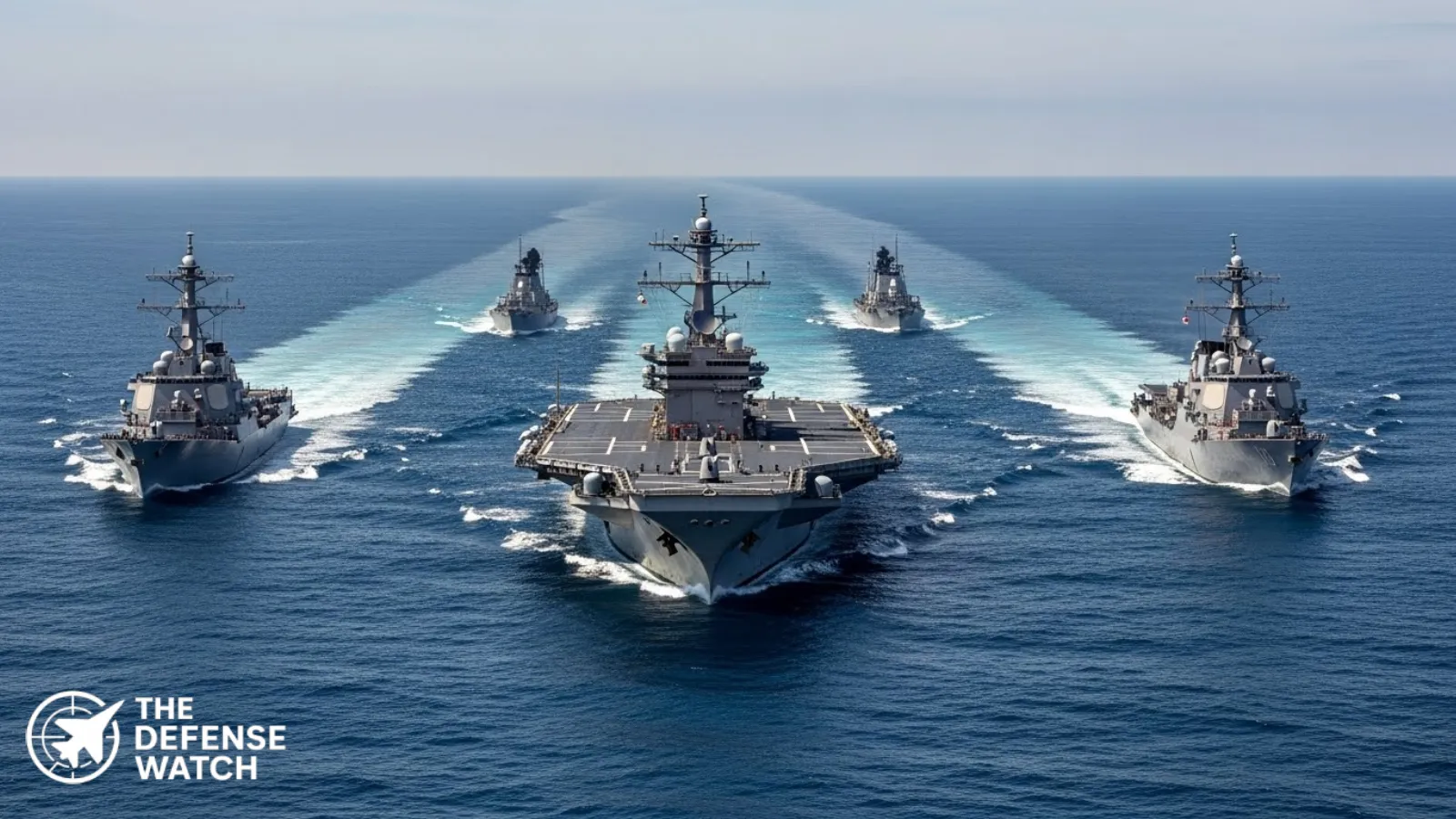
U.S. Navy Carrier Strike Group Near Venezuela Draws Regional Attention
The U.S. Navy carrier strike group near Venezuela has moved into a position close to the Venezuelan coastline, according to defense monitoring reports published on January 2025. The deployment involves the USS Gerald R. Ford, the United States Navy’s newest and most advanced aircraft carrier, operating with its escorting warships in the southern Caribbean Sea.
The movement places a high value naval formation within proximity of Venezuela’s maritime approaches at a time of continued regional security monitoring by Washington. While U.S. officials have not announced a specific operation tied to the deployment, the presence of a carrier strike group represents one of the most visible demonstrations of American naval power.
Background on the Gerald R. Ford Carrier Strike Group
The USS Gerald R. Ford is the lead ship of its class and serves as a cornerstone of modern U.S. Navy carrier operations. Designed to replace older Nimitz class carriers, the Ford class introduces advanced radar systems, improved sortie generation rates, and enhanced power generation to support future weapons and sensors.
A typical carrier strike group includes guided missile destroyers, a cruiser, and air wing assets capable of conducting air defense, strike missions, maritime surveillance, and electronic warfare. When deployed near sensitive regions, such formations offer a flexible response option for U.S. decision makers.
Details of the Current Deployment
Tracking data and defense reporting confirm that the U.S. Navy carrier strike group near Venezuela is operating in international waters. The group maintains freedom of navigation while remaining within operational reach of key maritime routes in the Caribbean basin.
The deployment aligns with routine U.S. Navy forward presence missions, which are intended to support regional stability, protect sea lanes, and reassure partners. Carrier strike groups routinely conduct training flights, intelligence collection, and coordinated maneuvers while underway.
U.S. defense officials have not released statements indicating any direct link between the deployment and specific developments inside Venezuela. The Pentagon traditionally refrains from detailing operational intent while ships remain on station.
Strategic and Policy Context
From a policy perspective, the presence of a U.S. Navy carrier strike group near Venezuela underscores Washington’s continued focus on the Western Hemisphere as a strategic theater. The Caribbean Sea remains a vital corridor for commercial shipping, energy flows, and regional security cooperation.
U.S. naval operations in the region often support counter narcotics missions, maritime domain awareness, and multinational exercises with allied and partner navies. Aircraft carriers provide command and control capabilities that allow rapid response to emerging situations without relying on land bases.
Defense analysts note that carrier deployments also serve as a signaling mechanism, demonstrating readiness and deterrence without direct engagement.
Expert Assessment and Regional Impact
Naval analysts observe that the Gerald R. Ford deployment highlights the increasing operational role of next generation carriers. The ship’s advanced systems allow sustained flight operations with reduced crew workload, improving endurance during extended deployments.
For regional actors, the presence of a U.S. carrier strike group reinforces U.S. naval dominance in the Caribbean. It also reflects ongoing U.S. monitoring of geopolitical developments across northern South America and adjacent maritime zones.
What Comes Next
The U.S. Navy carrier strike group near Venezuela is expected to continue routine operations in the region before proceeding to follow on tasking as directed by U.S. Fleet Command. Such deployments are fluid, with ship movements adjusted based on global operational requirements.
As the situation develops, defense observers will closely watch official statements and ship tracking data for indications of future movements or exercises.


22 comments
[…] from the AN APG 79 family, a proven active electronically scanned array system already used on U.S. Navy aircraft. By adapting this technology for the B-52, the Air Force aims to deliver improved target detection, […]
[…] now, U.S. Navy use of such systems has largely been experimental or land based. Launching a suicide drone from a […]
[…] combat capability. The Gotland-class is well known internationally, including for its role in U.S. Navy exercises, and remains a key asset for Sweden’s undersea […]
[…] Boeing E-6B Mercury, derived from the commercial 707 airframe, serves as the U.S. Navy’s primary airborne strategic command, control, and communications (C3) platform. First introduced in […]
[…] for the effort comes from a mix of U.S. Navy research, development, test, and evaluation accounts and Foreign Military Sales allocations. Fiscal […]
[…] is deployed across multiple U.S. Navy ship classes, […]
[…] U.S. Navy holds its leadership accountable to the highest standards of readiness, safety, and mission […]
[…] to defeat anti ship cruise missiles, aircraft, and helicopters at close range. It is widely deployed aboard U.S. Navy surface combatants, including destroyers, cruisers, and amphibious ships, as well as on allied […]
[…] 2024, the U.S. Navy fielded the AIM-174B, an air-launched variant of the SM-6 surface-to-air missile system. While […]
[…] in the region, along with additional U.S. air defense batteries deployed in recent weeks. Other U.S. Navy guided-missile destroyers have been positioned in the Gulf and the Red […]
[…] support, and system sustainment for radio frequency decoys already fielded across multiple U.S. Navy aviation platforms. These decoys emit signals that mimic or distort the radar signature of the host […]
[…] launch system is one of the most common naval missile launchers in service worldwide. It equips U.S. Navy surface combatants and is used by allied fleets across Europe and the […]
[…] MQ-25 Stingray, an uncrewed tanker under development for the U.S. Navy, is currently undergoing taxi tests. However, the platform’s size, capacity, range, and speed […]
[…] F A 18 remains the backbone of U.S. Navy carrier air wings. Integration of the AARGM ER missile onto the aircraft expands its ability to operate in […]
[…] the system supports earlier threat detection and cueing for other defensive measures. According to U.S. Navy program documentation, SEWIP upgrades are intended to keep pace with increasingly complex and agile […]
[…] awareness efforts. For example, Washington has tested air-deployable Slocum gliders to broaden U.S. Navy deployment […]
[…] operating area due to its proximity to major shipping lanes and ongoing regional tensions. U.S. naval deployments in the area are intended to reassure partners, deter state and non state threats, and ensure the […]
[…] Eight IFF interrogator sets for the U.S. Navy […]
[…] Liberty Class announcement comes as U.S. Navy leadership prioritizes unmanned systems deployment to complement traditional crewed vessels and expand overall fleet capacity. Pentagon officials have […]
[…] 09V’s estimated displacement of 9,000-10,000 tons places it in a similar size category to the U.S. Navy’s Virginia-class submarines (7,800 tons) and the larger Russian Yasen-class (13,800 tons). The X-tail […]
[…] Middle East, Africa, and Asia pass through this region. Energy shipments, commercial traffic, and naval deployments all converge […]
[…] which emphasize distributed operations and flexible force packages. Rather than relying solely on carrier strike groups, the Pentagon is leveraging land-based aircraft and regional partnerships to maintain […]