

Executive Summary:
U.S. drone manufacturer Red Cat Holdings unveiled its new Hellcat small unmanned aircraft system (sUAS) during Eurosatory 2026 in Paris. Built on the company’s Black Widow platform, the aircraft is designed for contested environments, modular mission integration, and future multi domain operations that may include tethered intelligence, surveillance, and reconnaissance (ISR) roles alongside unmanned surface vessels (USVs). The announcement reflects the growing defense industry focus on interoperable and rapidly adaptable autonomous systems.
Red Cat Introduces Hellcat UAV At Eurosatory 2026
The Red Cat Hellcat UAV made its public debut at Eurosatory 2026, one of the world’s largest land and defense technology exhibitions. The system was introduced by Red Cat Holdings as a new dual use small unmanned aircraft system built upon the company’s existing Black Widow architecture.
According to company statements released during the event, Hellcat incorporates operational feedback gathered from real world deployments and lessons learned through Red Cat’s ongoing collaboration with Ukrainian drone operators. The company stated that the platform was designed specifically for rapidly changing operational environments where adaptability and interoperability are increasingly critical.
The unveiling comes as defense ministries across Europe and NATO countries continue expanding investments in small tactical drones following battlefield lessons from Ukraine and other recent conflicts.
Built On The Black Widow Foundation
Rather than developing an entirely new airframe, Red Cat leveraged its proven Black Widow platform as the foundation for Hellcat.
The company said the aircraft follows a Modular Open Systems Architecture (MOSA) approach, allowing operators to configure mission software, command and control systems, payloads, and integration packages according to operational requirements.
Reported Hellcat Specifications
| Capability | Reported Performance |
|---|---|
| Flight endurance | More than 50 minutes |
| Operational range | Up to 6.8 miles (line of sight) |
| Navigation | GPS denied operations |
| Recovery | Return to Home Azimuth without GPS |
| Payload | Ocellus 3CP three camera ISR payload |
| Design | Field repairable, rucksack portable |
Specifications based on company-released information presented during Eurosatory 2026.
The ability to operate in GPS denied environments is increasingly important as military forces prepare for conflicts involving advanced electronic warfare systems capable of disrupting satellite navigation signals.
Tethered ISR Concept Draws Attention
One of the more significant developments surrounding Hellcat at Eurosatory was its apparent role in a broader tethered ISR ecosystem.
Industry discussions and exhibition materials highlighted integration with the ARASTELLE tether system, a plug and play solution designed to transform small drones into persistent ISR platforms or elevated communications relay nodes.
Unlike conventional battery powered drone operations that are constrained by endurance limits, tethered systems can remain airborne for extended periods while providing:
- Persistent surveillance
- Communications relay functions
- Electronic support capabilities
- Elevated sensor coverage
- Battlefield networking support
The concept aligns with growing military interest in low cost aerial mast alternatives that can be rapidly deployed by tactical units without requiring larger manned assets.
Beyond Aircraft: Red Cat’s Multi Domain Vision
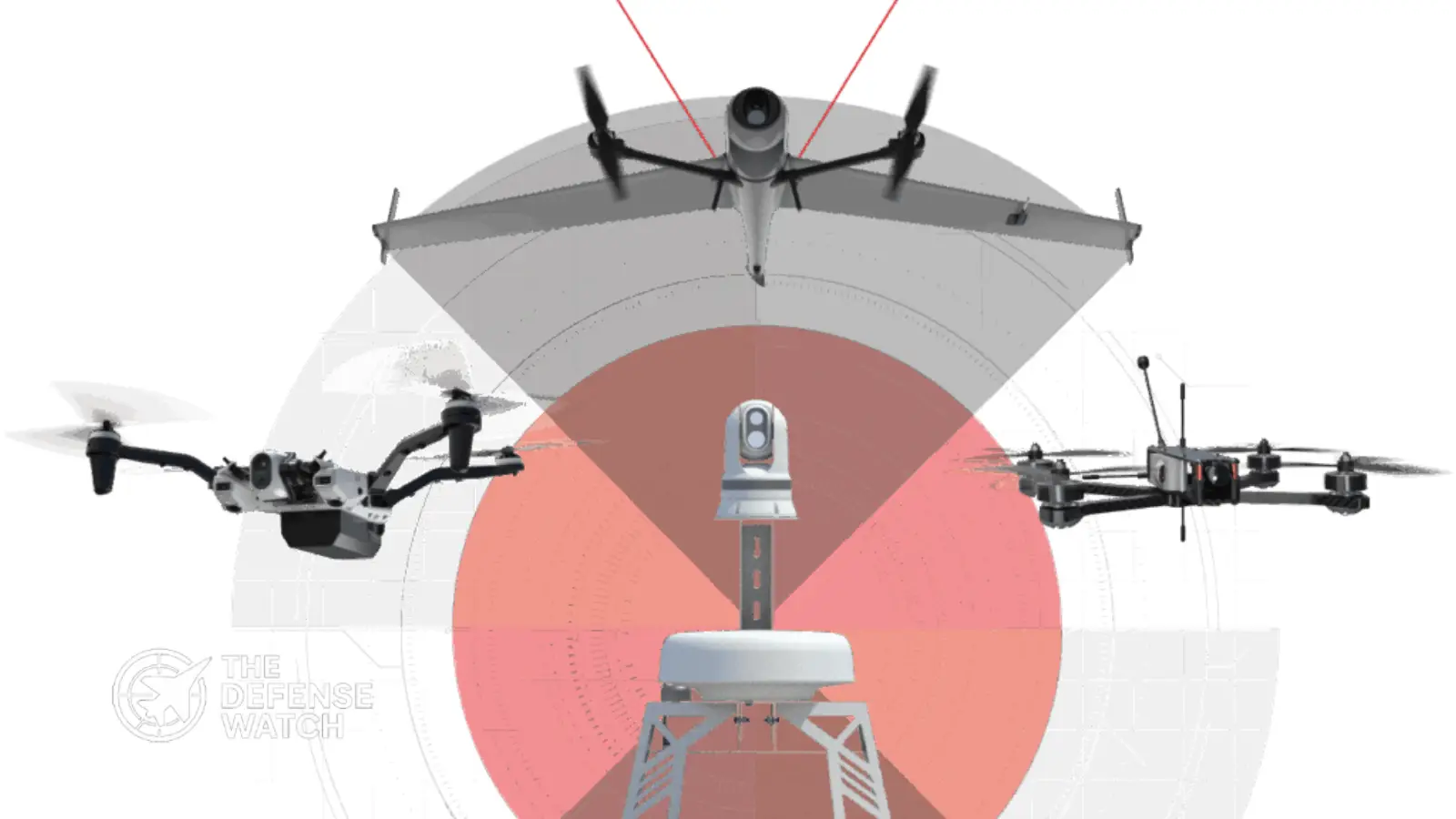
Perhaps the most strategically significant aspect of the Hellcat unveiling was how it was presented within Red Cat’s broader “Family of Systems” approach.
Company materials positioned Hellcat alongside several other autonomous platforms, including:
- Black Widow reconnaissance UAV
- FlightWave Edge 130 UAV
- FANG autonomous systems
- Blue Ops Variant 7 unmanned surface vessel
- Integrated command and control technologies
This suggests Red Cat is increasingly pursuing a multi domain autonomous ecosystem rather than operating solely as a drone manufacturer.
Industry observers at Eurosatory also noted displays and discussions linking Hellcat with future maritime applications and unmanned surface vessel concepts. While the company has not publicly detailed specific operational architectures, the combination of airborne ISR assets and autonomous maritime platforms reflects a growing trend across Western defense programs.
Why The Hellcat Matters
The introduction of Hellcat reflects several broader shifts underway across military drone development.
Rapid Battlefield Adaptation
Modern conflicts have demonstrated that drone technology evolves far faster than traditional acquisition cycles. Manufacturers increasingly rely on direct operational feedback from deployed users to accelerate development.
Red Cat explicitly stated that Hellcat incorporates battlefield lessons and operational insights gathered through ongoing Ukrainian partnerships.
Open Architecture Requirements
Defense customers are increasingly demanding systems that can integrate with existing command networks rather than relying on proprietary ecosystems.
By emphasizing MOSA compliance and configurable mission systems, Hellcat appears designed to support coalition operations across multiple countries and military services.
Multi Domain Operations
The future battlefield is expected to feature tighter coordination between air, land, maritime, cyber, and electronic warfare assets.
The inclusion of UAVs, tethered ISR systems, communications relays, and unmanned surface vessels within a common operational framework reflects this broader trend. Such architectures could enable distributed sensing and targeting networks while reducing risk to personnel.
Competitive Position In The Expanding Small UAS Market
The small UAS market has become one of the fastest growing segments of the global defense industry.
Companies are increasingly competing not only on aircraft performance but also on software architecture, electronic warfare resilience, sensor integration, and autonomous teaming capabilities.
Hellcat enters a market where military customers are seeking systems capable of operating in contested electromagnetic environments while remaining affordable and easily replaceable when necessary. Its emphasis on GPS denied operation, modular payloads, and interoperability directly addresses those requirements.
Outlook
Red Cat’s unveiling of Hellcat at Eurosatory 2026 represents more than the introduction of another small reconnaissance drone. The platform highlights the industry’s movement toward adaptable, software defined, and interconnected autonomous systems capable of operating across multiple domains.
Whether integrated into tactical reconnaissance missions, tethered ISR roles, communications relay networks, or future maritime operations, Hellcat appears positioned as a flexible node within a broader autonomous ecosystem rather than a standalone aircraft. As defense organizations continue adapting to lessons from contemporary conflicts, that systems based approach may prove as important as the drone’s individual performance characteristics.
