• Home
  • About
  • Defense Systems
  • Manufacturer
  • Comparisons
  • Compare 
  • Tools
TheDefenseWatch.com
  • Aerospace & Aviation
  • Military & Ordnance
  • Naval & Maritime
  • Cyber & Space Defense
  • Policy & Strategy
  • Global News
  • Tools Library
    • Smart Calculator
    • Drone Flight Time Calculator
    • Drone Range Calculator
    • Counter-Drone Jammer Effective Range Calculator
    • Counter-Battery Radar Detection Calculator
    • Artillery Fire Correction Calculator
    • Thermal Camera Detection Range Calculator
    • Missile Range & Time-of-Flight Calculator
    • Radar Detection Range Calculator
    • FPV Strike Drone Payload vs Range Calculator
    • Loitering Munition Endurance Calculator
    • Sniper Ballistic Drop & Windage Calculator
    • Bullet Drop Calculator
    • U.S. Army Combat Fitness Test (ACFT) Calculator
    • Military Pension Calculator
    • Military Retirement Calculator
    • Military Pension Calculator
    • Large Number Calculator
Font ResizerAa

TheDefenseWatch.com

The Defense Watch | U.S. & Global Defense News, Analysis & Military Updates

Search
  • Home
  • About
  • Defense Systems
  • Manufacturer
  • Comparisons
  • Compare 
  • Tools

Stay Updated

Get the latest update

Subscribe

Explore

  • Drone
  • Fighter Jets & Military Aircraft
  • Hypersonic Weapons
  • Aircraft Carriers
  • Strategic History & Missions
  • Tools Library
Home » Royal Navy Moves HMS Queen Elizabeth Back To Sea As Britain Sharpens Carrier Readiness
Aircraft CarriersNaval & Maritime

Royal Navy Moves HMS Queen Elizabeth Back To Sea As Britain Sharpens Carrier Readiness

Samuel Drake | Defense Analyst
Last updated: April 20, 2026 1:13 am
Samuel Drake | Defense Analyst
Share
4 Min Read
HMS Queen Elizabeth back at sea
SHARE

HMS Queen Elizabeth Back At Sea After Rapid Turnaround

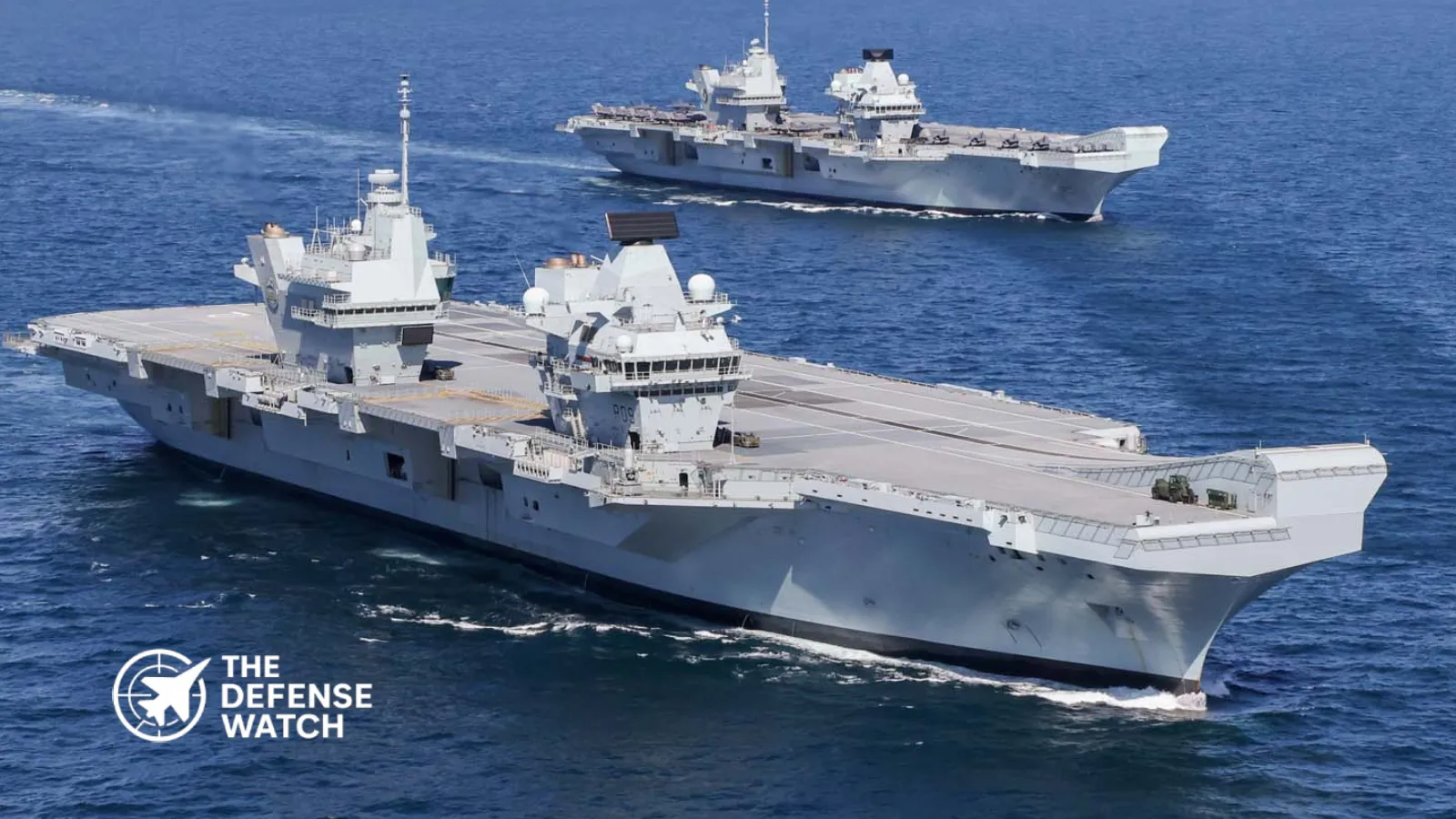
HMS Queen Elizabeth back at sea marks another visible sign that the Royal Navy is maintaining a high operational tempo for its carrier force. Britain’s flagship aircraft carrier departed Portsmouth only days after arriving, returning quickly to maritime duties following recent training activity.

Contents
  • HMS Queen Elizabeth Back At Sea After Rapid Turnaround
  • Why This Matters For Britain’s Naval Strategy
  • Capability Of The Queen Elizabeth Class
  • Original Analysis: Readiness Is The Real Message

The 65,000 ton warship had recently completed a 10 day training period involving Royal Air Force Chinook helicopters, naval aviation elements, and escort integration drills. Exercises also included cooperation with the Type 23 frigate HMS St Albans before the vessel re-entered port.

¦ KEY FACTS AT A GLANCE
  • HMS Queen Elizabeth has departed Portsmouth and returned to sea after a short port stop.
  • The carrier recently completed training with Royal Air Force Chinook helicopters and escort units.
  • The deployment highlights sustained Royal Navy readiness and rapid turnaround capability.
  • HMS Queen Elizabeth is one of two 65,000 ton Queen Elizabeth class aircraft carriers.
  • The ship can operate F-35B fighter jets, Merlin helicopters, and support carrier strike missions.

The quick turnaround is notable because large deck carriers require significant logistics support, maintenance coordination, and crew management even during short port visits. Returning to sea within days suggests the Royal Navy is emphasizing readiness rather than routine harbor downtime.

Why This Matters For Britain’s Naval Strategy

The British aircraft carrier force centers on two ships, HMS Queen Elizabeth and HMS Prince of Wales. Unlike larger navies with multiple carrier groups, the UK relies on rotating availability between these two vessels. That makes every deployment, sea trial, and training cycle strategically important.

- Advertisement -

A rapid redeployment can serve several purposes:

  • Sustain pilot and deck crew proficiency
  • Maintain escort integration with frigates and support ships
  • Demonstrate NATO maritime readiness
  • Preserve availability for crisis response
  • Prepare for future global deployments
  • HMS Queen Elizabeth Aircraft Carrier

    HMS Queen Elizabeth Aircraft Carrier

    • Large Flight Deck: 280 m, supports simultaneous STOVL operations
    • Onboard Air Wing: 40+ aircraft, F-35B, helicopters
    • Advanced Command & Control: Integrated CMS, CIC, AEW support
    • Defensive Weapon Systems: CIWS, short-range SAMs, decoy systems
    • View Details →
    7.8

    For London, carrier presence remains one of the clearest symbols of expeditionary military power. Whether operating in the North Atlantic, Mediterranean, Indo-Pacific, or on NATO tasking, these ships give Britain options beyond land-based airpower.

    Capability Of The Queen Elizabeth Class

    The Queen Elizabeth class carriers are among the largest warships ever built for the Royal Navy. Each vessel measures roughly 284 meters in length and can carry up to around 40 aircraft depending on mission profile. Their air wing can include F-35B Lightning II fighters and Merlin helicopters for anti-submarine warfare and airborne surveillance roles.

    The ski-jump flight deck design allows short takeoff and vertical landing operations, enabling flexible use without catapult systems. This keeps the carrier optimized for the F-35B concept while reducing some technical complexity compared with CATOBAR carriers.

    Original Analysis: Readiness Is The Real Message

    The most important signal from HMS Queen Elizabeth back at sea may not be combat power alone. It is readiness discipline.

    • HMS Queen Elizabeth Aircraft Carrier

      HMS Queen Elizabeth Aircraft Carrier

      • Large Flight Deck: 280 m, supports simultaneous STOVL operations
      • Onboard Air Wing: 40+ aircraft, F-35B, helicopters
      • Advanced Command & Control: Integrated CMS, CIC, AEW support
      • Defensive Weapon Systems: CIWS, short-range SAMs, decoy systems
      • View Details →
      7.8

      Modern carriers are expensive national assets, and critics often measure them only by wartime scenarios. In peacetime, however, value is often shown through availability, training output, alliance presence, and deterrence signaling. Sailing repeatedly, even for short periods, helps crews remain sharp and systems validated.

      For allies, this shows the UK can still generate credible maritime power. For rivals, it signals Britain’s carrier fleet is active, not ceremonial.

TAGGED:Aircraft CarrierBritish DefenseHMS Queen ElizabethNaval powerRoyal Navy
Share This Article
Facebook Copy Link Print
BySamuel Drake | Defense Analyst
Follow:
Samuel Drake is a defense analyst at TheDefenseWatch.com covering naval warfare, military ordnance, maritime technology, fleet modernization, and defense procurement. His reporting focuses on documented capabilities, procurement programs, and military technology.
Leave a Comment

Leave a Reply Cancel reply

Your email address will not be published. Required fields are marked *

Latest Defense Systems

  • SU-57 Felon Stealth Fighter SU-57 Felon Stealth Fighter
  • Boeing F/A-XX Fighter Boeing F/A-XX Fighter
  • JF-17 Thunder Fighter Jet JF-17 Thunder Fighter Jet
  • Gaurav Glide Bomb Gaurav Glide Bomb
  • F-47 Fighter Jet F-47 Fighter Jet
  • Spirit UAS Spirit UAS
  • GBU-43/B MOAB Bomb GBU-43/B MOAB Bomb
  • John F. Kennedy Aircraft Carrier John F. Kennedy Aircraft Carrier
  • Voyager Tanker Voyager Tanker

Recent Compares

  • J-10C vs JF-17 Thunder: Which Fighter Is More Capable? J-10C vs JF-17 Thunder: Which Fighter Is More Capable? View Comparison →
  • Tejas vs Gripen: Key Differences and Capabilities Tejas vs Gripen: Key Differences and Capabilities View Comparison →
  • Tejas vs MiG-21 Bison: How India Replaced Its Iconic Supersonic Fighter Tejas vs MiG-21 Bison: How India Replaced Its Iconic Supersonic Fighter View Comparison →
  • F-35 vs F-16: Stealth, Sensors and Combat Roles F-35 vs F-16: Stealth, Sensors and Combat Roles View Comparison →
  • Tejas Fighter Jet vs F-16 Fighting Falcon: Capability Compared Tejas Fighter Jet vs F-16 Fighting Falcon: Capability Compared View Comparison →
  • Rafale Fighter Jet vs F-16 Fighting Falcon : Which Fighter Has the Edge? Rafale Fighter Jet vs F-16 Fighting Falcon : Which Fighter Has the Edge? View Comparison →
  • Su-57 Fighter Jet vs J-20 Fighter Jet: Stealth and Air Combat Compared Su-57 Fighter Jet vs J-20 Fighter Jet: Stealth and Air Combat Compared View Comparison →
  • Mirage 2000 vs Tejas Mk1A: Legacy Combat Power vs Indigenous Modernization Mirage 2000 vs Tejas Mk1A: Legacy Combat Power vs Indigenous Modernization View Comparison →
  • Rafale Fighter Jet vs F-22 Raptor: Which Air Dominance Fighter Has the Edge? Rafale Fighter Jet vs F-22 Raptor: Which Air Dominance Fighter Has the Edge? View Comparison →
  • Tejas Fighter Jet vs. Rafale Fighter Jet: India’s Indigenous Fighter Meets France’s Proven Multirole Combat Aircraft Tejas Fighter Jet vs. Rafale Fighter Jet: India’s Indigenous Fighter Meets France’s Proven Multirole Combat Aircraft View Comparison →

Recent Posts

  • Ukrainian F-16 vs. Russian Su-35: What Happened, How the Engagement Unfolded and Why It Matters
  • Canada’s Fighter Jet Fleet Faces a Critical Transition as F-35 Review Continues
  • New Zealand Signs Deal for Five MH-60R Seahawk Helicopters
  • U.S. Air Force Test Pilot School Adds Water Landings to Training
  • F-22 Takes Control of YFQ-44A as U.S. Air Force Advances Collaborative Combat Aircraft Testing

You Might Also Like

Indian Navy EOIR system
Naval & MaritimeNaval Strategy & Maritime Security

Indian Navy Expands Maritime Surveillance With Indigenous EOIR System Acquisition

September 7, 2026
U.S. Navy LCAC deployment
Naval & MaritimeNaval Strategy & Maritime Security

U.S. Navy Expands Expeditionary Warfare Capability In South China Sea With LCAC Deployment Of LAV-25 Vehicles

September 7, 2026
Kimon-class frigates Greece
Naval & Maritime

France Offers Greece Three More Kimon-Class Frigates After U.S. Constellation Setback

February 2, 2026
Royal Navy NATO task group
Naval & MaritimeNaval Strategy & Maritime Security

Royal Navy Takes Command Of NATO Maritime Task Group As Alliance Boosts Atlantic Security

April 13, 2026

Logo

Copyright © 2026 TheDefenseWatch.com

Helpful Links

  • Home
  • About Us
  • Privacy Policy
  • Terms of Use / Disclaimer
  • U.S. Privacy Notice – CCPA Compliance

Defense Systems

  • Defense Systems
  • Comparisons 
  • Manufacturer
  • Tactical Calculators

Popuplar

Which 5 Air Forces Possess the Costliest Fighter Jet Fleets in the World
Evolving Strategic Value: Carrier Strike Groups in the Indo-Pacific’s Future Security Architecture
Autonomous Weapon Systems Spark U.S. Ethics Debate Amid Rapid Military AI Integration

We report on developments involving military forces, governments, defense companies, research organizations, and security institutions around the world. 

Welcome Back!

Sign in to your account

Username or Email Address
Password

Lost your password?