Night Stalkers’ MV-75 Cheyenne II Special Ops Variant Makes Its Public Debut
The MV-75 Cheyenne II special operations variant has made its public debut, offering the first concrete look at how the Army’s most capable tiltrotor will be configured for the elite 160th Special Operations Aviation Regiment. The U.S. Army gave the public its first glimpse at the MV-75A Cheyenne II in its special operations configuration on April 15, 2026, at the Army Aviation Association of America’s Warfighting Summit — and what was revealed signals a significant leap forward in how America’s Night Stalkers intend to fight in contested, complex environments.
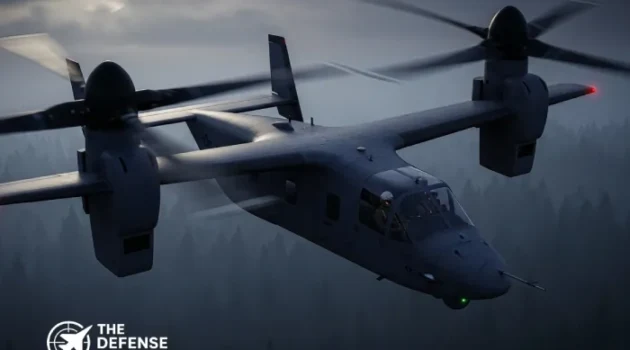
- The 160th Special Operations Aviation Regiment’s MV-75A Cheyenne II variant has been publicly revealed for the first time via a rendering shown at the Army Aviation Association of America’s 2026 Warfighting Summit.
- The special operations variant features a nose-mounted terrain-following/terrain-avoidance radar — likely the AN/APQ-187 Silent Knight — a sensor turret, Degraded Visual Environment Pilotage System (DVEPS), and an in-flight refueling probe.
- The MV-75 is designed to replace a portion of the 160th’s MH-60M Black Hawk fleet, offering significantly greater range and speed for deep-penetration special operations missions in contested environments.
- The Army accelerated its MV-75 fielding timeline in January 2026, targeting initial delivery to operational units in 2027 — four years ahead of the original 2031 schedule.
- The aircraft features a modular open systems architecture (MOSA), enabling faster, more affordable capability upgrades — a critical design priority for the 160th SOAR commander.
The Big Picture
Special operations aviation has long depended on aging Black Hawk variants to execute the military’s most sensitive missions. The MH-60M, while heavily modified, is a platform rooted in 1970s airframe technology. The Army has said in the past that it plans to replace roughly half of the 160th’s special operations MH-60M Black Hawk helicopters with MV-75s, though whether that proportion remains unchanged is not yet confirmed.
The MV-75 Cheyenne II represents a generational shift — not an incremental upgrade. As a tiltrotor descended from Bell’s V-280 Valor demonstrator, it combines helicopter-like vertical takeoff with fixed-wing cruise speeds and range. For a unit whose entire operational philosophy centers on inserting forces at precisely the right moment, from precisely the right distance, speed and reach are not just performance metrics — they are mission-enabling characteristics.
The unveiling at AAAA comes against the backdrop of a broader U.S. military push to modernize rotary-wing assets ahead of potential high-end conflict with China across the Indo-Pacific — a theater defined by vast maritime distances that fundamentally stress rotorcraft range limitations.
What’s Happening
Army Col. Roger Waleski, commander of the 160th, shared the rendering of the special operations-specific MV-75 during a presentation at the Army Aviation Association of America’s 2026 Warfighting Summit.
From what is seen in the rendering, the special operations variant of Cheyenne II will differ from the baseline type most in the configuration of its nose end. Like the 160th’s Black Hawks, its version of the MV-75A will feature a nose-mounted radar and sensor turret underneath, as well as an in-flight refueling probe that extends out from the right side.
The radar is likely to be the AN/APQ-187 Silent Knight, or SKR, a terrain-following/terrain avoidance type. SKR is increasingly the default for U.S. special operations aircraft, including Army MH-60M and MH-47G Chinook helicopters, as well as Air Force CV-22 Osprey tiltrotors and MC-130J Commando II special operations tanker/transports.
The rendering also shows what looks to be a fixed, forward-facing aperture on the nose to the left of the radar — most likely reflecting the inclusion of a Degraded Visual Environment Pilotage System (DVEPS) or a similar capability, as is found on the 160th’s MH-60s and MH-47s today. DVEPS uses cameras and LIDAR, together with a terrain database, to help crew navigate through degraded environments full of dust, sand, snow, fog, and other obscurants.
Why It Matters
The sensor suite revealed on the special operations MV-75 is not simply a continuation of prior configurations — it is a deliberate replication and enhancement of the proven architecture used on the Night Stalkers’ current fleet, scaled to a faster, longer-range platform.
TF/TA radar and DVEPS, together with other sensors and in-flight refueling capability, will enable long-range operations along extremely low-altitude nap-of-the-earth flight profiles, even in poor weather and at night. This combination is the operational signature of 160th SOAR missions — the ability to fly fast, low, and undetected across hundreds of miles.
Col. Waleski made clear that performance is only part of what excites the 160th’s leadership. “We’ve gone to a completely modular open system architecture, maintaining the data rights on the aircraft,” he said. “For the warfighters in the room, what that means is your ability to adapt in the warfighting environment, it’s going to be cheaper, it’s going to be quicker.”
That statement carries significant weight. MOSA adoption means the Army — not the prime contractor — controls the integration roadmap. Future sensor upgrades, new electronic warfare packages, or emerging communications systems can be fielded without the contractor dependency that has historically delayed and inflated upgrade costs across military aviation programs.
Strategic Implications
The MV-75’s speed and range advantages over the MH-60M are particularly relevant in the Pacific theater. Rotary-wing platforms operating from sea bases or austere island locations face extreme distance penalties. A tiltrotor with MV-75-class performance could allow the 160th to execute direct-action or personnel-recovery missions from distances that currently fall outside the MH-60M’s practical combat radius.
The in-flight refueling capability shown on the Night Stalker variant further multiplies this reach. Combined with MC-130J tanker support — a mission set already deeply integrated into SOCOM’s theater playbook — the special operations MV-75 would be capable of conducting extremely long-range infiltrations without requiring forward staging bases that may not exist or may be contested in a high-end fight.
“I’ve said this before, I’m exceptionally excited about this platform,” Col. Waleski said. Yes, I’m excited about the speed. Yes, I’m excited about the payload, and I’m excited about the range.
Competitor View
China and Russia will note the MV-75’s special operations configuration with particular attention. Beijing’s military strategists have long studied the operational methods of the 160th SOAR, recognizing that the unit’s ability to project precision force across great distances represents a direct threat to high-value command-and-control assets, leadership targets, and critical infrastructure in a conflict scenario.
The MV-75’s extended range and speed advantage over the MH-60M would meaningfully complicate Chinese integrated air defense planning in the Pacific. A platform that can fly further, faster, and lower — under the radar coverage that Beijing has invested heavily in developing — forces a more distributed and resource-intensive defense architecture.
Russia will similarly factor the Cheyenne II into its special operations threat calculus for European theater contingency planning. The Night Stalkers’ presence in any NATO response scenario has historically required adversaries to allocate additional air defense resources to rear areas, a dynamic that a faster, longer-range MV-75 only amplifies.
What To Watch Next
The baseline MV-75A is still in development, and it is unclear when it might fly for the first time. The Army’s accelerated program timeline, announced in January 2026, targets initial fielding to operational units in 2027 — a compressed schedule that will test Bell’s production and integration pace.
Army Maj. Gen. Clair Gill, the Program Acquisition Executive for Maneuver Air, acknowledged the ambition of the timeline, stating: “We are moving as fast as we can.”
The special operations variant adds another layer of complexity to that schedule. Converting baseline MV-75As into the SOAR configuration requires integration of specialized sensors, avionics, and refueling systems. The Army’s decision to build special operations-friendly conversion features into the baseline airframe from the start suggests the program office is thinking ahead, but the actual timeline for Night Stalker-specific deliveries will likely trail the baseline fielding date by a meaningful margin.
Key near-term milestones to track include the first flight of the production-representative MV-75A, formal confirmation of the 160th SOAR procurement quantity, and any announcement related to Silent Knight radar integration contracts.
Capability Gap
The MH-60M Black Hawk has served the 160th with distinction for decades, but the platform’s speed, range, and altitude performance impose real operational constraints. In the Pacific, those constraints become strategic liabilities. The MV-75 Cheyenne II directly targets this gap.
The special operations variant’s terrain-following radar and DVEPS suite also address a survivability gap: the ability to fly nap-of-the-earth profiles in complete sensor-degraded environments — sandstorms, snowstorms, heavy fog — without mission abort. In contested airspace, the aircraft that can stay low and keep moving is the aircraft that survives.
A realistic limitation to acknowledge is integration risk. The Night Stalker community flies some of the most sensor-dense, software-intensive rotorcraft in the U.S. inventory. Packing equivalent complexity into a new-design tiltrotor airframe, on an accelerated timeline, introduces meaningful developmental risk. Managing that risk without sacrificing fielding speed will be one of the program’s defining challenges in the years ahead.
The Bottom Line
The first public rendering of the Night Stalker MV-75 Cheyenne II confirms that the Army is building a special operations tiltrotor designed from the ground up to dominate the long-range, low-altitude, all-weather mission space — and to keep adapting as the threat environment evolves.