




@2026 – All Right Reserved. TheDefenseWatch.com
- Home
- Defense Systems
- Bombers & Strategic Aircraft
- Y-20B Kunpeng Airlifter
Y-20B Kunpeng Airlifter
Defense Systems Full Specifications
1. General Information
| Name | Y-20B Kunpeng |
| Manufacturer | Xi'an Aircraft Industrial Corporation (AVIC) |
| Country of Origin | China |
| Introduction / In Service Since | First flight ~2013 (base); Y-20B operational ~2023 |
| Status | In production and service |
| Category | Strategic transport aircraft |
| Crew | 3 |
| Unit Cost | ~$160 million (estimated) |
2. Dimensions & Structure
| Length | 47 m (154 ft 2 in) |
| Wingspan | 50 m (164 ft 1 in) |
| Height | 15 m (49 ft) |
| Wing Area | ~310 m² |
| Empty Weight | ~100,000 kg |
| Maximum Takeoff Weight (MTOW) | ~220,000 kg |
3. Performance
| Maximum Speed | 926 km/h (Mach 0.75) |
| Range | 7,800 km (with payload) |
| Combat Radius | Not primarily combat-focused |
| Service Ceiling | 13,000 m (43,000 ft) |
| Rate of Climb | Data limited |
4. Powerplant
| Engine Type | 4 × Shenyang WS-20 turbofans |
| Thrust (per engine) | ~140 kN (31,000 lbf) |
| Total Thrust | ~560 kN |
5. Payload & Armament
| Internal Payload Capacity | 66,000–70,000 kg |
| Weapons Bay | N/A (transport) |
| Compatible Weapons | N/A (cargo/troop focused) |
| Hardpoints | N/A |
6. Avionics & Systems
| Radar System | Advanced multi-mode (details classified) |
| Navigation | Modern integrated avionics |
| Electronic Warfare (EW) | Likely equipped for self-protection |
| Stealth Features | Minimal; conventional design |
7. Operational History
| Primary Operator | People's Liberation Army Air Force (PLAAF) |
| Conflict Usage | Primarily peacetime/logistics; humanitarian and repatriation missions |
| Notable Missions | Troop/equipment transport, martyr remains repatriation |
8. Additional Information
| Variants | Y-20A, Y-20B, YY-20 tanker |
| Successor / Future Replacement | Potential larger follow-ons |
| Notable Features | Indigenous engines, large rear ramp, 3D printing in production |
| Estimated Operational Life | 30+ years with upgrades |
PROS
- Indigenous WS-20 engines improve fuel efficiency, thrust, and operational independence.
- High payload capacity (up to ~66-70 tons) for heavy equipment transport.
- Extended range and ferry capabilities enable strategic reach.
- Versatile multi-role potential, including tanker variants (YY-20B).
- Rapid production ramp-up supports large fleet growth for PLAAF needs.
CONS
- Still maturing compared to decades of Western heavy-lift experience (e.g., C-17).
- Limited public data on advanced avionics and electronic warfare performance.
- Dependence on domestic supply chains that may face scaling challenges.
- Potentially higher maintenance demands during early WS-20 fleet integration.
- Less proven in sustained high-tempo combat operations than U.S. equivalents.
Y-20B Kunpeng: China’s Advanced Strategic Airlifter
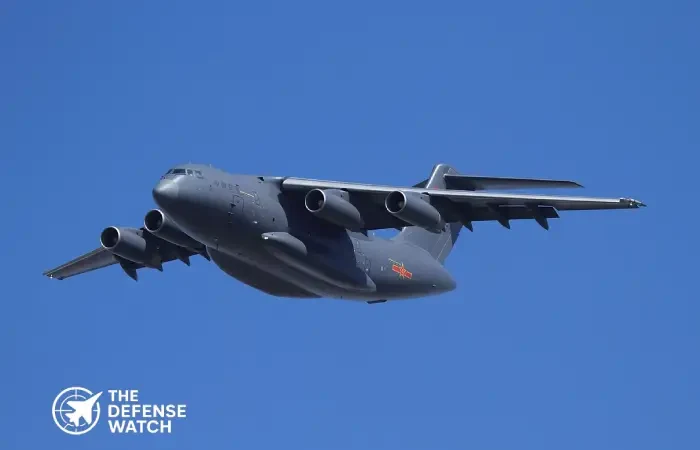
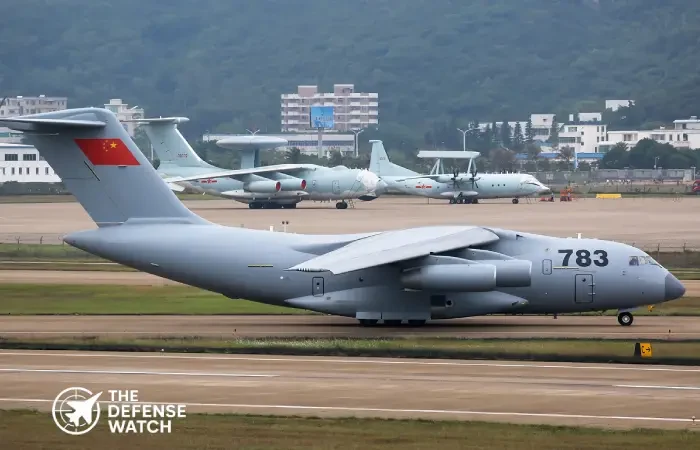
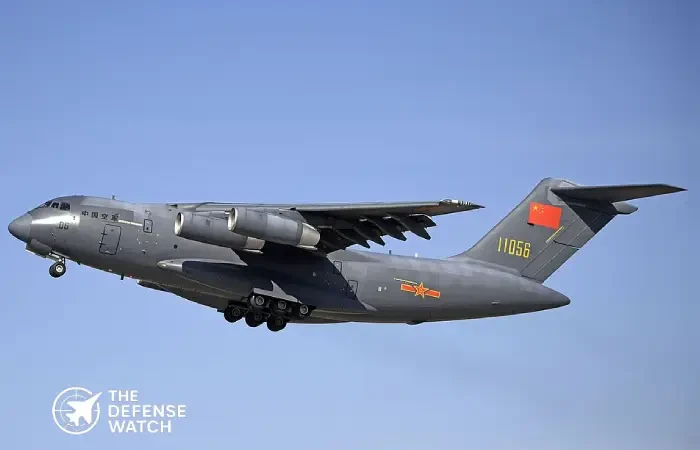
The Y-20B represents a significant evolution in China’s military airlift capabilities. Nicknamed “Kunpeng” after a mythical bird, this large transport aircraft provides the People’s Liberation Army Air Force (PLAAF) with modern strategic mobility. Designed for rapid deployment of troops, heavy equipment, and humanitarian aid across vast distances, the Y-20B addresses previous limitations in engine performance through full integration of domestic powerplants. It plays a key role in enhancing China’s ability to project power in the Indo-Pacific and beyond, serving as a counterpart to Western aircraft like the U.S. C-17 Globemaster III.
Manufacturer
Developed by the Xi’an Aircraft Industrial Corporation (part of the Aviation Industry Corporation of China – AVIC), the Y-20 family originated in China. The Y-20B variant incorporates fully indigenous WS-20 high-bypass turbofan engines, reducing reliance on foreign components like the earlier Russian D-30KP-2 used in the Y-20A.
Speed and Range
The Y-20B achieves a maximum speed of approximately 926 km/h (Mach 0.75) and a cruise speed around 630 km/h. Its range extends to 7,800 km with significant payload (such as two Type 15 tanks) and a ferry range of up to 10,000 km with lighter loads. These figures support long-haul strategic missions across China’s expansive territory and regional theaters.
Cost/Price
Unit cost estimates for the Y-20 series hover around $160 million, though actual figures for the Y-20B may vary based on configuration and production scale. China aims for high-volume production to meet PLAAF requirements for hundreds of such aircraft.
The Y-20B features a high-wing design, T-tail, and rear loading ramp for efficient cargo operations. With a maximum takeoff weight of approximately 220,000 kg and payload capacity of 66,000–70,000 kg, it can transport main battle tanks, armored vehicles, or large numbers of troops. Advanced avionics support operations in varied conditions, bolstering China’s self-reliant defense posture.
Disclaimer Note
The information provided on TheDefenseWatch.com is for general informational purposes only. While we strive to ensure the accuracy, completeness, and timeliness of our content regarding defense and aerospace products, technologies, and specifications, we cannot guarantee that all information is 100% accurate or up-to-date due to the evolving nature of military technology and classified data.TheDefenseWatch.com does not warrant the reliability, suitability, or availability of the information for any specific purpose. Users are advised to consult official sources, such as manufacturers, government publications, or defense agencies, for precise and verified data before making decisions based on our content.We are not affiliated with any defense manufacturers, governments, or military organizations mentioned. Opinions, reviews, and ratings reflect expert analysis but are subjective and should not be considered endorsements. TheDefenseWatch.com is not responsible for any errors, omissions, or consequences arising from the use of this website’s content.External links are provided for convenience and do not imply endorsement. TheDefenseWatch.com reserves the right to update or modify content without prior notice. By using this website, you agree to our Privacy & Cookies Policy.
More Defense Systems from Xi'an Aircraft Industrial Corporation (AVIC)
New Arrivals
Popular Comparisons
-
 Tejas vs Gripen: Key Differences and Capabilities
View Comparison →
Tejas vs Gripen: Key Differences and Capabilities
View Comparison → -
Tejas vs MiG-21 Bison: How India Replaced Its Iconic Supersonic Fighter
View Comparison →
-
F-35 vs F-16: Stealth, Sensors and Combat Roles
View Comparison →
-
Tejas Fighter Jet vs F-16 Fighting Falcon: Capability Compared
View Comparison →
-
Rafale Fighter Jet vs F-16 Fighting Falcon : Which Fighter Has the Edge?
View Comparison →
-
Su-57 Fighter Jet vs J-20 Fighter Jet: Stealth and Air Combat Compared
View Comparison →
-
Mirage 2000 vs Tejas Mk1A: Legacy Combat Power vs Indigenous Modernization
View Comparison →
-
Rafale Fighter Jet vs F-22 Raptor: Which Air Dominance Fighter Has the Edge?
View Comparison →
-
Tejas Fighter Jet vs. Rafale Fighter Jet: India’s Indigenous Fighter Meets France’s Proven Multirole Combat Aircraft
View Comparison →
-
F-22 Raptor vs. F-35 Joint Strike Fighter: Which Fifth Generation Fighter Has the Edge?
View Comparison →
- CSG Targets U.S. Land Systems Market With AUSA 2026 Debut

- General Dynamics Unveils Full Wolf XM30 Design Ahead of AUSA 2026
- Indian Air Force Needs 36 to 40 New Fighters Each Year, Chief Says
- Northrop Grumman Gets $66M MQ-4C Triton Retrofit Order
- Lockheed Martin Wins $209 Million Navy SEWIP Production Contract
- Navy Commissions USS Ted Stevens as Second Flight III Destroyer
- U.S. Army Tests Counter-Drone Systems Along Mexico Border
- Bolt Action Rifles: History, Design and Military Role
- India’s Nuclear Arsenal Reaches 190 Warheads as Triad Expands
- U.S. Navy Plans Major Redesign of F-35 Mission Planning Environment