
- Home
- Defense Systems
- Fighter Jets
- Mirage 5PA2 Fighter Jet
Mirage 5PA2 Fighter Jet
Defense Systems Full Specifications
General Information
| Name | Dassault Mirage 5PA2 |
| Manufacturer | Dassault-Breguet |
| Country of Origin | France |
| Type / Role | Supersonic strike fighter / fighter-bomber |
| Generation | 2nd |
| Status | Legacy variant; broader Mirage 5 fleet remains in Pakistani service |
| First Flight | May 19, 1967, Mirage 5 family |
| Introduction / In Service Since | 1981 |
| Number Built | 18 |
| Operators | Pakistan Air Force |
Dimensions & Structure
| Length | 15.56 m |
| Wingspan | 8.22 m |
| Height | Approximately 4.5 m |
| Wing Area | Approximately 35 m² |
| Empty Weight | 6,660 kg |
| Maximum Takeoff Weight (MTOW) | Approximately 13,700 kg |
| Internal Weapons Bay | None |
| External Hardpoints | 7 |
Performance
| Maximum Speed | More than Mach 2 |
| Range | Approximately 1,300 km |
| Combat Radius | Not reliably published for PA2 |
| Service Ceiling | 18,000 m / 59,000 ft |
| Rate of Climb | Approximately 83 m/s, variant dependent |
| Thrust-to-Weight Ratio | Approximately 0.5, configuration dependent |
| G Limits | Not reliably published for PA2 |
Powerplant
| Engine Type | SNECMA Atar 9C afterburning turbojet |
| No. of Engines | 1 |
| Thrust (each) | Approximately 58.8 kN with afterburner |
| Thrust Vectoring | No |
| Fuel Capacity | Approximately 4,000 liters, configuration dependent |
Armament
| Gun | 2 × 30 mm DEFA cannons |
| Missiles (Air-to-Air) | Compatible with period French air-to-air missiles, including Magic family weapons on suitable configurations |
| Missiles (Air-to-Ground) | Air-to-ground weapons dependent on integration and configuration |
| Bombs | Conventional bombs and external stores |
| Hardpoints | 7 |
| Payload Capacity | Up to approximately 4,000 kg |
Avionics & Systems
| Radar | Cyrano IV multimission radar |
| Radar Range | Approximately 111 km, published figure |
| Electronic Warfare (EW) System | Variant and upgrade dependent |
| Targeting System | Conventional attack and navigation systems |
| Helmet Display | No modern helmet-mounted display |
| Navigation | Conventional navigation system; later upgrades varied |
| Autopilot / AI Assistance | Conventional flight controls, no AI assistance |
| Communication | Conventional military radio systems |
Stealth & Technology
| Radar Cross Section (RCS) | Not publicly specified |
| Stealth Features | None |
| Infrared Signature Reduction | No dedicated modern signature reduction system |
| Sensor Fusion | None comparable to modern fighters |
| Networking Capabilities | Limited compared with modern network-centric fighters |
Variants
| Special Export Versions | Mirage 5PA, Mirage 5PA2, Mirage 5PA3, Mirage 5DPA2 |
Operational History
| Major Conflicts / Deployments | Pakistan Air Force tactical and strike operations |
| Notable Operators | Pakistan Air Force |
| Combat Proven? | Yes, Mirage III/V family |
| Mission Types | Ground attack, tactical strike, interception, training and reconnaissance roles across the wider family |
Cost & Program
| Unit Cost | Exact PA2 purchase price not reliably disclosed |
| Development Cost | Not publicly disclosed for the PA2 variant |
| Program Name | Mirage 5 Pakistan acquisition |
| Funding Countries | Pakistan; Saudi financing was reported for the 1979 Mirage package |
Additional Information
| Upgrades Planned | No major new-build PA2 upgrade program publicly identified |
| Future Replacement | Newer Pakistan Air Force combat aircraft, including JF-17 variants |
| Export Restrictions | Subject to French export controls and original contractual arrangements |
| Notable Achievements | Long service with the Pakistan Air Force and extensive Mirage family operational history |
| Competitors | Dassault Mirage III, F-5E Tiger II, MiG-21, A-4 Skyhawk |
PROS
- Mach 2-class supersonic performance
- Cyrano IV multimission radar
- Strong ground-attack capability
- Seven external weapon stations
- Long operational history with Pakistan
CONS
- Aging Cold War-era airframe
- No stealth characteristics
- No modern AESA radar
- Limited internal fuel compared with newer fighters
- Higher sustainment challenges due to age
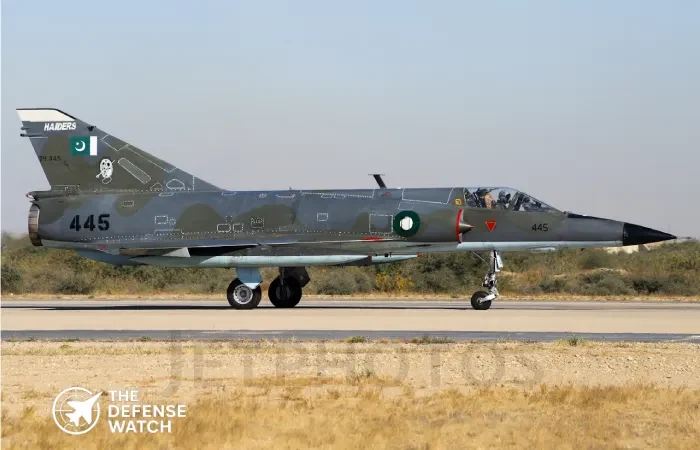
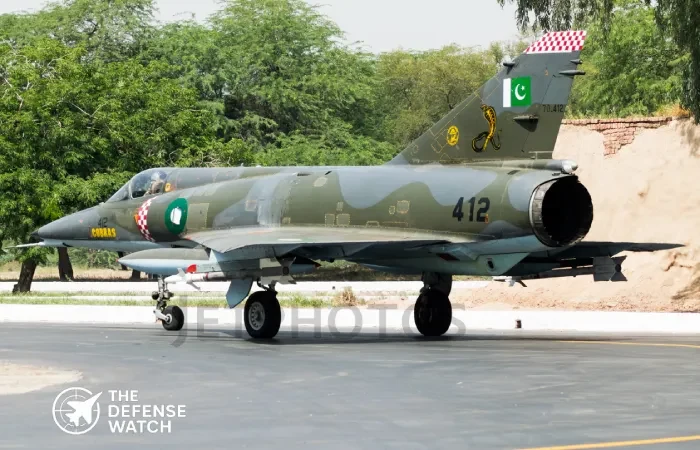
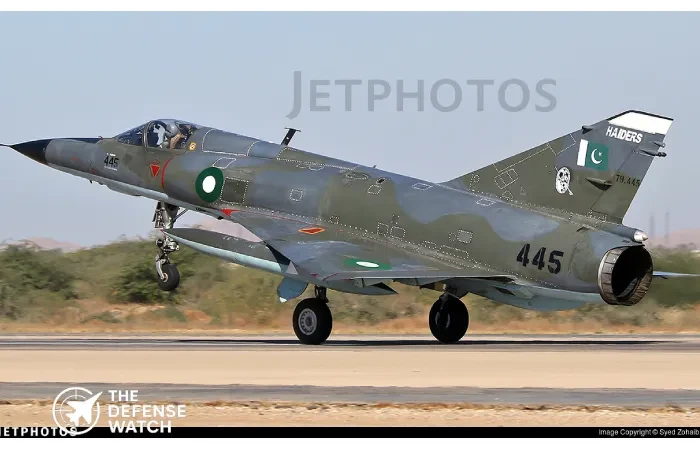
The Dassault Mirage 5PA2 is a Pakistan-specific version of the French Mirage 5, developed as a supersonic single-seat strike and fighter aircraft. Built from the Mirage III family, the Mirage 5 was designed primarily for low-level attack missions while retaining the speed needed for interception and tactical operations. The PA2 variant added a Cyrano IV multimission radar, giving Pakistan a more capable sensor-equipped version than the radarless Mirage 5PA. Eighteen Mirage 5PA2 aircraft were produced for Pakistan.
Manufacturer and Origin
The aircraft was manufactured by Dassault-Breguet in France for the Pakistan Air Force. Pakistan ordered the Mirage 5PA2 as part of a larger Mirage acquisition in the late 1970s, with deliveries completed by 1982. The Mirage 5 family first flew on May 19, 1967, and more than 500 Mirage 5 aircraft were produced in different versions.
Speed, Range and Armament
Powered by a single SNECMA Atar 9C turbojet, the Mirage 5 can exceed Mach 2 and reach a service ceiling of about 59,000 feet. Published Mirage 5 data gives a range of roughly 1,300 km, although actual mission range varies with weapons, fuel tanks, altitude, and flight profile.
The PA2 uses the Cyrano IV radar and can employ air-to-air weapons, bombs, rockets, and other external stores. The Mirage 5 design provides seven external weapon stations and a maximum external payload commonly reported at about 4,000 kg. Its two 30 mm DEFA cannons provide built-in gun armament.
Operational Use and Cost
The Mirage 5PA2 served with the Pakistan Air Force as a tactical strike platform and formed part of Pakistan’s long-running Mirage III and Mirage 5 fleet. Modernization programs later extended the service life and capabilities of several Pakistani Mirages. The exact individual purchase price of the Mirage 5PA2 has not been reliably disclosed in public sources, so a current unit price cannot be stated accurately.
Variants
| Field | Example |
| Mirage 5PA | Radarless Pakistani strike version |
| Mirage 5PA2 | Pakistani radar-equipped fighter with Cyrano IV |
| Mirage 5PA3 | Pakistani maritime strike variant with Agave radar |
| Mirage 5DPA2 | Two-seat Pakistani training variant |
Disclaimer Note
The information provided on TheDefenseWatch.com is for general informational purposes only. While we strive to ensure the accuracy, completeness, and timeliness of our content regarding defense and aerospace products, technologies, and specifications, we cannot guarantee that all information is 100% accurate or up-to-date due to the evolving nature of military technology and classified data.TheDefenseWatch.com does not warrant the reliability, suitability, or availability of the information for any specific purpose. Users are advised to consult official sources, such as manufacturers, government publications, or defense agencies, for precise and verified data before making decisions based on our content.We are not affiliated with any defense manufacturers, governments, or military organizations mentioned. Opinions, reviews, and ratings reflect expert analysis but are subjective and should not be considered endorsements. TheDefenseWatch.com is not responsible for any errors, omissions, or consequences arising from the use of this website’s content.External links are provided for convenience and do not imply endorsement. TheDefenseWatch.com reserves the right to update or modify content without prior notice. By using this website, you agree to our Privacy & Cookies Policy.


New Arrivals


Popular Comparisons
-
 J-10C vs JF-17 Thunder: Which Fighter Is More Capable?
View Comparison →
J-10C vs JF-17 Thunder: Which Fighter Is More Capable?
View Comparison → -
Tejas vs Gripen: Key Differences and Capabilities
View Comparison →
-
Tejas vs MiG-21 Bison: How India Replaced Its Iconic Supersonic Fighter
View Comparison →
-
F-35 vs F-16: Stealth, Sensors and Combat Roles
View Comparison →
-
Tejas Fighter Jet vs F-16 Fighting Falcon: Capability Compared
View Comparison →
-
Rafale Fighter Jet vs F-16 Fighting Falcon : Which Fighter Has the Edge?
View Comparison →
-
Su-57 Fighter Jet vs J-20 Fighter Jet: Stealth and Air Combat Compared
View Comparison →
-
Mirage 2000 vs Tejas Mk1A: Legacy Combat Power vs Indigenous Modernization
View Comparison →
-
Rafale Fighter Jet vs F-22 Raptor: Which Air Dominance Fighter Has the Edge?
View Comparison →
-
Tejas Fighter Jet vs. Rafale Fighter Jet: India’s Indigenous Fighter Meets France’s Proven Multirole Combat Aircraft
View Comparison →


- Department of War and Lockheed Martin Sign 10-Year F-35 Agreement With $7 Billion Investment Commitment

- Pentagon Approves Active Denial System for Potential U.S. Southern Border Use
- U.S. Air Force Plans Larger F-35 Role in 1,509-Aircraft Fighter Fleet
- Raytheon Wins Two-Year Extension for AN/TPY-2 Radar Support
- Space Force Selects Northrop Grumman, True Anomaly for New Orbital Reconnaissance Satellites
- Hegseth and Guyana’s President Establish Enhanced Military Partnership
- Ukrainian F-16 vs. Russian Su-35: What Happened, How the Engagement Unfolded and Why It Matters
- Canada’s Fighter Jet Fleet Faces a Critical Transition as F-35 Review Continues
- New Zealand Signs Deal for Five MH-60R Seahawk Helicopters
- U.S. Air Force Test Pilot School Adds Water Landings to Training



Fighter Jets
-
 SU-57 Felon Stealth Fighter
-
Boeing F/A-XX Fighter
-
JF-17 Thunder Fighter Jet
-
F-47 Fighter Jet
-
MIG-31 Fighter Jet
-
J-10CE Fighter Jet
-
Chengdu J-10 Fighter Jet
-
Chengdu J-10C Fighter Jet
-
Gripen E Fighter Jet
-
Tejas Mk1A Fighter Jet
-
Tejas Mk‑2 Fighter Jet
-
F-16V Viper Block 70 Fighter Jet
-
F-15EX Eagle II Fighter
-
F-15E Strike Eagle Fighter
-
F/A-18E/F Super Hornet Fighter Jet
-
Saab Gripen F Fighter Jet
-
JAS 39E/F Gripen Fighter Jet
-
JAS 39 Gripen Fighter Jet
-
F-35A Lightning II Fighter Jet
-
F/A-18F Super Hornet
-
J-50 Fighter Jet
-
Spanish EF-18 Hornet Fighter
-
F-35i Adir Fighter Jet
-
F-16 Fighting Falcon






Recent Compares
-
J-10C vs JF-17 Thunder: Which Fighter Is More Capable?
View Comparison →
-
Tejas vs Gripen: Key Differences and Capabilities
View Comparison →
-
Tejas vs MiG-21 Bison: How India Replaced Its Iconic Supersonic Fighter
View Comparison →
-
F-35 vs F-16: Stealth, Sensors and Combat Roles
View Comparison →
-
Tejas Fighter Jet vs F-16 Fighting Falcon: Capability Compared
View Comparison →
Latest Defense Systems
10 Compares Defense Systems
-
J-10C vs JF-17 Thunder: Which Fighter Is More Capable?
View Comparison →
-
Tejas vs Gripen: Key Differences and Capabilities
View Comparison →
-
Tejas vs MiG-21 Bison: How India Replaced Its Iconic Supersonic Fighter
View Comparison →
-
F-35 vs F-16: Stealth, Sensors and Combat Roles
View Comparison →
-
Tejas Fighter Jet vs F-16 Fighting Falcon: Capability Compared
View Comparison →
-
Rafale Fighter Jet vs F-16 Fighting Falcon : Which Fighter Has the Edge?
View Comparison →
-
Su-57 Fighter Jet vs J-20 Fighter Jet: Stealth and Air Combat Compared
View Comparison →
-
Mirage 2000 vs Tejas Mk1A: Legacy Combat Power vs Indigenous Modernization
View Comparison →
-
Rafale Fighter Jet vs F-22 Raptor: Which Air Dominance Fighter Has the Edge?
View Comparison →
-
Tejas Fighter Jet vs. Rafale Fighter Jet: India’s Indigenous Fighter Meets France’s Proven Multirole Combat Aircraft
View Comparison →
- Department of War and Lockheed Martin Sign 10-Year F-35 Agreement With $7 Billion Investment Commitment
- Pentagon Approves Active Denial System for Potential U.S. Southern Border Use
- U.S. Air Force Plans Larger F-35 Role in 1,509-Aircraft Fighter Fleet
- Raytheon Wins Two-Year Extension for AN/TPY-2 Radar Support
- Space Force Selects Northrop Grumman, True Anomaly for New Orbital Reconnaissance Satellites