



















@2026 – All Right Reserved. TheDefenseWatch.com
- Home
- Catalog
- Small Arms & Infantry Weapons
- M16 Rifle
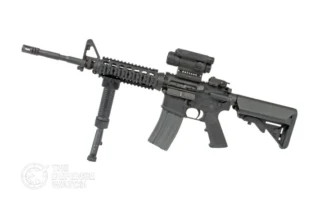
M16 Rifle

Full Specifications
1. General Information
| Name | M16 Rifle |
| Weapon Type | Assault Rifle |
| Manufacturer | Colt / FN (various contracts) |
| Country of Origin | United States |
| Year Introduced | 1964 |
| Designer | Eugene Stoner |
| Service Status | In Service (limited U.S., global use) |
| Users | U.S., NATO partners, global militaries |
2. Performance
| Muzzle Velocity | ~930 m/s |
| Effective Range | ~550 m |
| Maximum Range | 3,600 m |
| Rate of Fire | Semi-auto / Burst / Full-auto |
| Accuracy | High |
| Reliability | Moderate to High |
3. Dimensions
| Overall Length | ~39 in (varies) |
| Barrel Length | 20 in |
| Height | ~10 in |
| Width | ~2.5 in |
| Weight (Empty) | ~6.4 lbs |
| Weight (Loaded) | ~7.5–8.5 lbs |
4. Ammunition & Firepower
| Caliber | 5.56×45mm NATO |
| Cartridge Type | M193 / M855 |
| Feed System | 20/30-round magazines |
| Fire Modes | Semi-auto / Burst / Auto |
| Operating Mechanism | Gas-operated, direct impingement |
5. Build & Materials
| Construction | Aluminum alloy, polymer |
| Durability | Medium to High |
| Ergonomics | Good (modern variants) |
6. Sights & Accessories
| Standard Sights | Iron sights |
| Optics Compatibility | Picatinny rail (A4 variant) |
| Accessory Mounts | Picatinny |
| Optional Attachments | Optics, laser, flashlight, bipod, etc. |
7. Variants
| Variants | M16A1/A2/A4 - Successive upgrades in barrel, sights, and modularity |
8. Operational History
| Combat Proven | Yes |
| Notable Conflicts | Vietnam, Gulf War, Iraq, Afghanistan |
| Military Adoption | U.S. and allied militaries |
9. Additional Notes
| Special Features | Lightweight 5.56mm design |
| Modern Upgrades | Rails, optics, improved materials |
10. Disclaimer
| Legal Notice | Information is for educational purposes only. TheDefenseWatch.com does not sell, trade, or promote illegal acquisition of firearms., Information is for educational purposes only. TheDefenseWatch.com does not sell, trade, or promote illegal acquisition of firearms. |
PROS
- Lightweight design improves soldier mobility
- High accuracy at medium-range engagements
- Modular and compatible with modern accessories
- Proven combat history across major conflicts
- Widely supported with global spare parts availability
CONS
- Direct impingement system requires frequent maintenance
- Less reliable in extreme dust and sand compared to piston rifles
- Reduced stopping power vs. larger calibers
- Older variants lack modern ergonomics
- Burst-fire mechanisms can reduce trigger consistency
M16 Rifle: History, Specifications, and Military Service
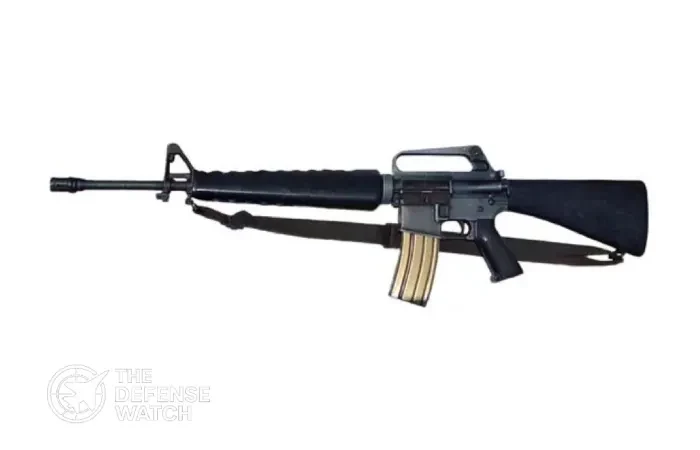
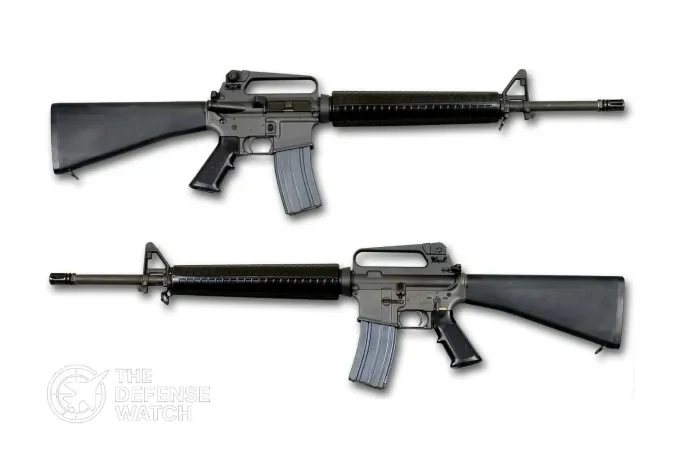
The M16 rifle is one of the most widely recognized service rifles in modern military history. Developed during the Cold War, it introduced the 5.56×45mm NATO cartridge to the U.S. armed forces and became a standard infantry weapon for decades. Its lightweight design, modular construction, and accuracy influenced the development of many modern military rifles used around the world.
Designed by Eugene Stoner and manufactured for the U.S. military by Colt’s Manufacturing Company, the M16 entered military service in the 1960s. It replaced the larger 7.62mm M14 rifle as the U.S. military sought a lighter platform better suited to modern infantry operations. The rifle features a direct impingement gas operating system, aluminum alloy receivers, and synthetic furniture, helping reduce the weight carried by service members.
The M16 fires the 5.56×45mm NATO cartridge and is designed for effective performance at typical infantry engagement distances. Depending on the specific variant, the rifle is configured with semi automatic and burst or fully automatic firing modes for authorized military use. Throughout its service life, the platform has undergone several improvements to increase durability, reliability, and compatibility with evolving battlefield requirements.
Major variants include the M16A1, M16A2, M16A3, and M16A4. The M16A2 introduced a heavier barrel profile, improved rear sights, and other refinements based on operational experience. The M16A4 later added a flat top receiver with a Picatinny rail, allowing military units to mount optical sights, aiming devices, and other mission specific equipment.
Although the M4 Carbine has largely replaced the M16 in many front line U.S. Army units, the rifle continues to serve in selected roles within the U.S. military and remains in use with numerous allied nations. Many countries continue to operate M16 variants for military training, reserve forces, and standard infantry missions.
Technical Specifications
| Specification | Details |
|---|---|
| Type | Military service rifle |
| Country of Origin | United States |
| Designer | Eugene Stoner |
| Manufacturer | Colt’s Manufacturing Company and licensed producers |
| Cartridge | 5.56×45mm NATO |
| Operating System | Direct impingement, rotating bolt |
| Feed System | Detachable box magazine |
| Effective Range | Approximately 500 to 600 meters, depending on the variant and conditions |
| Weight | Approximately 3.3 to 4.0 kg, depending on the variant |
| Service Entry | 1960s |
Operational History
The M16 has been employed in numerous military operations since its introduction, including the Vietnam War and later conflicts involving U.S. and allied forces. Over time, continuous improvements addressed early reliability concerns and enhanced the platform’s performance. Its influence can be seen in many modern military rifle designs that followed.
Legacy
The M16 remains an important milestone in the evolution of military small arms. Its adoption marked a significant shift toward lightweight, intermediate caliber service rifles and helped shape infantry weapon development for decades. While many armed forces are transitioning to newer platforms, the M16 continues to be studied as one of the most influential military rifles of the modern era.
Note: This article is provided for informational, historical, and educational purposes. It does not promote, advertise, or facilitate the sale, purchase, or use of firearms.
Reviews
Disclaimer Note
The information provided on TheDefenseWatch.com is for general informational purposes only. While we strive to ensure the accuracy, completeness, and timeliness of our content regarding defense and aerospace products, technologies, and specifications, we cannot guarantee that all information is 100% accurate or up-to-date due to the evolving nature of military technology and classified data.TheDefenseWatch.com does not warrant the reliability, suitability, or availability of the information for any specific purpose. Users are advised to consult official sources, such as manufacturers, government publications, or defense agencies, for precise and verified data before making decisions based on our content.We are not affiliated with any defense manufacturers, governments, or military organizations mentioned. Opinions, reviews, and ratings reflect expert analysis but are subjective and should not be considered endorsements. TheDefenseWatch.com is not responsible for any errors, omissions, or consequences arising from the use of this website’s content.External links are provided for convenience and do not imply endorsement. TheDefenseWatch.com reserves the right to update or modify content without prior notice. By using this website, you agree to our Privacy & Cookies Policy.
More Products from Colt

New Arrivals
-
 LOCUST X3 Laser Weapon System
-
AN/APG-83 SABR Radar
-
Lynx XM30 Infantry Fighting Vehicle
-
Bell 407M Helicopter
-
Bell 412 EPX Helicopter
-
Robin Radar IRIS Drone Detection Radar
-
C-130J Super Hercules Aircraft
-
Saab Gripen F Fighter Jet
-
F-22s Raptor Fighter Jet
-
Airbus A330 MRTT+ Refueling Tanker
-
Airbus A330 MRTT Refueling Tanker
-
AIM-424 Malice Missile
Popular Comparisons
-
 Su-57 Fighter Jet vs J-20 Fighter Jet: Stealth and Air Combat Compared
View Comparison →
Su-57 Fighter Jet vs J-20 Fighter Jet: Stealth and Air Combat Compared
View Comparison → -
Mirage 2000 vs Tejas Mk1A: Legacy Combat Power vs Indigenous Modernization
View Comparison →
-
Rafale Fighter Jet vs F-22 Raptor: Which Air Dominance Fighter Has the Edge?
View Comparison →
-
Tejas Fighter Jet vs. Rafale Fighter Jet: India’s Indigenous Fighter Meets France’s Proven Multirole Combat Aircraft
View Comparison →
-
F-22 Raptor vs. F-35 Joint Strike Fighter: Which Fifth Generation Fighter Has the Edge?
View Comparison →
-
F-35A vs. F-22 Raptor: Which U.S. Stealth Fighter Dominates Modern Air Combat?
View Comparison →
-
AGM-114 Hellfire vs. AGM-179 JAGM: Which U.S. Precision Missile Is Better?
View Comparison →
-
Patriot (PAC-3) vs. THAAD: Complete Missile Defense System Comparison, Capabilities, Range, and Strategic Roles
View Comparison →
-
AIM-120 AMRAAM vs. AIM-9X Sidewinder: Complete Air-to-Air Missile Comparison, Range, Speed, and Combat Roles
View Comparison →
-
BGM-109 Tomahawk vs. AGM-158 JASSM: Which Long Range Precision Strike Missile Offers Greater Strategic Advantage?
View Comparison →
- Patria Completes Finland’s First F135 Engine Assembly Ahead Of F-35A Arrival

- Boeing Secures $31.5 Million Deal For P-8A Poseidon Sustainment Support
- General Dynamics Secures $194 Million Deal For SLCM-N Fire Control Engineering
- Iranian Wedding Strike Likely Direct U.S. Munition Hit, Reuters Analysis Finds
- Department of War Launches Secure Space Network With 50 Mobile SCIFs
- West Point Branch Week Gives Army Cadets A Look At Future Careers
- Department Of War Secures Clean SOC-1 Opinion For War Data Platform
- UK Army Weighs Second Army Foundation College As Under-18 Recruitment Expands
- U.S. Army Moves TITAN AI Targeting Into Production With $192 Million Awards
- U.S. Navy Tests Robotic At Sea Refueling To Extend T38 USV Endurance