
- Home
- Defense Systems
- Fighter Jets
- F-22s Raptor Fighter Jet
F-22s Raptor Fighter Jet
Defense Systems Full Specifications
General Information
| Name | F-22s Raptor |
| Manufacturer | Lockheed Martin (Boeing, Pratt & Whitney) |
| Country of Origin | United States |
| Type / Role | Air superiority fighter (multirole capable) |
| Generation | 5th |
| Status | Active service; production closed |
| First Flight | September 7, 1997 |
| Introduction / In Service Since | December 2005 |
| Number Built | 195 (187 combat-coded/operational) |
| Operators | United States Air Force (sole operator) |
Dimensions & Structure
| Length | 62.1 ft (18.92 m) |
| Wingspan | 44.5 ft (13.56 m) |
| Height | 16.7 ft (5.08 m) |
| Wing Area | 840 sq ft (78.04 m²) |
| Empty Weight | 43,340 lb (19,700 kg) |
| Maximum Takeoff Weight (MTOW) | 83,500 lb (38,000 kg) |
| Internal Weapons Bay | 1 ventral bay + 2 side bays |
| External Hardpoints | 4 (rarely used — compromises stealth) |
Performance
| Maximum Speed | Mach 2.25 |
| Range | ~1,840 mi (2,960 km) with external tanks |
| Combat Radius | ~590 nmi (interdiction profile) |
| Service Ceiling | Above 50,000 ft (15,240 m) |
| Rate of Climb | Not officially disclosed; estimated in the 60,000+ ft/min class |
| Thrust-to-Weight Ratio | ~1.08:1 (with full fuel) |
| G Limits | +9.0 / -3.0 g |
Powerplant
| Engine Type | Pratt & Whitney F119-PW-100 afterburning turbofan |
| No. of Engines | 2 |
| Thrust (each) | ~35,000 lbf class with afterburner |
| Thrust Vectoring | 2D nozzles, ±20 degrees pitch |
| Fuel Capacity | ~18,000 lb internal |
Armament
| Gun | M61A2 Vulcan 20mm, 480 rounds |
| Missiles (Air-to-Air) | AIM-120 AMRAAM, AIM-9X Sidewinder; AIM-260 JATM integration planned |
| Missiles (Air-to-Ground) | Precision-guided munitions under evaluation for expanded strike role |
| Bombs | 2× GBU-32 JDAM (1,000 lb) or 8× GBU-39 Small Diameter Bomb |
| Hardpoints | 4 external (wing pylons) |
| Payload Capacity | ~2,000 lb internal typical; additional capacity via external stores |
Avionics & Systems
| Radar | AN/APG-77 AESA |
| Radar Range | ~125–150 miles against fighter-sized targets (approximate, sensitive) |
| Electronic Warfare (EW) System | AN/ALR-94 radar warning/EW suite |
| Targeting System | Integrated sensor fusion; IRST pod upgrades in development |
| Helmet Display | Not standard; helmet-mounted cueing under evaluation |
| Navigation | INS/GPS |
| Autopilot / AI Assistance | Standard flight-control automation; no AI-assisted combat systems |
| Communication | Intra-Flight Data Link (IFDL); Link 16 receive-only (legacy) |
Stealth & Technology
| Radar Cross Section (RCS) | Extremely low (exact figure classified) |
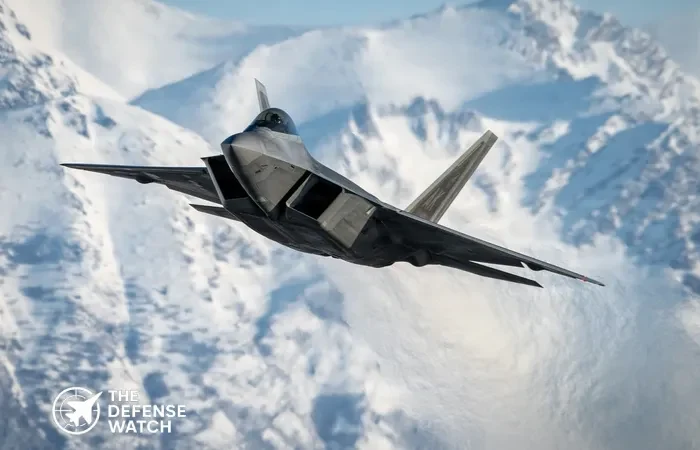
| Stealth Features | Faceted airframe shaping, radar-absorbent coatings, internal weapons carriage |
| Infrared Signature Reduction | Shielded, cooled exhaust nozzles |
| Sensor Fusion | Yes |
| Networking Capabilities | Fighter-to-fighter IFDL; broader network integration being upgraded |
Variants
| Special Export Versions | None — U.S. law prohibits foreign sale of the F-22s |
Operational History
| Major Conflicts / Deployments | Anti-ISIS strikes over Syria (2014); regional deterrence deployments in CENTCOM and INDOPACOM |
| Notable Operators | U.S. Air Force only |
| Combat Proven? | Yes — limited but confirmed combat and intercept use, including the 2023 Chinese surveillance balloon shootdown |
| Mission Types | Air superiority, strike support, escort, homeland air defense |
Cost & Program
| Unit Cost | ~$150M flyaway (2009 dollars); ~$330–350M program acquisition unit cost |
| Development Cost | ~$67.3 billion total program cost |
| Program Name | Advanced Tactical Fighter (ATF) |
| Funding Countries | United States only |
Additional Information
| Upgrades Planned | AIM-260 JATM integration, IRST pods, improved avionics and stealth coatings |
| Future Replacement | Next Generation Air Dominance (NGAD) program |
| Export Restrictions | Banned by U.S. law (Obey Amendment) |
| Notable Achievements | World's first operational fifth-generation fighter; undefeated record in air-to-air exercises |
| Competitors | Su-57 (Russia), J-20 (China) |
PROS
- Unmatched simulated air-to-air combat record since entering service
- Supercruise lets it fly supersonic without burning through fuel on afterburner
- Extremely low radar cross-section makes it difficult to detect or track
- AN/APG-77 AESA radar and sensor fusion deliver exceptional situational awareness
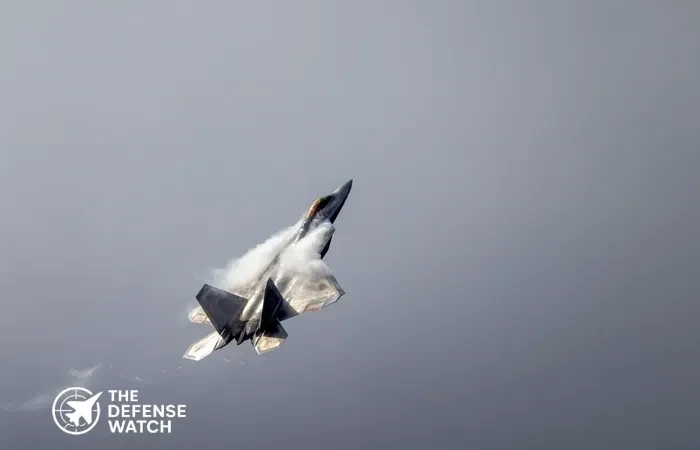
- Thrust-vectoring nozzles enable maneuvers other fighters can't match
CONS
- Capped at 187 operational jets, limiting fleet-wide availability
- High acquisition and hourly operating costs strain Air Force budgets
- Export ban prevents allied air forces from flying or supporting it
- Data-link architecture (Link 16 receive-only) trails newer platforms like the F-35
- Maintenance-intensive stealth coatings have historically dragged down mission-capable rates
F-22s Raptor: America’s Stealth Air Superiority Fighter
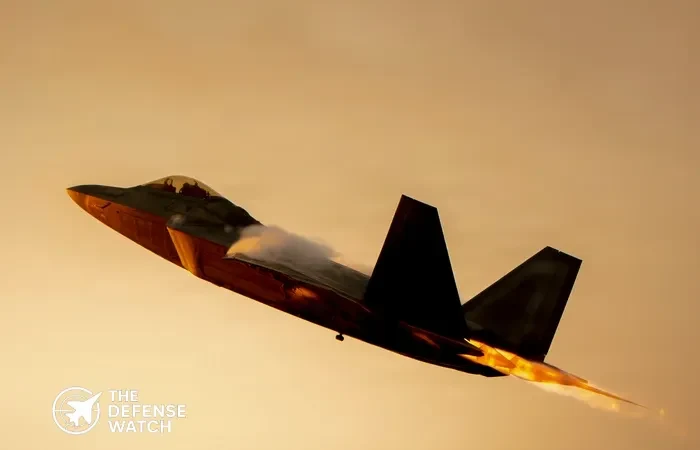
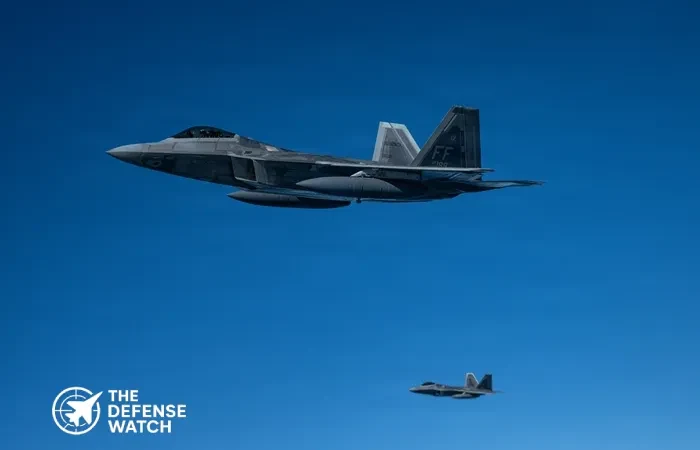
The Lockheed Martin F-22s Raptor is the aircraft that defined the fifth-generation fighter category. Built to guarantee uncontested control of the skies, it pairs radar-evading stealth with raw speed and agility rarely matched by any jet flying today. Since entering service in 2005, the Raptor has never lost a mock dogfight against a foreign fighter and remains the U.S. Air Force’s benchmark for air dominance.
Manufacturer
The Raptor was developed by Lockheed Martin, with Boeing supplying the wings, aft fuselage, and avionics integration, and Pratt & Whitney building its engines. It emerged from the Advanced Tactical Fighter (ATF) competition of the late 1980s, beating out the Northrop YF-23 to become the Air Force’s next-generation replacement for the F-15 Eagle. Only the United States operates the F-22s — federal law bars its export to any foreign buyer.
Speed and Range
Twin Pratt & Whitney F119-PW-100 afterburning turbofans push the Raptor to a top speed of roughly Mach 2.25, while its ability to supercruise at Mach 1.8 without afterburner lets it sustain supersonic speed without draining fuel reserves. Its combat radius runs around 590 nautical miles, extendable with external tanks, and its service ceiling exceeds 50,000 feet. Two-dimensional thrust-vectoring nozzles give it a turn rate and post-stall agility that few, if any, fighters can replicate.
Cost/Price
The F-22s’s price tag is famously split into two figures. The flyaway cost per additional aircraft ran close to $150 million in 2009 dollars, but because production was capped at 195 airframes instead of the originally planned 750, the fully burdened program acquisition cost — spreading the entire $67.3 billion program across the fleet — works out closer to $330–$350 million per jet. That limited run, combined with maintenance-heavy stealth coatings, is why the Raptor remains one of the most expensive fighters the Air Force operates.
Variants
| Variant | Description |
|---|---|
| YF-22s | Advanced Tactical Fighter competition prototype |
| F-22A | Sole production variant, single-seat |
| F-22B (two-seat) | Planned trainer variant, cancelled before production |
| Export Versions | None — U.S. law prohibits foreign sale of the F-22s |
Disclaimer Note
The information provided on TheDefenseWatch.com is for general informational purposes only. While we strive to ensure the accuracy, completeness, and timeliness of our content regarding defense and aerospace products, technologies, and specifications, we cannot guarantee that all information is 100% accurate or up-to-date due to the evolving nature of military technology and classified data.TheDefenseWatch.com does not warrant the reliability, suitability, or availability of the information for any specific purpose. Users are advised to consult official sources, such as manufacturers, government publications, or defense agencies, for precise and verified data before making decisions based on our content.We are not affiliated with any defense manufacturers, governments, or military organizations mentioned. Opinions, reviews, and ratings reflect expert analysis but are subjective and should not be considered endorsements. TheDefenseWatch.com is not responsible for any errors, omissions, or consequences arising from the use of this website’s content.External links are provided for convenience and do not imply endorsement. TheDefenseWatch.com reserves the right to update or modify content without prior notice. By using this website, you agree to our Privacy & Cookies Policy.



New Arrivals

Popular Comparisons
-
 J-10C vs JF-17 Thunder: Which Fighter Is More Capable?
View Comparison →
J-10C vs JF-17 Thunder: Which Fighter Is More Capable?
View Comparison → -
Tejas vs Gripen: Key Differences and Capabilities
View Comparison →
-
Tejas vs MiG-21 Bison: How India Replaced Its Iconic Supersonic Fighter
View Comparison →
-
F-35 vs F-16: Stealth, Sensors and Combat Roles
View Comparison →
-
Tejas Fighter Jet vs F-16 Fighting Falcon: Capability Compared
View Comparison →
-
Rafale Fighter Jet vs F-16 Fighting Falcon : Which Fighter Has the Edge?
View Comparison →
-
Su-57 Fighter Jet vs J-20 Fighter Jet: Stealth and Air Combat Compared
View Comparison →
-
Mirage 2000 vs Tejas Mk1A: Legacy Combat Power vs Indigenous Modernization
View Comparison →
-
Rafale Fighter Jet vs F-22 Raptor: Which Air Dominance Fighter Has the Edge?
View Comparison →
-
Tejas Fighter Jet vs. Rafale Fighter Jet: India’s Indigenous Fighter Meets France’s Proven Multirole Combat Aircraft
View Comparison →


- Pratt & Whitney Begins $100 Million Polish Expansion for F-35 Engine Parts

- Northrop Grumman Wins $43.9 Million Contract for Trident II Rocket Motor Facilities
- Ukraine Drone Strikes Disrupt Russian Data Centers, Raising Questions About AI Infrastructure Security
- Lockheed Martin Wins $114.6 Million Contract to Redesign F-35 Navigation Systems
- Project Agincourt Pushes Pentagon to Speed Up Autonomous Weapons Fielding
- Northrop Grumman Factory Expansion Aims to Increase B-21 Raider Production
- France Orders Four More SAMP/T NG Air Defense Systems
- France and UAE Revive Rafale F5 Fighter Development Partnership
- P-800 Oniks Missile: Range, Speed and BrahMos Comparison
- Ukrainian Drone Unit Caused 70% of Simulated U.S. Brigade Casualties in Germany Exercise




Fighter Jets
-
 F-100 Super Sabre
-
North American F-86 Sabre
-
Northrop YF-23 Fighter
-
Rafale F5 Fighter
-
SU-57 Felon Stealth Fighter
-
Boeing F/A-XX Fighter
-
JF-17 Thunder Fighter Jet
-
F-47 Fighter Jet
-
MIG-31 Fighter Jet
-
J-10CE Fighter Jet
-
Chengdu J-10 Fighter Jet
-
Chengdu J-10C Fighter Jet
-
Gripen E Fighter Jet
-
Tejas Mk1A Fighter Jet
-
Tejas Mk‑2 Fighter Jet
-
F-16V Viper Block 70 Fighter Jet
-
F-15EX Eagle II Fighter
-
F-15E Strike Eagle Fighter
-
F/A-18E/F Super Hornet Fighter Jet
-
Saab Gripen F Fighter Jet
-
JAS 39E/F Gripen Fighter Jet
-
JAS 39 Gripen Fighter Jet
-
F-35A Lightning II Fighter Jet
-
F/A-18F Super Hornet







Recent Compares
-
J-10C vs JF-17 Thunder: Which Fighter Is More Capable?
View Comparison →
-
Tejas vs Gripen: Key Differences and Capabilities
View Comparison →
-
Tejas vs MiG-21 Bison: How India Replaced Its Iconic Supersonic Fighter
View Comparison →
-
F-35 vs F-16: Stealth, Sensors and Combat Roles
View Comparison →
-
Tejas Fighter Jet vs F-16 Fighting Falcon: Capability Compared
View Comparison →
Latest Defense Systems
10 Compares Defense Systems
-
J-10C vs JF-17 Thunder: Which Fighter Is More Capable?
View Comparison →
-
Tejas vs Gripen: Key Differences and Capabilities
View Comparison →
-
Tejas vs MiG-21 Bison: How India Replaced Its Iconic Supersonic Fighter
View Comparison →
-
F-35 vs F-16: Stealth, Sensors and Combat Roles
View Comparison →
-
Tejas Fighter Jet vs F-16 Fighting Falcon: Capability Compared
View Comparison →
-
Rafale Fighter Jet vs F-16 Fighting Falcon : Which Fighter Has the Edge?
View Comparison →
-
Su-57 Fighter Jet vs J-20 Fighter Jet: Stealth and Air Combat Compared
View Comparison →
-
Mirage 2000 vs Tejas Mk1A: Legacy Combat Power vs Indigenous Modernization
View Comparison →
-
Rafale Fighter Jet vs F-22 Raptor: Which Air Dominance Fighter Has the Edge?
View Comparison →
-
Tejas Fighter Jet vs. Rafale Fighter Jet: India’s Indigenous Fighter Meets France’s Proven Multirole Combat Aircraft
View Comparison →
- Pratt & Whitney Begins $100 Million Polish Expansion for F-35 Engine Parts
- Northrop Grumman Wins $43.9 Million Contract for Trident II Rocket Motor Facilities
- Ukraine Drone Strikes Disrupt Russian Data Centers, Raising Questions About AI Infrastructure Security
- Lockheed Martin Wins $114.6 Million Contract to Redesign F-35 Navigation Systems
- Project Agincourt Pushes Pentagon to Speed Up Autonomous Weapons Fielding