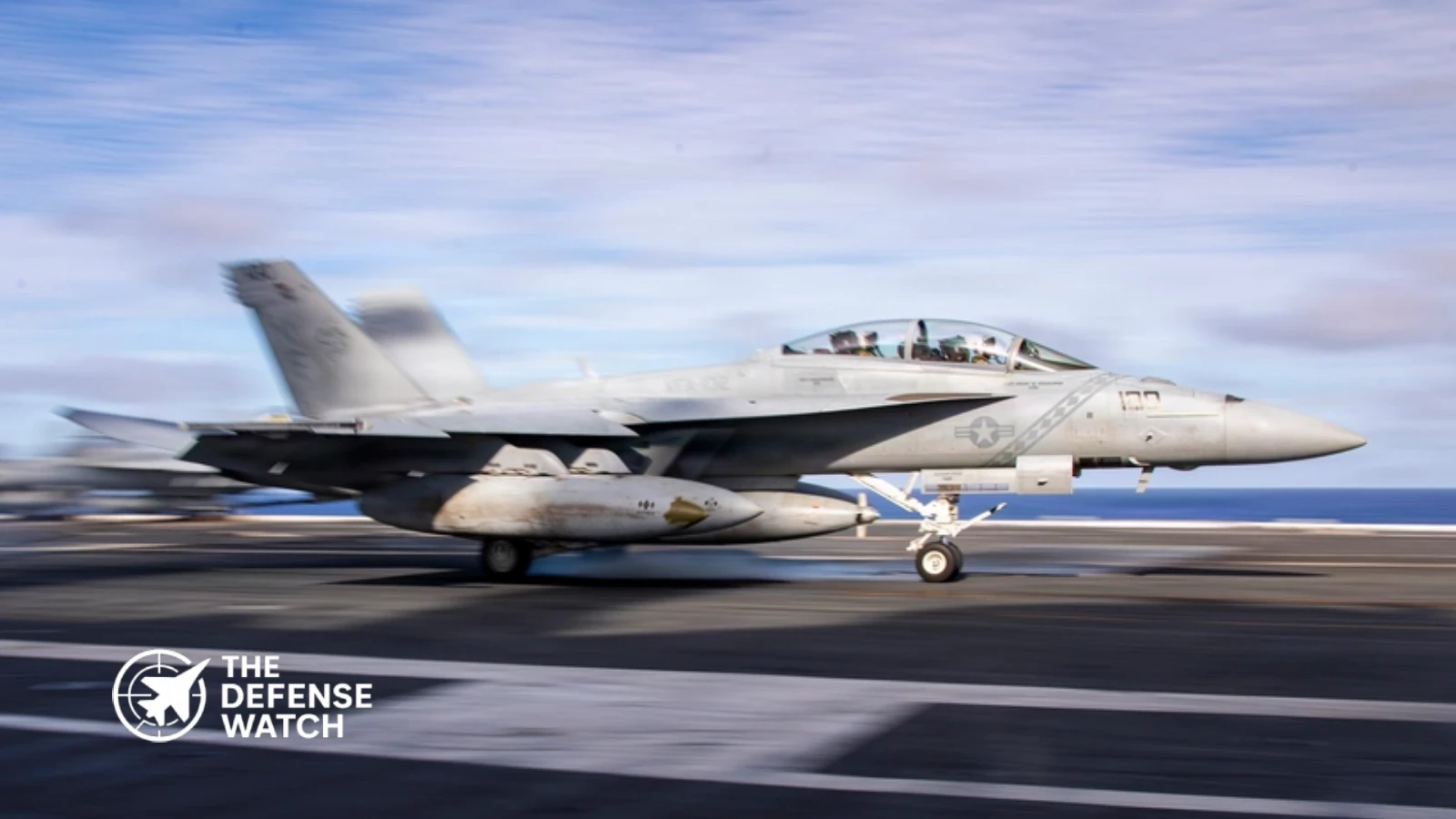
The U.S. Navy has awarded Boeing a ceiling-priced delivery order worth up to $109.03 million for 76 outer wing panels used on F/A-18 aircraft, extending a major structural sustainment effort through October 2031.
According to the contract announcement, Naval Supply Systems Command Weapon Systems Support, Philadelphia, is the contracting activity. Boeing will perform 90% of the work in St. Louis, Missouri, and 10% in Hazelwood, Missouri.
- Boeing received a ceiling-priced delivery order valued at up to $109.03 million for 76 F/A-18 outer wing panels.
- The work will be performed primarily in St. Louis, with additional engineering and production activity in Hazelwood, Missouri.
- The order supports the structural sustainment of the Navy’s F/A-18 fleet as Super Hornets remain central to carrier air wings.
- Boeing is expected to complete the work by October 2031, giving the Navy a long-term supply of replacement structural components.
- The procurement was conducted on a sole-source basis under 10 U.S.C. 3204(a)(1), with one offer received.
Deep Technical & Strategic Context Analysis
The outer wing panel is a structural component rather than a mission system, but its availability directly affects aircraft readiness. The F/A-18 family operates from demanding carrier environments where repeated arrested landings, catapult launches, high aerodynamic loads, folding-wing cycles and exposure to saltwater place substantial stress on the airframe. NAVAIR maintenance activities have previously highlighted the importance of repairing and replacing Hornet wing structures, including outer wing panels and associated spars.
The new procurement also fits into the Navy’s broader effort to keep Super Hornets operational while extending their service lives. Boeing describes the F/A-18 Super Hornet as the backbone of U.S. carrier air wings and says its Service Life Modification program is extending selected aircraft from 6,000 to 10,000 flight hours while adding Block III capabilities. NAVAIR reported in April 2026 that Fleet Readiness Center Southwest had completed its first fully organic Super Hornet Block III modification.
That makes structural sustainment particularly important. New avionics, networking and electronic warfare capabilities cannot provide additional combat availability if aircraft are restricted by airframe condition. Replacement wing panels therefore form part of the less visible industrial base required to keep upgraded fighters in service.
Boeing’s continued engineering and production support in Missouri is also significant. Boeing currently maintains F/A-18 structural analysis expertise in Hazelwood covering new-source activity, modifications, repairs and spare production for both legacy Hornets and Super Hornets.
What The Contract Means
The award is structured as a ceiling-priced delivery order under an existing basic ordering agreement. In practical terms, the Navy has placed an order against a previously established contracting framework, with a maximum value of $109.03 million. The ceiling is the maximum value stated for the order, not necessarily an indication that the entire amount is being obligated immediately.
The Navy is initially obligating $53.42 million, or approximately 49% of the ceiling, using fiscal 2026 Navy working capital funds. The remaining $55.60 million is committed to support the maximum value of the order.
This distinction matters when reading defense contract announcements. The maximum contract value and the amount obligated at award are not always the same figure. In this case, the Navy has committed funding against the delivery order in stages rather than treating the entire $109.03 million as a new fiscal-year obligation.
Contract Breakdown & Details
Boeing F/A-18 Outer Wing Panel Award
- Contractor: Boeing Co., St. Louis, Missouri
- Delivery Order: N00383-26-F-YY29
- Basic Ordering Agreement: N00383-22-G-YY01
- Maximum Value: $109,027,999
- Quantity: 76 outer wing panels
- Aircraft: F/A-18 family
- Options: None
- Expected Completion: October 2031
- Contracting Activity: Naval Supply Systems Command Weapon Systems Support, Philadelphia
Manufacturing And Engineering Locations
- St. Louis, Missouri: 90% of work
- Hazelwood, Missouri: 10% of work
The concentration of work in Missouri reflects Boeing’s established F/A-18 industrial and engineering presence in the region. Boeing’s Hazelwood operation supports F/A-18 structural engineering, including modifications, repairs and spare production support.
Funding Structure
- Fiscal 2026 Navy working capital funds: $53,423,719
- Initial obligation: 49%
- Remaining committed amount: $55,604,280
- Maximum delivery order value: $109,027,999
- Funds expiration: The obligated fiscal 2026 funds will not expire at the end of the current fiscal year.
Why The Navy Used A Sole-Source Award
The announcement states that one source was solicited and one offer was received under 10 U.S.C. 3204(a)(1).
That statutory authority permits the Department of Defense to use procedures other than full and open competition when the required property or services are available from only one responsible source, or from a limited number of responsible sources, and other alternatives would not meet the government’s requirements.
For an established aircraft structural component, this can reflect the importance of existing technical data, qualified manufacturing processes, tooling, engineering responsibility and configuration control. It does not by itself mean that the government simply chose Boeing without considering acquisition requirements. The cited authority provides the legal basis for limiting competition when the conditions specified by the statute are met.
Why The Wing Panels Matter To F/A-18 Readiness
The F/A-18 Super Hornet is being sustained alongside major modernization efforts rather than immediately replaced across the entire carrier aviation fleet. Boeing’s Block III configuration adds upgraded cockpit systems, networking and other improvements, while the Service Life Modification program is intended to extend aircraft utilization.
That creates a parallel requirement for structural parts. As aircraft accumulate flight hours, the Navy must manage fatigue, corrosion, repairs and component replacement alongside avionics modernization. Wing structures are particularly important because they experience repeated aerodynamic and carrier-operation loads.
The Navy’s previous work on F/A-18 wing structures illustrates the practical importance of maintaining this supply chain. NAVAIR has documented both organic repair activity for outer wing panels and efforts to produce replacement structural components for legacy Hornets.
The $109 million Boeing order therefore represents more than a parts purchase. It is an industrial sustainment measure supporting the Navy’s ability to keep F/A-18 aircraft available while the service transitions toward a future carrier air wing increasingly built around the F-35C and other next-generation capabilities.
With deliveries extending to 2031, the order also shows that the Navy expects the F/A-18 fleet to remain an important operational asset well into the next decade. Maintaining the physical airframe remains a prerequisite for exploiting the aircraft’s upgraded sensors, networking and weapons capabilities.