










@2026 – All Right Reserved. TheDefenseWatch.com
- Home
- Defense Systems
- Bombers & Strategic Aircraft
- Hawk T2 Jet Trainer
Hawk T2 Jet Trainer
Defense Systems Full Specifications
1. General Information
| Name | Hawk T2 (Hawk 128) |
| Manufacturer | BAE Systems |
| Country of Origin | United Kingdom |
| Introduction / In Service Since | 2009 (RAF operational) |
| Status | In Service (UK primary operator) |
| Category | Advanced Jet Trainer |
| Crew | 2 |
| Unit Cost | ~$27–30 million (estimated) |
2. Dimensions & Structure
| Length | 12.43 m (40 ft 9 in) |
| Wingspan | 9.94 m (32 ft 7 in) |
| Height | 3.98 m (13 ft 1 in) |
| Wing Area | 16.70 m² (179.64 sq ft) |
| Empty Weight | 4,480 kg (9,880 lb) |
| Maximum Takeoff Weight (MTOW) | 9,100 kg (20,000 lb) |
3. Performance
| Maximum Speed | Mach 0.84 (1,028 km/h) |
| Range | 2,520 km |
| Combat Radius | Not primary (training-focused) |
| Service Ceiling | ~13,565 m (44,500 ft) |
| Rate of Climb | ~3,597 m/min (11,800 ft/min) |
4. Powerplant
| Engine Type | 1 × Rolls-Royce/Turbomeca Adour Mk 951 turbofan |
| Thrust (per engine) | 29 kN (6,500 lbf) |
| Total Thrust | 29 kN |
5. Payload & Armament
| Internal Payload Capacity | Limited (training configuration) |
| Weapons Bay | None |
| Compatible Weapons | Practice munitions, AIM-9 equivalents, gun pod (optional) |
| Hardpoints | 5+ (wing and centerline) |
6. Avionics & Systems
| Radar System | Synthetic radar via data link |
| Navigation | Advanced glass cockpit / INS |
| Electronic Warfare (EW) | Sensor simulation / RWR |
| Stealth Features | None |
7. Operational History
| Primary Operator | Royal Air Force (UK) |
| Conflict Usage | Training only (no combat) |
| Notable Missions | Fast-jet pilot preparation for Typhoon/F-35 |
8. Additional Information
| Variants | Based on Hawk 100 series |
| Successor / Future Replacement | Under consideration (post-2040 OSD) |
| Notable Features | Glass cockpit, synthetic training systems |
| Estimated Operational Life | To ~2040 (planned) |
PROS
- Advanced glass cockpit and synthetic radar closely replicate frontline fighter avionics for seamless transition training.
- Excellent aerobatic performance and handling characteristics in a subsonic/transonic regime.
- Cost-effective operating hours compared to high-end fighters like the Typhoon.
- Proven reliability with a strong global operator base and export track record.
- Versatile simulation capabilities, including EW and intercept training without live weapons.
CONS
- Limited supersonic performance (Mach 1.2 in dive only), restricting certain high-speed training profiles.
- Aging airframe with reported engine and support challenges affecting availability.
- Relatively modest payload and combat radius for dedicated light attack roles.
- Dependence on specific supply chains for the Adour engine and UK-centric support.
- No inherent stealth features, making it less representative of fifth-generation threats.
Hawk T2 Advanced Jet Trainer: RAF’s Proven Fast-Jet Preparation Platform
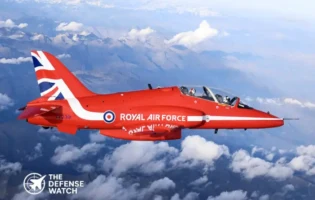
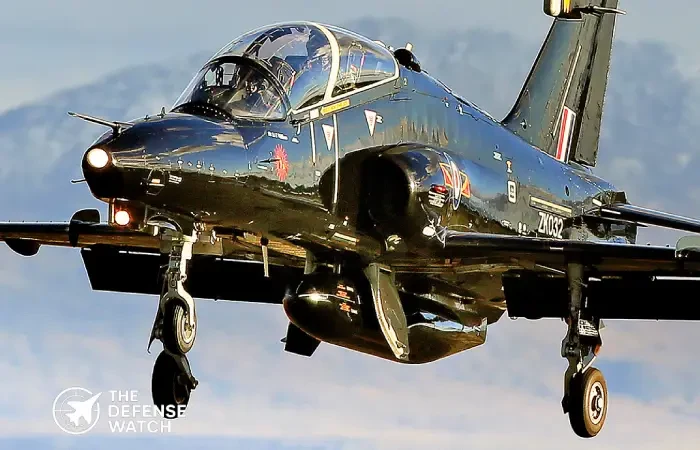
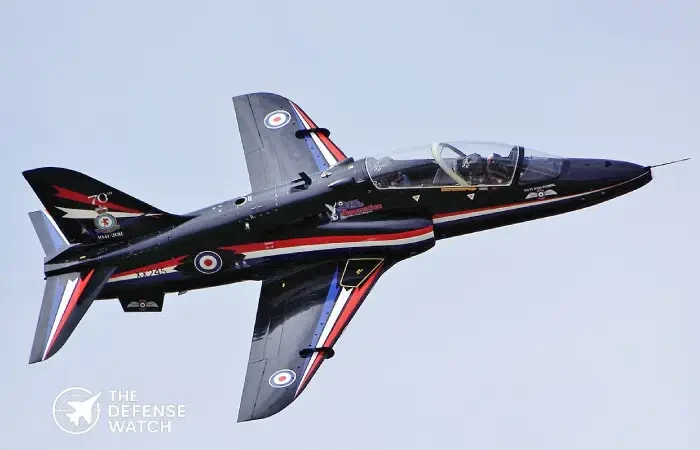
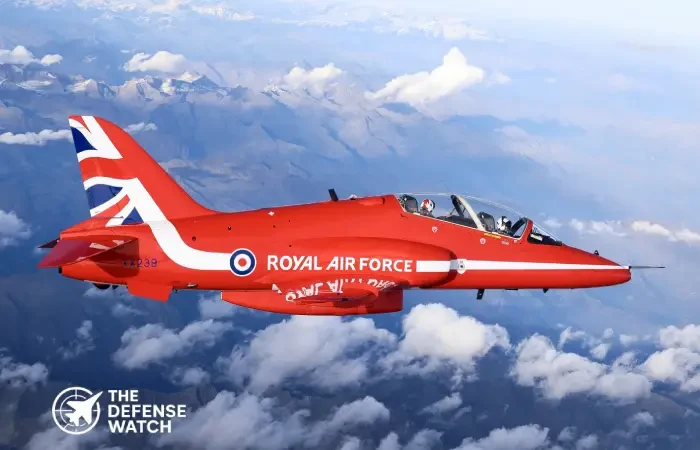
The Hawk T2 represents a critical evolution in advanced jet training, bridging the gap between basic flight instruction and frontline fighter operations. Developed as an upgrade to the original Hawk series, this transonic, two-seat trainer equips pilots with the skills needed for modern combat aircraft like the Eurofighter Typhoon and F-35 Lightning II. Its glass cockpit and simulation systems provide realistic training scenarios in a cost-effective platform, making it a cornerstone of the United Kingdom Military Flying Training System (UKMFTS).
Manufacturer
BAE Systems, based in the United Kingdom, manufactures the Hawk T2 (also known as Hawk 128). It builds on the original Hawker Siddeley/BAE Hawk design, with production of the T2 variant tied to a 2006 contract for 28 aircraft. The platform has seen extensive export success, with licensed production in India by Hindustan Aeronautics Limited (HAL).
Speed and Range
The Hawk T2 delivers strong performance for training: a maximum speed of Mach 0.84 (approximately 1,028 km/h or 555 knots) at altitude and a ferry range of about 2,520 km. It reaches a service ceiling of around 42,000–44,500 feet with a strong rate of climb, supporting aerobatic maneuvers and simulated combat profiles.
Cost/Price
Unit cost estimates for Hawk 128/T2 variants hover around $27–30 million (adjusted for advanced configurations). The UK program involved significant investment, including a £450 million production contract in 2006, reflecting the value of its advanced avionics and long-term training savings compared to frontline fighters.
The Hawk T2 entered RAF service around 2009–2011 and remains operational, primarily at RAF Valley. It features a Rolls-Royce/Turbomeca Adour Mk 951 turbofan engine providing 29 kN (6,500 lbf) of thrust, enabling efficient high-performance training. While optimized as a trainer, it retains light attack potential with hardpoints for practice weapons, air-to-air missiles (e.g., AIM-9 Sidewinder equivalents), and a centerline gun pod. Advanced systems include synthetic radar via data link, sensor simulation for electronic warfare training, and a glass cockpit with HOTAS controls closely mirroring operational fighters.
Disclaimer Note
The information provided on TheDefenseWatch.com is for general informational purposes only. While we strive to ensure the accuracy, completeness, and timeliness of our content regarding defense and aerospace products, technologies, and specifications, we cannot guarantee that all information is 100% accurate or up-to-date due to the evolving nature of military technology and classified data.TheDefenseWatch.com does not warrant the reliability, suitability, or availability of the information for any specific purpose. Users are advised to consult official sources, such as manufacturers, government publications, or defense agencies, for precise and verified data before making decisions based on our content.We are not affiliated with any defense manufacturers, governments, or military organizations mentioned. Opinions, reviews, and ratings reflect expert analysis but are subjective and should not be considered endorsements. TheDefenseWatch.com is not responsible for any errors, omissions, or consequences arising from the use of this website’s content.External links are provided for convenience and do not imply endorsement. TheDefenseWatch.com reserves the right to update or modify content without prior notice. By using this website, you agree to our Privacy & Cookies Policy.
New Arrivals
-
 F-15EX Eagle II Fighter
-
UH-60M Black Hawk Helicopter
-
AN/SPY-6(V)1 Air and Missile Defense Radar
-
SR-71 Blackbird Aircraft
-
Boeing F/A-XX Fighter
-
F-15E Strike Eagle Fighter
-
F/A-18E/F Super Hornet Fighter Jet
-
Saab Gripen F Fighter Jet
-
JAS 39E/F Gripen Fighter Jet
-
JAS 39 Gripen Fighter Jet
-
F-35A Lightning II Fighter Jet
-
F/A-18F Super Hornet
Popular Comparisons
-
 F-35 vs F-16: Stealth, Sensors and Combat Roles
View Comparison →
F-35 vs F-16: Stealth, Sensors and Combat Roles
View Comparison → -
Tejas Fighter Jet vs F-16 Fighting Falcon: Capability Compared
View Comparison →
-
Rafale Fighter Jet vs F-16 Fighting Falcon : Which Fighter Has the Edge?
View Comparison →
-
Su-57 Fighter Jet vs J-20 Fighter Jet: Stealth and Air Combat Compared
View Comparison →
-
Mirage 2000 vs Tejas Mk1A: Legacy Combat Power vs Indigenous Modernization
View Comparison →
-
Rafale Fighter Jet vs F-22 Raptor: Which Air Dominance Fighter Has the Edge?
View Comparison →
-
Tejas Fighter Jet vs. Rafale Fighter Jet: India’s Indigenous Fighter Meets France’s Proven Multirole Combat Aircraft
View Comparison →
-
F-22 Raptor vs. F-35 Joint Strike Fighter: Which Fifth Generation Fighter Has the Edge?
View Comparison →
-
F-35A vs. F-22 Raptor: Which U.S. Stealth Fighter Dominates Modern Air Combat?
View Comparison →
-
AGM-114 Hellfire vs. AGM-179 JAGM: Which U.S. Precision Missile Is Better?
View Comparison →
- SpaceX Launches Crew-13 to International Space Station

- U.S. Army Selects Five Companies for PrSM Increment 4 Prototypes
- Boeing Wins $2.38 Billion Contract for 22 F-15EX Eagle II Fighters
- Captain Smit Machchhar, Indian Pilot Stabbed Aboard Flydubai Flight, Helped Prevent Disaster
- Hegseth Orders Creation of Autonomous Warfare Command
- Russia Reportedly Uses KRSN Cutting Warhead on Jet-Powered Drone Against Ukraine
- U.S. Army Expands UH-60 Black Hawk Production Pipeline Beyond 100 Aircraft
- Northrop Grumman Uses Robotics and AI to Accelerate F-35 Avionics Production
- MSI Defence Systems Wins $197 Million U.S. Navy Gun Mount Contract
- Raytheon Wins $20.7 Billion AMRAAM Multi-Year Contract