





















@2026 – All Right Reserved. TheDefenseWatch.com
- Home
- Defense Systems
- Military Helicopters
- Mi-26 Halo Helicopter
Mi-26 Halo Helicopter

Defense Systems Full Specifications
1. General Information
| Name / Designation | Mi-26 Halo |
| Type / Role | Heavy Transport / Cargo / Multirole |
| Country of Origin | Russia (Soviet Union) |
| Manufacturer | Mil Moscow Helicopter Plant / Rostvertol |
| Introduced / Service Entry | 1983 |
| Operational Status | Active |
| Operators | Russia, India, Algeria, and others |
2. Performance
| Maximum Speed (Road) | 295 km/h |
| Cruise Speed | 255 km/h |
| Range | 500 km (with payload) / 1,920 km (ferry) |
| Endurance | Approx. 3-4 hours (mission dependent) |
| Service Ceiling | 4,600 m |
| Rate of Climb | High performance for size |
3. Dimensions & Weight
| Length | 40.025 m |
| Height | 8.145 m |
| Rotor Diameter | 32 m |
| Empty Weight | 28,200 kg |
| Maximum Takeoff Weight (MTOW) | 56,000 kg |
4. Armament & Payload
| Primary Armament | None (primarily transport; optional defensive) |
| Secondary Armament | N/A |
| Hardpoints / Weapon Stations | N/A |
| Payload Capacity | 20,000 kg (internal/external) |
| Countermeasures | Optional flares, chaff, ECM in upgraded variants |
5. Avionics & Systems
| Radar Name | Weather/navigation radar (variants) |
| Targeting System | N/A (transport focused) |
| Navigation System | GPS/INS, upgraded digital in T2 |
| Communication System | Secure military radios |
| Defensive Systems | Optional MAWS, RWR, Vitebsk suite |
6. Powerplant
| Engines | 2 × Turboshaft Engines |
| Engine Model | Lotarev D-136 |
| Power Output | 11,400 shp each |
| Fuel Capacity | Sufficient for extended ferry range |
7. Crew & Capacity
| Crew | 5 (2 pilots, navigator, engineer, technician) |
| Passenger Capacity | Up to 90 troops or 60 stretchers |
| Cabin Configuration | Cargo / Troop / MEDEVAC |
| Cargo Load (Internal/External) | Up to 20,000 kg |
8. Operational Capabilities
| Mission Types | Heavy Cargo Transport, Troop Movement, Disaster Relief, Crane Ops |
| Night Operation Capability | Yes (upgraded variants) |
| All-weather Operation | Yes |
| Combat Proven | Yes |
PROS
- Unrivaled payload capacity of 20 tons, far exceeding other production helicopters.
- Versatile multi-role platform suitable for troop transport, cargo, MEDEVAC, and crane operations.
- Robust design capable of operating in harsh environments and remote areas.
- High cruise speed combined with heavy-lift efficiency for time-sensitive missions.
- Proven track record in military and civilian service worldwide.
CONS
- High acquisition and operating costs limit widespread adoption.
- Large size requires significant infrastructure and skilled crews for maintenance and operations.
- Vulnerable to MANPADS and ground fire in contested airspace due to its size.
- Relatively high fuel consumption compared to smaller utility helicopters.
- Complex systems demand specialized training and logistics support.
Mi-26 Halo: World’s Largest Heavy-Lift Helicopter
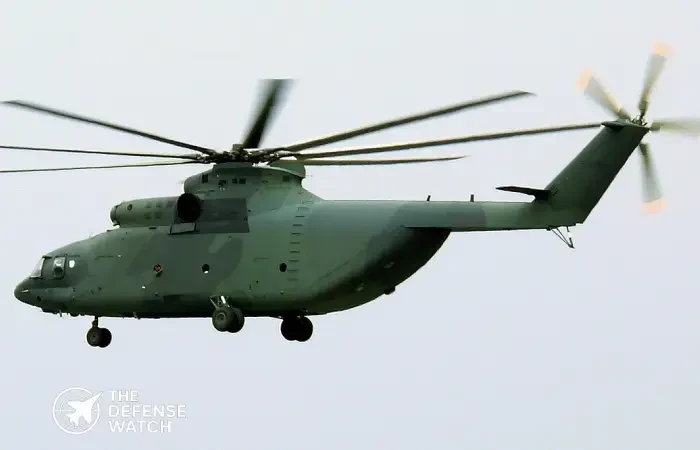
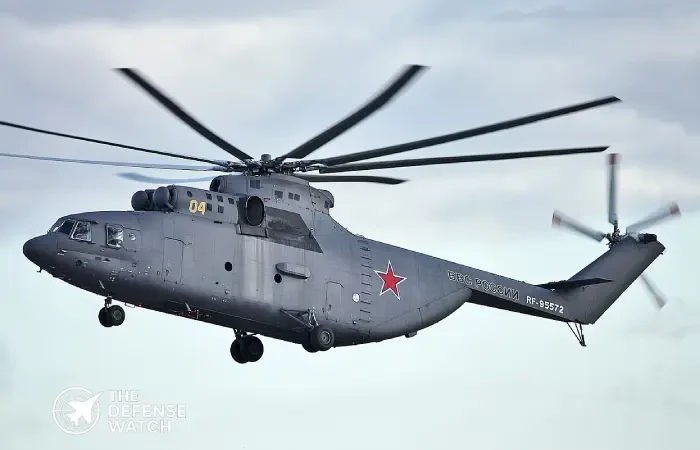
The Mil Mi-26 Halo stands as a engineering marvel in rotary-wing aviation—the largest and most powerful helicopter ever to enter serial production. Designed during the Soviet era to address the limitations of earlier heavy-lift platforms like the Mi-6, the Mi-26 delivers extraordinary cargo-moving capability in environments where fixed-wing aircraft or smaller helicopters cannot operate effectively. Its massive size and power allow it to transport armored vehicles, construction equipment, or other helicopters internally or via external sling, making it indispensable for military logistics, humanitarian aid, and industrial applications.
Manufacturer
Developed by the Mil Moscow Helicopter Plant (now part of Russian Helicopters), the Mi-26 is manufactured by Rostvertol in Russia. It originated in the Soviet Union with its first flight in 1977 and entered service in 1983 (some sources note 1985). The helicopter was built for both military and civilian heavy-lift roles, emphasizing reliability in extreme conditions.
Speed and Range
Powered by two Lotarev D-136 turboshaft engines, each producing approximately 11,400 shp, the Mi-26 achieves a maximum speed of 295 km/h and a cruise speed of 255 km/h. It offers a standard operational range of around 500 km with a 7,700 kg payload, extending to a ferry range of up to 1,920 km with auxiliary fuel tanks. Its service ceiling reaches 4,600 m, with strong hovering performance even at altitude.
Cost/Price
The estimated unit cost for a new Mi-26 is approximately $25 million, reflecting its advanced engineering and substantial size. Operating costs are high due to fuel consumption and maintenance requirements for such a large airframe, though its unmatched payload efficiency provides strong value for heavy-lift missions.
The Mi-26 features an eight-bladed main rotor with a 32 m diameter, enabling it to lift up to 20,000 kg (44,000 lb) of internal or external cargo. It can accommodate up to 90 troops or 60 stretchers in a spacious cabin. Modern variants like the Mi-26T2 incorporate upgraded avionics, digital displays, night-vision compatibility, and enhanced defensive systems for improved all-weather and night operations. It has seen extensive use in conflicts, disaster response (including Chernobyl), and civil projects globally.
Get real time update about this post category directly on your device, subscribe now.
Disclaimer Note
The information provided on TheDefenseWatch.com is for general informational purposes only. While we strive to ensure the accuracy, completeness, and timeliness of our content regarding defense and aerospace products, technologies, and specifications, we cannot guarantee that all information is 100% accurate or up-to-date due to the evolving nature of military technology and classified data.TheDefenseWatch.com does not warrant the reliability, suitability, or availability of the information for any specific purpose. Users are advised to consult official sources, such as manufacturers, government publications, or defense agencies, for precise and verified data before making decisions based on our content.We are not affiliated with any defense manufacturers, governments, or military organizations mentioned. Opinions, reviews, and ratings reflect expert analysis but are subjective and should not be considered endorsements. TheDefenseWatch.com is not responsible for any errors, omissions, or consequences arising from the use of this website’s content.External links are provided for convenience and do not imply endorsement. TheDefenseWatch.com reserves the right to update or modify content without prior notice. By using this website, you agree to our Privacy & Cookies Policy.
More Defense Systems from Mil Moscow Helicopter Plant
New Arrivals
Popular Comparisons
-
 Tejas vs Gripen: Key Differences and Capabilities
View Comparison →
Tejas vs Gripen: Key Differences and Capabilities
View Comparison → -
Tejas vs MiG-21 Bison: How India Replaced Its Iconic Supersonic Fighter
View Comparison →
-
F-35 vs F-16: Stealth, Sensors and Combat Roles
View Comparison →
-
Tejas Fighter Jet vs F-16 Fighting Falcon: Capability Compared
View Comparison →
-
Rafale Fighter Jet vs F-16 Fighting Falcon : Which Fighter Has the Edge?
View Comparison →
-
Su-57 Fighter Jet vs J-20 Fighter Jet: Stealth and Air Combat Compared
View Comparison →
-
Mirage 2000 vs Tejas Mk1A: Legacy Combat Power vs Indigenous Modernization
View Comparison →
-
Rafale Fighter Jet vs F-22 Raptor: Which Air Dominance Fighter Has the Edge?
View Comparison →
-
Tejas Fighter Jet vs. Rafale Fighter Jet: India’s Indigenous Fighter Meets France’s Proven Multirole Combat Aircraft
View Comparison →
-
F-22 Raptor vs. F-35 Joint Strike Fighter: Which Fifth Generation Fighter Has the Edge?
View Comparison →
- Lockheed Martin to Supply Black Hawk Training Systems to Philippine Air Force

- US Air Force Expands B-21 Raider Production Capacity by 25%
- Boeing Wins $10.9 Million VC-25B Test Maintenance Contract Modification
- Raytheon Wins $6.34 Billion Contract for SM-3 Block IB Missile Production
- USS Abraham Lincoln CO Addresses Crew Welfare Concerns After 322-Day Deployment
- General Dynamics, Primordial Labs to Add Voice Control to Abrams and XM30
- Turkey’s KAAN Advances Toward New Flight Tests as F-35 Comparison Remains Premature
- Mach 2.4 at 65,000 Feet: IAF Pilots Reveal the Real Story Behind the 1997 MiG-25 Islamabad Recon Mission
- Saab and GKN Aerospace Strengthen Gripen E/F Engine Cooperation
- Chinese Crew Member Says Foreign Warship Lost Power While Tracking Type 055 Zunyi