
- Home
- Defense Systems
- Military Helicopters
- CH-149 Cormorant Helicopter
CH-149 Cormorant Helicopter
Defense Systems Full Specifications
1. General Information
| Name / Designation | CH-149 Cormorant |
| Type / Role | Search and Rescue (SAR) / Medium Utility |
| Country of Origin | Italy (AgustaWestland/Leonardo) / Canada (customized) |
| Manufacturer | Leonardo Helicopters (AgustaWestland) |
| Introduced / Service Entry | 2000 |
| Operational Status | Active (Mid-Life Upgrade ongoing) |
| Operators | Canada (Royal Canadian Air Force) |
2. Performance
3. Dimensions & Weight
4. Armament & Payload
5. Avionics & Systems
6. Powerplant
7. Crew & Capacity
8. Operational Capabilities
PROS
- Exceptional long-range endurance for vast SAR areas.
- Three-engine redundancy enhances safety in harsh conditions.
- Superior hover stability for precise hoist and rescue operations.
- Large cabin capacity supporting multiple casualties or equipment.
- Proven reliability in extreme maritime and arctic environments.
CONS
- Higher operating costs compared to some lighter SAR helicopters.
- Aging airframe requires ongoing expensive upgrades.
- Limited onboard offensive/defensive armament as a dedicated SAR platform.
- Fleet size constraints can strain availability during peak demand.
- Heavier platform may have higher maintenance demands in remote bases.
CH-149 Cormorant SAR Helicopter
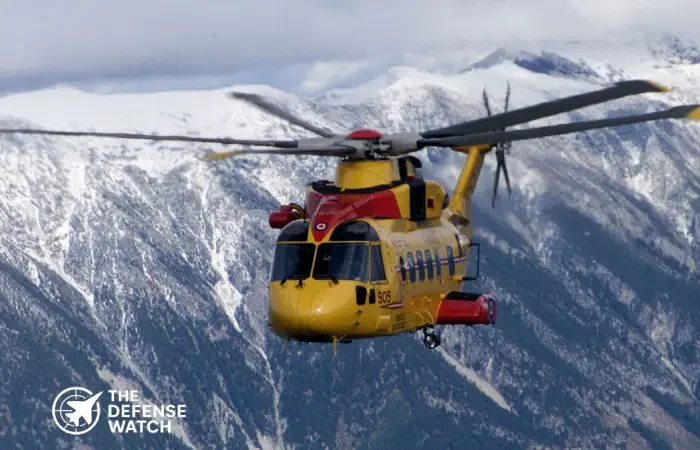
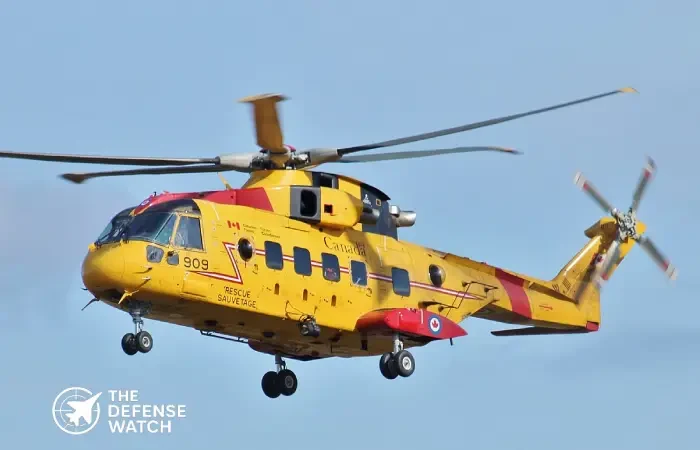
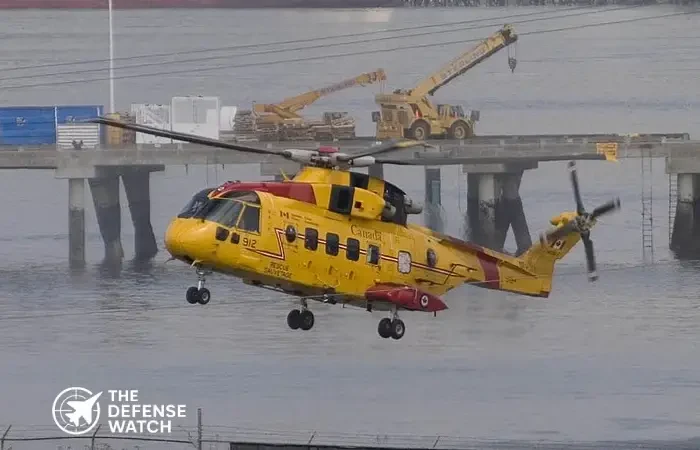
The CH-149 Cormorant stands as a cornerstone of Canada’s search and rescue (SAR) operations, delivering reliable performance in some of the world’s most demanding environments. As a variant of the AgustaWestland AW101 (now under Leonardo), this medium-lift helicopter supports the Royal Canadian Air Force in maritime, mountain, and overland rescue missions, often in severe weather where fixed-wing assets cannot operate effectively. Its robust three-engine design and advanced hover capabilities enable precise hoist operations critical for saving lives at sea or in remote terrain.
Manufacturer
The CH-149 Cormorant was developed by AgustaWestland (now Leonardo Helicopters) in Italy, with significant customization for Canadian requirements. It entered RCAF service in 2000–2001. The platform draws from the EH101/AW101 family, originally a collaborative European effort. A major Mid-Life Upgrade (CMLU) program, valued at approximately CAD $1 billion, is underway with Leonardo to modernize avionics, engines, sensors, and extend service life beyond 2042, increasing the fleet from around 13–14 to 16 aircraft.
Speed and Range
Powered by three General Electric T700-T6A1 turboshaft engines, the CH-149 achieves a maximum speed of approximately 277–280 km/h and a never-exceed speed near 309 km/h. Its operational range exceeds 1,000 km, with a ferry range up to 1,389 km, allowing it to cover vast Canadian territories effectively. Endurance supports extended SAR patrols, with a service ceiling around 3,000–4,575 m and strong rate of climb for rapid response.
Cost/Price
Exact unit acquisition costs are historical, but the ongoing CMLU program reflects significant investment in sustainment, estimated in the hundreds of millions per major upgrade phase. Operating costs are higher than some contemporaries, but upgrades aim to improve efficiency and availability for long-term value in Canada’s SAR network.
The Cormorant’s primary role is dedicated SAR, featuring dual rescue winches, a cargo hook for up to 5,000 kg external loads, and capacity for multiple stretchers. It operates from bases in Comox, B.C., Gander, N.L., and Greenwood, N.S., with plans to expand coverage. Its all-weather, day/night capabilities and stable hover make it uniquely suited to Canada’s challenging geography.
Disclaimer Note
The information provided on TheDefenseWatch.com is for general informational purposes only. While we strive to ensure the accuracy, completeness, and timeliness of our content regarding defense and aerospace products, technologies, and specifications, we cannot guarantee that all information is 100% accurate or up-to-date due to the evolving nature of military technology and classified data.TheDefenseWatch.com does not warrant the reliability, suitability, or availability of the information for any specific purpose. Users are advised to consult official sources, such as manufacturers, government publications, or defense agencies, for precise and verified data before making decisions based on our content.We are not affiliated with any defense manufacturers, governments, or military organizations mentioned. Opinions, reviews, and ratings reflect expert analysis but are subjective and should not be considered endorsements. TheDefenseWatch.com is not responsible for any errors, omissions, or consequences arising from the use of this website’s content.External links are provided for convenience and do not imply endorsement. TheDefenseWatch.com reserves the right to update or modify content without prior notice. By using this website, you agree to our Privacy & Cookies Policy.

New Arrivals


Popular Comparisons
-
 J-10C vs JF-17 Thunder: Which Fighter Is More Capable?
View Comparison →
-
Tejas vs Gripen: Key Differences and Capabilities
View Comparison →
-
Tejas vs MiG-21 Bison: How India Replaced Its Iconic Supersonic Fighter
View Comparison →
-
F-35 vs F-16: Stealth, Sensors and Combat Roles
View Comparison →
-
Tejas Fighter Jet vs F-16 Fighting Falcon: Capability Compared
View Comparison →
-
Rafale Fighter Jet vs F-16 Fighting Falcon : Which Fighter Has the Edge?
View Comparison →
-
Su-57 Fighter Jet vs J-20 Fighter Jet: Stealth and Air Combat Compared
View Comparison →
-
Mirage 2000 vs Tejas Mk1A: Legacy Combat Power vs Indigenous Modernization
View Comparison →
-
Rafale Fighter Jet vs F-22 Raptor: Which Air Dominance Fighter Has the Edge?
View Comparison →
-
Tejas Fighter Jet vs. Rafale Fighter Jet: India’s Indigenous Fighter Meets France’s Proven Multirole Combat Aircraft
View Comparison →


- P-800 Oniks Missile: Range, Speed and BrahMos Comparison

- Ukrainian Drone Unit Caused 70% of Simulated U.S. Brigade Casualties in Germany Exercise
- OCCAR Marks 25 Years of European Defense Cooperation With 28 Programs
- Saab Q3 2026 Results Show 30.6% Organic Sales Growth as Orders Surge
- How Much Does a Tomahawk Missile Cost? Price, Range and Blocks
- Faster Than Sound, Unstoppable at Sea: Inside China’s YJ-20 and YJ-17 Hypersonic Missiles
- U.S., Australia and UK Test Maritime Autonomy Under AUKUS
- TAI Anka-3: Turkey’s Stealth Flying-Wing Drone and Specifications
- Lockheed Martin’s Third-Quarter Innovations Span Missile Defense, Aviation and Space
- RTX Plans to Increase Missile Production Up to Fourfold Under Pentagon Contracts


Fighter Jets
-
 SU-57 Felon Stealth Fighter
-
Boeing F/A-XX Fighter
-
JF-17 Thunder Fighter Jet
-
F-47 Fighter Jet
-
MIG-31 Fighter Jet
-
J-10CE Fighter Jet
-
Chengdu J-10 Fighter Jet
-
Chengdu J-10C Fighter Jet
-
Gripen E Fighter Jet
-
Tejas Mk1A Fighter Jet
-
Tejas Mk‑2 Fighter Jet
-
F-16V Viper Block 70 Fighter Jet
-
F-15EX Eagle II Fighter
-
F-15E Strike Eagle Fighter
-
F/A-18E/F Super Hornet Fighter Jet
-
Saab Gripen F Fighter Jet
-
JAS 39E/F Gripen Fighter Jet
-
JAS 39 Gripen Fighter Jet
-
F-35A Lightning II Fighter Jet
-
F/A-18F Super Hornet
-
J-50 Fighter Jet
-
Spanish EF-18 Hornet Fighter
-
F-35i Adir Fighter Jet
-
F-16 Fighting Falcon






Recent Compares
-
J-10C vs JF-17 Thunder: Which Fighter Is More Capable?
View Comparison →
-
Tejas vs Gripen: Key Differences and Capabilities
View Comparison →
-
Tejas vs MiG-21 Bison: How India Replaced Its Iconic Supersonic Fighter
View Comparison →
-
F-35 vs F-16: Stealth, Sensors and Combat Roles
View Comparison →
-
Tejas Fighter Jet vs F-16 Fighting Falcon: Capability Compared
View Comparison →
Latest Defense Systems
10 Compares Defense Systems
-
J-10C vs JF-17 Thunder: Which Fighter Is More Capable?
View Comparison →
-
Tejas vs Gripen: Key Differences and Capabilities
View Comparison →
-
Tejas vs MiG-21 Bison: How India Replaced Its Iconic Supersonic Fighter
View Comparison →
-
F-35 vs F-16: Stealth, Sensors and Combat Roles
View Comparison →
-
Tejas Fighter Jet vs F-16 Fighting Falcon: Capability Compared
View Comparison →
-
Rafale Fighter Jet vs F-16 Fighting Falcon : Which Fighter Has the Edge?
View Comparison →
-
Su-57 Fighter Jet vs J-20 Fighter Jet: Stealth and Air Combat Compared
View Comparison →
-
Mirage 2000 vs Tejas Mk1A: Legacy Combat Power vs Indigenous Modernization
View Comparison →
-
Rafale Fighter Jet vs F-22 Raptor: Which Air Dominance Fighter Has the Edge?
View Comparison →
-
Tejas Fighter Jet vs. Rafale Fighter Jet: India’s Indigenous Fighter Meets France’s Proven Multirole Combat Aircraft
View Comparison →
- P-800 Oniks Missile: Range, Speed and BrahMos Comparison
- Ukrainian Drone Unit Caused 70% of Simulated U.S. Brigade Casualties in Germany Exercise
- OCCAR Marks 25 Years of European Defense Cooperation With 28 Programs
- Saab Q3 2026 Results Show 30.6% Organic Sales Growth as Orders Surge
- How Much Does a Tomahawk Missile Cost? Price, Range and Blocks