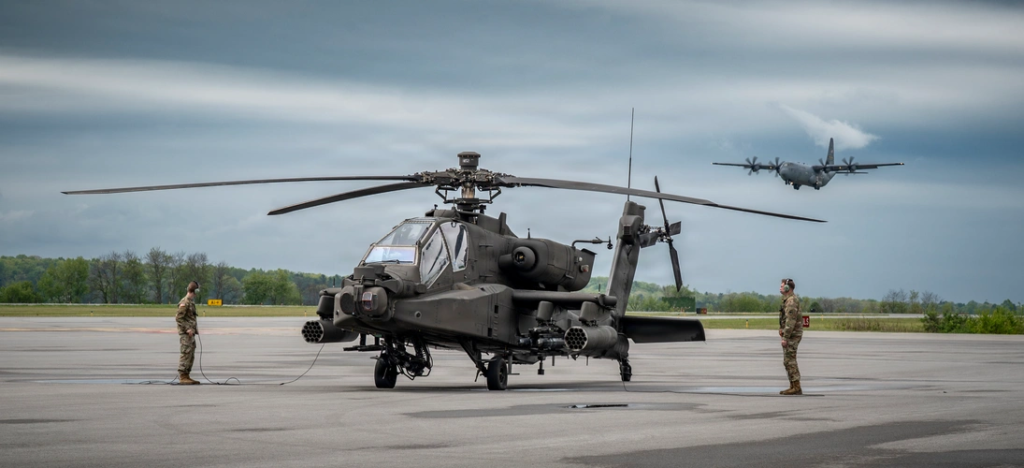
(adsbygoogle = window.adsbygoogle || []).push({});Executive Summary:
The U.S. Army’s transition from the AH-64D Apache attack helicopter to the AH-64E Apache Guardian standard represents far more than an engine swap — it is a shift from a platform-centric gunship to a networked strike node capable of directing unmanned systems and sharing targeting data across the joint force in real time. With Poland fielding the largest non-U.S. Apache fleet on NATO’s eastern flank and South Korea, the UK, and Israel all deepening their Echo-model commitments in 2026, the AH-64E has become the backbone of allied attack aviation even as the U.S. Army’s next-generation FARA program lies canceled.
The Apache’s Second Life as a Networked Strike Node
Attack aviation in 2026 is no longer judged solely by missile count or top speed. It is judged by how fast a crew can move from detection to engagement across a contested, sensor-saturated battlefield — and on that metric, the gap between the AH-64D Apache Longbow and the AH-64E Apache Guardian has become the defining storyline of Western rotary-wing modernization.
What began as an incremental Block III upgrade to the Delta-model airframe has matured into a wholesale redesign of how the Apache fights: a more powerful drivetrain, an open-systems mission computer, and — critically — the ability to receive, process, and act on live sensor feeds from unmanned aircraft without a human ever touching a joystick on the drone end.
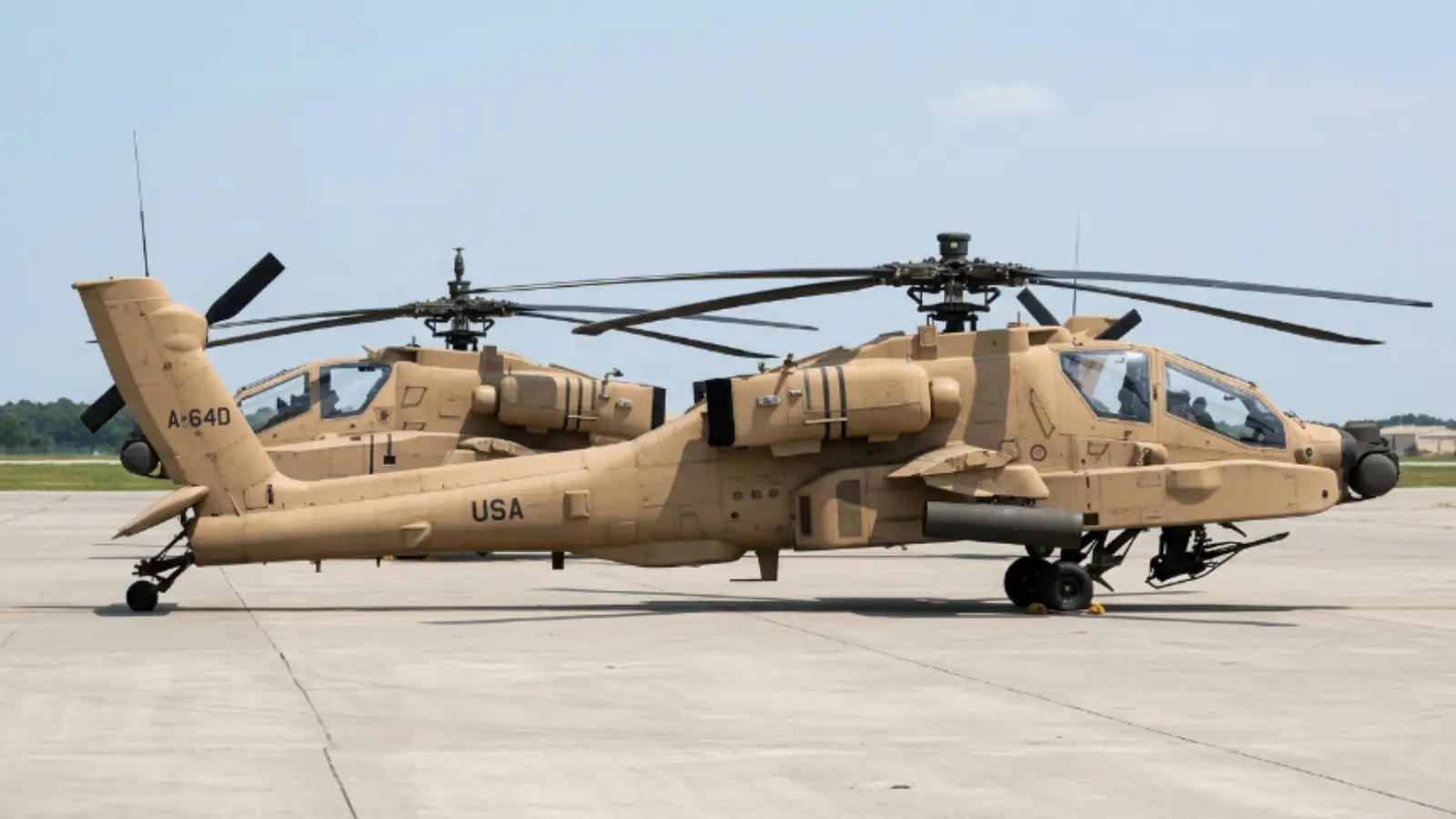
The AH-64D Saraf variant introduced the Longbow fire control radar and improved night-fighting capability, but the Echo model added an open systems architecture that enables faster software updates and simpler integration of new sensors and weapons. That architectural leap is why NATO planners increasingly describe the AH-64E not as an upgraded helicopter, but as a different category of weapon system entirely.
From AH-64A to AH-64D: The Longbow Baseline
The AH-64D Apache Longbow entered service in the 1990s built around a single transformative addition: the mast-mounted AN/APG-78 Longbow millimeter-wave fire control radar, developed jointly by Lockheed Martin and Northrop Grumman under the Longbow LLC joint venture.
The radar allowed the Delta-model Apache to track up to 128 targets simultaneously and engage the sixteen highest-priority threats from behind terrain cover, cueing a new radar-guided version of the Hellfire missile. For its era, this was a genuine leap — it let the AH-64D Apache attack helicopter fight in adverse weather and heavy obscurant conditions where earlier A-model Apaches, reliant purely on electro-optical sensors, were effectively blind.
But the Delta-model airframe carried structural and propulsion limitations that became increasingly apparent as combat loads grew heavier and operating theaters expanded from temperate Europe to the “hot-and-high” conditions of Afghanistan and the Gulf. The Army’s own modernization assessment identified engine power, lift capacity, and digital interoperability as the specific shortfalls driving the next-generation requirement — the gaps that would define the AH-64D-to-AH-64E transition.
The AH-64D to AH-64E Transition: What Actually Changed
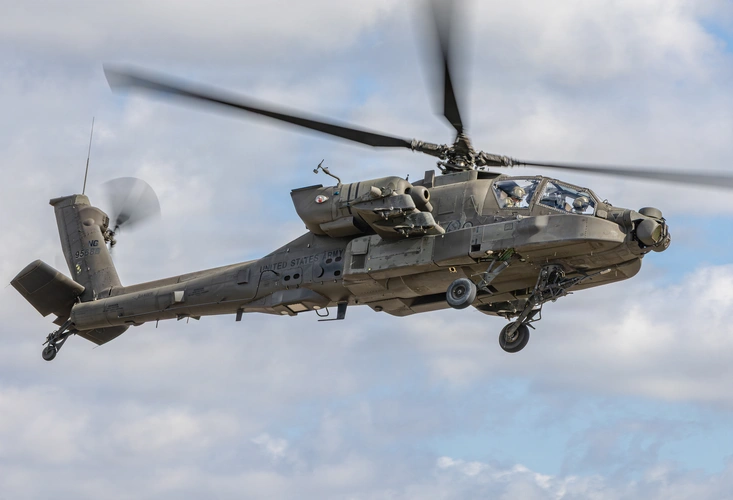
The AH-64E Apache Guardian was formally redesignated from “AH-64D Block III” in 2012, but the rebrand reflected a genuine platform discontinuity rather than a marketing exercise. Three subsystems account for nearly all of the operational separation between the two variants.
Drivetrain and Powerplant
The AH-64E integrates the Joint Tactical Information Distribution System for enhanced digital connectivity, and is powered by twin General Electric T700-GE-701D engines paired with an upgraded transmission that increases available power and payload capacity, while composite rotor blades improve cruise speed and climb performance.
Those composite blades trace their lineage to the canceled RAH-66 Comanche program — a rare instance of a scrapped Army aviation effort still paying dividends two decades later. The resulting airframe achieves speeds up to 293 km/h (158 knots) and can operate at altitudes exceeding 6,000 meters, materially closing the hot-and-high performance gap that limited the Delta model in Afghanistan-type environments.
South Korea’s ongoing fleet upgrade illustrates how central the powerplant remains to modernization economics: a 2024 U.S. approval for Seoul covered up to 36 additional AH-64Es alongside 76 T700-GE-701D engines, 14 AN/APG-78 radars, and hundreds of Hellfire and Joint Air-to-Ground Missiles — a package that treats the engine as inseparable from the sensor and weapons upgrade rather than a standalone line item.

Sensor Fusion: Longbow Radar and Modernized TADS/PNVS
The AN/APG-78 radar itself did not stand still between the Delta and Echo models. The updated Longbow radar fitted to the AH-64E gained overwater capability, enabling naval and littoral strike missions that the original Delta-model radar could not perform.
This is paired with the Modernized Target Acquisition and Designation Sight/Pilot Night Vision Sensor, which delivers high-resolution thermal imaging, day optics, and laser designation, supplemented by the AGM-179 Joint Air-to-Ground Missile’s dual-mode millimeter-wave radar and semi-active laser guidance — a combination that materially improves effectiveness against moving, concealed, or low-signature aerial targets such as small UAVs, a threat category that barely existed when the Delta model was designed.
(adsbygoogle = window.adsbygoogle || []).push({});Network Architecture and Open-Systems Avionics
This is the least visually obvious but most operationally significant change. The Delta-model Apache was fundamentally a self-contained sensor-shooter platform; the Echo model is a network participant. The AH-64E’s enhanced mission computer, advanced data links, and improved cockpit displays provide greater situational awareness and reduce crew workload during complex strike missions involving multiple targets and friendly forces.
South Korea’s Link 16 integration illustrates the practical effect: the KOR-24A Small Tactical Terminal brings Link 16 data exchange and secure voice to the aircraft, allowing a crew to receive target data from a ground command post, another aircraft, or a drone, update friendly-force awareness, and pass a target location to artillery or combat aircraft — reducing the time between detection, decision, and engagement.
Manned-Unmanned Teaming: The Real Dividing Line
If a single capability separates the AH-64D Apache attack helicopter from its successor, it is manned-unmanned teaming (MUM-T). The Echo model’s kill chain runs through detection by a drone, satellite, or the Longbow radar; automated classification of the contact; network-level prioritization of the threat; assignment of the best-positioned shooter — whether that is the Apache itself, ground artillery, or a fixed-wing aircraft; and execution before the target is aware it has been observed. Unlike earlier Apache variants, which relied on limited or bolted-on solutions to work with unmanned aircraft, the Guardian is designed natively to receive, process, and exploit real-time sensor feeds from unmanned aerial systems.
atOptions = { ‘key’ : ‘3d48d603f906e3fe9f205be3c4433835’, ‘format’ : ‘iframe’, ‘height’ : 250, ‘width’ : 300, ‘params’ : {} };U.S. Army aviation is now pushing that concept further with experimental “launched effects” — small, disposable unmanned systems such as Anduril’s Altius-700 — that scout ahead of the crewed aircraft, relay communications, and can disrupt or strike before the Apache itself enters the most heavily defended airspace. This shifts survivability calculus by extending sensor and strike reach while reducing crew exposure, a change NATO planners view as decisive for future high-intensity operations in Europe.
AH-64D vs. AH-64E: Head-to-Head
System AH-64D Apache Longbow AH-64E Apache Guardian Engines Earlier T700 variants Twin T700-GE-701D turboshafts, upgraded transmission Rotor system Standard four-blade rotor Composite rotor derived from RAH-66 Comanche program Fire control radar AN/APG-78 Longbow (original) AN/APG-78 Longbow (updated, overwater-capable) Sensor suite Original TADS/PNVS Modernized TADS/PNVS, higher resolution Primary anti-armor weapon AGM-114 Hellfire AGM-114R Hellfire and AGM-179 JAGM (dual-mode) Networking Limited/legacy data links Link 16, open-systems mission computer Unmanned integration Minimal, externally bolted-on Native MUM-T, “MUM-TX” drone control Chain gun M230, ~600–650 rounds/min M230E1, same rate, IHADSS-slaved Max speed Comparable airframe limits Up to 293 km/h (158 knots) Service ceiling Lower hot-and-high performance Above 6,000 meters NATO’s Eastern Flank: The Apache Attack Helicopter as Alliance Backbone
Poland’s 96-Aircraft Program
No single procurement decision illustrates the AH-64E’s centrality to European deterrence better than Poland’s. Boeing was awarded a Foreign Military Sales contract worth nearly $4.7 billion in November 2025 to build AH-64E Apache attack helicopters for Poland, marking the largest Apache order ever placed by a country outside the United States.
The Polish Apaches will carry the standard U.S.-export sensor and weapons suite — the mast-mounted Longbow radar, advanced electro-optical systems, and AGM-114 Hellfire or AGM-179 JAGM precision missiles — designed to integrate with Poland’s new M1A2 Abrams and K2 Black Panther tanks, HIMARS and K239 Chunmoo rocket artillery, and Patriot and Narew air-defense systems into a layered, mobile deterrent along the eastern flank. When deliveries begin in 2028, Poland is set to operate the largest Apache fleet outside the United States, replacing a legacy Mi-24 Hind fleet increasingly unsuited to modern combat environments.
(adsbygoogle = window.adsbygoogle || []).push({});The interoperability groundwork is already being laid. In May 2026, U.S. Army AH-64E crews from the 12th Combat Aviation Brigade conducted live-fire training with Polish and British forces near Toruń, Poland, demonstrating the kind of rapid target-sharing and multinational coordination that NATO views as central to deterring a high-intensity conflict along its eastern defense line.
UK Joint Helicopter Command and Allied Interoperability
Britain’s Army Air Corps, operating under the Joint Helicopter Command framework, made its own Delta-to-Echo transition years ahead of Poland. The United Kingdom has operated the AH-64E variant since 2022, transitioning from the legacy WAH-64D model as part of a broader Army Air Corps modernization effort, while the Netherlands has separately been upgrading its own AH-64D fleet to the Echo standard with deliveries expected to complete in 2026.
That shared baseline — Britain, the Netherlands, and soon Poland all operating the same Echo-model architecture — is precisely what makes exercises like the Toruń live-fire tables operationally meaningful rather than symbolic: a British and a Polish Apache attack helicopter crew can now, in principle, receive and act on the same targeting picture as a U.S. Army crew flying the identical airframe.
The FARA/FLRAA Context: Why the Apache Still Carries the Fight
Any account of Apache modernization in 2026 has to reckon with what didn’t happen. The Army’s Future Attack Reconnaissance Aircraft — intended to replace the retired OH-58 Kiowa Warrior in the armed scout role — was canceled in the FY2025 budget request after roughly $2 billion in development spending.
Army leadership framed the cancellation as a reflection of how aerial reconnaissance has changed, citing lessons from Ukraine that sensors and weapons mounted on unmanned systems and in space are more ubiquitous, longer-reaching, and cheaper than a dedicated scout helicopter.
Part of that rebalancing redirected the General Electric T901 engine program away from FARA and toward integration on existing AH-64 Apache and UH-60 Black Hawk fleets instead — meaning the Echo-model Apache is now a direct beneficiary of a canceled program’s engineering investment.
The Future Long-Range Assault Aircraft, by contrast, continues on track. The Army’s Bell-built FLRAA, designated the MV-75, is intended to cruise at up to 280 knots and fly up to 1,700 nautical miles with twelve passengers, with a first prototype flight planned for 2026 and initial fielding targeted for 2030.
FLRAA is a troop-transport and assault-lift replacement for the Black Hawk, not an attack platform — which means the AH-64E Apache Guardian remains, by default, the U.S. Army’s primary crewed attack helicopter for at least the next decade, with no FARA-class successor in the acquisition pipeline.
The Kill-Chain Parallel: Why the Sim-and-Strategy Crowd Should Be Paying Attention
For readers who spend as much time in RTS lobbies and tactical shooters as they do tracking defense procurement, the AH-64E’s MUM-T architecture will feel familiar in structure if not in stakes. The detect-classify-prioritize-assign-execute sequence that now governs Apache targeting is, functionally, the same resource-allocation problem competitive strategy games have modeled for two decades: limited high-value units, a contested information space, and a premium on compressing the decision loop faster than the opponent.
The difference is that the Echo model’s “map” is a real battlefield, its “fog of war” is genuine sensor denial, and its “APM” advantage — the speed at which the network converts a drone contact into a fired JAGM — is measured in human lives rather than a scoreboard.
Strategic Takeaway
The AH-64D-to-AH-64E transition closes out a design lineage that began with the Longbow radar in the 1990s and now terminates in a platform built explicitly to fight as one node among many. With Poland’s 96-aircraft program, South Korea’s $1.2 billion sensor and networking upgrade, and continued British and Dutch fleet modernization all converging on the same Echo-model baseline, the AH-64E Apache Guardian has effectively become NATO’s common attack helicopter standard by default — not because a formal alliance-wide program mandated it, but because FARA’s cancellation left no near-term successor and the Apache’s open-systems architecture proved cheap enough to keep upgrading instead of replacing.
The next inflection point will not be a new airframe; it will be how deeply launched-effects drones and AI-assisted target prioritization get pushed into the existing AH-64E mission computer before FLRAA’s armed variants — if they materialize — arrive at the end of the decade.
Get real time update about this post category directly on your device, subscribe now.