(adsbygoogle = window.adsbygoogle || []).push({});Executive Summary:
The U.S. Navy and Marine Corps recently demonstrated expeditionary warfare capabilities in the South China Sea by deploying LAV-25 armored reconnaissance vehicles aboard Landing Craft Air Cushion (LCAC) hovercraft. The operation underscores the Navy-Marine Corps team’s emphasis on rapid littoral maneuver, distributed operations, and regional deterrence amid growing strategic competition in the Indo-Pacific.
U.S. Navy LCAC Deployment Highlights Expeditionary Warfare Focus In South China Sea
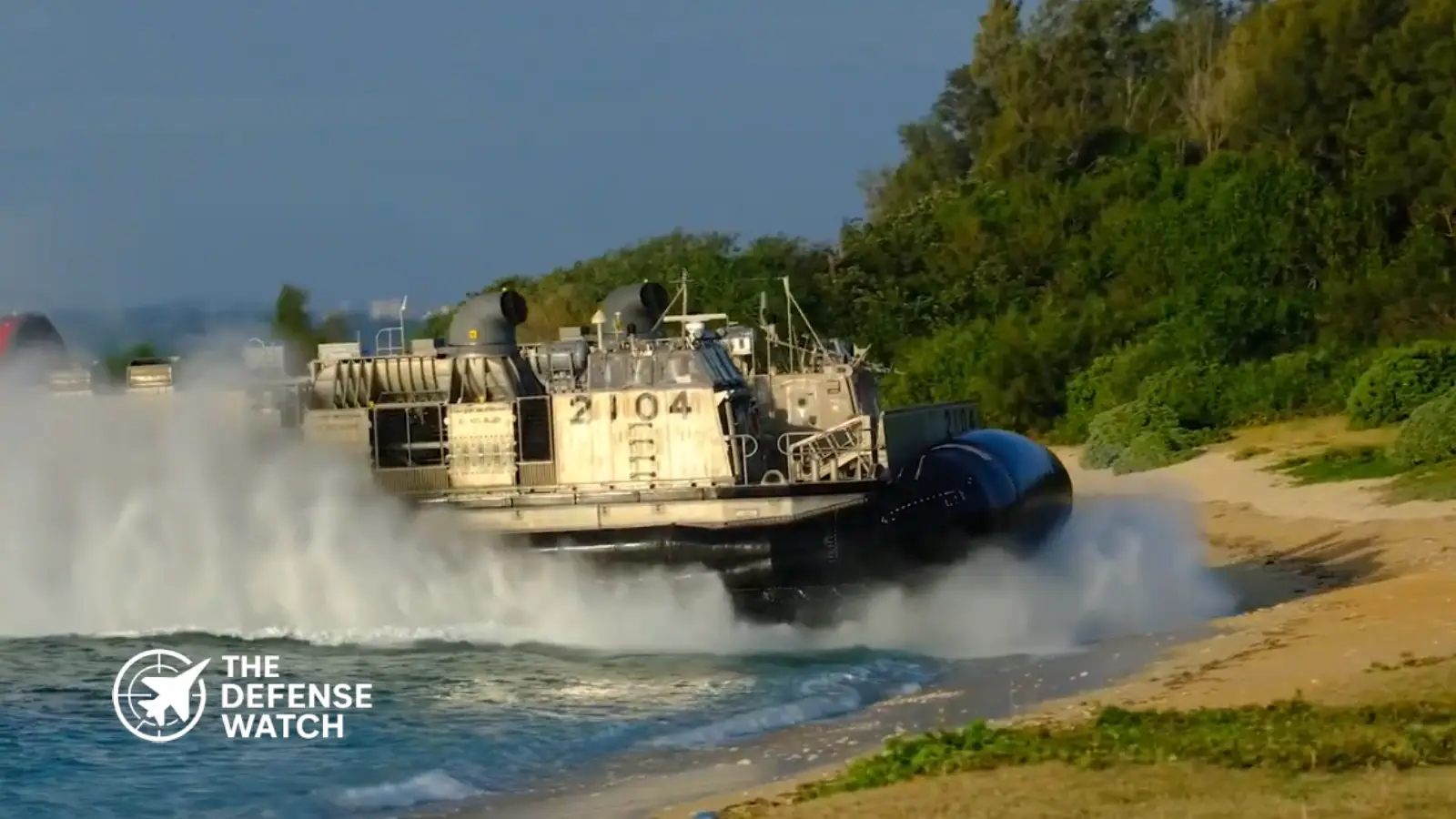
The deployment of U.S. Marine Corps LAV-25 armored reconnaissance vehicles aboard U.S. Navy Landing Craft Air Cushion (LCAC) vessels in the South China Sea reflects a continued focus on expeditionary warfare and maritime maneuver operations across the Indo-Pacific.
Images released during the operation show LCACs transporting LAV-25 vehicles between amphibious platforms and coastal objectives, demonstrating the ability to rapidly move combat forces across contested littoral environments. The activity aligns with broader Navy and Marine Corps efforts to enhance mobility, survivability, and operational flexibility in strategically important maritime regions.
The South China Sea remains a central theater in U.S. defense planning due to its importance to global commerce, regional security, and freedom of navigation operations.
LCAC And LAV-25 Combination Provides Rapid Littoral Mobility
The operational pairing of the LCAC and LAV-25 provides expeditionary forces with a highly mobile capability designed to support amphibious assaults, reconnaissance missions, and distributed operations.
The LCAC is a high-speed hovercraft capable of transporting troops, vehicles, equipment, and supplies directly from ships at sea to coastal objectives without requiring developed port infrastructure.
Meanwhile, the LAV-25 serves as the Marine Corps’ primary light armored reconnaissance platform, offering a combination of mobility, firepower, and operational reach.
Key Platform Characteristics
| System | Role | Key Capability |
|---|---|---|
| LCAC | Ship-to-shore connector | High-speed transport across water, mudflats, beaches, and obstacles |
| LAV-25 | Light armored reconnaissance vehicle | Mobile reconnaissance and security operations |
| Amphibious Ready Group Assets | Sea basing platform | Expeditionary force projection and sustainment |
LAV-25 Specifications
| Feature | Details |
|---|---|
| Primary Armament | M242 25mm Chain Gun |
| Secondary Armament | 7.62mm machine guns |
| Crew | Three |
| Troop Capacity | Up to six scouts |
| Operational Role | Reconnaissance, security, screening operations |
| Mobility | Wheeled 8×8 armored vehicle |
The ability to transport armored reconnaissance vehicles directly from amphibious ships to dispersed landing areas expands operational options for commanders operating across island chains and coastal regions.
Supporting The Marine Corps’ Expeditionary Advanced Base Operations Concept
The deployment also aligns closely with the Marine Corps’ Expeditionary Advanced Base Operations (EABO) concept.
Under EABO, small, mobile units are expected to operate from temporary and often austere locations across maritime theaters. These forces support intelligence collection, sea denial operations, logistics networks, and long-range precision strike capabilities while remaining difficult to target.
Rapid transport systems such as the LCAC enable Marine units to establish and reposition expeditionary positions quickly without relying on fixed infrastructure.
The ability to move reconnaissance assets such as the LAV-25 between islands, coastal zones, and forward operating locations contributes directly to the distributed force structure envisioned by Marine Corps planners.
(adsbygoogle = window.adsbygoogle || []).push({});Strategic Significance In The South China Sea
The operational importance of the South China Sea extends beyond routine training activities.
The region contains critical shipping routes through which trillions of dollars in global trade pass annually. Multiple territorial disputes involving China and several Southeast Asian nations continue to drive military modernization and increased naval activity.
For the United States, maintaining the ability to rapidly project combat power across the region remains a key component of deterrence and alliance assurance.
The deployment of LCACs carrying armored reconnaissance vehicles demonstrates several operational priorities:
- Rapid force insertion from sea-based platforms
- Increased maneuver options in contested littoral zones
- Reduced dependence on ports and established infrastructure
- Enhanced support for distributed maritime operations
- Improved responsiveness during regional contingencies
These capabilities become increasingly important as military planners prepare for scenarios involving denied access environments, dispersed operations, and potential disruptions to traditional logistics networks.
Operational Challenges And Future Considerations
While LCACs provide exceptional mobility, operating in contested maritime environments presents challenges.
Modern anti-ship missile systems, long-range surveillance networks, unmanned systems, and electronic warfare capabilities have increased the risks associated with amphibious operations.
As a result, Navy and Marine Corps planners continue to emphasize distributed force employment, deception measures, signature management, and integrated air and missile defense support.
The future introduction of the Navy’s next-generation Ship-to-Shore Connector (SSC), which is replacing legacy LCAC platforms, is expected to further improve payload capacity, reliability, and operational endurance.
These upgrades will enhance the ability of expeditionary forces to move personnel and equipment throughout the Indo-Pacific while supporting emerging operational concepts designed for high-end conflict scenarios.
Why The Deployment Matters
Beyond the tactical movement of armored vehicles, the operation illustrates how the Navy-Marine Corps team is adapting to the realities of modern maritime competition.
The combination of sea-based logistics, high-speed connectors, and mobile reconnaissance forces supports a broader shift toward agile and distributed operations across the Indo-Pacific.
For U.S. military planners, the ability to move combat-capable forces quickly between ships, islands, and coastal positions is increasingly viewed as a decisive advantage in a region characterized by vast distances, contested waters, and evolving security challenges.
The deployment of LAV-25 vehicles aboard LCACs in the South China Sea serves as a visible demonstration of that evolving expeditionary warfare posture and highlights the continuing role of amphibious forces in U.S. Indo-Pacific strategy.