(adsbygoogle = window.adsbygoogle || []).push({});Executive Summary: The Indian Air Force sits 12 squadrons below its sanctioned strength of 42, with the last MiG-21 retired in 2025 and Russian-origin jets aging fast. India is responding with a $40+ billion Rafale order for 114 jets, a $14.1 billion commitment for 180 Tejas Mk1A aircraft, and a “Super Sukhoi” upgrade covering up to 200 Su-30MKIs—the most expensive single-generation fighter recapitalization in South Asian history. The outcome will determine India’s air power posture against China and Pakistan for the next 40 years.
Twelve squadrons. That’s the gap between what the Indian Air Force is authorized to field and what it actually operates right now. With approximately 30 active combat squadrons against a sanctioned strength of 42, the IAF is running thin—and has been for over a decade, as successive MiG-21 retirements outpaced any new inductions.
- The Deep Dive: India’s Fighter Platforms, Specs, and Hard Numbers
- Dassault Rafale — The Crown Jewel With a Price Tag to Match
- HAL Tejas Mk1A — The Indigenous Backbone
- Sukhoi Su-30MKI — Aging Workhorse, Being Reborn
- Comparative Data Block
- The Strategic Calculus: Why This Fleet Mix Makes Geopolitical Sense
- The History Angle: From MiG-21 to Multi-Vendor Mastery
- Conclusion: A Force in the Making, Racing a Clock
The math is brutal. The MiG-21 Bison—India’s workhorse since the Cold War—flew its final sortie in 2025. The Jaguar, Mirage 2000, and MiG-29 fleets are all inside their retirement windows. What replaces them is a three-platform bet that will shape Indian airspace through the 2060s.
The Deep Dive: India’s Fighter Platforms, Specs, and Hard Numbers
Dassault Rafale — The Crown Jewel With a Price Tag to Match
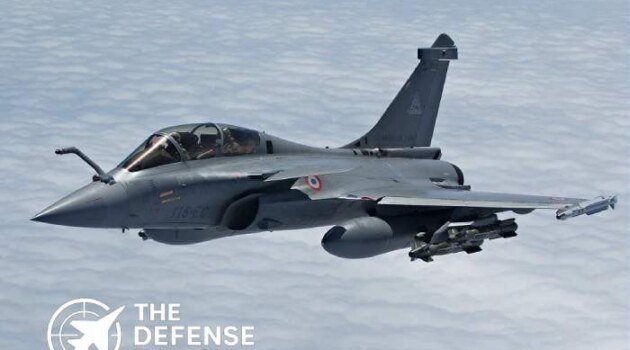
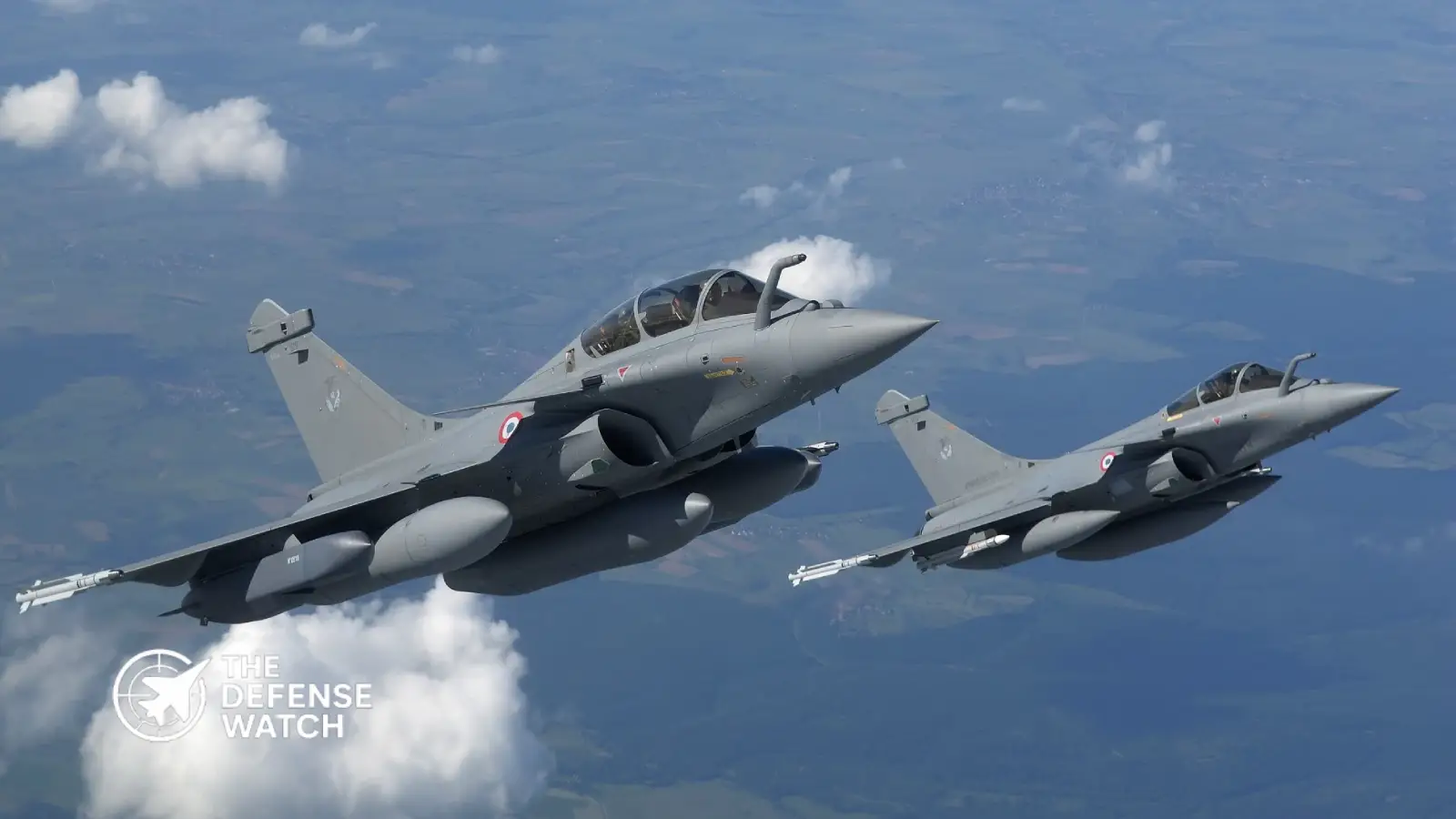
The IAF’s Rafale story begins in 2016 with a controversial ₹59,000 crore deal for 36 aircraft. The final “C” variant was delivered in December 2024. What exists now is two full squadrons—No. 17 “Golden Arrows” and No. 101 “Falcons”—based at Ambala and Hasimara respectively.
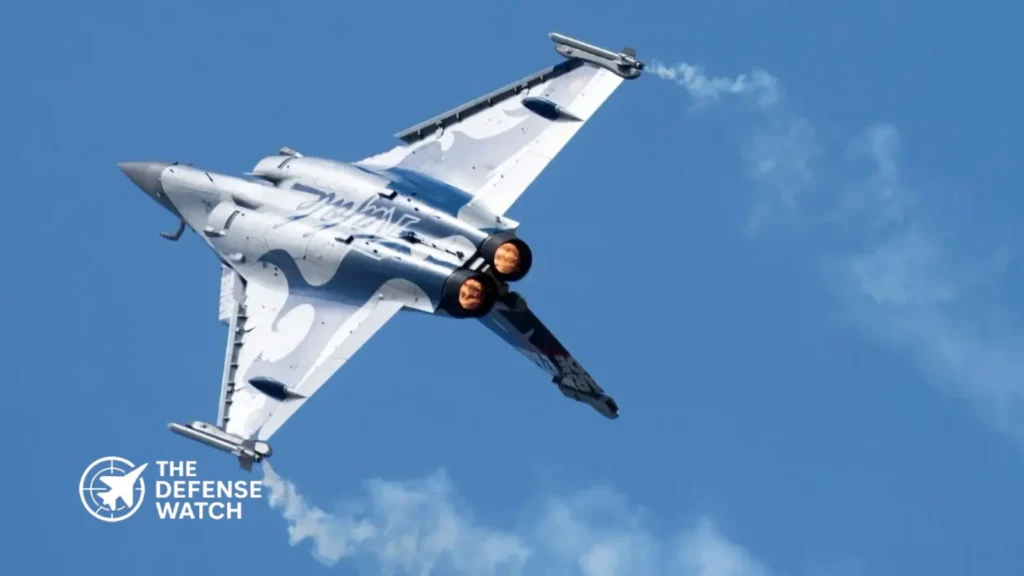
In February 2026, India’s Defence Acquisition Council cleared the single largest fighter jet deal in the country’s history: 114 additional Rafales at approximately ₹3.25 lakh crore (~$36–40 billion, with cost estimates varying between sources by accounting methodology). Unlike the 2016 flyaway purchase, this order mandates substantial local manufacturing—18 jets delivered from France, with the remaining 96 produced in India. Final assembly at the Dassault Reliance Aerospace facility in Nagpur. Indigenous content could hit 60%, with Tata Advanced Systems already manufacturing Rafale fuselage sections in Hyderabad.
At full build-out, India becomes one of the largest non-French Rafale operators on the planet.
Rafale (IAF Configuration) — Key Specs:
- Role: Twin-engine 4.5-gen multirole fighter
- Max Speed: Mach 1.8
- Combat Radius: ~1,850 km (with external tanks)
- Payload: Up to 9,500 kg
- Key Weapons: MBDA METEOR BVR, SCALP cruise missile, HAMMER precision munitions
- Unit Cost (approx.): ~$243 million per airframe (2026 batch, including support)
HAL Tejas Mk1A — The Indigenous Backbone
The Tejas program is now 43 years old, launched as the Light Combat Aircraft project in 1983. That history invites ridicule in some quarters. What’s less discussed is how far the final product has traveled from its clunky origins.
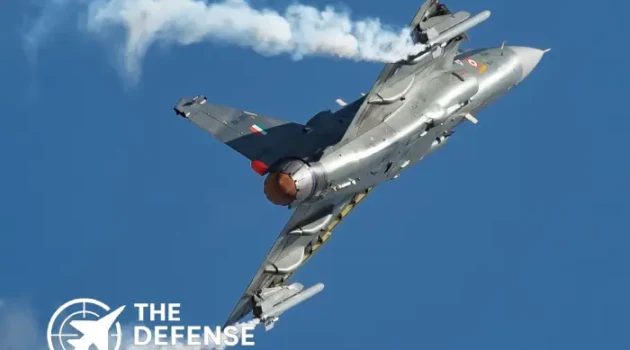
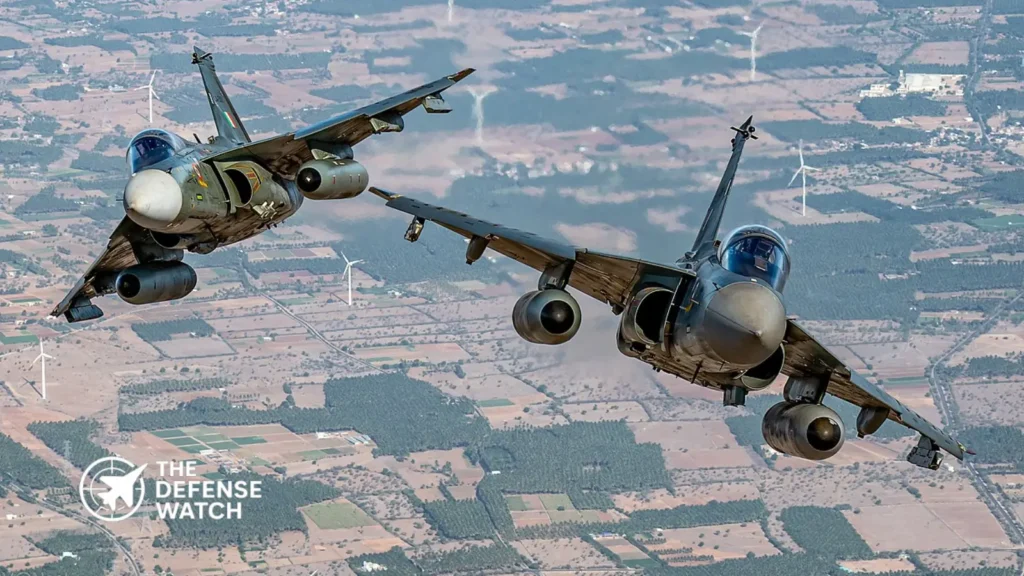
The Mk1A is a genuine fourth-generation-plus platform. It carries an indigenous AESA radar, an advanced electronic warfare suite, an in-flight refueling probe, and the GE F404-IN20 engine rated at 84 kN in afterburner. Beyond-visual-range missile capability (Astra Mk1 with 80+ km range) puts it in contention with regional peers.
- (adsbygoogle = window.adsbygoogle || []).push({});
India has now committed to 180 Mk1A aircraft: 83 jets under a 2021 contract worth ₹48,000 crore (~$5.5B), and a second batch of 97 jets signed in September 2025 for ₹62,370 crore (~$7.1B). Deliveries from the second batch commence in 2027–28, with production ramping to 24 aircraft annually.

HAL Tejas Mk1A The program’s Achilles’ heel remains engines. GE delivered its first F404-IN20 to HAL only in March 2025, after supply chain disruptions tied to the Russia-Ukraine conflict caused years of slippage. Air Chief Marshal AP Singh publicly flagged the delays—a rare admission of how close the IAF was to a genuine capability crisis.
Tejas Mk1A — Key Specs:
- Role: Single-engine light combat aircraft
- Max Speed: Mach 1.6
- Combat Radius: ~500 km
- Payload: ~3,500 kg
- Key Weapons: Astra Mk1/Mk2 BVR, Derby, Python-5
- Unit Cost (approx.): ~$37.8 million (fighter variant, Mk1A contract pricing)
Sukhoi Su-30MKI — Aging Workhorse, Being Reborn
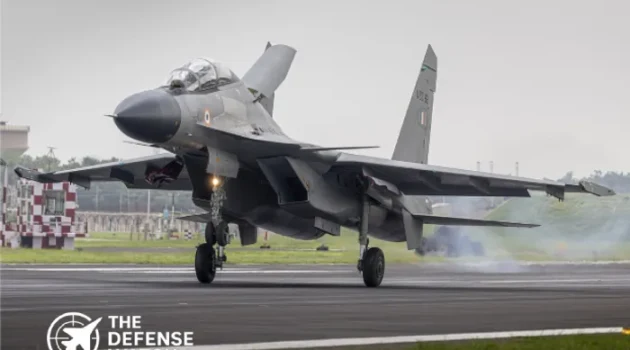
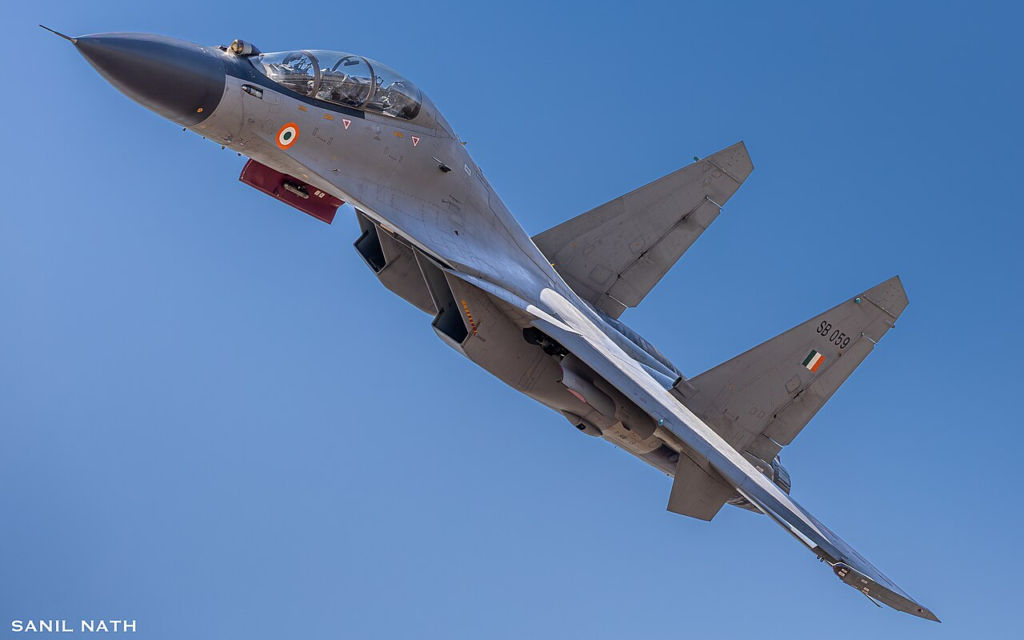
Approximately 260 Su-30MKIs form the absolute core of IAF combat power—the heavy hitter in every air superiority and deep-strike scenario. Built by HAL under a Sukhoi license, these twin-engine behemoths carry up to 8,130 kg of ordnance and boast a combat radius of roughly 1,500 km clean.
(adsbygoogle = window.adsbygoogle || []).push({});The problem: the original mission computer dates to 1998 and runs on a 32-bit architecture. In a network-centric combat environment—particularly against China’s J-20 and J-35 fleets—that’s a structural disadvantage.
The “Super-30” program addresses this directly. Phase One, approved in 2023 for ₹19,000 crore, upgrades 84 Su-30MKIs with a new DRDO-developed 64-bit mission computer, Tejas Mk1A-derived avionics, and an indigenous AESA radar. Phase Two—around 2030—targets another 84 jets with AMCA-derived technologies. An even more ambitious proposal would extend modernization to 200 of the 260-strong fleet, potentially integrating the AL-31F 177S engine (a serious thrust upgrade) and the Virupaksha AESA radar.

Sukhoi Su-30MKI The IAF’s intent is unambiguous: keep these jets operationally relevant deep into the 2070s.
Comparative Data Block
Platform Generation Max Speed Combat Radius Max Payload Unit Cost (approx.) Fleet Size (2026) Dassault Rafale C 4.5 Mach 1.8 ~1,850 km 9,500 kg ~$243M 36 (150 on order) HAL Tejas Mk1A 4+ Mach 1.6 ~500 km 3,500 kg ~$38M Deliveries ongoing (180 contracted) Sukhoi Su-30MKI 4 (upgrading) Mach 2.0 ~1,500 km 8,130 kg ~$50M (unit cost at time of production) ~260 Mirage 2000 (legacy) 4 Mach 2.2 ~1,480 km 6,300 kg N/A (retiring) <50 (phasing out) MiG-29 (legacy) 4 Mach 2.25 ~1,430 km 4,000 kg N/A (retiring) <50 (phasing out) HAL AMCA (in dev.) 5 Mach 1.8+ TBD TBD TBD 0 (prototype ~2035) The Strategic Calculus: Why This Fleet Mix Makes Geopolitical Sense
India doesn’t face one air force threat—it faces two simultaneously, and they’re coordinating.
China fields approximately 300 J-20 fifth-generation fighters and over 50 J-35 stealth aircraft. Pakistan operates F-16 Block 52s, J-10Cs, and JF-17 Block IIIs—a substantially modernized force compared to 2019. The IAF’s planners aren’t designing a fleet for today’s order of battle. They’re designing for 2035, when these numbers will have grown further.
The Rafale handles the high-end fight. Its METEOR missile—with a no-escape zone exceeding 60 km—outranges anything currently in Pakistan Air Force inventory and most of what China deploys. Its SCALP cruise missile gives the IAF a deep-strike capability it didn’t have before. Two Rafale squadrons at Ambala, located 220 km from Pakistan and 500 km from the Chinese border, are positioned deliberately.
(adsbygoogle = window.adsbygoogle || []).push({});The Tejas fills volume. 180 Mk1A jets won’t match Rafale in raw capability, but at roughly one-sixth the unit cost, they allow the IAF to rebuild squadron numbers without bankrupting a procurement budget already stretched to its limits. They also drive HAL’s production capacity upward, setting the industrial foundation for the Tejas Mk2—a heavier, GE F414-powered follow-on designed to replace the Mirage 2000 and fill the “medium fighter” role.
The Su-30MKI upgrade ensures continuity. Withdrawing 260 jets for replacement simultaneously is logistically impossible. “Super Sukhoi” buys time, capability, and industrial employment—while the AMCA program aims for a genuine fifth-generation capability by the mid-2030s.
“The IAF is not fighting the last war. It is building a force for the next 40 years—and the decisions made between 2024 and 2028 will determine whether India achieves air parity with China or spends the 2030s playing catch-up.”
— Synthesis of IAF strategic planning documents and public statements by Air Chief Marshal AP Singh, 2025–2026
The History Angle: From MiG-21 to Multi-Vendor Mastery
The MiG-21’s final retirement in 2025 closed a chapter that defined Indian air power since the 1960s. The jet that helped India win the 1971 war—and later earned the grim nickname “Flying Coffin” due to crash rates—is gone. What’s replacing it is a fleet built on three continents: France, Russia, and India itself.
That multi-vendor architecture is deliberate. Over-reliance on Soviet/Russian platforms exposed the IAF structurally—when GE’s supply chain stumbled on F404 engines for Tejas, the entire domestic production program stalled. When geopolitical pressure constrains Russian spares pipelines, Su-30MKI serviceability suffers. India’s answer is diversification, codified in the “Make in India” defense policy: buy Rafale now, manufacture it locally, build Tejas in parallel, and develop AMCA entirely in-house.
(adsbygoogle = window.adsbygoogle || []).push({});The cultural resonance here cuts deep. India’s aerospace industry—for decades considered a cautionary tale of bureaucratic delays and missed timelines—is now producing fighters, helicopters, and warships at scale. Tejas is no longer a punchline. It’s a platform with 180 active orders, a pipeline of private-sector suppliers (over 105 Indian companies in the Mk1A supply chain), and an export pitch being made to Malaysia and Argentina.
The “Flying Coffin” era is over. The question now is whether the “Make in India” era can close a 12-squadron gap before the strategic window narrows.
Conclusion: A Force in the Making, Racing a Clock
The IAF’s transformation is real, well-funded, and strategically coherent. Over ₹4.5 lakh crore (~$52 billion) in active or approved fighter procurement—Rafale, Tejas Mk1A, Su-30MKI upgrades—represents the most significant recapitalization of any Asian air force outside China in this decade.
But timelines remain the enemy. AMCA won’t fly operationally until the late 2030s at earliest. Tejas Mk1A deliveries are behind schedule. The Rafale’s 114-jet order will take years to execute at scale. In the interim, India will fly under its sanctioned strength, facing two nuclear-armed neighbors whose air forces are modernizing on parallel tracks.
The $47 billion bet is not a guarantee of air dominance. It is a wager that indigenous production, multi-source procurement, and generational platform overlap can close a 12-squadron gap before China’s fifth-generation fleet achieves the kind of qualitative overmatch that makes the numbers irrelevant.
The IAF knows the clock is running. The question is whether the production lines can keep pace with it.