

Executive Summary:
India has completed the maiden flight trial of the Tactical Advanced Range Augmentation (TARA) glide weapon system, developed by DRDO with support from the Indian Air Force. The low cost precision guidance kit is designed to convert conventional unguided bombs into stand off precision weapons, strengthening India’s domestic smart munitions capability.
India Tests Indigenous TARA Glide Bomb Capability
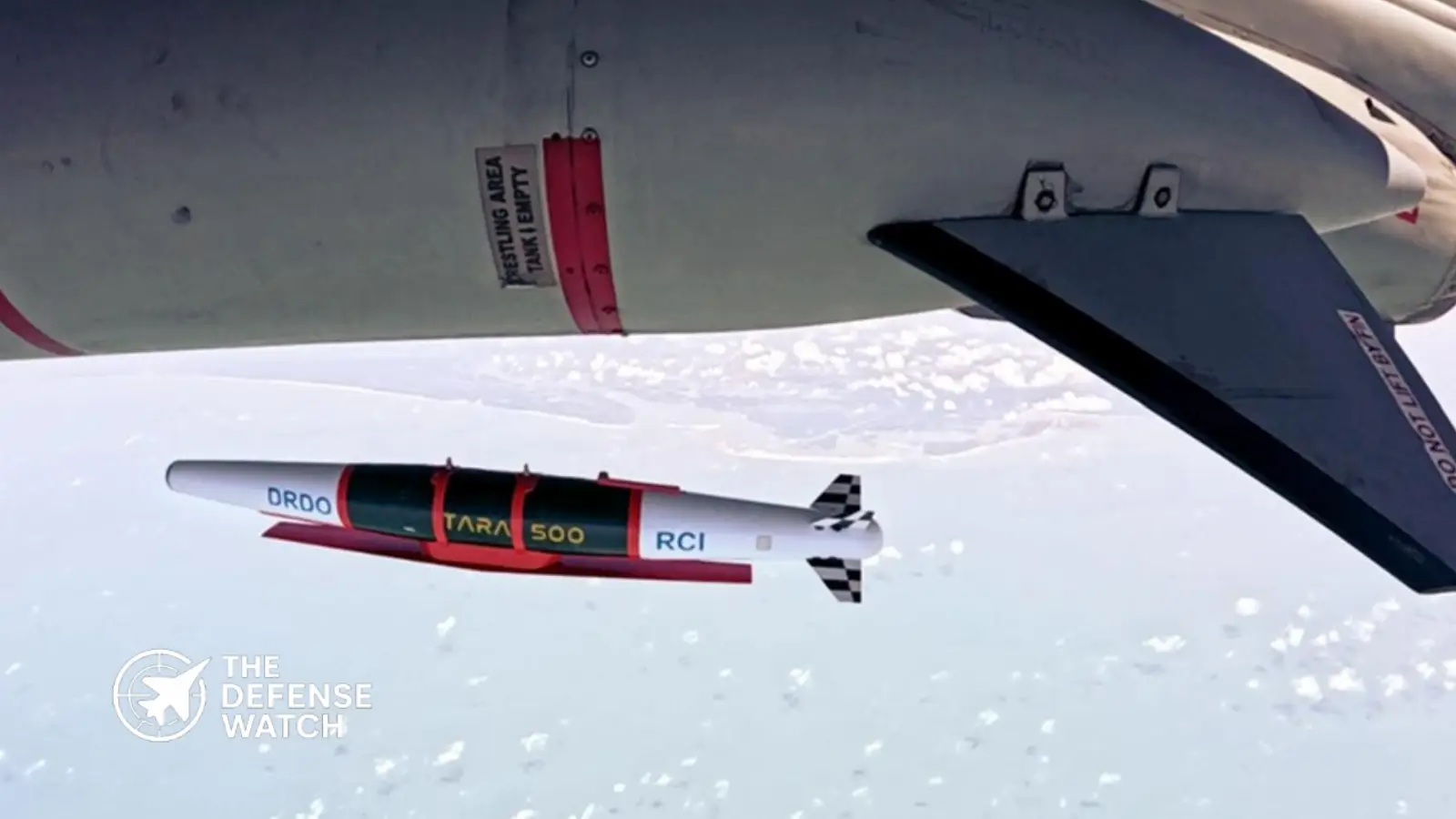
India has tested a new low cost glide bomb capability aimed at expanding the precision strike reach of the Indian Air Force (IAF). The country’s Defence Research and Development Organisation (DRDO), working alongside the IAF, successfully conducted the first flight trial of the Tactical Advanced Range Augmentation (TARA) weapon system off the coast of Odisha on May 7.
According to India’s Ministry of Defence, the TARA system is the country’s first indigenous glide weapon kit designed to convert conventional unguided bombs into precision guided munitions.
The flight trial involved an IAF SEPECAT Jaguar strike aircraft launching a 500 kg class bomb fitted with the TARA modular guidance and glide kit. The system was developed by DRDO’s Hyderabad based Research Centre Imarat (RCI) with support from other DRDO laboratories and Indian industry partners.
Low Cost Precision Weapons Gain Strategic Importance
The TARA glide bomb program reflects a broader shift in military airpower doctrine toward affordable precision strike weapons that can be deployed in large numbers.
Modern air campaigns increasingly rely on stand off munitions capable of striking targets from outside heavily defended airspace. However, high end cruise missiles and advanced smart weapons remain expensive and difficult to mass produce during prolonged conflict scenarios.
India’s approach mirrors efforts by several major military powers to convert existing “dumb bombs” into guided stand off weapons using modular kits. Similar concepts include the American JDAM family, Russia’s UMPK glide kits, and Turkey’s HGK precision guidance systems.
What makes the TARA program notable is its emphasis on low cost production and domestic manufacturing. Indian officials stated that production activities have already started with development and production partners from the private sector.
That production strategy could allow the IAF to expand its inventory of precision weapons without relying heavily on imported systems.
Designed For Multiple Aircraft Platforms
Although the maiden test was conducted using the Jaguar strike aircraft, Indian defense reports indicate the TARA kit is also intended for integration with several frontline IAF combat platforms.
These reportedly include the Sukhoi Su-30MKI, Mirage 2000, and the indigenous Light Combat Aircraft (LCA) Tejas fleet.
The flexibility of the modular kit is operationally important. Rather than developing entirely new missile systems, the TARA concept allows existing bomb inventories to be upgraded into precision stand off weapons.
According to information presented by Indian industry during Aero India 2025, the weapon may achieve strike ranges between 80 and 100 kilometers when released from high altitude at near transonic speed.
Open source reporting also suggests the system could be offered in different guidance configurations. One version reportedly uses satellite aided navigation with an accuracy under 20 meters circular error probable (CEP), while another variant may employ imaging infrared terminal guidance for significantly greater accuracy.
Expanding India’s Indigenous Precision Strike Portfolio
The TARA test comes amid a wider Indian push to strengthen domestic missile and guided weapon production under the government’s long running defense self reliance strategy.
India has already fielded several indigenous stand off weapon systems in recent years, including the Smart Anti Airfield Weapon (SAAW), BrahMos cruise missile variants, and the long range Gaurav glide bomb program.
TARA appears positioned as a lower cost option within that growing precision strike ecosystem. Its role may focus on enabling mass deployment against fixed ground targets while preserving more expensive missile inventories for higher value targets.
The system could also provide operational flexibility during regional contingencies where large quantities of precision guided munitions may be required over extended periods.
Analysts note that affordable glide bomb kits have gained renewed military relevance following lessons observed in conflicts in Ukraine and the Middle East, where cost effective stand off strike systems have been used extensively against fixed infrastructure and battlefield targets.
Regional Security Context
India’s continued investment in stand off strike weapons reflects broader regional military modernization trends across Asia.
China has rapidly expanded its inventory of precision guided munitions and long range air launched weapons, while Pakistan has also pursued precision strike capabilities through both imported and indigenous systems.
For the IAF, systems such as TARA may help improve survivability by allowing aircraft to release munitions farther from contested air defense zones.
The ability to retrofit existing bomb stockpiles also offers logistical and economic advantages during sustained military operations.
Defense Minister Rajnath Singh described the TARA trial as an important milestone for India’s indigenous defense capabilities, while DRDO Chairman Samir V Kamat congratulated the teams involved in the successful test campaign.
