
- Home
- Defense Systems
- Bombs & Aerial Munitions
- GBU-43/B MOAB Bomb
GBU-43/B MOAB Bomb
Defense Systems Full Specifications
1. General Information
| Name / Designation | GBU-43/B MOAB |
| Type | Conventional precision-guided bomb |
| Manufacturer | Air Force Research Laboratory; Dynetics contributed to development |
| Country of Origin | United States |
| Year Introduced | 2003, initial testing and development |
| Operational Status | Public sources identify the weapon as an existing U.S. capability; current inventory details are not fully disclosed |
2. Physical Characteristics
| Weight | Approximately 21,000 lb (9,525 kg), published figures vary |
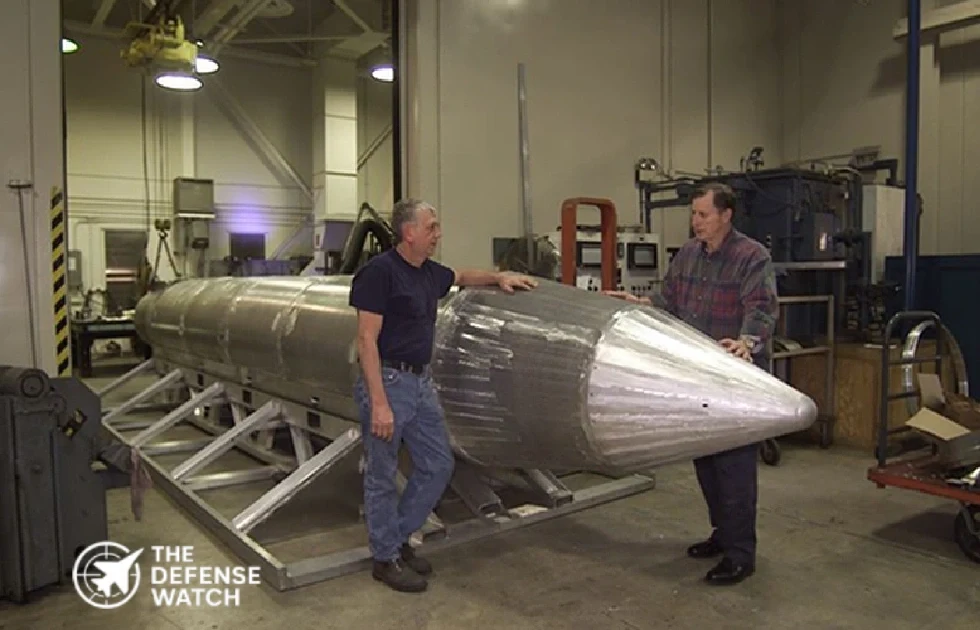
| Length | Approximately 30 ft (9.14 m) |
| Diameter | Approximately 40.5 in (1.03 m) |
| Casing Type | Large conventional bomb casing |
3. Performance
| Yield | Conventional blast, not nuclear |
| Guidance | GPS / INS |
| Accuracy (CEP) | A verified public CEP figure is not established in the cited references |
| Delivery Platforms | Compatible MC-130 aircraft; integration details depend on configuration |
| Penetration Capability | Not a dedicated earth-penetrating weapon |
4. Warhead / Explosive Details
| Warhead Type | High explosive |
| Fuzing Options | Detailed configuration not consistently disclosed in public references |
| Explosive Composition | Public references identify the BLU-120/B warhead; published descriptions of the explosive filling vary |
5. Operational Use
| Primary Mission | Large-area blast effects against suitable surface targets and accessible underground complexes |
| Operators | United States |
| Notable Deployments / History | First used in combat on April 13, 2017, against an Islamic State tunnel complex in Afghanistan |
6. Variants
| Variants | GBU-43/B is the publicly documented operational designation; no widely documented separate operational variant |
PROS
- Large conventional explosive payload for area targets.
- GPS and inertial navigation guidance.
- Designed for use against exposed targets and accessible cave or tunnel complexes.
- Can be deployed from compatible military transport aircraft.
- Provides a substantial blast effect without a nuclear warhead.
CONS
- Requires a compatible aircraft and specialized airdrop equipment.
- Very large size limits the number of suitable delivery platforms.
- Not designed specifically to penetrate deeply buried, hardened structures.
- Large blast effects create significant risks to nearby personnel and infrastructure.
- Current unit price and inventory figures are not consistently available in public sources.
GBU-43/B MOAB Bomb: Specifications, Cost and Capabilities
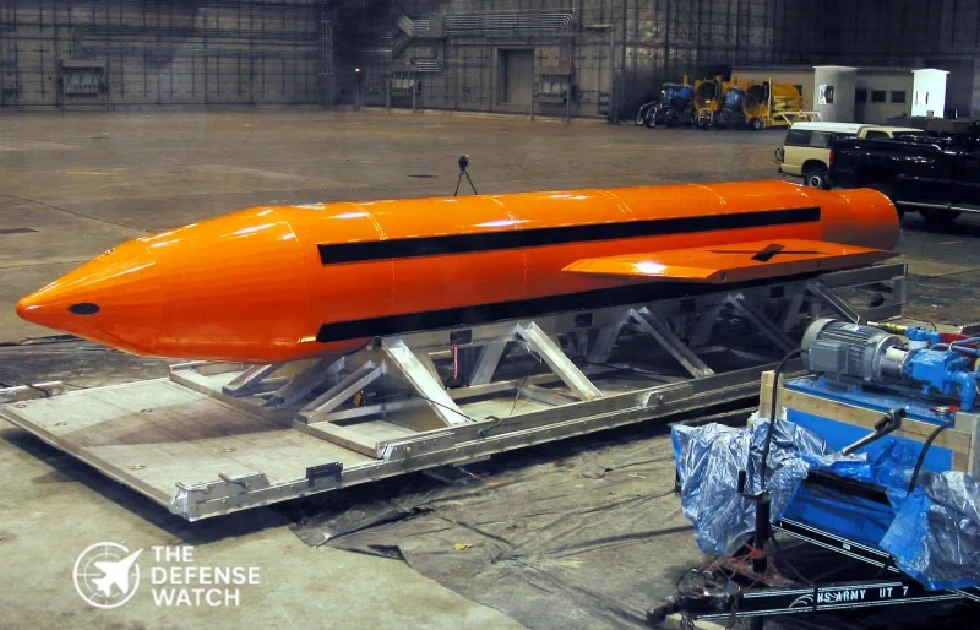
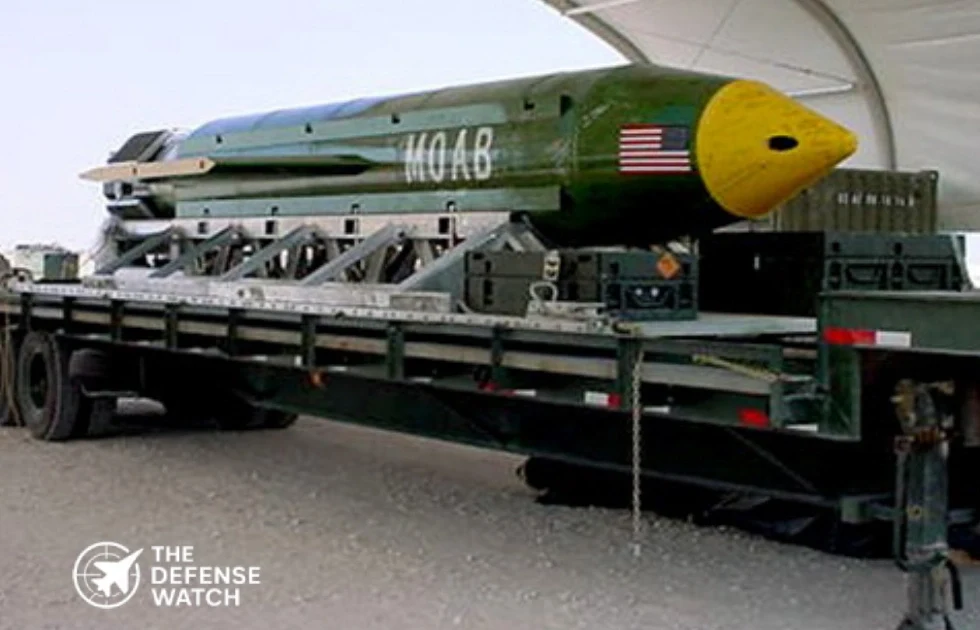
The GBU-43/B Massive Ordnance Air Blast (MOAB) is a U.S. conventional, air-delivered bomb designed to attack large target areas and exposed or accessible underground complexes. Commonly called the Mother of All Bombs, it is among the largest conventional weapons in the U.S. military inventory. Unlike nuclear weapons, the MOAB uses a high-explosive warhead to produce a powerful blast.
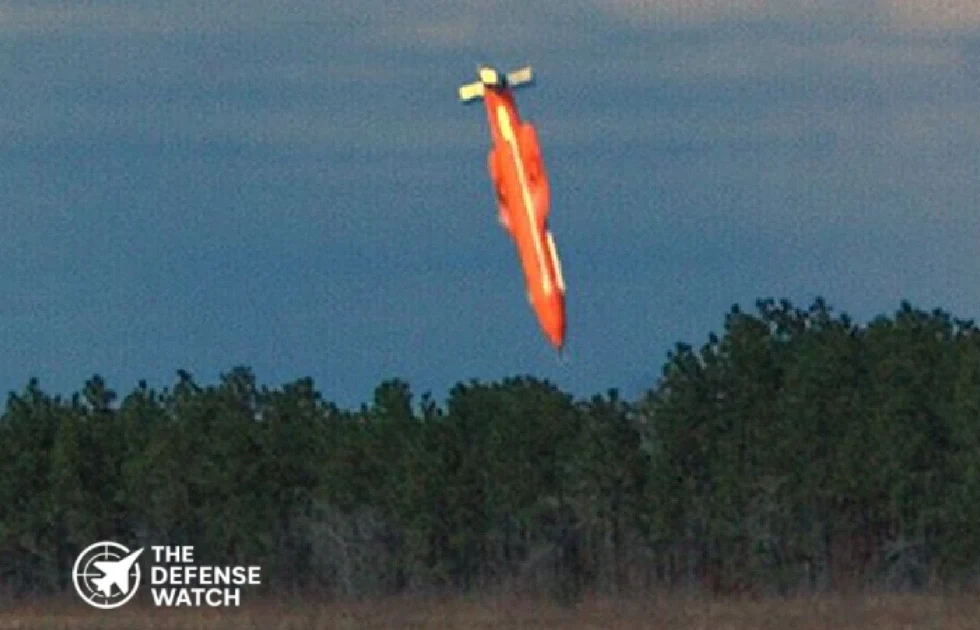
Weighing approximately 21,000 pounds, the bomb combines satellite-based guidance with an inertial navigation system to improve delivery accuracy. Its design includes deployable grid fins and control surfaces that steer the weapon after release. The MOAB is intended for targets where a large blast effect is required, including cave entrances, tunnel complexes, and concentrations of personnel or equipment. It is not a specialized earth-penetrating bomb, and its effectiveness against deeply buried, hardened facilities is limited by its blast-based design.
Manufacturer
The U.S. Air Force Research Laboratory (AFRL) developed the GBU-43/B in 2003 to meet an urgent operational requirement. Dynetics contributed to the program, while production information identifies the McAlester Army Ammunition Plant in Oklahoma as a manufacturing location. The weapon underwent its first major test in March 2003 and was developed with potential use during Operation Iraqi Freedom in mind. It was not used in that campaign.
Speed and Range
The MOAB is a gravity bomb, not a powered missile or rocket. It has no independent propulsion system, so missile-style speed ratings and powered flight range do not apply. Its trajectory depends on aircraft release conditions, gravity, aerodynamic control, and guidance. Public references describe GPS and inertial navigation guidance, but do not establish a single standard maximum range or a verified operational speed figure. The weapon was designed for deployment from compatible MC-130 aircraft using an airdrop system.
Cost/Price
The U.S. Air Force historically cited a unit cost of approximately $170,000. This is an older estimate, not a verified current procurement price. The cost of producing additional weapons could differ because of inflation, component availability, manufacturing requirements, and renewed testing.
FAQs
What is the GBU-43/B MOAB bomb?
The GBU-43/B is a U.S. conventional precision-guided bomb designed to create a large blast effect against suitable surface targets and accessible cave or tunnel complexes.
How much does the MOAB bomb weigh?
Published specifications place its weight at approximately 21,000 pounds, or about 9,525 kilograms. Figures vary slightly across sources.
Is the MOAB a nuclear bomb?
No. The GBU-43/B uses conventional high explosives. Its large blast effect does not make it a nuclear weapon.
How much does a GBU-43/B MOAB cost?
A historical U.S. Air Force estimate placed its unit cost at approximately $170,000. That figure is not a confirmed current production price, and the cost of manufacturing additional weapons may differ.
Which aircraft can carry the MOAB?
The weapon was designed for delivery from compatible MC-130 aircraft using specialized airdrop equipment. It is not a standard bomb carried on conventional fighter aircraft.
Disclaimer Note
The information provided on TheDefenseWatch.com is for general informational purposes only. While we strive to ensure the accuracy, completeness, and timeliness of our content regarding defense and aerospace products, technologies, and specifications, we cannot guarantee that all information is 100% accurate or up-to-date due to the evolving nature of military technology and classified data.TheDefenseWatch.com does not warrant the reliability, suitability, or availability of the information for any specific purpose. Users are advised to consult official sources, such as manufacturers, government publications, or defense agencies, for precise and verified data before making decisions based on our content.We are not affiliated with any defense manufacturers, governments, or military organizations mentioned. Opinions, reviews, and ratings reflect expert analysis but are subjective and should not be considered endorsements. TheDefenseWatch.com is not responsible for any errors, omissions, or consequences arising from the use of this website’s content.External links are provided for convenience and do not imply endorsement. TheDefenseWatch.com reserves the right to update or modify content without prior notice. By using this website, you agree to our Privacy & Cookies Policy.
More Defense Systems from US Defense Prime Contractor
New Arrivals












Popular Comparisons
-
 Tejas vs Gripen: Key Differences and Capabilities
View Comparison →
Tejas vs Gripen: Key Differences and Capabilities
View Comparison → -
Tejas vs MiG-21 Bison: How India Replaced Its Iconic Supersonic Fighter
View Comparison →
-
F-35 vs F-16: Stealth, Sensors and Combat Roles
View Comparison →
-
Tejas Fighter Jet vs F-16 Fighting Falcon: Capability Compared
View Comparison →
-
Rafale Fighter Jet vs F-16 Fighting Falcon : Which Fighter Has the Edge?
View Comparison →
-
Su-57 Fighter Jet vs J-20 Fighter Jet: Stealth and Air Combat Compared
View Comparison →
-
Mirage 2000 vs Tejas Mk1A: Legacy Combat Power vs Indigenous Modernization
View Comparison →
-
Rafale Fighter Jet vs F-22 Raptor: Which Air Dominance Fighter Has the Edge?
View Comparison →
-
Tejas Fighter Jet vs. Rafale Fighter Jet: India’s Indigenous Fighter Meets France’s Proven Multirole Combat Aircraft
View Comparison →
-
F-22 Raptor vs. F-35 Joint Strike Fighter: Which Fifth Generation Fighter Has the Edge?
View Comparison →


- US Military Weighs MOAB for Potential Future Strikes on Iran, CNN Reports

- Saab Wins $120 Million Order for New Gripen Flight Control Computer
- L3Harris Delivers First VAMPIRE Counter-Drone Systems to U.S. Army
- Lockheed Martin Invests $300 Million in Texas Munitions Expansion, Plans 6,000 U.S. Jobs
- Lockheed Martin Taps Avio for ER GMLRS and PrSM Rocket Motor Production
- Lockheed Martin Wins $16.1 Million Contract Modification for F-35 Processor Support
- Lockheed Martin Wins $74.3 Million Contract Modification for AN/SLQ-32(V)6 Electronic Warfare Systems
- Hegseth Says Autonomous Warfare Has Long Been the Pentagon’s End Goal
- US Rejects Automatic Body Camera Activation for ICE Officers
- Iron Dome Architect Develops New Counter-Swarm Drone Defense System






Fighter Jets
-
 MIG-31 Fighter Jet
-
J-10CE Fighter Jet
-
Chengdu J-10 Fighter Jet
-
Chengdu J-10C Fighter Jet
-
Gripen E Fighter Jet
-
Tejas Mk1A Fighter Jet
-
Tejas Mk‑2 Fighter Jet
-
F-16V Viper Block 70 Fighter Jet
-
F-15EX Eagle II Fighter
-
Boeing F/A-XX Fighter
-
F-15E Strike Eagle Fighter
-
F/A-18E/F Super Hornet Fighter Jet
-
Saab Gripen F Fighter Jet
-
JAS 39E/F Gripen Fighter Jet
-
JAS 39 Gripen Fighter Jet
-
F-35A Lightning II Fighter Jet
-
F/A-18F Super Hornet
-
J-50 Fighter Jet
-
Spanish EF-18 Hornet Fighter
-
F-47 Fighter Jet
-
F-35i Adir Fighter Jet
-
F-16 Fighting Falcon
-
AIDC T-5 Brave Eagle
-
F-CK-1 Ching-Kuo Fighter









Recent Compares
-
Tejas vs Gripen: Key Differences and Capabilities
View Comparison →
-
Tejas vs MiG-21 Bison: How India Replaced Its Iconic Supersonic Fighter
View Comparison →
-
F-35 vs F-16: Stealth, Sensors and Combat Roles
View Comparison →
-
Tejas Fighter Jet vs F-16 Fighting Falcon: Capability Compared
View Comparison →
-
Rafale Fighter Jet vs F-16 Fighting Falcon : Which Fighter Has the Edge?
View Comparison →
Latest Defense Systems
10 Compares Defense Systems
-
Tejas vs Gripen: Key Differences and Capabilities
View Comparison →
-
Tejas vs MiG-21 Bison: How India Replaced Its Iconic Supersonic Fighter
View Comparison →
-
F-35 vs F-16: Stealth, Sensors and Combat Roles
View Comparison →
-
Tejas Fighter Jet vs F-16 Fighting Falcon: Capability Compared
View Comparison →
-
Rafale Fighter Jet vs F-16 Fighting Falcon : Which Fighter Has the Edge?
View Comparison →
-
Su-57 Fighter Jet vs J-20 Fighter Jet: Stealth and Air Combat Compared
View Comparison →
-
Mirage 2000 vs Tejas Mk1A: Legacy Combat Power vs Indigenous Modernization
View Comparison →
-
Rafale Fighter Jet vs F-22 Raptor: Which Air Dominance Fighter Has the Edge?
View Comparison →
-
Tejas Fighter Jet vs. Rafale Fighter Jet: India’s Indigenous Fighter Meets France’s Proven Multirole Combat Aircraft
View Comparison →
-
F-22 Raptor vs. F-35 Joint Strike Fighter: Which Fifth Generation Fighter Has the Edge?
View Comparison →
- US Military Weighs MOAB for Potential Future Strikes on Iran, CNN Reports
- Saab Wins $120 Million Order for New Gripen Flight Control Computer
- L3Harris Delivers First VAMPIRE Counter-Drone Systems to U.S. Army
- Lockheed Martin Invests $300 Million in Texas Munitions Expansion, Plans 6,000 U.S. Jobs
- Lockheed Martin Taps Avio for ER GMLRS and PrSM Rocket Motor Production