
- Home
- Defense Systems
- Fighter Jets
- AIDC T-5 Brave Eagle
AIDC T-5 Brave Eagle
Defense Systems Full Specifications
General Information
| Name | AIDC T-5 Brave Eagle |
| Manufacturer | Aerospace Industrial Development Corporation (AIDC) |
| Country of Origin | Taiwan |
| Type / Role | Advanced jet trainer / light attack |
| Generation | Modern advanced trainer |
| Status | In service / production |
| First Flight | June 10, 2020 |
| Introduction / In Service Since | 2021 |
| Number Built | 66 planned; production ongoing |
| Operators | Republic of China Air Force |
Dimensions & Structure
| Length | 14.5 m (47.6 ft) |
| Wingspan | 9.2 m (30.3 ft) |
| Height | 4.39 m (14.4 ft) |
| Wing Area | Not publicly confirmed |
| Empty Weight | Approx. 4,500 kg (9,921 lb) |
| Maximum Takeoff Weight (MTOW) | Approx. 7,500 kg (16,535 lb) |
| Internal Weapons Bay | None |
| External Hardpoints | 2 publicly reported |
Performance
| Maximum Speed | Mach 0.97 / 550 knots |
| Range | 1,058 nautical miles |
| Combat Radius | Not publicly disclosed |
| Service Ceiling | 40,000 ft |
| Rate of Climb | Public figures vary; approximately 9,500 ft/min |
| Thrust-to-Weight Ratio | Not officially disclosed |
| G Limits | Not officially disclosed |
Powerplant
| Engine Type | Honeywell/ITEC F124-200TW turbofan |
| No. of Engines | 2 |
| Thrust (each) | Approx. 6,250 lbf / 27.8 kN |
| Thrust Vectoring | No |
| Fuel Capacity | Not publicly disclosed |
Armament
| Gun | No permanently installed internal gun publicly confirmed |
| Missiles (Air-to-Air) | Sky Sword I, AIM-9 Sidewinder compatibility reported |
| Missiles (Air-to-Ground) | AGM-65 Maverick compatibility reported |
| Bombs | External training/light-attack stores |
| Hardpoints | 2 publicly reported |
| Payload Capacity | Public sources provide inconsistent figures; official figure not confirmed |
Avionics & Systems
| Radar | No confirmed operational radar publicly specified |
| Radar Range | Not publicly disclosed |
| Electronic Warfare (EW) System | Details not publicly disclosed |
| Targeting System | Training and mission systems; detailed configuration not publicly disclosed |
| Helmet Display | Not publicly confirmed |
| Navigation | Modern digital navigation systems |
| Autopilot / AI Assistance | Digital flight-control and training systems; AI capability not publicly confirmed |
| Communication | Modern military communications and antenna systems |
Stealth & Technology
| Radar Cross Section (RCS) | Not publicly disclosed |
| Stealth Features | No dedicated stealth design |
| Infrared Signature Reduction | Not publicly disclosed |
| Sensor Fusion | Limited/public details unavailable |
| Networking Capabilities | Military communications and training-network capabilities; detailed specifications not public |
Variants
| Special Export Versions | XAT-5, T-5 Production |
Operational History
| Major Conflicts / Deployments | No combat deployment publicly confirmed |
| Notable Operators | Republic of China Air Force |
| Combat Proven? | No |
| Mission Types | Advanced training, lead-in fighter training, weapons training, limited light attack |
Cost & Program
| Unit Cost | Public estimates approximately US$20 million to US$30 million |
| Development Cost | Program cost approximately NT$68.6 billion |
| Program Name | Advanced Jet Trainer (AJT) |
| Funding Countries | Taiwan |
Additional Information
| Upgrades Planned | Continued avionics, training and domestic component development |
| Future Replacement | No confirmed replacement announced |
| Export Restrictions | Export activity limited; aircraft developed primarily for Taiwan |
| Notable Achievements | Taiwan's first indigenous modern advanced jet trainer program |
| Competitors | Boeing T-7A Red Hawk, KAI T-50, Leonardo M-346, TAI Hürjet, Hongdu L-15 |
PROS
- Modern advanced jet training platform
- Twin-engine configuration provides redundancy
- F124 turbofans provide useful transonic performance
- Designed around Taiwan's indigenous aerospace requirements
- Can support limited light-attack and weapons-training missions
CONS
- Subsonic rather than supersonic
- Limited weapons carriage compared with frontline fighters
- Public radar specifications remain limited
- Small production and operator base
- Not designed to replace a modern multirole fighter
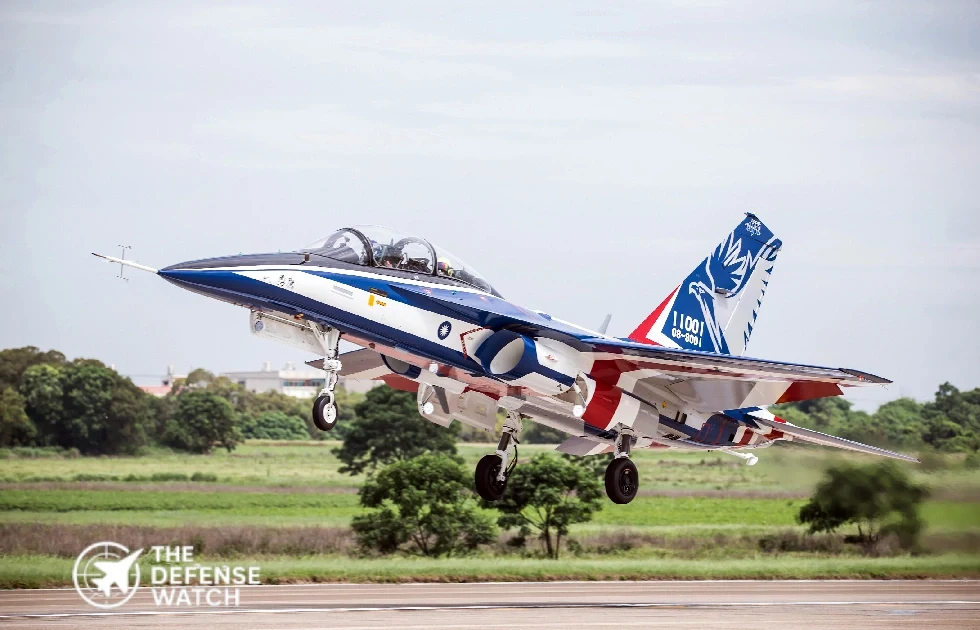
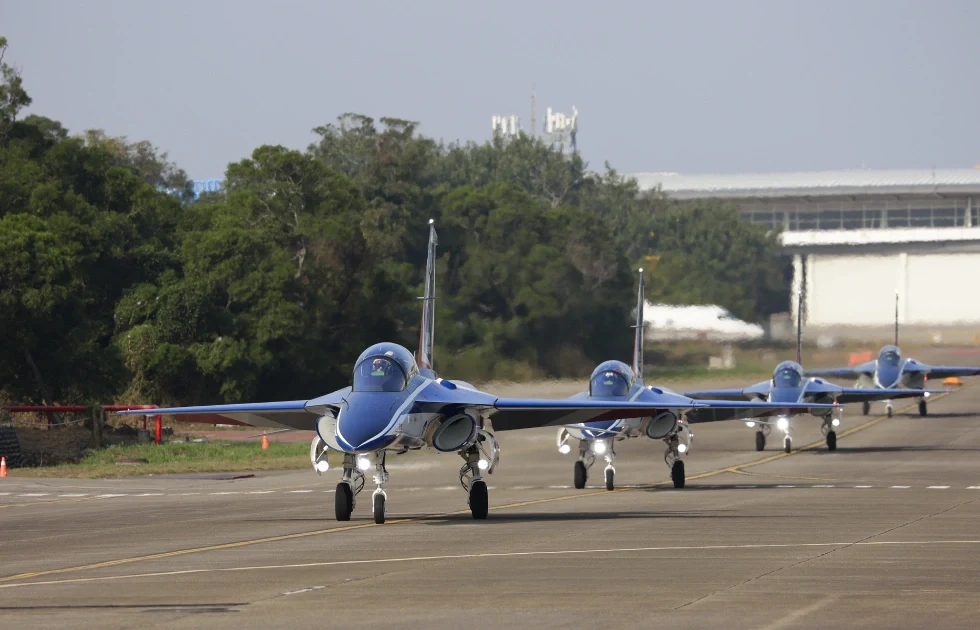
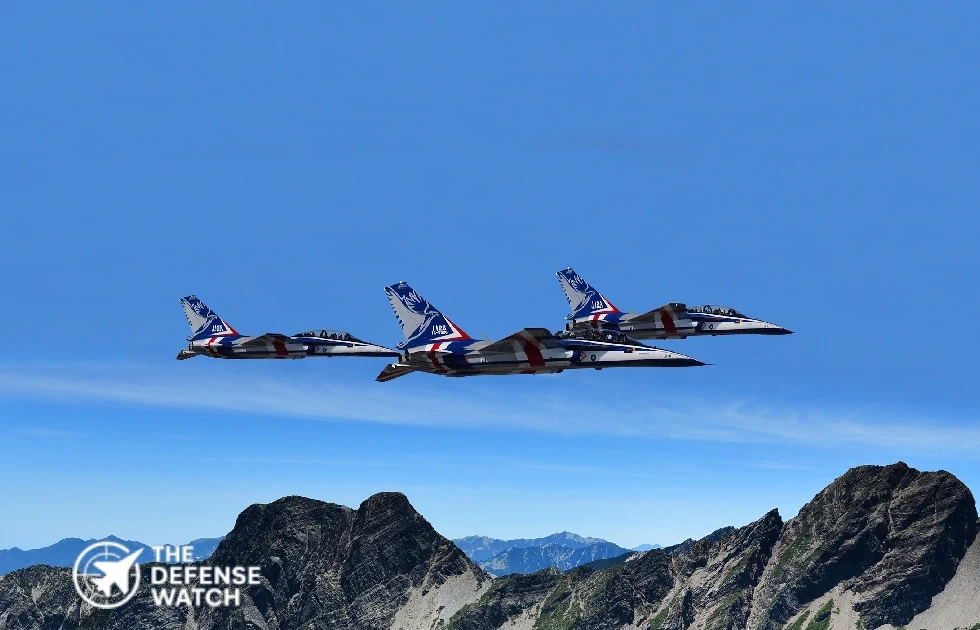
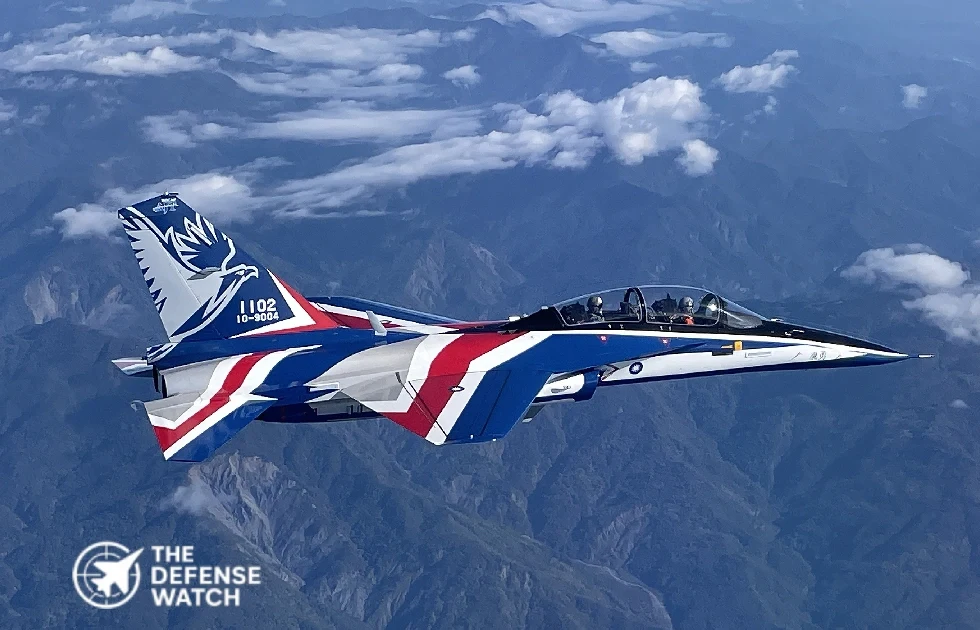
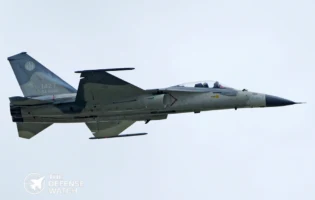
The AIDC T-5 Brave Eagle, also known as the Yung Ying, is Taiwan’s indigenous advanced jet trainer developed to prepare pilots for modern combat aircraft. Designed by Aerospace Industrial Development Corporation (AIDC) with support from Taiwan’s National Chung-Shan Institute of Science and Technology, the aircraft is derived from the F-CK-1 Ching-Kuo design but incorporates substantial new components and a dedicated two-seat training configuration.
The T-5 is intended to replace Taiwan’s aging AT-3 trainers and the F-5E/F aircraft used for lead-in fighter training. Its glass cockpit, digital flight controls and modern training systems are designed to help pilots transition toward frontline aircraft such as the F-16V and F-CK-1.
Manufacturer and Development
AIDC manufactures the T-5 in Taiwan, while NCSIST contributed to its development. The prototype made its first flight on June 10, 2020, and the first production aircraft entered service in 2021. Taiwan plans to acquire 66 aircraft.
Speed, Range and Power
The aircraft uses two Honeywell/ITEC F124-200TW non-afterburning turbofan engines, each producing about 27.8 kN (6,250 lbf) of thrust. Taiwan’s Ministry of National Defense lists a maximum speed of Mach 0.97, maximum range of 1,058 nautical miles, and service ceiling of 40,000 feet.
The T-5 can also support limited weapons training and light-attack missions. Publicly reported compatible weapons include Sky Sword I, AIM-9 Sidewinder and AGM-65 Maverick.
Cost and Program
Taiwan’s overall T-5 development and production program has been reported at approximately NT$68.6 billion, or about US$2.2 billion at commonly cited exchange rates. Public sources have estimated individual aircraft costs around US$20 million to US$30 million, depending on whether development costs and program overhead are included.
The T-5 is primarily a sovereign Taiwanese training program rather than an export-focused aircraft.
Variants
| Variants | Description |
|---|
| XAT-5 | Prototype and development aircraft |
| T-5 Production | Standard advanced jet trainer |
| T-5 LIFT Configuration | Lead-in fighter training configuration |
| Planned Combat Derivatives | Light-attack concepts have been reported, but configurations should not be treated as confirmed production variants |
Disclaimer Note
The information provided on TheDefenseWatch.com is for general informational purposes only. While we strive to ensure the accuracy, completeness, and timeliness of our content regarding defense and aerospace products, technologies, and specifications, we cannot guarantee that all information is 100% accurate or up-to-date due to the evolving nature of military technology and classified data.TheDefenseWatch.com does not warrant the reliability, suitability, or availability of the information for any specific purpose. Users are advised to consult official sources, such as manufacturers, government publications, or defense agencies, for precise and verified data before making decisions based on our content.We are not affiliated with any defense manufacturers, governments, or military organizations mentioned. Opinions, reviews, and ratings reflect expert analysis but are subjective and should not be considered endorsements. TheDefenseWatch.com is not responsible for any errors, omissions, or consequences arising from the use of this website’s content.External links are provided for convenience and do not imply endorsement. TheDefenseWatch.com reserves the right to update or modify content without prior notice. By using this website, you agree to our Privacy & Cookies Policy.
More Defense Systems from AIDC
New Arrivals

Popular Comparisons
-
 J-10C vs JF-17 Thunder: Which Fighter Is More Capable?
View Comparison →
J-10C vs JF-17 Thunder: Which Fighter Is More Capable?
View Comparison → -
Tejas vs Gripen: Key Differences and Capabilities
View Comparison →
-
Tejas vs MiG-21 Bison: How India Replaced Its Iconic Supersonic Fighter
View Comparison →
-
F-35 vs F-16: Stealth, Sensors and Combat Roles
View Comparison →
-
Tejas Fighter Jet vs F-16 Fighting Falcon: Capability Compared
View Comparison →
-
Rafale Fighter Jet vs F-16 Fighting Falcon : Which Fighter Has the Edge?
View Comparison →
-
Su-57 Fighter Jet vs J-20 Fighter Jet: Stealth and Air Combat Compared
View Comparison →
-
Mirage 2000 vs Tejas Mk1A: Legacy Combat Power vs Indigenous Modernization
View Comparison →
-
Rafale Fighter Jet vs F-22 Raptor: Which Air Dominance Fighter Has the Edge?
View Comparison →
-
Tejas Fighter Jet vs. Rafale Fighter Jet: India’s Indigenous Fighter Meets France’s Proven Multirole Combat Aircraft
View Comparison →


- DIA 2026 Space Report Warns China May Field Orbital Directed-Energy Weapons by Late 2020s

- Boeing Advances Second MQ-25 Stingray Toward Testing for U.S. Navy
- Saab Unveils Sea Giraffe AMB D Radar With 250-Kilometer Air Surveillance Range
- Most Advanced Fighter Jet in the World in 2026: F-22 vs. F-35 vs. J-20
- Lockheed Martin Wins $88.6 Million Navy Contract for Radiant Mercury Systems
- Pentagon Uses Department of War Name to Reinforce Message to Adversaries
- Israel’s Military Chief Reportedly Opposed Pre-Election Strike on Iran
- Canada Receives First Two F-35 Fighters as Review of 72 Aircraft Continues
- Lockheed Martin Completes $3.45 Billion Ultra Maritime Acquisition
- Lockheed Martin Advances Ramjet-Powered PrSM Increment 4 Missile




Fighter Jets
-
 F-100 Super Sabre
-
North American F-86 Sabre
-
Northrop YF-23 Fighter
-
Rafale F5 Fighter
-
SU-57 Felon Stealth Fighter
-
Boeing F/A-XX Fighter
-
JF-17 Thunder Fighter Jet
-
F-47 Fighter Jet
-
MIG-31 Fighter Jet
-
J-10CE Fighter Jet
-
Chengdu J-10 Fighter Jet
-
Chengdu J-10C Fighter Jet
-
Gripen E Fighter Jet
-
Tejas Mk1A Fighter Jet
-
Tejas Mk‑2 Fighter Jet
-
F-16V Viper Block 70 Fighter Jet
-
F-15EX Eagle II Fighter
-
F-15E Strike Eagle Fighter
-
F/A-18E/F Super Hornet Fighter Jet
-
Saab Gripen F Fighter Jet
-
JAS 39E/F Gripen Fighter Jet
-
JAS 39 Gripen Fighter Jet
-
F-35A Lightning II Fighter Jet
-
F/A-18F Super Hornet







Recent Compares
-
J-10C vs JF-17 Thunder: Which Fighter Is More Capable?
View Comparison →
-
Tejas vs Gripen: Key Differences and Capabilities
View Comparison →
-
Tejas vs MiG-21 Bison: How India Replaced Its Iconic Supersonic Fighter
View Comparison →
-
F-35 vs F-16: Stealth, Sensors and Combat Roles
View Comparison →
-
Tejas Fighter Jet vs F-16 Fighting Falcon: Capability Compared
View Comparison →
Latest Defense Systems
10 Compares Defense Systems
-
J-10C vs JF-17 Thunder: Which Fighter Is More Capable?
View Comparison →
-
Tejas vs Gripen: Key Differences and Capabilities
View Comparison →
-
Tejas vs MiG-21 Bison: How India Replaced Its Iconic Supersonic Fighter
View Comparison →
-
F-35 vs F-16: Stealth, Sensors and Combat Roles
View Comparison →
-
Tejas Fighter Jet vs F-16 Fighting Falcon: Capability Compared
View Comparison →
-
Rafale Fighter Jet vs F-16 Fighting Falcon : Which Fighter Has the Edge?
View Comparison →
-
Su-57 Fighter Jet vs J-20 Fighter Jet: Stealth and Air Combat Compared
View Comparison →
-
Mirage 2000 vs Tejas Mk1A: Legacy Combat Power vs Indigenous Modernization
View Comparison →
-
Rafale Fighter Jet vs F-22 Raptor: Which Air Dominance Fighter Has the Edge?
View Comparison →
-
Tejas Fighter Jet vs. Rafale Fighter Jet: India’s Indigenous Fighter Meets France’s Proven Multirole Combat Aircraft
View Comparison →
- DIA 2026 Space Report Warns China May Field Orbital Directed-Energy Weapons by Late 2020s
- Boeing Advances Second MQ-25 Stingray Toward Testing for U.S. Navy
- Saab Unveils Sea Giraffe AMB D Radar With 250-Kilometer Air Surveillance Range
- Most Advanced Fighter Jet in the World in 2026: F-22 vs. F-35 vs. J-20
- Lockheed Martin Wins $88.6 Million Navy Contract for Radiant Mercury Systems